A French Word to Live By
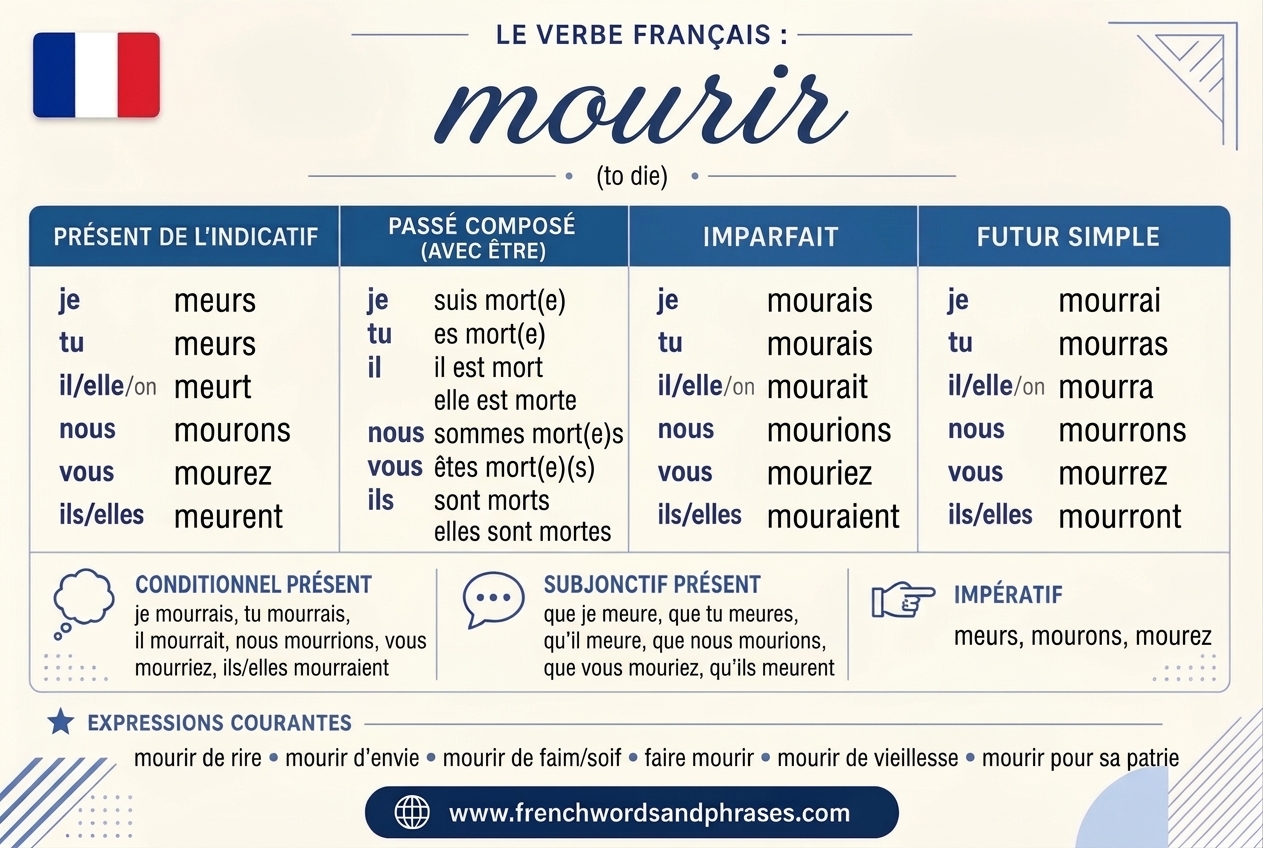
How to Conjugate Mourir in French
/mu.ʁiʁ/
Mourir means to die.
Some words carry the whole weight of a life. A flower fades, a story ends, and a person we love is gone — that is mourir, a verb we use with care, for endings and for farewells.
In this guide, you’ll learn how to conjugate mourir in all the major French tenses and moods. Explore complete conjugation tables, French examples, English translations, and practice quizzes.
Understanding the French Verb Mourir
Mourir is an irregular French verb belonging to the third group of verbs, those ending in -ir.
It means to die. It is commonly used to talk about death, literally and in everyday expressions — to die of laughter, to die of boredom, to die of hunger — where it means to feel something very strongly.
Verb classification: Third group (irregular -ir verb)
Auxiliary verb: Être
Past participle: mort
Present participle: mourant
English equivalents: To die.
One important detail: mourir takes être as its auxiliary verb in compound tenses, so the past participle agrees with the subject. The stem also changes in the present tense — je meurs, nous mourons, ils meurent.
Experience the Word
Mourir is more than an ending. It is the word we reach for when something, or someone, is no longer there.
Imagine an old garden in autumn. The flowers fade, the leaves fall, and the year quietly comes to an end, making room for what will grow again in spring.
Nothing lasts forever. Everything has its season.
How to Conjugate Mourir: Complete French Conjugation Guide
Let’s explore every major conjugation of mourir, beginning with the indicative mood.
How to Conjugate Mourir in the Indicative Mood
The indicative mood is used to express facts, observations, actions, and events.
How to Conjugate Mourir in the Present Tense (Présent)
Used for actions happening now, habitual actions, and general truths.
| Subject | Conjugation |
|---|---|
| je | meurs |
| tu | meurs |
| il / elle | meurt |
| nous | mourons |
| vous | mourez |
| ils / elles | meurent |
Example
Les fleurs meurent sans eau.
The flowers die without water.
Quick Quiz 1
Complete the sentence:
Nous ______ de faim !
Reveal the answer
mourons
Nous mourons de faim !
We are dying of hunger!
How to Conjugate Mourir in the Passé Composé
Used for completed actions in the past. Mourir takes the auxiliary verb être.
| Subject | Conjugation |
|---|---|
| je | suis mort / suis morte |
| tu | es mort / es morte |
| il / elle | est mort / est morte |
| nous | sommes morts / sommes mortes |
| vous | êtes morts / êtes mortes / êtes mort / êtes morte |
| ils / elles | sont morts / sont mortes |
Example
Il est mort hier soir.
He died last night.
How to Conjugate Mourir in the Imparfait (Imperfect Tense)
Used for habitual past actions, descriptions, and ongoing situations in the past.
| Subject | Conjugation |
|---|---|
| je | mourais |
| tu | mourais |
| il / elle | mourait |
| nous | mourions |
| vous | mouriez |
| ils / elles | mouraient |
Example
Autrefois, beaucoup de gens mouraient jeunes.
In the past, many people died young.
Quick Quiz 2
Choose the correct form:
In the past, many people died young.
Autrefois, beaucoup de gens ______ jeunes.
Reveal the answer
mouraient
Autrefois, beaucoup de gens mouraient jeunes.
How to Conjugate Mourir in the Plus-que-parfait
Used to describe an action that had already been completed before another past event.
| Subject | Conjugation |
|---|---|
| je | étais mort / étais morte |
| tu | étais mort / étais morte |
| il / elle | était mort / était morte |
| nous | étions morts / étions mortes |
| vous | étiez morts / étiez mortes / étiez mort / étiez morte |
| ils / elles | étaient morts / étaient mortes |
Example
Il était déjà mort quand le médecin est arrivé.
He had already died when the doctor arrived.
How to Conjugate Mourir in the Passé Simple
Primarily used in formal writing, literature, and historical narratives. It is rarely used in everyday conversation.
| Subject | Conjugation |
|---|---|
| je | mourus |
| tu | mourus |
| il / elle | mourut |
| nous | mourûmes |
| vous | mourûtes |
| ils / elles | moururent |
Example
Il mourut en 1965.
He died in 1965.
How to Conjugate Mourir in the Passé Antérieur
A literary tense used to express an action completed immediately before another past action, generally in the passé simple.
| Subject | Conjugation |
|---|---|
| je | fus mort / fus morte |
| tu | fus mort / fus morte |
| il / elle | fut mort / fut morte |
| nous | fûmes morts / fûmes mortes |
| vous | fûtes morts / fûtes mortes / fûtes mort / fûtes morte |
| ils / elles | furent morts / furent mortes |
Example
Dès que le roi fut mort, son fils monta sur le trône.
As soon as the king had died, his son took the throne.
How to Conjugate Mourir in the Future Tense (Futur Simple)
Used to describe actions that will take place in the future.
| Subject | Conjugation |
|---|---|
| je | mourrai |
| tu | mourras |
| il / elle | mourra |
| nous | mourrons |
| vous | mourrez |
| ils / elles | mourront |
Example
Un jour, nous mourrons tous.
One day, we will all die.
How to Conjugate Mourir in the Futur Antérieur (Future Perfect)
Used for an action that will have been completed before a particular point in the future.
| Subject | Conjugation |
|---|---|
| je | serai mort / serai morte |
| tu | seras mort / seras morte |
| il / elle | sera mort / sera morte |
| nous | serons morts / serons mortes |
| vous | serez morts / serez mortes / serez mort / serez morte |
| ils / elles | seront morts / seront mortes |
Example
Dans cent ans, nous serons tous morts.
In a hundred years, we will all have died.
How to Conjugate Mourir in the Near Future (Futur Proche)
Used to describe something that is going to happen soon. Formed with aller + infinitive.
| Subject | Conjugation |
|---|---|
| je | vais mourir |
| tu | vas mourir |
| il / elle | va mourir |
| nous | allons mourir |
| vous | allez mourir |
| ils / elles | vont mourir |
Example
Je vais mourir de rire !
I am going to die laughing!
How to Conjugate Mourir in the Conditional Mood
The conditional mood expresses what would happen under certain circumstances. It is also frequently used to make polite requests or express wishes.
How to Conjugate Mourir in the Present Conditional
| Subject | Conjugation |
|---|---|
| je | mourrais |
| tu | mourrais |
| il / elle | mourrait |
| nous | mourrions |
| vous | mourriez |
| ils / elles | mourraient |
Example
Je mourrais d’ennui sans mes livres.
I would die of boredom without my books.
How to Conjugate Mourir in the Past Conditional
| Subject | Conjugation |
|---|---|
| je | serais mort / serais morte |
| tu | serais mort / serais morte |
| il / elle | serait mort / serait morte |
| nous | serions morts / serions mortes |
| vous | seriez morts / seriez mortes / seriez mort / seriez morte |
| ils / elles | seraient morts / seraient mortes |
Example
Il serait mort sans l’aide des médecins.
He would have died without the doctors’ help.
Mourir in the Literary Past Conditional Form
This less common literary form uses the imperfect subjunctive of être.
| Subject | Conjugation |
|---|---|
| je | fusse mort / fusse morte |
| tu | fusses mort / fusses morte |
| il / elle | fût mort / fût morte |
| nous | fussions morts / fussions mortes |
| vous | fussiez morts / fussiez mortes / fussiez mort / fussiez morte |
| ils / elles | fussent morts / fussent mortes |
Example
Il fût mort sans secours s’il était resté seul.
He would have died without help if he had stayed alone.
How to Conjugate Mourir in the Subjunctive Mood
The subjunctive is used to express wishes, emotions, doubts, necessity, and uncertainty. It frequently follows expressions such as il faut que (it is necessary that) or bien que (although).
How to Conjugate Mourir in the Present Subjunctive
| Subject | Conjugation |
|---|---|
| que je | meure |
| que tu | meures |
| qu’il / qu’elle | meure |
| que nous | mourions |
| que vous | mouriez |
| qu’ils / qu’elles | meurent |
Example
Je crains qu’il meure de froid.
I fear he will die of cold.
Quick Quiz 3
Complete the sentence using the subjunctive:
Je crains que nous ______ de froid.
Reveal the answer
mourions
Je crains que nous mourions de froid.
I fear we will die of cold.
How to Conjugate Mourir in the Imperfect Subjunctive
A literary tense, rarely encountered in modern spoken French.
| Subject | Conjugation |
|---|---|
| que je | mourusse |
| que tu | mourusses |
| qu’il / qu’elle | mourût |
| que nous | mourussions |
| que vous | mourussiez |
| qu’ils / qu’elles | mourussent |
Example
Il craignait qu’elle mourût avant de revoir son fils.
He feared she would die before seeing her son again.
How to Conjugate Mourir in the Pluperfect Subjunctive
A literary construction used to express an action completed before another past action.
| Subject | Conjugation |
|---|---|
| que je | fusse mort / fusse morte |
| que tu | fusses mort / fusses morte |
| qu’il / qu’elle | fût mort / fût morte |
| que nous | fussions morts / fussions mortes |
| que vous | fussiez morts / fussiez mortes / fussiez mort / fussiez morte |
| qu’ils / qu’elles | fussent morts / fussent mortes |
Example
Il regrettait que son père fût mort avant sa naissance.
He regretted that his father had died before he was born.
How to Conjugate Mourir in the Past Subjunctive
| Subject | Conjugation |
|---|---|
| que je | sois mort / sois morte |
| que tu | sois mort / sois morte |
| qu’il / qu’elle | soit mort / soit morte |
| que nous | soyons morts / soyons mortes |
| que vous | soyez morts / soyez mortes / soyez mort / soyez morte |
| qu’ils / qu’elles | soient morts / soient mortes |
Example
Je suis triste qu’il soit mort si jeune.
I am sad that he died so young.
How to Conjugate Mourir in the Imperative
The imperative is used to give commands, instructions, invitations, or suggestions. Subject pronouns are omitted.
How to Conjugate Mourir in the Present Imperative
| Person | Conjugation |
|---|---|
| (tu) | meurs |
| (nous) | mourons |
| (vous) | mourez |
Example
Ne meurs pas d’inquiétude, tout ira bien !
Do not die of worry, everything will be fine!
Quick Quiz 4
How would you say “Do not die of worry!” (tu form)?
Reveal the answer
Ne meurs pas d’inquiétude !
French Participles of Mourir
Participles are verb forms that can be used in compound tenses and other grammatical constructions.
Present Participle of Mourir
mourant
En mourant, il a souri à ses enfants.
Dying, he smiled at his children.
Past Participle of Mourir
mort
Nous sommes morts de rire.
We died laughing.
Mourir in Everyday French: Real-Life Examples
Now that you know the conjugations, let’s see how mourir appears in everyday French.
Example 1 — Present
Je meurs de faim !
I am dying of hunger!
Example 2 — Passé composé
Mon téléphone est mort hier.
My phone died yesterday.
Example 3 — Imparfait
Les plantes mouraient faute d’eau.
The plants were dying for lack of water.
Example 4 — Future
Les fleurs mourront sans arrosage.
The flowers will die without watering.
Example 5 — Conditional
Je mourrais de peur dans cette maison.
I would die of fear in that house.
Example 6 — Subjunctive
Bien que nous mourions un jour, nous vivons pleinement.
Although we will die one day, we live fully.
Beyond Translation: The Meaning of Mourir
English has one word, die, for the meaning of mourir, but the French verb is also used lightly, in everyday exaggeration — to die of laughter, of hunger, of boredom.
An ending, and an exaggeration.
To mourir is to come to an end, but in French it is also a playful way of saying that a feeling is overwhelming. It reminds us that language can hold both sorrow and humour in a single word.
How to Remember the French Verb Mourir
Remember it this way: Mourir is about dying, and feeling something so strongly that you say you are dying of it.
- You laugh so hard at a joke that your stomach hurts — tu meurs de rire.
- You have not eaten all day and your stomach is empty — tu meurs de faim.
- You look at a flower that has faded without water — elle est morte.
The key idea is dying, and feeling something so strongly that you say you are dying of it.
Test Your Knowledge of Mourir
Let’s see how much you’ve learned. Try answering these questions before revealing the answers.
Question 1
What auxiliary verb is used with mourir in compound tenses?
Reveal the answer
Être
Question 2
How do you say “I will die” in French?
Reveal the answer
Je mourrai.
Question 3
Translate: “He died last night.”
Reveal the answer
Il est mort hier soir.
Question 4
What is the present participle of mourir?
Reveal the answer
Mourant.
Question 5
Complete the sentence:
Sans mes livres, je ______ d’ennui.
Reveal the answer
mourrais
Sans mes livres, je mourrais d’ennui.
Without my books, I would die of boredom.
Your Final Challenge
Can You Use It?
How would you say this in French?
“Tomorrow, I want to die laughing with my friends.”
Reveal the answer
Demain, je veux mourir de rire avec mes amis.
Tomorrow, I want to die laughing with my friends.
A little French. A little curiosity. A richer everyday life.
LEARN FRENCH ONE WORD AT A TIME