A French Word to Live By
Translate Mort to English
/mɔʁ/
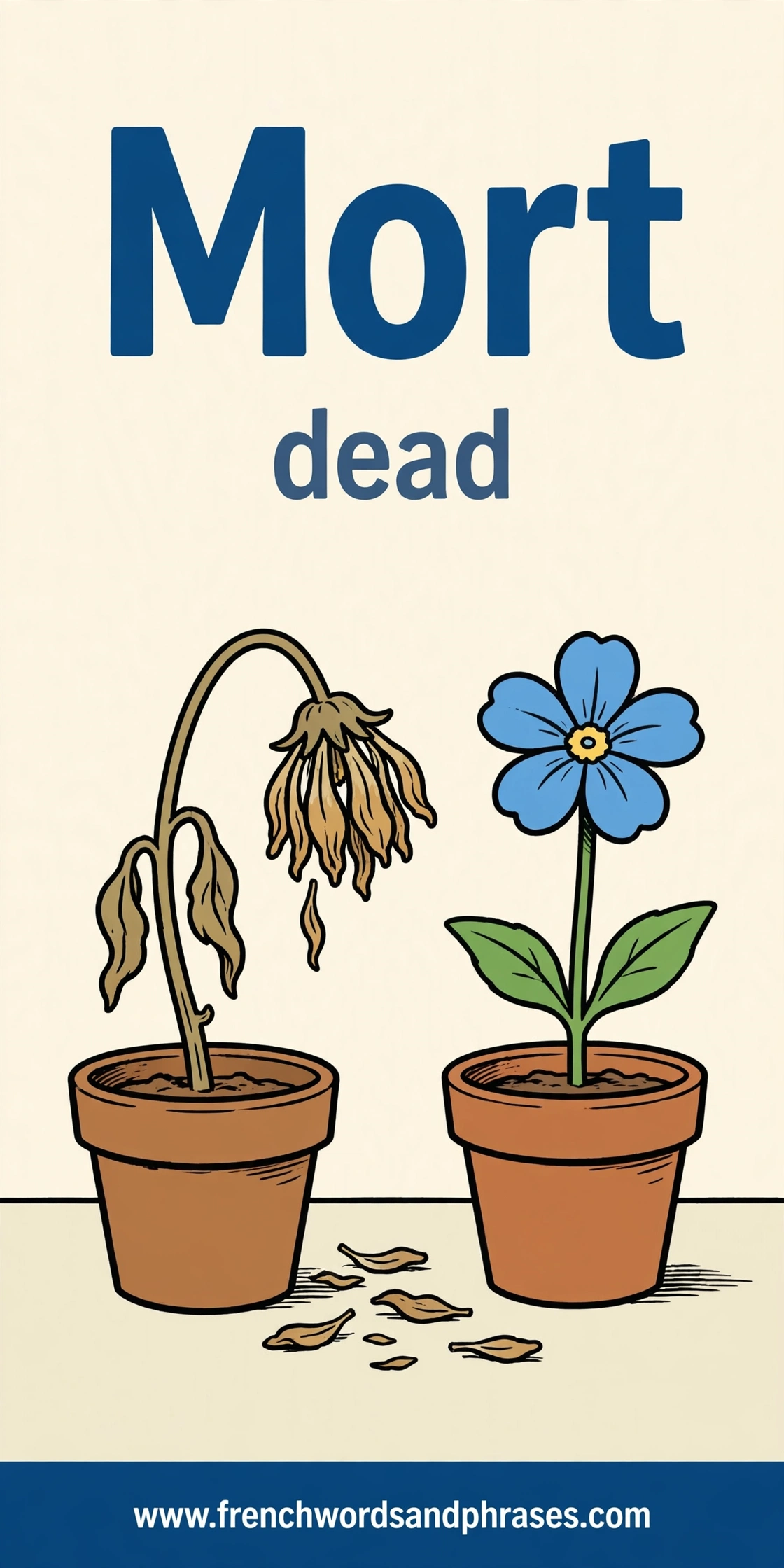
Mort means dead.
The battery shows nothing, the engine will not turn, the old tree by the gate has not budded for two springs. « Il est mort », says the vet, gently, of the dog; « elle est morte », says the mechanic, of the car. Mort is the adjective of the end of life — and French uses it, without flinching, for batteries, languages and evenings too.
In this guide, you’ll learn what mort means in English, how its feminine morte is formed, where it stands in the sentence, and how French uses it for people, batteries, languages and dull parties. Explore French examples, English translations, and practice quizzes.
Understanding the French Adjective Mort
Mort is a French adjective meaning dead, and also the past participle of the verb mourir, to die — mourir has its own page on this site. Its feminine is morte: un homme mort, une femme morte, des soldats morts, des feuilles mortes. As a noun, un mort is a dead person and la mort is death itself. The adjective stretches far beyond people: une batterie morte, a flat battery; une langue morte, a dead language; une saison morte, the off-season; mort de fatigue, dead tired.
It means dead — no longer alive: un animal mort, a dead animal; il est mort en 1910, he died in 1910 (here mort is the participle of mourir, with être). Then by extension, anything that has stopped working or living: un téléphone mort, a dead phone; un village mort, a dead village; un après-midi mort, a dead afternoon. French softens the blow in set phrases of exhaustion: mort de rire, dying of laughter; mort de peur, scared to death; mort de faim, starving — where mort is pure exaggeration and nobody has died at all.
Type: Adjective — dead; also the past participle of mourir (to die)
Answers the question: What is he/she/it like? — dead, no longer alive or working
Changes form: Feminine morte — mort / morte; plurals morts / mortes
English equivalents: Dead; flat (battery); extinct (language).
One important usage detail: mort follows être for both its lives — il est mort, he is dead / he died; elle est morte, she is dead / she died — and the feminine morte is written with one t in the middle and a final e: morte, mortes. As a noun, keep the two apart: un mort is a dead man, a casualty (les morts de la guerre), while la mort is death itself. For animals and things, mort works exactly as for people: le poisson est mort, la batterie est morte.
Experience the Word
Mort is the adjective French reaches for at the end of every kind of life — a person’s, a language’s, a battery’s, a party’s.
Imagine the November garden after the first frost: the last roses blackened on the stem, les feuilles mortes already thick on the path. Nothing dramatic — just the season’s quiet signature, and the gardener raking what summer left behind.
You have not just named an ending. You have learned the word French trusts with all of them — mort, dead, from the battlefield to the flat battery.
How to Use Mort in French: Complete Guide
Let’s explore how mort works in French, beginning with the whole word on one card.
Mort at a Glance
Before the details, here is the whole word on one card.
The Whole Word on One Card
Meaning, type, position and forms — mort in four lines.
| Point | Mort |
|---|---|
| Meaning | dead — no longer alive; stopped, flat, extinct by extension |
| Type | adjective — also the past participle of mourir |
| Usual position | after the noun, and after être — il est mort |
| Form | mort / morte — morts / mortes in the plural |
Example
L’arbre au fond du jardin est mort.
The tree at the bottom of the garden is dead.
The Four Forms of Mort
Mort forms its feminine as morte — one t, a final e — and both take an s in the plural.
| Form | Mort | Example |
|---|---|---|
| Masculine singular | mort | un homme mort — a dead man |
| Feminine singular | morte | une femme morte — a dead woman |
| Masculine plural | morts | des soldats morts — dead soldiers |
| Feminine plural | mortes | des feuilles mortes — dead leaves |
Example
Les feuilles mortes couvrent le trottoir.
The dead leaves cover the pavement.
Quick Quiz 1
What is the feminine of mort?
Reveal the answer
morte
Une batterie morte — the feminine is morte, with a final e.
A flat battery.
The Feminine of Mort: Morte
Morte is not a separate word to learn later — it is half of this word’s life, for every dead or flat feminine thing.
| Situation | Example |
|---|---|
| Masculine | un téléphone mort — a dead phone |
| Feminine | une batterie morte — a flat battery |
| Why | the feminine of mort is morte, with one t and a final e |
| The plural | add s — des langues mortes, dead languages |
Example
Le latin est une langue morte, mais on l’étudie encore.
Latin is a dead language, but it is still studied.
Where Mort Goes: After Être and After the Noun
Mort lives after être for states and deaths, and after the noun it describes.
| Pattern | Example |
|---|---|
| After être (a death) | il est mort en 1910 — he died in 1910 |
| After être (a state) | la batterie est morte — the battery is flat |
| After the noun | un animal mort — a dead animal |
| In set phrases | mort de fatigue — dead tired |
Example
Après la randonnée, ils étaient morts de fatigue.
After the hike, they were dead tired.
Quick Quiz 2
How do you say ‘a dead language’ — une morte langue or une langue morte?
Reveal the answer
une langue morte
Mort stands after the noun, in its feminine form morte.
A dead language.
More Mort: Comparing with Mort
Death does not take degrees, but French still compares the figurative senses — the deader afternoons and the flattest batteries.
| Degree | Example |
|---|---|
| As dead as | aussi mort que — as dead as |
| More dead (figurative) | plus mort que — un quartier plus mort que l’autre |
| Completely dead | complètement mort — completely dead, quite flat |
| Half-dead | à moitié mort — half-dead (of exhaustion) |
| The superlative | le plus mort — used only in jest or hyperbole |
Example
Le dimanche soir, ce quartier est complètement mort.
On Sunday evenings, this district is completely dead.
Everyday Expressions with Mort
Mort appears wherever French exaggerates, mourns or switches off — in the home, the garden and the history book.
| Expression | In English |
|---|---|
| mort de fatigue | dead tired |
| mort de rire | dying of laughter |
| mort de peur | scared to death |
| une langue morte | a dead language |
| les feuilles mortes | dead leaves (autumn’s carpet) |
| la saison morte | the off-season, the dead season |
Example
Le film était si drôle, nous étions morts de rire.
The film was so funny, we were dying of laughter.
Quick Quiz 3
What does mort de fatigue mean?
Reveal the answer
Dead tired
Mort de fatigue — exhausted, worn out completely.
Dead tired.
Mort and Its Neighbours
Mort keeps company with the words of life and its end — and faces vivant across the divide.
| French | In English |
|---|---|
| vivant | alive, living — the exact opposite |
| mourir | to die — the verb whose participle mort is |
| la mort | death — the noun |
| un mort | a dead person, a casualty — the noun |
| décédé | deceased — the official, administrative word |
| éteint | extinct, gone out — of species, volcanoes, lights |
Example
Vivant hier, mort aujourd’hui : la batterie n’a pas survécu au froid.
Alive yesterday, dead today: the battery did not survive the cold.
Watch Out: The Traps Around Mort
The traps here are the noun twins and the spelling of the feminine: la mort is death, un mort is a dead person, morte has one t.
| Trap | The truth |
|---|---|
| La mort / un mort | la mort is death itself; un mort is a dead person — les morts de la guerre, the war dead |
| The feminine | morte with one t — never write mortte |
| Mort ou décédé | mort is the everyday word; décédé belongs to forms, news and official announcements |
| Figurative mort | mort de rire, mort de faim: pure exaggeration — nobody has died |
Example
On annonce deux morts dans l’accident de la route.
Two deaths are reported in the road accident.
Quick Quiz 4
How do you say ‘dead leaves’?
Reveal the answer
des feuilles mortes
Mort follows the noun and agrees: feuilles is feminine plural, so mortes.
Dead leaves.
Mort in Everyday French: Real-Life Examples
Now that you know the word, let’s see how mort appears in everyday French.
Example 1 — In the garden
Les feuilles mortes s’entassent sous les arbres.
The dead leaves pile up under the trees.
Example 2 — Batteries
Mon téléphone est mort, je n’ai plus de batterie.
My phone is dead, I have no battery left.
Example 3 — Exhaustion
Après le marathon, elle était morte de fatigue.
After the marathon, she was dead tired.
Example 4 — Laughter
Cette scène nous a fait mourir de rire — morts de rire !
That scene made us die laughing — dying of laughter!
Example 5 — Languages
Le latin et le grec ancien sont des langues mortes.
Latin and ancient Greek are dead languages.
Example 6 — Quiet places
En août, le bureau est mort, tout le monde est en vacances.
In August, the office is dead, everyone is on holiday.
Beyond Translation: The Meaning of Mort
Mort is the past participle of mourir that walked out of the verb and set up as an adjective, a noun and a small philosophy. French history counts its morts — les morts pour la France on every village memorial — while everyday speech spends the word on batteries and boring Sundays, and hyperbole spends it further: mort de rire is the happiest death in the language. Between the memorial and the joke, mort carries the whole French scale of seriousness without changing its face.
Mort is the word of the end — trusted alike by the war memorial and the flat phone.
Learn it beside vivant and mourir, and keep la mort (death) and un mort (a dead person) carefully apart.
How to Remember the French Adjective Mort
Remember it this way: Mort is the dead adjective — mort for him, morte for her, and it doubles as the participle of mourir.
- You learn the pair together — un animal mort, une batterie morte.
- You sort the nouns — la mort est la mort elle-même, un mort est une personne morte.
- You spend it lightly — mort de rire, mort de fatigue : l’exagération quotidienne.
The key idea is mort / morte means dead; also the past participle of mourir.
Test Your Knowledge of Mort
Let’s see how much you’ve learned. Try answering these questions before revealing the answers.
Question 1
What does mort mean?
Reveal the answer
Dead — no longer alive; flat, extinct or stopped by extension.
Question 2
What is the feminine of mort?
Reveal the answer
morte — une batterie morte, des feuilles mortes.
Question 3
Translate: The tree at the bottom of the garden is dead.
Reveal the answer
L’arbre au fond du jardin est mort.
Question 4
Complete the sentence:
Les feuilles ______ couvrent le trottoir.
Reveal the answer
mortes
Les feuilles mortes couvrent le trottoir.
The dead leaves cover the pavement.
Question 5
What is the difference between la mort and un mort?
Reveal the answer
La mort is death itself; un mort is a dead person, a casualty.
Your Final Challenge
Can You Use It?
How would you say this in French?
“After the marathon, she was dead tired.”
Reveal the answer
Après le marathon, elle était morte de fatigue.
After the marathon, she was dead tired.
A little French. A little curiosity. A richer everyday life.
LEARN FRENCH ONE WORD AT A TIME