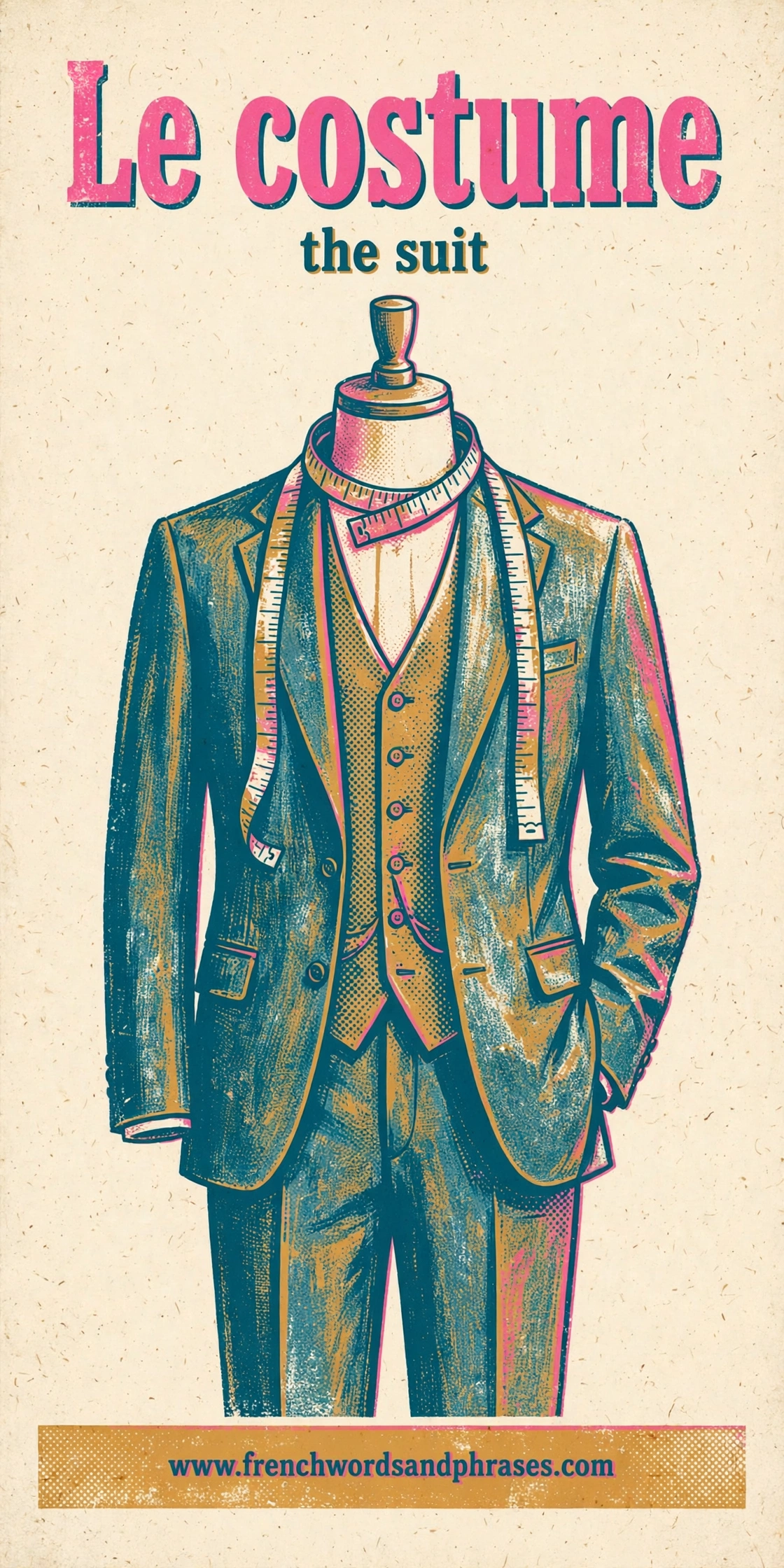
A French Word to Live By
Translate Costume to English
/kɔs.tym/
Le costume means the suit.
Pressed trousers, a jacket that matches, a tie chosen like a signature: le costume, the suit — the uniform of French offices and weddings, and, with one more word, the disguise of carnival and the dress of a whole region’s history.
In this guide, you’ll learn what costume means in English, how to use it with its articles, how to form its plural, and how it appears in everyday French. Explore French examples, English translations, and practice quizzes.
Understanding the French Noun Costume
Costume is a masculine French noun, learned with its article: le costume, un costume. It comes from the Italian costume, custom — the dress that custom prescribes. French divides its lives cleanly: the business suit (un costume, often un costume-cravate for the full suit-and-tie), the fancy dress of parties (un costume de carnaval, se déguiser is the verb), and the traditional dress of a region or an era (le costume traditionnel, le costume d’époque in theatre and film).
It means a suit — the matching jacket and trousers a man wears for work, weddings and ceremonies: un costume bleu marine, a navy suit, porter un costume, to wear a suit, un costume sur mesure, a made-to-measure suit. For women, the matching outfit is un tailleur. The second life is disguise and stage dress: un costume de pirate, a pirate costume, les costumes du spectacle, the show’s costumes — designed by le costumier, the costume designer.
Gender: Masculine — le costume
Definite article: le — le costume (the suit)
Indefinite article: un — un costume (a suit)
Plural: les costumes — regular, with a simple -s
Spelling note: from Italian costume, custom — the dress custom prescribes; a false friend for English costume parties
Key division: the suit (office), the fancy dress (party), the period dress (stage and history)
English equivalents: The suit; a costume (fancy dress, stage).
In a French office invitation, costume-cravate means suit and tie — the dress code itself. A woman’s suit is un tailleur, never un costume in careful French. For parties, the verb matters: se déguiser is to dress up, un déguisement the disguise, while un costume de plus the character names the outfit: un costume de sorcière, a witch costume.
Experience the Word
Costume is clothing with an intention: to be taken seriously at the office, to disappear into a pirate at the party, to step into another century on stage.
Imagine the tailor’s shop in October, chalk on dark wool, the final fitting before the wedding — le costume tombe parfaitement, and the young man in the mirror suddenly looks like the person he is about to become.
You have not just named clothes. You have named the outfit that assigns a role — le costume, the suit, the disguise, the dress of an era.
How to Use Costume in French: Complete Guide
Let’s explore how costume works in French, beginning with its articles — le costume, un costume, un costume sur mesure.
Costume with the Definite Article (Le, Les)
Used for a specific suit — his wedding suit, the show’s costumes.
| Form | French |
|---|---|
| Masculine singular | le costume |
| Plural | les costumes |
Example
Le costume du marié est prêt chez le tailleur.
The groom’s suit is ready at the tailor’s.
Costume with the Indefinite Article (Un, Des)
Used for a suit or costume in general — office, carnival or stage.
| Form | French |
|---|---|
| Masculine singular | un costume |
| Plural | des costumes |
Example
Il a acheté un costume pour son nouvel emploi.
He bought a suit for his new job.
Costume by Occasion (De carnaval, Traditionnel, Sur mesure…)
The occasion names the costume — the phrases that sort the wardrobe out.
| Quantity | French |
|---|---|
| a made-to-measure suit | un costume sur mesure |
| a carnival costume | un costume de carnaval |
| traditional dress | le costume traditionnel |
| a pirate costume | un costume de pirate |
| suit and tie (dress code) | le costume-cravate |
Example
Les enfants préparent leurs costumes de carnaval.
The children are preparing their carnival costumes.
Quick Quiz 1
Complete the sentence:
______ costume de mon frère est bleu marine. (the)
Reveal the answer
Le
Le costume de mon frère est bleu marine.
My brother’s suit is navy blue — costume is masculine, so le.
The Plural of Costume
Costume takes a regular plural in -s — wardrobes, theatre racks and carnival parties.
| Number | French |
|---|---|
| Singular | le costume |
| Plural | les costumes |
Example
Les costumes du spectacle sont magnifiques.
The costumes of the show are magnificent.
Costume with Possessive Adjectives (Mon, Ton, Son…)
Possessives agree with the noun: costume is masculine, so mon, ton, son in the singular.
| Owner | French |
|---|---|
| my | mon costume |
| your (tu) | ton costume |
| his / her | son costume |
| our | notre costume |
| your (vous) | votre costume |
| their | leur costume |
Example
Son costume de pirate a gagné le concours.
His pirate costume won the competition.
Quick Quiz 2
Complete the sentence:
Elle a cousu ______ costume pour la fête de l’école. (her)
Reveal the answer
son
Elle a cousu son costume pour la fête de l’école.
She sewed her costume for the school fête — son, because costume is masculine.
Costume with Demonstrative Adjectives (Ce, Ces)
Used to point: ce costume, this suit — this outfit on the rail.
| Form | French |
|---|---|
| Masculine singular | ce costume |
| Plural | ces costumes |
Example
Ce costume te va très bien.
This suit suits you very well.
Costume with Adjectives
Adjectives agree with costume — masculine singular: un costume élégant, un costume neuf.
| Adjective | With Costume |
|---|---|
| élégant (elegant) | un costume élégant |
| neuf (new) | un costume neuf |
| traditionnel (traditional) | un costume traditionnel |
| sur mesure (made-to-measure) | un costume sur mesure |
| sombre (dark) | un costume sombre |
Example
Un costume sombre convient pour un enterrement.
A dark suit is appropriate for a funeral.
Quick Quiz 3
Complete the sentence:
Il porte un costume ______ pour son entretien. (elegant)
Reveal the answer
élégant
Il porte un costume élégant pour son entretien.
He is wearing an elegant suit for his interview — élégant agrees with the masculine noun.
Everyday Expressions with Costume
Offices, weddings and carnival — the costume phrases of daily life.
| Expression | In English |
|---|---|
| un costume sur mesure | a made-to-measure suit |
| le costume-cravate | suit and tie (the dress code) |
| un costume de carnaval | a carnival costume, fancy dress |
| le costume traditionnel | traditional dress, folk costume |
| se déguiser | to dress up, to wear fancy dress (the verb) |
Example
Pour le mariage, costume-cravate obligatoire.
For the wedding, suit and tie required.
Words from the Same Family as Costume
Suits and dressing up — the words that travel with costume.
| French | In English |
|---|---|
| un tailleur | a tailor; a woman’s suit |
| une veste | a jacket |
| une cravate | a tie |
| le costumier | the costume designer (theatre, cinema) |
| un déguisement | a disguise, fancy dress |
Example
Le costumier a dessiné deux cents costumes pour le film.
The costume designer designed two hundred costumes for the film.
Quick Quiz 4
What does costume-cravate mean on an invitation?
Reveal the answer
Suit and tie — the dress code: formal dress required.
Réunion importante : costume-cravate pour tout le monde.
Important meeting: suit and tie for everyone.
Costume in Everyday French: Real-Life Examples
Now that you know the word, let’s see how costume appears in everyday French.
Example 1 — At work
Dans cette banque, le costume est de rigueur.
In this bank, a suit is required.
Example 2 — Weddings
Le marié porte un costume bleu nuit.
The groom is wearing a midnight-blue suit.
Example 3 — Carnival
Son costume de mousquetaire est fait maison.
His musketeer costume is homemade.
Example 4 — Theatre
Les costumes d’époque ont coûté une fortune.
The period costumes cost a fortune.
Example 5 — Regions
Elle danse en costume traditionnel breton.
She dances in traditional Breton dress.
Example 6 — Tailors
Un costume sur mesure dure dix ans.
A made-to-measure suit lasts ten years.
Beyond Translation: The Meaning of Costume
Costume began as custom itself — the Italian word named first the habit, then the dress the habit prescribed — and French still hears the rule inside the cloth: every costume says what its wearer is supposed to be. The office suit promises seriousness, the carnival costume licenses its opposite, and the costume traditionnel carries a region’s whole memory in embroidery. One word for the uniform, the disguise and the heritage — because all three are the same act: dressing as a role.
To say costume is to ask what part the clothes are playing.
It evokes the tailor’s chalk, the carnival mask, and the dancer’s embroidered vest.
How to Remember the French Noun Costume
Remember it this way: Costume is the suit — masculine: le costume, and un costume de carnaval is the fancy dress of the party.
- Always masculine — le costume, un costume, mon costume.
- The dress code — costume-cravate, suit and tie; a woman’s suit is un tailleur.
- The party sense — un costume de carnaval, and the verb is se déguiser.
The key idea is le costume — the suit, masculine; also fancy dress and traditional dress.
Test Your Knowledge of Costume
Let’s see how much you’ve learned. Try answering these questions before revealing the answers.
Question 1
Is costume masculine or feminine?
Reveal the answer
Masculine — le costume, un costume.
Question 2
How do you say a made-to-measure suit?
Reveal the answer
Un costume sur mesure.
Question 3
Translate: He bought a suit for his new job.
Reveal the answer
Il a acheté un costume pour son nouvel emploi.
Question 4
What is a woman’s suit called in French?
Reveal the answer
Un tailleur — un costume is the man’s suit.
Question 5
Complete the sentence:
______ costumes du spectacle sont magnifiques. (the)
Reveal the answer
Les
Les costumes du spectacle sont magnifiques.
The costumes of the show are magnificent.
Your Final Challenge
Can You Use It?
How would you say this in French?
“This suit suits you very well.”
Reveal the answer
Ce costume te va très bien.
This suit suits you very well.
A little French. A little curiosity. A richer everyday life.
LEARN FRENCH ONE WORD AT A TIME