A French Word to Live By
Translate Mille to English
/mil/
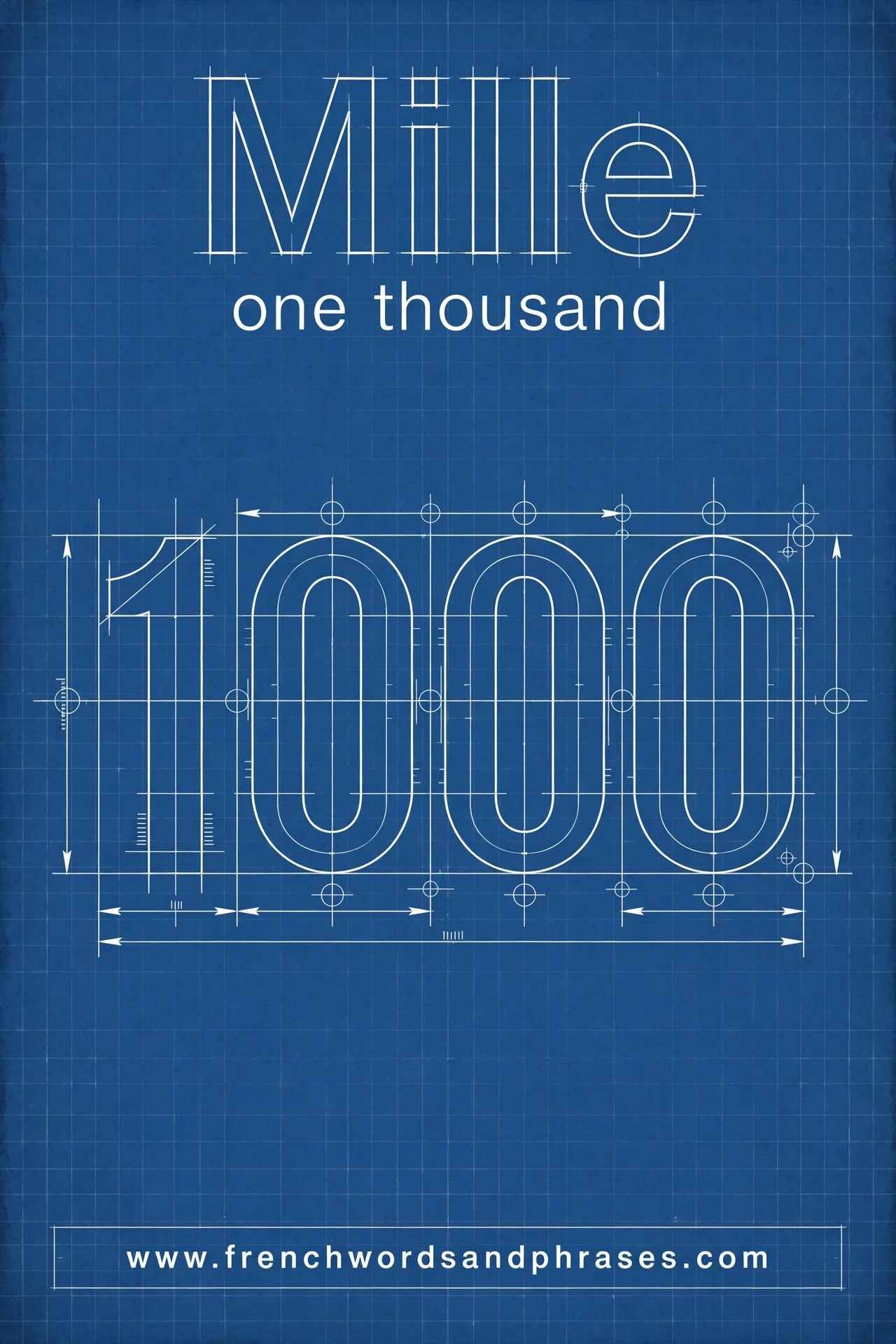
Mille means one thousand.
A fisherman on the quay at dawn, throwing his catch back one fish at a time while his grandson counts — and gives up, laughing, long before the end. For the really big counts, French reaches for the word that means a thousand all by itself: mille.
In this guide, you’ll learn what mille means in English, why it never takes an s and never a ‘un’, how it differs from million — the noun that behaves completely differently — and the expressions where mille shines. Explore French examples, English translations, and practice quizzes.
Understanding the French Number Mille
Mille is a French cardinal number — the counting word for 1,000 and the base of every thousand. It is the most disciplined word in the counting book: perfectly invariable, it never takes an s (trois mille, dix mille, cent mille) and it never takes ‘un’ — mille on its own already means one thousand.
It means one thousand. Where cent needed a rule with an s, mille needs the opposite rule: nothing ever changes. And mille must not be confused with million, which is not a counting word at all but a noun — un million, deux millions, un million d’euros — with an article, a plural and a ‘de’ before the thing counted.
Type: Cardinal number — the base of the thousands
Value: 1,000
Ordinal: millième — thousandth (le millième jour)
Changes form: Never — mille is invariable: no s, no ‘un’, in every company
English equivalents: One thousand; millième = thousandth.
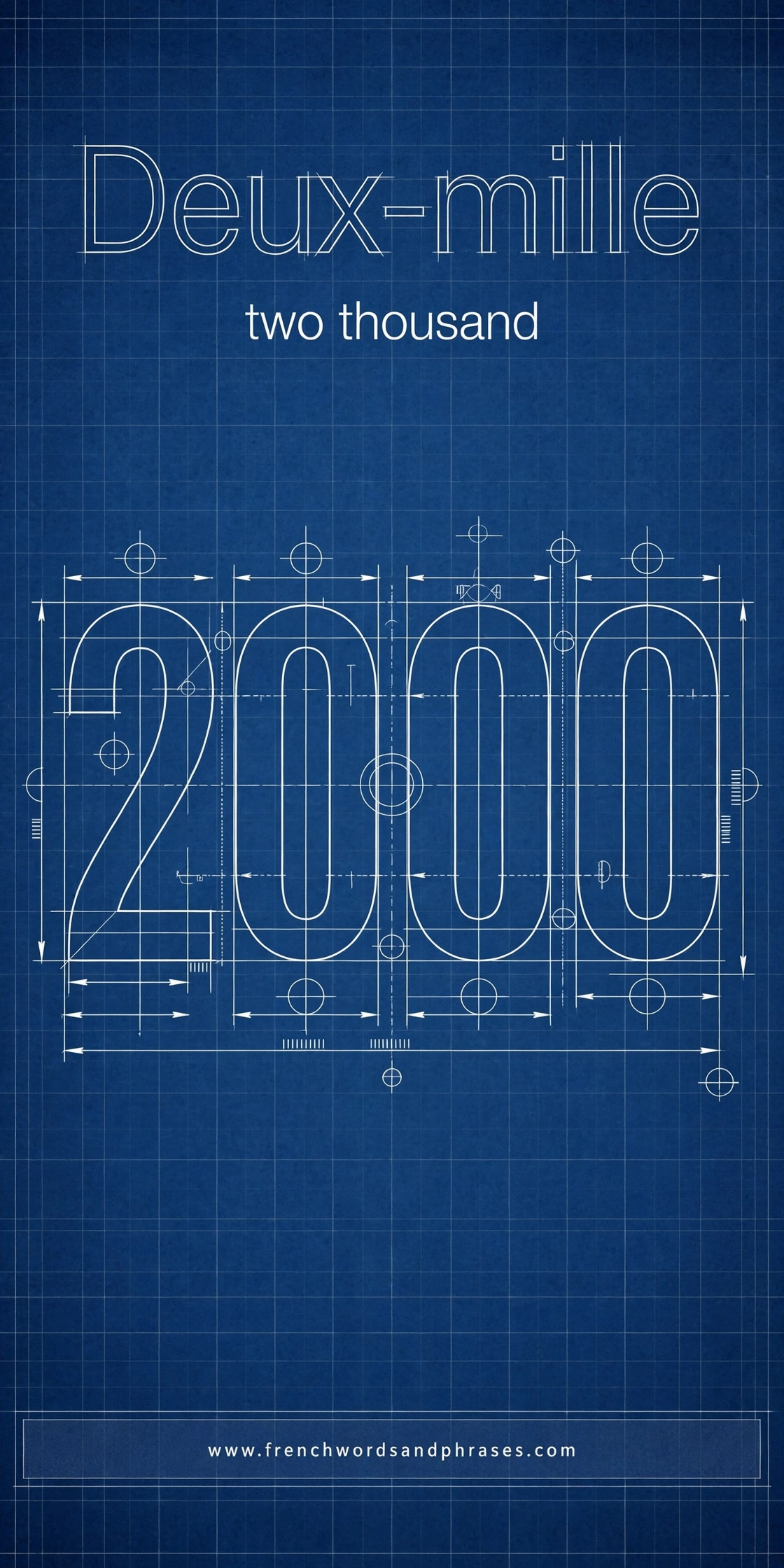
One important detail for dates: in years, the thousand is traditionally written mil, not mille — l’an mil neuf cent for the year 1000, mil neuf cent quatre-vingt-dix-huit for 1998. But 2000 breaks the habit: the year 2000 is deux-mille, with mille in full. In ordinary counting, always mille.
Experience the Word
Mille is the number of exaggeration and gratitude — mille mercis, a thousand thanks, is how French says thank you with its whole heart.
Imagine the night sky over the desert, far from every town: a child tries to count the stars and the grandfather stops her gently — il y en a mille, et mille fois mille. Some numbers are not for counting; they are for wondering.
You have not just learned a big number. You have learned the word French reaches for when counting becomes poetry.
How to Use Mille in French: Complete Guide
Let’s explore how mille works in French, beginning with the whole number on one card.
Mille at a Glance
Before the details, here is the whole number on one card.
The Whole Number on One Card
Value, word, ordinal and behaviour — mille in four lines.
| Point | Mille |
|---|---|
| Value | 1,000 |
| Meaning | one thousand |
| Ordinal | millième — thousandth |
| Changes form | never — trois mille, cent mille, no s and no un, ever |
Example
Mille mercis pour ton aide.
A thousand thanks for your help.
Counting with Mille
Mille stands before the noun it counts, bare and unchanged, whatever stands in front of it.
| Pattern | Example |
|---|---|
| 1,000 | mille euros — one thousand euros |
| 3,000 | trois mille habitants — three thousand inhabitants |
| 10,000 | dix mille personnes — ten thousand people |
| 100,000 | cent mille livres — one hundred thousand books |
Example
Le village compte trois mille habitants.
The village has three thousand inhabitants.
Quick Quiz 1
Does mille take an s in ‘trois mille’?
Reveal the answer
No, never
Mille is invariable: trois mille, dix mille, cent mille — the word never changes by a single letter.
One thousand, always mille.
Mille Is Not Million
The most important contrast in big French numbers: mille counts, million behaves like a noun.
| Point | Mille vs Million |
|---|---|
| 1,000 / 1,000,000 | mille — but un million (million needs its ‘un’) |
| Plural | trois mille, no s — deux millions, with an s |
| Before a noun | mille euros — un million d’euros (million needs ‘de’) |
| Kind of word | mille is a counting word — million is a noun |
Example
La ville a un million d’habitants, le village en a mille.
The city has a million inhabitants, the village has a thousand.
Mille in Prices, Crowds and Dates
Salaries, stadiums and a thousand years of history — mille at work.
| Situation | Example |
|---|---|
| A price | mille euros — one thousand euros |
| A crowd | dix mille personnes — ten thousand people |
| A year | l’an mil — the year 1000 (mil in dates) |
| A distance | mille kilomètres — one thousand kilometres |
Example
La voiture coûte huit mille euros.
The car costs eight thousand euros.
Quick Quiz 2
How do you say ‘a million euros’ in French?
Reveal the answer
un million d’euros
Million is a noun: it takes un, and de before the thing counted. Mille takes neither: mille euros.
A million euros.
Everyday Expressions with Mille
Thanks, bullseyes and a thousand and one nights — mille is the poet of the counting book.
| Expression | In English |
|---|---|
| mille mercis | a thousand thanks — thank you so much |
| mille fois | a thousand times |
| dans le mille ! | bullseye! — spot on! |
| les Mille et Une Nuits | the Thousand and One Nights |
| un mille-pattes | a millipede (a ‘thousand-legs’) |
| je te le donne en mille | you’ll never guess (I give you a thousand tries) |
Example
Tu as visé dans le mille du premier coup.
You hit the bullseye on the first try.
Mille and Its Neighbours
Mille opens the thousands — and beyond it waits million, playing by noun rules.
| French | In English |
|---|---|
| cent | one hundred — the number below |
| mille | one thousand |
| deux-mille | two thousand — the number after |
| millième | thousandth — le millième visiteur |
| un millième | a thousandth — un millième du total |
| un million | a million — a noun, not a counting word |
Example
Le millième visiteur gagne un cadeau.
The thousandth visitor wins a prize.
Quick Quiz 3
What does ‘dans le mille !’ mean?
Reveal the answer
Bullseye! Spot on!
From archery: hitting the thousand-point centre. French cries ‘dans le mille !’ for any perfect guess.
Right on target.
Words from the Same Family as Mille
Mille measures thousands of everything — people, years and tiny parts alike.
| French | In English |
|---|---|
| millième | thousandth |
| un millier | about a thousand (un millier de personnes) |
| un millénaire | a millennium — a thousand years |
| un millimètre | a millimetre — a thousandth of a metre |
| un mille-pattes | a millipede |
| un million | a million — the big cousin, a noun |
Example
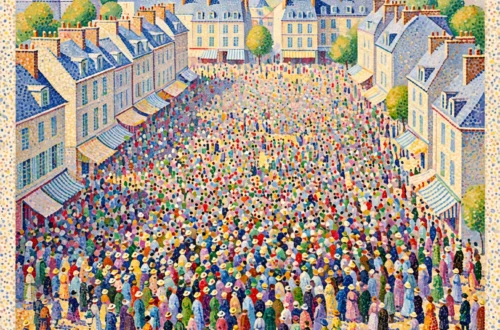
Un millier de personnes attendent sur la place.
About a thousand people are waiting in the square.
Watch Out: The Traps Around Mille
Mille’s traps are all about doing too much: an s too many, an ‘un’ too many, a million confused.
| Trap | The truth |
|---|---|
| No s, ever | trois mille, dix mille — never ‘trois milles’ in counting |
| No ‘un’ | 1,000 is mille, never ‘un mille’ as a counting word |
| Million differs | un million d’euros — article, s in the plural, and de before the noun |
| In dates | the year 1000 is l’an mil — but 2000 is deux-mille |
Example
Mille euros, pas un million : il y a une grande différence.
A thousand euros, not a million: there is a big difference.
Quick Quiz 4
How do you say ‘three thousand inhabitants’?
Reveal the answer
trois mille habitants
No s on mille, no article — mille never changes.
Three thousand inhabitants.
Mille in Everyday French: Real-Life Examples
Now that you know the word, let’s see how mille appears in everyday French.
Example 1 — Gratitude
Mille mercis pour ton aide, vraiment.
A thousand thanks for your help, truly.
Example 2 — Money
La voiture coûte huit mille euros.
The car costs eight thousand euros.
Example 3 — The village
Le village compte trois mille habitants.
The village has three thousand inhabitants.
Example 4 — Travel
Il reste mille kilomètres avant la frontière.
There are one thousand kilometres left before the border.
Example 5 — Stories
Les Mille et Une Nuits commencent par un roi et une conteuse.
The Thousand and One Nights begin with a king and a storyteller.
Example 6 — Games
Dans le mille ! Tu as gagné du premier coup.
Bullseye! You won on the first try.
Beyond Translation: The Meaning of Mille
English thousand and French mille parted company long ago: mille comes straight from Latin mille, the same root that gives English ‘mile’ — the Roman mille passus, a thousand paces.
Mille is the disciplined giant: the biggest counting word that never changes at all.
Hold it up against million and the lesson sharpens. Mille is grammar; million is a thing. One counts in silence, invariable — the other takes articles, plurals and a ‘de’, like any self-respecting noun. Knowing which is which is the whole art of big French numbers.
How to Remember the French Number Mille
Remember it this way: Mille is the perfectly behaved giant — no s, no ‘un’, no changes — while million, its cousin, behaves like a noun.
- You change nothing — trois mille, dix mille, cent mille, jamais de s.
- You skip the article — mille euros, pas « un mille ».
- You thank with it — mille mercis, dans le mille !
The key idea is mille = one thousand, invariable — unlike million, the noun.
Test Your Knowledge of Mille
Let’s see how much you’ve learned. Try answering these questions before revealing the answers.
Question 1
What does mille mean?
Reveal the answer
One thousand — the base of all the thousands.
Question 2
Does mille ever take an s?
Reveal the answer
Never — mille is invariable: trois mille, cent mille, always the same.
Question 3
Translate: A thousand thanks! The village has a thousand inhabitants, not a million.
Reveal the answer
Mille mercis ! Le village a mille habitants, pas un million.
Question 4
Complete the sentence:
La ville a un ______ d’habitants. (million)
Reveal the answer
million
La ville a un million d’habitants.
The city has a million inhabitants — million is a noun and takes de.
Question 5
How is the year 1000 written in French dates?
Reveal the answer
l’an mil — in dates, the thousand is traditionally mil; but 2000 is deux-mille.
Your Final Challenge
Can You Use It?
How would you say this in French?
“A thousand thanks! The village has a thousand inhabitants, not a million.”
Reveal the answer
Mille mercis ! Le village a mille habitants, pas un million.
A thousand thanks! The village has a thousand inhabitants, not a million.
A little French. A little curiosity. A richer everyday life.
LEARN FRENCH ONE WORD AT A TIME