
A French Word to Live By
Translate Mer to English
/mɛʁ/
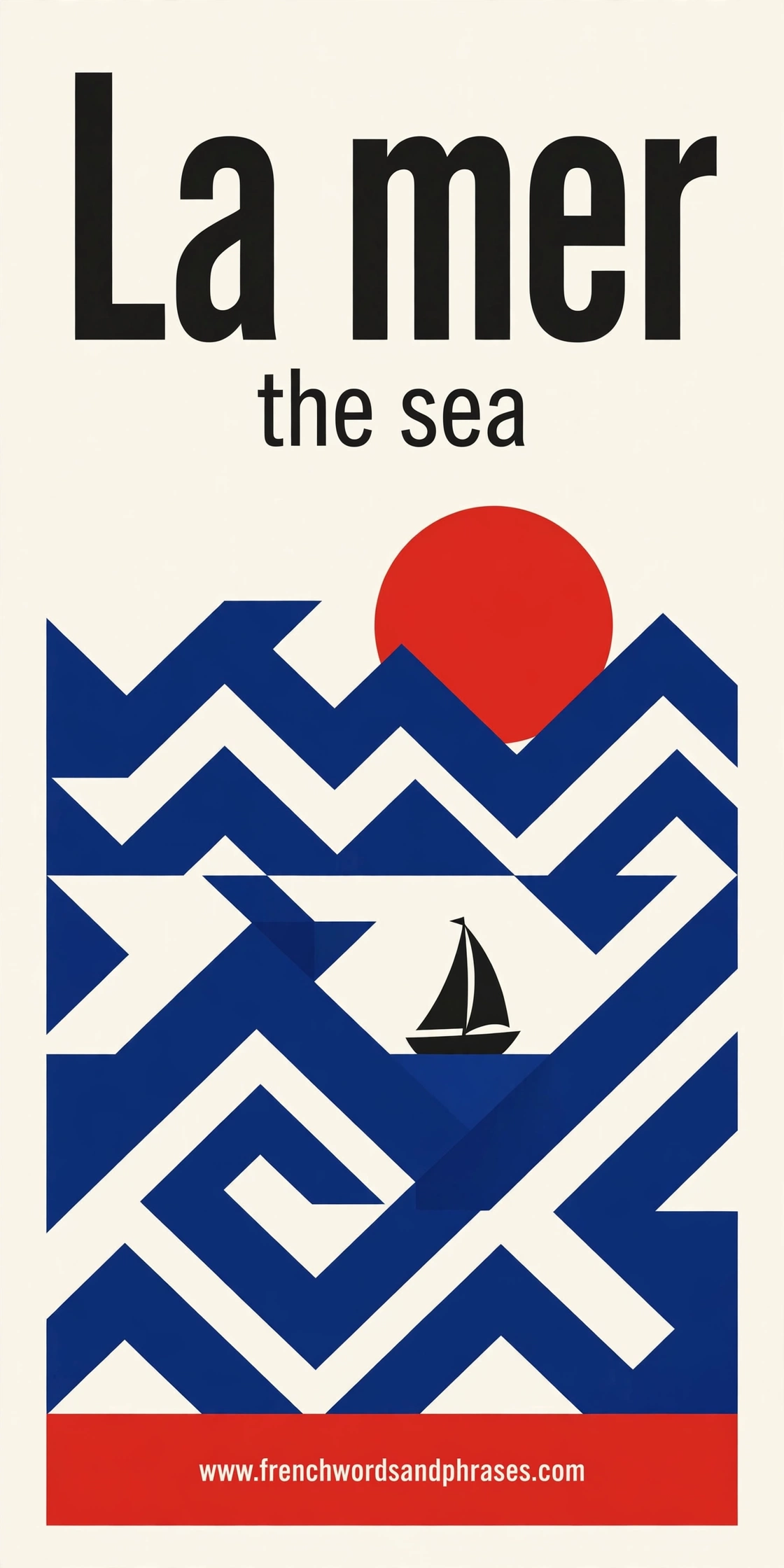
La mer means the sea.
Salt on the lips, gulls overhead, and the horizon drawing its one straight line at the end of the world: la mer, the sea — for a country with three coastlines, less a word than a member of the family.
In this guide, you’ll learn what mer means in English, how to use it with its articles, how to form its plural, and how it appears in everyday French. Explore French examples, English translations, and practice quizzes.
Understanding the French Noun Mer
Mer is a feminine French noun, learned with its article: la mer, une mer. It comes straight from the Latin mare. Handle it with care in speech: la mer (the sea), la mère (the mother) and le maire (the mayor) are all pronounced exactly alike, /mɛʁ/ — only the article and the context tell the sea from the mother and the mayor.
It means the sea — the salt water that covers most of the earth: la mer Méditerranée, the Mediterranean Sea, la mer du Nord, the North Sea, au bord de la mer, by the seaside. French uses it for the water itself and for its moods: une mer calme, a calm sea, la haute mer, the open sea, le mal de mer, seasickness. Its harvest has a name of its own: les fruits de mer, seafood — literally, the fruits of the sea. By extension, une mer de foule, a sea of people, and une mer de sable, a sea of sand in the desert.
Gender: Feminine — la mer
Definite article: la — la mer (the sea)
Indefinite article: une — une mer (a sea)
Plural: les mers — regular, with a simple -s
Spelling note: pronounced exactly like mère (mother) and maire (mayor) — the article separates them
Key phrases: au bord de la mer (by the sea), les fruits de mer (seafood)
English equivalents: The sea.
Three words, one sound: la mer is the sea, la mère is the mother, le maire is the mayor — French listeners separate them by article and context, and French writers by spelling alone. You go à la mer for the holidays, swim dans la mer, sail en mer, and feel ill with le mal de mer. A lake is not a mer: that is un lac, and the ocean is l’océan — la mer is the word of coasts, tides and holidays.
Experience the Word
Mer is France’s third horizon: after the fields and the mountains, the flat blue line that promises fish, salt and departure.
Imagine the first morning of the holidays — shutters opened on the port, the tide out, the boats resting on the mud, and the whole village already saying the only sentence that matters: on va à la mer.
You have not just named water. You have named the edge of the land — la mer, the sea, where every road in France eventually stops.
How to Use Mer in French: Complete Guide
Let’s explore how mer works in French, beginning with its articles — la mer, une mer, au bord de la mer.
Mer with the Definite Article (La, Les)
Used for a specific sea — the Mediterranean, the one at the end of the street.
| Form | French |
|---|---|
| Feminine singular | la mer |
| Plural | les mers |
Example
La mer est calme ce matin.
The sea is calm this morning.
Mer with the Indefinite Article (Une, Des)
Used for a sea in general — and for the sea as a mass, rough or smooth.
| Form | French |
|---|---|
| Feminine singular | une mer |
| Plural | des mers |
Example
Une mer agitée retarde les bateaux.
A rough sea delays the boats.
Mer with the Partitive (De la mer, l’eau de mer…)
The sea as a substance comes in splashes, buckets and drops — de la mer, de l’eau de mer.
| Quantity | French |
|---|---|
| sea water | l’eau de mer |
| a drop of sea water | une goutte d’eau de mer |
| a bucket of sea water | un seau d’eau de mer |
| a sea of sand | une mer de sable |
| a sea of people | une mer de foule |
Example
L’eau de mer est salée, évidemment.
Sea water is salty, of course.
Quick Quiz 1
Complete the sentence:
______ mer Méditerranée borde le sud de la France. (the)
Reveal the answer
La
La mer Méditerranée borde le sud de la France.
The Mediterranean Sea borders the south of France — mer is feminine, so la.
The Plural of Mer
Mer takes a regular plural in -s — the plural names the seas of the world, one by one.
| Number | French |
|---|---|
| Singular | la mer |
| Plural | les mers |
Example
Les mers et les océans couvrent la plupart de la planète.
The seas and oceans cover most of the planet.
Mer with Possessive Adjectives (Ma, Ta, Sa…)
Possessives agree with the noun: mer is feminine, so ma, ta, sa in the singular — sailors speak of their sea exactly so.
| Owner | French |
|---|---|
| my | ma mer |
| your (tu) | ta mer |
| his / her | sa mer |
| our | notre mer |
| your (vous) | votre mer |
| their | leur mer |
Example
Le vieux marin parle de sa mer comme d’une amie.
The old sailor speaks of his sea as of a friend.
Quick Quiz 2
Complete the sentence:
Elle regarde ______ mer préférée depuis la falaise. (her)
Reveal the answer
sa
Elle regarde sa mer préférée depuis la falaise.
She looks at her favourite sea from the cliff — sa, because mer is feminine.
Mer with Demonstrative Adjectives (Cette, Ces)
Used to point: cette mer, this sea — this water, under this sky.
| Form | French |
|---|---|
| Feminine singular | cette mer |
| Plural | ces mers |
Example
Cette mer-là change de couleur à chaque heure.
That sea changes colour every hour.
Mer with Adjectives
Adjectives agree with mer — feminine singular: une mer calme, la mer bleue.
| Adjective | With Mer |
|---|---|
| calme (calm) | une mer calme |
| agitée (rough) | une mer agitée |
| bleue (blue) | la mer bleue |
| haute (open, in the set phrase) | la haute mer |
| morte (dead, in the set phrase) | une mer morte |
Example
Par une mer calme, la traversée dure deux heures.
On a calm sea, the crossing takes two hours.
Quick Quiz 3
Complete the sentence:
Aujourd’hui, la mer est très ______. (rough)
Reveal the answer
agitée
Aujourd’hui, la mer est très agitée.
Today, the sea is very rough — agitée, feminine, to agree with mer.
Everyday Expressions with Mer
Holidays, harbours and dinner plates — the mer phrases of daily life.
| Expression | In English |
|---|---|
| au bord de la mer | by the sea, at the seaside |
| les fruits de mer | seafood |
| le mal de mer | seasickness |
| en haute mer | on the open sea |
| aller à la mer | to go to the seaside |
Example
Nous avons commandé un plateau de fruits de mer.
We ordered a seafood platter.
Words from the Same Family as Mer
Salt water and sailing — the words that travel with mer.
| French | In English |
|---|---|
| un marin | a sailor |
| la marée | the tide |
| la plage | the beach |
| une vague | a wave |
| maritime | maritime, seafaring (adjective) |
Example
La marée monte, les bateaux se relèvent.
The tide is coming in, the boats are rising.
Quick Quiz 4
What are les fruits de mer?
Reveal the answer
Seafood — literally “the fruits of the sea”: shellfish, prawns, oysters and their kin.
Le plateau de fruits de mer arrive avec du citron.
The seafood platter arrives with lemon.
Mer in Everyday French: Real-Life Examples
Now that you know the word, let’s see how mer appears in everyday French.
Example 1 — Holidays
Cet été, nous allons à la mer.
This summer, we’re going to the seaside.
Example 2 — Swimming
Les enfants nagent dans la mer tous les jours.
The children swim in the sea every day.
Example 3 — The weather
La mer est agitée, le ferry ne part pas.
The sea is rough, the ferry isn’t leaving.
Example 4 — Dinner
J’adore les fruits de mer, surtout les huîtres.
I love seafood, especially oysters.
Example 5 — Seasickness
Sur le bateau, il a eu le mal de mer.
On the boat, he was seasick.
Example 6 — The view
De la fenêtre, on voit la mer.
From the window, you can see the sea.
Beyond Translation: The Meaning of Mer
Mer is one third of a famous French trap: mer, mère, maire — sea, mother, mayor — three spellings, one sound, separated only by the article a listener hears and the letters a reader sees. The word itself is as old as Latin mare and as present as this summer’s beach traffic: France measures its holidays en semaines à la mer, its dinners en fruits de mer, and its weather en état de la mer. Poets made it a mother of a different kind — Baudelaire’s homme libre who will always cherish la mer — but the everyday word stays saltier and simpler: the water at the end of the land.
To say mer is to hear the gulls already.
It evokes wet sand, striped windbreaks and the ferry horn — the sea as France’s oldest holiday and oldest highway.
How to Remember the French Noun Mer
Remember it this way: Mer is the sea — feminine: la mer. Say the three apart by their articles: la mer (sea), la mère (mother), le maire (mayor).
- Always feminine — la mer, une mer, ma mer.
- The homophone trap — mer / mère / maire sound identical; the article and spelling separate them.
- The dinner phrase — les fruits de mer, seafood, the fruits of the sea.
The key idea is la mer — the sea, feminine; not mère (mother) or maire (mayor).
Test Your Knowledge of Mer
Let’s see how much you’ve learned. Try answering these questions before revealing the answers.
Question 1
Is mer masculine or feminine?
Reveal the answer
Feminine — la mer, une mer.
Question 2
Which two words sound exactly like mer, and what do they mean?
Reveal the answer
Mère, mother, and maire, mayor — all three are pronounced /mɛʁ/.
Question 3
Translate: We’re going to the seaside this summer.
Reveal the answer
Cet été, nous allons à la mer.
Question 4
What is le mal de mer?
Reveal the answer
Seasickness — the illness of the sea, felt on boats.
Question 5
Complete the sentence:
______ mer est bleue aujourd’hui. (the)
Reveal the answer
La
La mer est bleue aujourd’hui.
The sea is blue today.
Your Final Challenge
Can You Use It?
How would you say this in French?
“From the window, you can see the sea.”
Reveal the answer
De la fenêtre, on voit la mer.
From the window, you can see the sea.
A little French. A little curiosity. A richer everyday life.
LEARN FRENCH ONE WORD AT A TIME




