A French Word to Live By
Translate Marquer quelque chose d’une pierre blanche to English
/maʁ.ke kɛl.kə ʃoz dyn pjɛʁ blɑ̃ʃ/
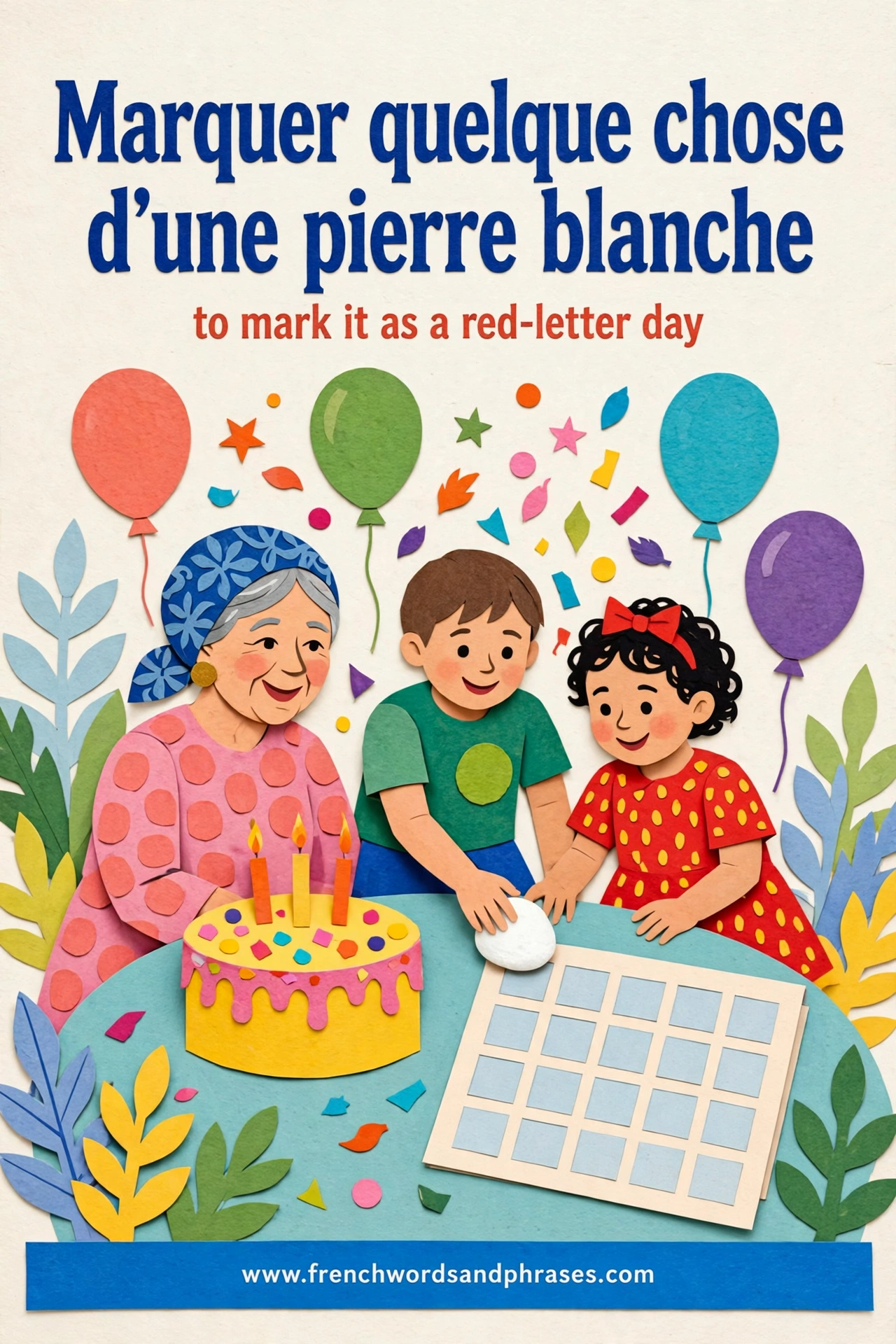
Marquer quelque chose d’une pierre blanche means to mark it as a red-letter day — to single out a moment as one to remember.
The results are posted on the school gate, and there it is — her name, at the top of the list. After three years of evening classes, your sister has passed. Your mother is already on the phone, half laughing, half crying: « Ce jour-là, on le marquera d’une pierre blanche ! »
Let’s explore how marquer quelque chose d’une pierre blanche works in French, beginning with the whole phrase on one card.
Understanding the French Phrase Marquer quelque chose d’une pierre blanche
Marquer quelque chose d’une pierre blanche is a French idiomatic expression built from marquer (to mark), quelque chose (something) and une pierre blanche (a white stone). It reaches back to Roman days, when fortunate dates were marked with a white stone or a stroke of chalk: the phrase means to mark a day or an event as exceptional — one to remember.
It means to mark something as a red-letter day — to single out a day or an event as rare, happy and worth remembering forever. Nobody is painting stones: the white stone is the calendar mark itself, the sign that this date, unlike the grey run of ordinary days, deserves to stand out.
Type: Idiomatic expression — celebration (verb + noun phrase)
Answers the need: Saying a day or event is exceptional and unforgettable
Register: Neutral to warm — affectionate, slightly literary, safe everywhere
Strength: High — not just a good day, but a landmark day
One important usage detail: what gets marked is usually a day, a date or an event — on marquera ce jour d’une pierre blanche — and the phrase often appears in the pattern un jour à marquer d’une pierre blanche, a day to be marked with a white stone. The marked thing is almost always joyful: victories, reunions, births, the day the letter finally arrived.
Experience the Word
Marquer quelque chose d’une pierre blanche is memory given a colour — most days blur into grey, and then one day earns the white stone.
Imagine a kitchen calendar at the end of a long year: appointments, bills, rain. And then one square circled so hard the pen nearly tears the paper. That circled square is the pierre blanche — the day the family will still be telling stories about in twenty years.
The Romans started it, marking their lucky days with chalk and their black days with charcoal. French kept the white half of the custom — the half worth keeping.
How to Use Marquer quelque chose d’une pierre blanche in French: Complete Guide
Let’s explore how marquer quelque chose d’une pierre blanche works in French, beginning with the whole phrase on one card.
Marquer quelque chose d’une pierre blanche at a Glance
The Whole Phrase on One Card
Real meaning, literal picture, English twin and register — marquer quelque chose d’une pierre blanche in five lines.
| Point | Marquer quelque chose d’une pierre blanche |
|---|---|
| What it really means | to mark a day or event as exceptional — a red-letter day |
| Word for word | to mark something with a white stone |
| English equivalent | to mark it as a red-letter day / a day to remember |
| Register | neutral to warm — affectionate and a little literary |
| Use it for | victories, reunions, births, long-awaited good news |
Example
Le jour de leur rencontre est à marquer d’une pierre blanche.
The day they met is one to mark as a red-letter day.
Word by Word: Building the Celebration
Six small pieces — take them one by one and the calendar starts to glow.
| Word | Literal meaning | Its job in the phrase |
|---|---|---|
| marquer | to mark | the verb that leaves the sign — the same marquer as in marquer un but, to score a goal |
| quelque chose | something | the thing being honoured — usually a day, a date, an event |
| d’ | with | the tool of the marking follows: marked WITH the stone |
| une pierre | a stone | the marker itself — small, bright and permanent |
| blanche | white | the colour of luck and celebration — feminine, agreeing with pierre |
Example
Elle a marqué la date d’une pierre blanche dans son agenda.
She marked the date as a red-letter day in her diary.
Quick Quiz 1
Why is the stone white?
Reveal the answer
White was the Roman colour of lucky days — fortunate dates were marked with a white stone or chalk; black marked the bad ones.
Ce succès est à marquer d’une pierre blanche.
This success deserves to be marked as a red-letter day.
When You Say It: The Landmark Moments
Marquer d’une pierre blanche fires at moments like these — the day rises above all the others.
| Situation | Example |
|---|---|
| An exam passed | son diplôme ? un jour à marquer d’une pierre blanche — her degree? a day to remember |
| A reunion | retrouver son frère après vingt ans, c’est à marquer d’une pierre blanche — finding her brother after twenty years deserves the white stone |
| A birth | la naissance du bébé sera marquée d’une pierre blanche — the baby’s birth will be marked as a landmark day |
| A victory | cette victoire est à marquer d’une pierre blanche — this victory is one for the history books |
| Good news at last | le jour où la lettre est arrivée, on l’a marqué d’une pierre blanche — the day the letter arrived got the white stone |
Example
Leur mariage reste un jour à marquer d’une pierre blanche.
Their wedding remains a day to mark with a white stone.
Make It Yours: The White Stone for Every Day
The thing marked changes freely — a day, a date, a victory, a meeting — while d’une pierre blanche never changes at all.
| Form | French | In English |
|---|---|---|
| The classic pattern | un jour à marquer d’une pierre blanche | a day to mark as a red-letter day |
| Marking the date | marquer cette date d’une pierre blanche | to mark this date with a white stone |
| In the past | on l’a marqué d’une pierre blanche | we marked it as a day to remember |
| About an event | un événement à marquer d’une pierre blanche | an event to single out and remember |
| With the family | nous marquerons ce jour d’une pierre blanche | we shall mark this day with a white stone |
| Question | ce jour mérite-t-il une pierre blanche ? | does this day deserve the white stone? |
Example
Le 14 juillet de cette année-là est à marquer d’une pierre blanche.
That year’s 14 July is a day to mark with a white stone.
Quick Quiz 2
Which pattern is the classic shape — un jour à marquer d’une pierre blanche or un jour avec une pierre blanche?
Reveal the answer
À marquer d’une pierre blanche — a day TO BE marked WITH a white stone: à for the purpose, d’ for the tool.
Leur retour est un jour à marquer d’une pierre blanche.
Their return is a day to mark with a white stone.
Everyday Expressions: Building on the White Stone
Marquer d’une pierre blanche slots into these everyday frames — each one ready to use as it stands.
| Frame | In English |
|---|---|
| un jour à marquer d’une pierre blanche | a red-letter day, a day to remember |
| marquer la date d’une pierre blanche | to mark the date as a landmark |
| être marqué d’une pierre blanche | to be singled out as exceptional |
| une date à retenir | a date to remember — the plain cousin |
| un jour exceptionnel | an exceptional day — no stone, no picture |
Example
Cette date sera marquée d’une pierre blanche dans l’histoire du club.
This date will be marked as a landmark in the club’s history.
Close Cousins: The Other Memorable Days
French has a whole shelf of remembering phrases — the pierre blanche is the joyful one; its cousins engrave, celebrate or simply date things.
| Expression | The difference |
|---|---|
| marquer d’une pierre blanche | to mark a day as a joyful landmark — the white stone of celebration |
| graver dans le marbre | to set in stone — for rules and decisions that must never change; solemn, not joyful |
| faire date | to be a landmark date — the event itself makes history |
| un jour de fête | a day of celebration — festive, but any party qualifies |
| inoubliable | unforgettable — the plain adjective, no picture at all |
Example
Ce concert fera date, un vrai jour à marquer d’une pierre blanche.
This concert will be a landmark — a real day to mark with a white stone.
Quick Quiz 3
A new law must never be changed. Pierre blanche or graver dans le marbre?
Reveal the answer
Graver dans le marbre — marble is for permanence and rules. The white stone is for joyful days to remember.
Ces règles sont gravées dans le marbre.
These rules are set in stone.
Marquer quelque chose d’une pierre blanche and Its Neighbours
The memory shelf around the phrase — calendars, chalk and the days that earn them.
| French | In English |
|---|---|
| la pierre blanche | the white stone |
| un jour mémorable | a memorable day |
| le calendrier | the calendar |
| un anniversaire | a birthday, an anniversary |
| célébrer | to celebrate |
| se souvenir | to remember |
Example
Sur le calendrier, ce jour mémorable porte une pierre blanche.
On the calendar, that memorable day carries a white stone.
Watch Out: The Traps Around the White Stone
The traps: a stone that only celebrates, an agreement in blanche, and a cousin in marble that means the opposite job.
| Trap | The truth |
|---|---|
| joyful days only | the white stone marks happy landmarks — for a disaster, French would never reach for it; say un jour noir, a black day |
| blanche agrees with pierre | pierre is feminine, so blanche takes its -e: une pierre blanche, never blanc |
| not the same as graver dans le marbre | the white stone remembers a day; marble fixes a rule forever — celebration versus permanence |
| the d’ is the tool | marquer quelque chose D’une pierre blanche — marked WITH the stone; the thing marked comes first |
Example
Un jour noir pour le club, mais celui-ci est à marquer d’une pierre blanche.
A black day for the club — but this one deserves the white stone.
Quick Quiz 4
True or false: you could mark the day of a terrible defeat d’une pierre blanche.
Reveal the answer
False — the white stone is for joyful, memorable days only. A disastrous day is un jour noir.
Après ce jour noir, enfin un jour à marquer d’une pierre blanche.
After that black day, at last a day to mark with a white stone.
Marquer quelque chose d’une pierre blanche in Everyday French: Real-Life Examples
Now that you know the word, let’s see how marquer quelque chose d’une pierre blanche appears in everyday French.
Example 1 — The exam results
Son succès est un jour à marquer d’une pierre blanche.
Her success is a day to mark as a red-letter day.
Example 2 — The reunion
Retrouver sa sœur après dix ans : à marquer d’une pierre blanche.
Finding his sister again after ten years: a day to mark with a white stone.
Example 3 — The wedding
Leur mariage a été marqué d’une pierre blanche par tout le village.
Their wedding was marked as a landmark day by the whole village.
Example 4 — The promotion
Le jour de sa promotion, elle l’a marqué d’une pierre blanche.
The day of her promotion, she marked it as a red-letter day.
Example 5 — The letter
La lettre est arrivée un mardi à marquer d’une pierre blanche.
The letter arrived on a Tuesday worth marking with a white stone.
Example 6 — Grandmother’s verdict
Notez bien ce jour, les enfants : pierre blanche !
Mark this day well, children: white stone!
Beyond Translation: The Meaning of Marquer quelque chose d’une pierre blanche
English marks its special days in red — the red letters of old calendars, where saints’ days and festivals were printed in crimson. French marks them in white — the white stone of the Romans, laid on the lucky dates. Two colours, one instinct: a year is mostly grey, and the bright days must be flagged before they slip away.
To marquer un jour d’une pierre blanche is to refuse to let happiness pass unrecorded.
The stone is small and the gesture takes a second — but it tells the future where to look when it asks what this life contained.
How to Remember the French Phrase Marquer quelque chose d’une pierre blanche
Remember it this way: Marquer d’une pierre blanche is the Roman calendar trick — a white stone laid on the lucky days so the eye finds them at once.
- You picture the Roman calendar — white stones on the fortunate days, black on the others; French kept the white ones.
- You keep blanche feminine — it agrees with pierre: une pierre blanche.
- You save it for joy — victories, reunions, births; disasters get un jour noir, never the white stone.
The key idea is marquer quelque chose d’une pierre blanche means to mark it as a red-letter day — a joyful day singled out to remember.
Test Your Knowledge of Marquer quelque chose d’une pierre blanche
Let’s see how much you’ve learned. Try answering these questions before revealing the answers.
Question 1
What does marquer quelque chose d’une pierre blanche mean?
Reveal the answer
To mark it as a red-letter day — to single out a day or event as exceptional and unforgettable.
Question 2
Where does the white stone come from?
Reveal the answer
From Roman custom — fortunate days were marked with a white stone or chalk; black marked the unlucky ones.
Question 3
How do you say ‘a day to remember’ with this phrase?
Reveal the answer
Un jour à marquer d’une pierre blanche — the classic pattern: à marquer d’une pierre blanche.
Question 4
What is the difference between the pierre blanche and graver dans le marbre?
Reveal the answer
The white stone celebrates a day; marble fixes a rule or decision forever. One remembers joy, the other imposes permanence.
Question 5
Complete the sentence:
Ce jour est à marquer d’une pierre ______. (This day is one to mark as a red-letter day.)
Reveal the answer
blanche
Ce jour est à marquer d’une pierre blanche.
This day is one to mark as a red-letter day.
Your Final Challenge
Can You Use It?
How would you say this in French?
“It is a day to remember.”
Reveal the answer
C’est un jour à marquer d’une pierre blanche.
It is a day to remember.
A little French. A little curiosity. A richer everyday life.
LEARN FRENCH ONE WORD AT A TIME