A French Word to Live By
Translate Apporter sa pierre à l’édifice to English
/a.pɔʁ.te sa pjɛʁ a le.di.fis/
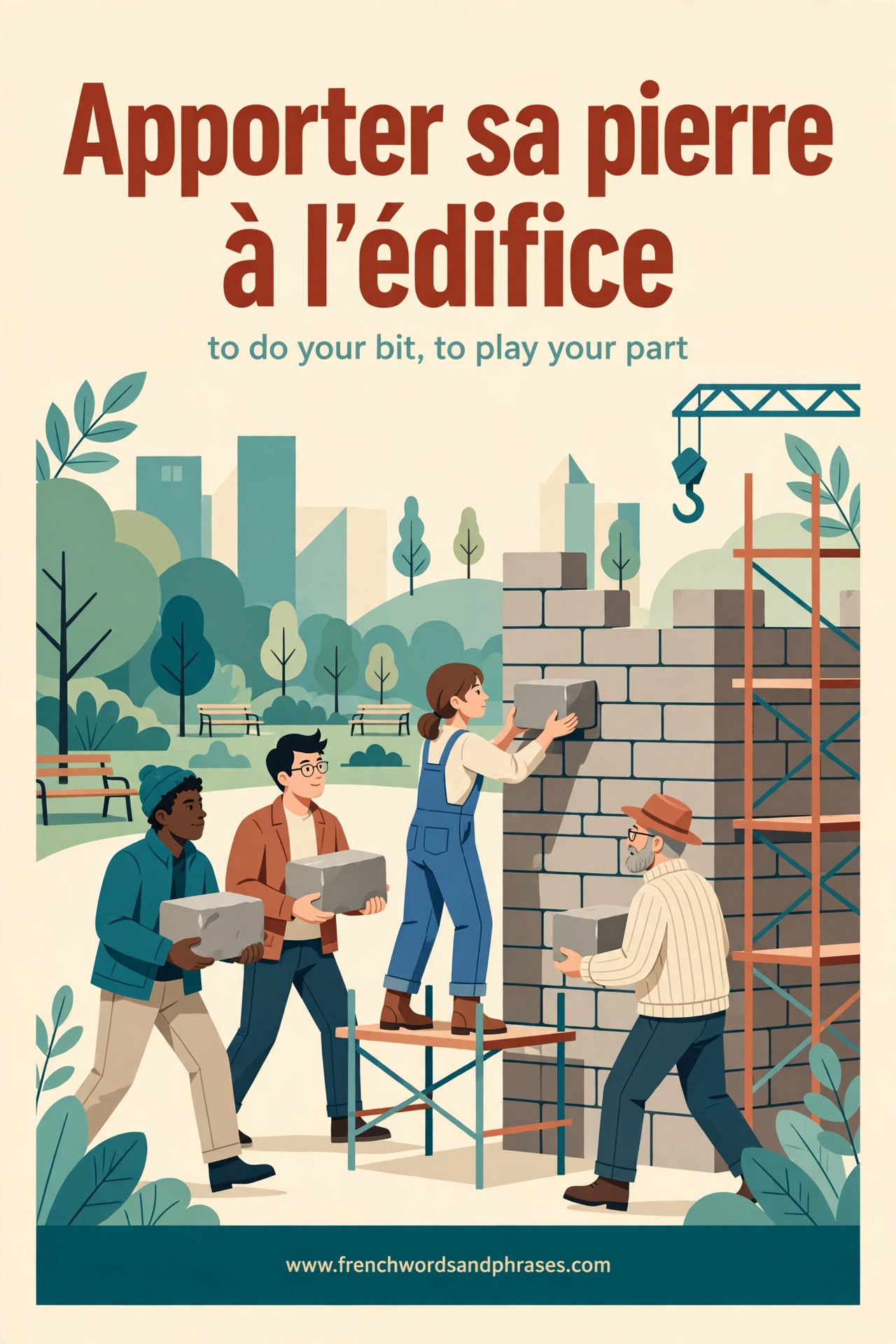
Apporter sa pierre à l’édifice means to do your bit — to add your own contribution to a shared piece of work.
The village hall is being rebuilt by volunteers. The mason is seventy, the architect is a student, and the mayor is carrying buckets. When a journalist asks the oldest volunteer why she comes every Saturday, she wipes her hands and smiles: « Moi aussi, j’apporte ma pierre à l’édifice. »
Let’s explore how apporter sa pierre à l’édifice works in French, beginning with the whole phrase on one card.
Understanding the French Phrase Apporter sa pierre à l’édifice
Apporter sa pierre à l’édifice is a French idiomatic expression built from apporter (to bring), sa pierre (one’s stone) and l’édifice (the building, the edifice). Think of the great cathedrals, raised stone by stone over generations: the phrase means to do your bit, to add your own stone to a work far bigger than yourself.
It means to do your bit — to make your own modest contribution to a shared, collective effort. Nobody is building alone: the picture is of one worker carrying one stone towards a building that hundreds of hands are raising together. The stone is small; the edifice is grand; the phrase honours the smallness and the grandeur at once.
Type: Idiomatic expression — contribution (verb + possessive + noun)
Answers the need: Saying you played your part in a collective effort
Register: Neutral to warm — speeches, thanks, everyday speech alike
Strength: Modest and generous — it shrinks your share and praises the whole
One important usage detail: sa changes with the person — j’apporte ma pierre, tu apportes ta pierre, chacun apporte sa pierre, nous apportons notre pierre. Sa agrees with pierre (feminine), not with the contributor, so a man and a woman both say sa pierre. The phrase loves the company of chacun: chacun a apporté sa pierre à l’édifice.
Experience the Word
Apporter sa pierre à l’édifice is the humblest boast in French — it claims almost nothing, and that is exactly why it sounds so noble.
Imagine the cathedral builders: most of them never saw the spire finished, and every one of them knew it. They carried their stones anyway. The phrase carries that same patience — your contribution matters even if you never see the roof.
French is fond of building metaphors for teamwork, but this is the kindest of them. It does not ask how big your stone is. It only asks that you bring one.
How to Use Apporter sa pierre à l’édifice in French: Complete Guide
Let’s explore how apporter sa pierre à l’édifice works in French, beginning with the whole phrase on one card.
Apporter sa pierre à l’édifice at a Glance
The Whole Phrase on One Card
Real meaning, literal picture, English twin and register — apporter sa pierre à l’édifice in five lines.
| Point | Apporter sa pierre à l’édifice |
|---|---|
| What it really means | to do your bit — to contribute your share to a collective work |
| Word for word | to bring your stone to the building |
| English equivalent | to do your bit / to play your part / to pitch in |
| Register | neutral to warm — speeches, thanks and everyday speech |
| Use it for | teamwork, volunteering, community projects, shared research |
Example
Chacun a apporté sa pierre à l’édifice, et le projet a réussi.
Everyone did their bit, and the project succeeded.
Word by Word: Building the Contribution
Five small pieces — take them one by one and the building starts to rise.
| Word | Literal meaning | Its job in the phrase |
|---|---|---|
| apporter | to bring | the carrying verb — you bring something from where you are to where it is needed |
| sa | his, her, one’s | your own stone — it changes with the person: ma, ta, sa, notre pierre |
| pierre | a stone | your contribution — one stone, modest and real |
| à | to | the direction of the gift — towards the shared work |
| l’édifice | the building, the edifice | the great collective work itself — a masculine noun, un édifice |
Example
Elle a apporté sa pierre à l’édifice dès le premier jour.
She did her bit from the very first day.
Quick Quiz 1
What is l’édifice in this phrase — your house, or something bigger?
Reveal the answer
Something bigger — the great shared building, like a cathedral raised by generations: the project, the cause, the collective work.
Un édifice se construit pierre par pierre.
A great building goes up stone by stone.
When You Say It: The Teamwork Moments
Apporter sa pierre à l’édifice fires at moments like these — a shared effort, and your place inside it.
| Situation | Example |
|---|---|
| Joining a project | je veux apporter ma pierre à l’édifice — I want to do my bit |
| Thanking volunteers | merci à tous ceux qui ont apporté leur pierre à l’édifice — thanks to everyone who played their part |
| At work | chaque service apporte sa pierre à l’édifice — every department contributes its share |
| In a speech | apportons tous notre pierre à l’édifice — let us all do our bit |
| Modestly, about yourself | j’ai simplement apporté ma petite pierre — I simply did my small bit |
Example
Les bénévoles ont chacun apporté leur pierre à l’édifice.
The volunteers each did their bit.
Make It Yours: The Stone for Every Person
The possessive does the travelling — ma, ta, sa, notre, votre, leur — while pierre and édifice stay fixed.
| Form | French | In English |
|---|---|---|
| My bit | j’apporte ma pierre à l’édifice | I do my bit |
| Your bit | tu apportes ta pierre à l’édifice | you do your bit |
| His or her bit | il apporte sa pierre à l’édifice | he does his bit |
| Our bit | nous apportons notre pierre à l’édifice | we do our bit |
| Everyone’s | chacun apporte sa pierre à l’édifice | everyone does their bit |
| In the past | elle a apporté sa pierre à l’édifice | she did her bit |
Example
Apporte ta pierre à l’édifice, même petite, elle compte.
Do your bit — even a small one counts.
Quick Quiz 2
A woman says ‘I did my bit’: ma pierre or mon pierre — and why?
Reveal the answer
Ma pierre — the possessive agrees with pierre, which is feminine, whoever is carrying it.
Elle a apporté sa pierre à l’édifice.
She did her bit.
Everyday Expressions: Building on the Stone
Apporter sa pierre à l’édifice slots into these everyday frames — each one ready to use as it stands.
| Frame | In English |
|---|---|
| apporter sa pierre à l’édifice | to do your bit, to play your part |
| apporter sa petite pierre | to make your small contribution — extra modest |
| chacun sa pierre | everyone brings their stone — one each |
| une pierre de plus à l’édifice | one more stone for the building — one more contribution |
| construire l’édifice ensemble | to build the great work together |
Example
Une pierre de plus à l’édifice, et le projet avance.
One more contribution, and the project moves forward.
Close Cousins: The Other Ways to Help
French has a whole shelf of helping phrases — the pierre is the builder’s one; its cousins cook, push or simply take part.
| Expression | The difference |
|---|---|
| apporter sa pierre à l’édifice | to do your bit — one contribution to a grand collective work |
| mettre la main à la pâte | to lend a hand, to get stuck in — the cook’s version, hands in the dough |
| donner un coup de main | to give a helping hand — a single act of help, no edifice required |
| faire sa part | to do your share — plain and neutral, the prose version |
| participer à l’effort collectif | to take part in the collective effort — formal, administrative |
Example
Il a mis la main à la pâte après avoir apporté sa pierre à l’édifice.
He got stuck in after doing his bit.
Quick Quiz 3
You helped a friend move house for one afternoon. Pierre à l’édifice or coup de main?
Reveal the answer
Coup de main — one act of help between two people. The pierre belongs to big collective works with many contributors.
Merci pour le coup de main, sans toi je n’y serais pas arrivé.
Thanks for the help — without you I’d never have managed.
Apporter sa pierre à l’édifice and Its Neighbours
The building shelf around the phrase — stones, builders and the finished work.
| French | In English |
|---|---|
| la pierre | the stone |
| un édifice | a great building, an edifice |
| construire | to build |
| un bénévole | a volunteer |
| un chantier | a building site, a worksite |
| pierre par pierre | stone by stone |
Example
Sur le chantier, chacun construit pierre par pierre.
On the site, everyone builds stone by stone.
Watch Out: The Traps Around Apporter sa pierre
The traps: an edifice with the wrong gender, a possessive agreeing with the wrong noun, and building work that is only literal.
| Trap | The truth |
|---|---|
| édifice is masculine | un édifice, l’édifice — despite the quiet -e ending, the noun is masculine |
| sa agrees with pierre | a man says sa pierre too — the possessive matches pierre (feminine), not the carrier |
| not for solo work | the phrase needs a collective edifice; for your own private project, say faire ma part or travailler à mon projet |
| no real stones required | your pierre can be an idea, an hour of time, a signature — anything you genuinely contribute |
Example
Sa pierre à lui, c’était les plans de la salle.
His contribution was the plans for the hall.
Quick Quiz 4
True or false: un édifice is a feminine noun.
Reveal the answer
False — édifice is masculine: un édifice, l’édifice. Only pierre is feminine in this phrase.
L’édifice entier a été rénové par des bénévoles.
The whole building was renovated by volunteers.
Apporter sa pierre à l’édifice in Everyday French: Real-Life Examples
Now that you know the word, let’s see how apporter sa pierre à l’édifice appears in everyday French.
Example 1 — The village project
Chacun a apporté sa pierre à l’édifice, même les enfants.
Everyone did their bit, even the children.
Example 2 — Volunteering
Elle apporte sa pierre à l’édifice tous les samedis.
She does her bit every Saturday.
Example 3 — At the office
Notre équipe a apporté sa pierre à l’édifice national.
Our team played its part in the national effort.
Example 4 — A modest answer
Moi ? J’ai juste apporté ma petite pierre.
Me? I just did my small bit.
Example 5 — The appeal
Venez apporter votre pierre à l’édifice !
Come and do your bit!
Example 6 — Looking back
Des années plus tard, son édifice tient toujours debout.
Years later, their great work is still standing.
Beyond Translation: The Meaning of Apporter sa pierre à l’édifice
English does its bit and plays its part — phrases from the army and the theatre. French builds. The picture reaches back to the cathedral centuries, when a mason could spend his whole life on one wall of a nave he would never see vaulted, and count the life well spent.
To apporter sa pierre à l’édifice is to accept that the work is bigger than you — and to bring your stone anyway.
It is the opposite of the heroic solo gesture: no trumpets, just one more stone, carried willingly, laid straight.
How to Remember the French Phrase Apporter sa pierre à l’édifice
Remember it this way: Apporter sa pierre à l’édifice is the cathedral builder’s motto — the work is enormous, your stone is small, and both facts are the point.
- You picture the cathedral — generations of hands, one building; your pierre is a single stone in its wall.
- You change the owner, not the stone — ma, ta, sa, notre pierre; pierre stays feminine and singular.
- You keep it collective — an édifice needs many builders; for one favour between friends, reach for un coup de main.
The key idea is apporter sa pierre à l’édifice means to do your bit — one stone carried to a great shared building.
Test Your Knowledge of Apporter sa pierre à l’édifice
Let’s see how much you’ve learned. Try answering these questions before revealing the answers.
Question 1
What does apporter sa pierre à l’édifice mean?
Reveal the answer
To do your bit — to make your own contribution to a collective effort.
Question 2
What is the literal, word-for-word meaning?
Reveal the answer
To bring your stone to the building — one worker’s stone carried to a great edifice.
Question 3
How do you say ‘everyone did their bit’?
Reveal the answer
Chacun a apporté sa pierre à l’édifice — sa agrees with pierre, whoever carries it.
Question 4
What is the difference between apporter sa pierre à l’édifice and donner un coup de main?
Reveal the answer
A coup de main is one act of help; the pierre is a contribution to a large collective work built by many hands.
Question 5
Complete the sentence:
Nous apportons notre ______ à l’édifice. (We are doing our bit.)
Reveal the answer
pierre
Nous apportons notre pierre à l’édifice.
We are doing our bit.
Your Final Challenge
Can You Use It?
How would you say this in French?
“Everyone did their bit.”
Reveal the answer
Chacun a apporté sa pierre à l’édifice.
Everyone did their bit.
A little French. A little curiosity. A richer everyday life.
LEARN FRENCH ONE WORD AT A TIME