
A French Word to Live By
How to Conjugate Manutentionner in French
/ma.ny.tɑ̃.sjɔ.ne/
Manutentionner means to handle goods.
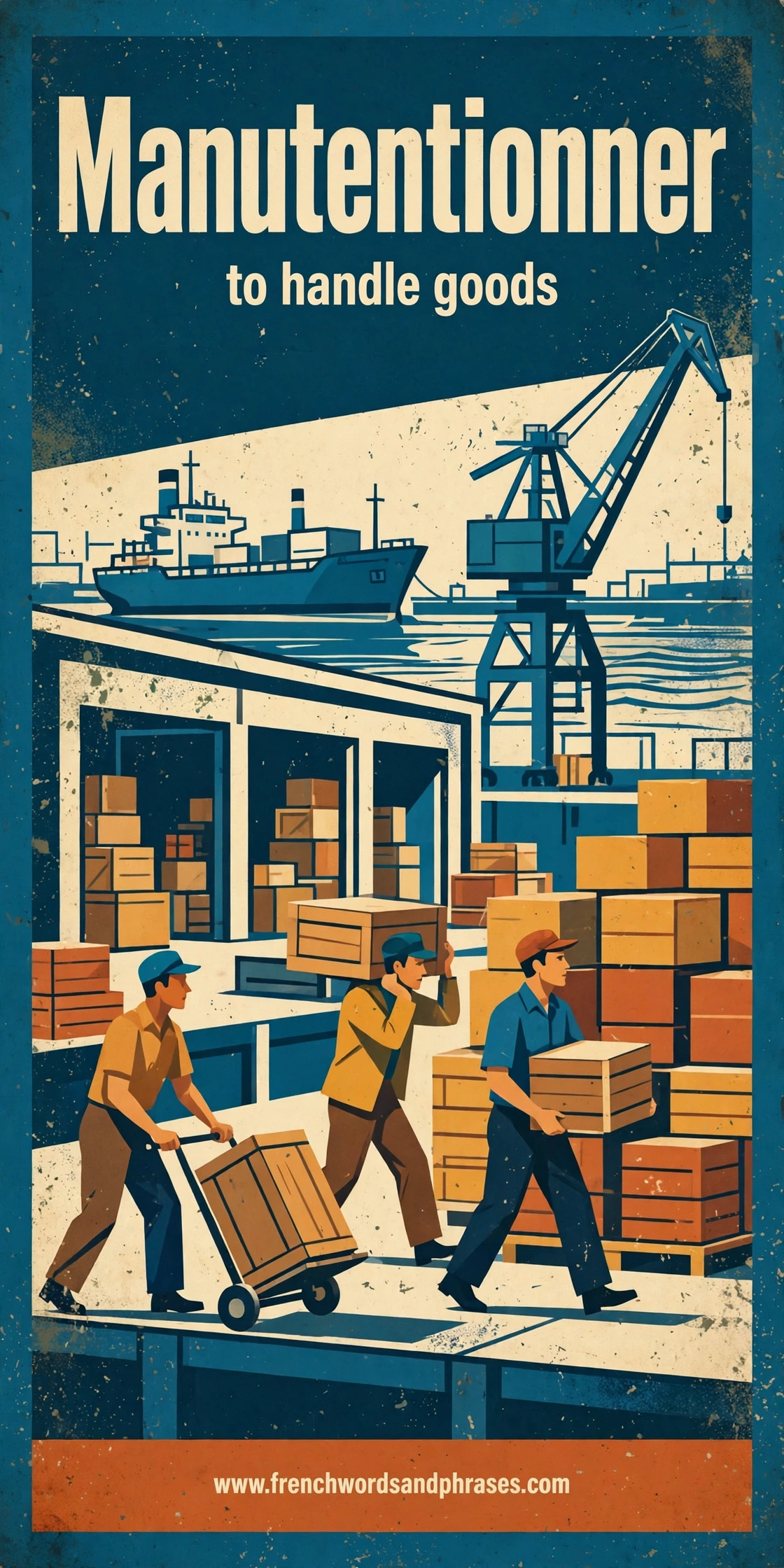
Crates swung off a truck, pallets gliding on forklift forks, boxes moving from ship to shelf — manutentionner is the verb of goods in motion, the hidden handling behind everything you buy.
In this guide, you’ll learn how to conjugate manutentionner in all the major French tenses and moods. Explore complete conjugation tables, French examples, English translations, and practice quizzes.
Understanding the French Verb Manutentionner
Manutentionner is a regular French verb belonging to the first group of verbs, those ending in -er.
It means to handle goods. It is commonly used in warehouses and ports for moving crates, pallets and containers, in logistics for loading and unloading trucks, and in safety instructions — manutentionner avec soin, handle with care, the professional cousin of the label on fragile boxes.
Verb classification: First group (-er)
Auxiliary verb: Avoir
Past participle: manutentionné
Present participle: manutentionnant
English equivalents: To handle goods, to move freight; la manutention — goods handling, materials handling.
One important detail: manutentionner is the verb of the noun la manutention — goods handling, the whole trade of lifting, carrying, stacking and storing. The worker who does it is un manutentionnaire, a handler or warehouseman, a word you will meet on job adverts and warehouse doors everywhere in France. Both words keep the Latin manus — the hand — even when a forklift does the lifting.
Experience the Word
Manutentionner is the verb nobody sees and everybody depends on — before anything reaches a shelf, someone has handled it, often twice.
Imagine a port at dawn. Containers rise and fall in slow arcs, forklifts beep their way between the stacks, and a team in orange vests manutentionne the cargo of a ship that arrived in the night.
The goods have not yet travelled. They have been handled — lifted, moved, stacked, made ready.
How to Conjugate Manutentionner: Complete French Conjugation Guide
Let’s explore every major conjugation of manutentionner, beginning with the indicative mood.
How to Conjugate Manutentionner in the Indicative Mood
The indicative mood is used to express facts, observations, actions, and events.
How to Conjugate Manutentionner in the Present Tense (Présent)
Used for actions happening now, habitual actions, and general truths.
| Subject | Conjugation |
|---|---|
| je | manutentionne |
| tu | manutentionnes |
| il / elle | manutentionne |
| nous | manutentionnons |
| vous | manutentionnez |
| ils / elles | manutentionnent |
Example
Les dockers manutentionnent les conteneurs dès l’aube.
The dockers handle the containers from dawn.
Quick Quiz 1
Complete the sentence:
Nous ______ les palettes avec un chariot.
Reveal the answer
manutentionnons
Nous manutentionnons les palettes avec un chariot.
We handle the pallets with a forklift.
How to Conjugate Manutentionner in the Passé Composé
Used for completed actions in the past. Manutentionner takes the auxiliary verb avoir.
| Subject | Conjugation |
|---|---|
| j’ | ai manutentionné |
| tu | as manutentionné |
| il / elle | a manutentionné |
| nous | avons manutentionné |
| vous | avez manutentionné |
| ils / elles | ont manutentionné |
Example
Nous avons manutentionné deux cents caisses ce matin.
We handled two hundred crates this morning.
How to Conjugate Manutentionner in the Imparfait (Imperfect Tense)
Used for habitual past actions, descriptions, and ongoing situations in the past.
| Subject | Conjugation |
|---|---|
| je | manutentionnais |
| tu | manutentionnais |
| il / elle | manutentionnait |
| nous | manutentionnions |
| vous | manutentionniez |
| ils / elles | manutentionnaient |
Example
Autrefois, on manutentionnait les sacs de café à dos d’homme.
In the old days, people used to handle the coffee sacks on their backs.
Quick Quiz 2
Choose the correct form:
They handled the crates.
Ils ______ les caisses. (ont manutentionné / sont manutentionnés)
Reveal the answer
ont manutentionné
Ils ont manutentionné les caisses.
Manutentionner takes avoir.
How to Conjugate Manutentionner in the Plus-que-parfait
Used to describe an action that had already been completed before another past event.
| Subject | Conjugation |
|---|---|
| j’ | avais manutentionné |
| tu | avais manutentionné |
| il / elle | avait manutentionné |
| nous | avions manutentionné |
| vous | aviez manutentionné |
| ils / elles | avaient manutentionné |
Example
Ils avaient manutentionné la marchandise avant la pluie.
They had handled the goods before the rain.
How to Conjugate Manutentionner in the Passé Simple
Primarily used in formal writing, literature, and historical narratives. It is rarely used in everyday conversation.
| Subject | Conjugation |
|---|---|
| je | manutentionnai |
| tu | manutentionnas |
| il / elle | manutentionna |
| nous | manutentionnâmes |
| vous | manutentionnâtes |
| ils / elles | manutentionnèrent |
Example
L’équipe manutentionna le piano par la fenêtre du grenier.
The team manhandled the piano through the attic window.
How to Conjugate Manutentionner in the Passé Antérieur
A literary tense used to express an action completed immediately before another past action, generally in the passé simple.
| Subject | Conjugation |
|---|---|
| j’ | eus manutentionné |
| tu | eus manutentionné |
| il / elle | eut manutentionné |
| nous | eûmes manutentionné |
| vous | eûtes manutentionné |
| ils / elles | eurent manutentionné |
Example
Quand ils eurent manutentionné les palettes, le camion ferma ses portes.
When they had handled the pallets, the truck closed its doors.
How to Conjugate Manutentionner in the Future Tense (Futur Simple)
Used to describe actions that will take place in the future.
| Subject | Conjugation |
|---|---|
| je | manutentionnerai |
| tu | manutentionneras |
| il / elle | manutentionnera |
| nous | manutentionnerons |
| vous | manutentionnerez |
| ils / elles | manutentionneront |
Example
Demain, nous manutentionnerons les meubles du déménagement.
Tomorrow, we will handle the furniture for the move.
How to Conjugate Manutentionner in the Futur Antérieur (Future Perfect)
Used for an action that will have been completed before a particular point in the future.
| Subject | Conjugation |
|---|---|
| j’ | aurai manutentionné |
| tu | auras manutentionné |
| il / elle | aura manutentionné |
| nous | aurons manutentionné |
| vous | aurez manutentionné |
| ils / elles | auront manutentionné |
Example
À midi, l’équipe aura manutentionné tout le stock.
By noon, the team will have handled all the stock.
How to Conjugate Manutentionner in the Near Future (Futur Proche)
Used to describe something that is going to happen soon. Formed with aller + infinitive.
| Subject | Conjugation |
|---|---|
| je | vais manutentionner |
| tu | vas manutentionner |
| il / elle | va manutentionner |
| nous | allons manutentionner |
| vous | allez manutentionner |
| ils / elles | vont manutentionner |
Example
Je vais manutentionner ces cartons un par un.
I am going to handle these boxes one by one.
How to Conjugate Manutentionner in the Conditional Mood
The conditional mood expresses what would happen under certain circumstances. It is also frequently used to make polite requests or express wishes.
How to Conjugate Manutentionner in the Present Conditional
| Subject | Conjugation |
|---|---|
| je | manutentionnerais |
| tu | manutentionnerais |
| il / elle | manutentionnerait |
| nous | manutentionnerions |
| vous | manutentionneriez |
| ils / elles | manutentionneraient |
Example
Avec un chariot élévateur, on manutentionnerait ces caisses sans effort.
With a forklift, we would handle these crates effortlessly.
How to Conjugate Manutentionner in the Past Conditional
| Subject | Conjugation |
|---|---|
| j’ | aurais manutentionné |
| tu | aurais manutentionné |
| il / elle | aurait manutentionné |
| nous | aurions manutentionné |
| vous | auriez manutentionné |
| ils / elles | auraient manutentionné |
Example
Ils auraient manutentionné les colis plus vite avec un deuxième camion.
They would have handled the parcels faster with a second truck.
Manutentionner in the Literary Past Conditional Form
This less common literary form uses the imperfect subjunctive of avoir.
| Subject | Conjugation |
|---|---|
| j’ | eusse manutentionné |
| tu | eusses manutentionné |
| il / elle | eût manutentionné |
| nous | eussions manutentionné |
| vous | eussiez manutentionné |
| ils / elles | eussent manutentionné |
Example
Les portefaix eussent manutentionné les ballots sur le quai.
The porters would have handled the bales on the quay.
How to Conjugate Manutentionner in the Subjunctive Mood
The subjunctive is used to express wishes, emotions, doubts, necessity, and uncertainty. It frequently follows expressions such as il faut que (it is necessary that) or bien que (although).
How to Conjugate Manutentionner in the Present Subjunctive
| Subject | Conjugation |
|---|---|
| que je | manutentionne |
| que tu | manutentionnes |
| qu’il / qu’elle | manutentionne |
| que nous | manutentionnions |
| que vous | manutentionniez |
| qu’ils / qu’elles | manutentionnent |
Example
Il faut que vous manutentionniez ces verres avec soin.
You must handle these glasses with care.
Quick Quiz 3
Complete the sentence using the subjunctive:
Il faut que vous ______ ces colis avec soin.
Reveal the answer
manutentionniez
Il faut que vous manutentionniez ces colis avec soin.
You must handle these parcels with care.
How to Conjugate Manutentionner in the Imperfect Subjunctive
A literary tense, rarely encountered in modern spoken French.
| Subject | Conjugation |
|---|---|
| que je | manutentionnasse |
| que tu | manutentionnasses |
| qu’il / qu’elle | manutentionnât |
| que nous | manutentionnassions |
| que vous | manutentionnassiez |
| qu’ils / qu’elles | manutentionnassent |
Example
Le chef voulait que l’équipe manutentionnât les caisses avant midi.
The boss wanted the team to handle the crates before noon.
How to Conjugate Manutentionner in the Pluperfect Subjunctive
A literary construction used to express an action completed before another past action.
| Subject | Conjugation |
|---|---|
| que j’ | eusse manutentionné |
| que tu | eusses manutentionné |
| qu’il / qu’elle | eût manutentionné |
| que nous | eussions manutentionné |
| que vous | eussiez manutentionné |
| qu’ils / qu’elles | eussent manutentionné |
Example
On craignait qu’ils eussent manutentionné les colis sans précaution.
People feared they had handled the parcels carelessly.
How to Conjugate Manutentionner in the Past Subjunctive
| Subject | Conjugation |
|---|---|
| que j’ | aie manutentionné |
| que tu | aies manutentionné |
| qu’il / qu’elle | ait manutentionné |
| que nous | ayons manutentionné |
| que vous | ayez manutentionné |
| qu’ils / qu’elles | aient manutentionné |
Example
Je suis content que vous ayez manutentionné la commande à temps.
I am glad you handled the order in time.
How to Conjugate Manutentionner in the Imperative
The imperative is used to give commands, instructions, invitations, or suggestions. Subject pronouns are omitted.
How to Conjugate Manutentionner in the Present Imperative
| Person | Conjugation |
|---|---|
| (tu) | manutentionne |
| (nous) | manutentionnons |
| (vous) | manutentionnez |
Example
Manutentionnez ce colis avec soin, il est fragile !
Handle this parcel with care, it is fragile!
Quick Quiz 4
How would you say Handle this crate gently (tu form)?
Reveal the answer
Manutentionne cette caisse doucement !
French Participles of Manutentionner
Participles are verb forms that can be used in compound tenses and other grammatical constructions.
Present Participle of Manutentionner
manutentionnant
En manutentionnant les caisses, il s’est fait mal au dos.
While handling the crates, he hurt his back.
Past Participle of Manutentionner
manutentionné
Manutentionnées avec soin, les œuvres sont arrivées intactes.
Handled with care, the artworks arrived intact.
Manutentionner in Everyday French: Real-Life Examples
Now that you know the conjugations, let’s see how manutentionner appears in everyday French.
Example 1 — Present
On manutentionne les palettes avec un chariot élévateur.
We handle the pallets with a forklift.
Example 2 — Passé composé
Ils ont manutentionné tout le déménagement en un jour.
They handled the whole move in one day.
Example 3 — Imparfait
Les dockers manutentionnaient les sacs à la main.
The dockers used to handle the sacks by hand.
Example 4 — Future
Nous manutentionnerons les cartons demain matin.
We will handle the boxes tomorrow morning.
Example 5 — Conditional
Tu manutentionnerais ce meuble tout seul ?
Would you handle this piece of furniture on your own?
Example 6 — Imperative
Manutentionne cette caisse doucement !
Handle this crate gently!
Beyond Translation: The Meaning of Manutentionner
English hides this work inside handling and logistics; French manutentionner gives the lifting itself a full verb, and a whole profession to go with it.
La manutention is an industry.
Warehouses advertise for manutentionnaires, safety courses teach la manutention, and every fragile parcel in France is, in spirit, asking to be manutentionné avec soin.
How to Remember the French Verb Manutentionner
Remember it this way: Manutentionner is about goods in motion — crates, pallets and careful hands.
- La manutention — goods handling; un manutentionnaire — the handler who does it.
- Manutentionner avec soin — handle with care, the warehouse version of the label.
- Regular -er: je manutentionne, nous manutentionnons, past participle manutentionné.
The key idea is goods in motion — crates, pallets and careful hands.
Test Your Knowledge of Manutentionner
Let’s see how much you’ve learned. Try answering these questions before revealing the answers.
Question 1
What is un manutentionnaire?
Reveal the answer
A goods handler — the warehouse worker who manutentionne.
Question 2
How do you say Handle with care in French?
Reveal the answer
Manutentionner avec soin.
Question 3
Translate: We handled two hundred crates this morning.
Reveal the answer
Nous avons manutentionné deux cents caisses ce matin.
Question 4
What is the past participle of manutentionner?
Reveal the answer
Manutentionné.
Question 5
Complete the sentence:
Il faut que vous ______ ces verres avec soin.
Reveal the answer
manutentionniez
Il faut que vous manutentionniez ces verres avec soin.
You must handle these glasses with care.
Your Final Challenge
Can You Use It?
How would you say this in French?
The dockers handle the containers from dawn, and the port wakes up.
Reveal the answer
Les dockers manutentionnent les conteneurs dès l’aube, et le port se réveille.
The dockers handle the containers from dawn, and the port wakes up.
A little French. A little curiosity. A richer everyday life.
LEARN FRENCH ONE WORD AT A TIME




