
A French Word to Live By
How to Conjugate Manger in French
/mɑ̃.ʒe/
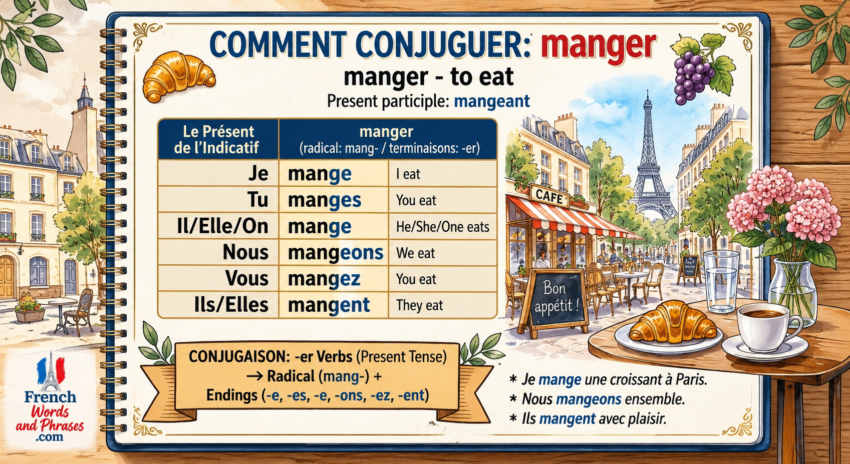
Manger means to eat.
Food is an important part of everyday life, and knowing how to talk about eating is essential when learning French. Whether you’re ordering at a restaurant, enjoying a meal with friends, or talking about your favorite foods, the verb manger is one you’ll use constantly.
In this guide, you’ll learn how to conjugate manger in all the major French tenses and moods. Explore complete conjugation tables, French examples, English translations, pronunciation links, and practice quizzes.
Understanding the French Verb Manger
Manger is a regular French verb belonging to the first group of verbs, those ending in -er. It is commonly used to describe eating food or having a meal.
Although manger follows the regular -er conjugation pattern in most forms, it has one important spelling detail: an extra e is retained before the endings beginning with -ons to preserve the soft sound of the letter g.
Verb classification: First group (-er)
Auxiliary verb: Avoir
Past participle: mangé
Present participle: mangeant
English equivalent: To eat.
Remember the spelling in the present tense: nous mangeons, not nous mangons. The extra e keeps the pronunciation of the g soft, as in manger.
Experience the Word
Manger is one of those French verbs that appears throughout everyday life. It is used when talking about breakfast, lunch, dinner, snacks, and practically every occasion involving food.
Imagine sitting at a small café in Paris, ordering a croissant and coffee, or enjoying a long lunch with friends. You might say Je mange un sandwich (I am eating a sandwich), or Nous mangeons ensemble (We are eating together).
Whether you’re talking about what you eat, what you ate yesterday, or what you will eat tomorrow, manger is an essential verb to know.
How to Conjugate Manger: Complete French Conjugation Guide
Let’s explore every major conjugation of manger, beginning with the indicative mood.
How to Conjugate Manger in the Indicative Mood
The indicative mood is used to express facts, observations, actions, and events.
How to Conjugate Manger in the Present Tense (Présent)
Used for actions happening now, habitual actions, and general truths.
| Subject | Conjugation |
|---|---|
| je | mange |
| tu | manges |
| il / elle | mange |
| nous | mangeons |
| vous | mangez |
| ils / elles | mangent |
Example
Je mange une pomme.
I am eating an apple.
Quick Quiz 1
Complete the sentence:
Nous ______ au restaurant ce soir.
Reveal the answer
mangeons
Nous mangeons au restaurant ce soir.
We are eating at the restaurant tonight.
How to Conjugate Manger in the Passé Composé
Used for completed actions in the past. Manger takes the auxiliary verb avoir.
| Subject | Conjugation |
|---|---|
| j’ | ai mangé |
| tu | as mangé |
| il / elle | a mangé |
| nous | avons mangé |
| vous | avez mangé |
| ils / elles | ont mangé |
Example
Hier, j’ai mangé dans un petit restaurant.
Yesterday, I ate in a small restaurant.
How to Conjugate Manger in the Imparfait (Imperfect Tense)
Used for habitual past actions, descriptions, and ongoing situations in the past.
| Subject | Conjugation |
|---|---|
| je | mangeais |
| tu | mangeais |
| il / elle | mangeait |
| nous | mangions |
| vous | mangiez |
| ils / elles | mangeaient |
Example
Quand j’étais enfant, je mangeais souvent chez ma grand-mère.
When I was a child, I often ate at my grandmother’s house.
Quick Quiz 2
Choose the correct form:
When we were children, we used to eat together every evening.
Quand nous étions enfants, nous ______ ensemble chaque soir.
Reveal the answer
mangions
Quand nous étions enfants, nous mangions ensemble chaque soir.
How to Conjugate Manger in the Plus-que-parfait
Used to describe an action that had already been completed before another past event.
| Subject | Conjugation |
|---|---|
| j’ | avais mangé |
| tu | avais mangé |
| il / elle | avait mangé |
| nous | avions mangé |
| vous | aviez mangé |
| ils / elles | avaient mangé |
Example
J’avais déjà mangé avant son arrivée.
I had already eaten before his arrival.
How to Conjugate Manger in the Passé Simple
Primarily used in formal writing, literature, and historical narratives. It is rarely used in everyday conversation.
| Subject | Conjugation |
|---|---|
| je | mangeai |
| tu | mangeas |
| il / elle | mangea |
| nous | mangeâmes |
| vous | mangeâtes |
| ils / elles | mangèrent |
Example
Il mangea rapidement avant de partir.
He ate quickly before leaving.
How to Conjugate Manger in the Passé Antérieur
A literary tense used to express an action completed immediately before another past action, generally in the passé simple.
| Subject | Conjugation |
|---|---|
| j’ | eus mangé |
| tu | eus mangé |
| il / elle | eut mangé |
| nous | eûmes mangé |
| vous | eûtes mangé |
| ils / elles | eurent mangé |
Example
Dès qu’il eut mangé, il quitta la maison.
As soon as he had eaten, he left the house.
How to Conjugate Manger in the Future Tense (Futur Simple)
Used to describe actions that will take place in the future.
| Subject | Conjugation |
|---|---|
| je | mangerai |
| tu | mangeras |
| il / elle | mangera |
| nous | mangerons |
| vous | mangerez |
| ils / elles | mangeront |
Example
Demain, nous mangerons ensemble.
Tomorrow, we will eat together.
How to Conjugate Manger in the Futur Antérieur (Future Perfect)
Used for an action that will have been completed before a particular point in the future.
| Subject | Conjugation |
|---|---|
| j’ | aurai mangé |
| tu | auras mangé |
| il / elle | aura mangé |
| nous | aurons mangé |
| vous | aurez mangé |
| ils / elles | auront mangé |
Example
À huit heures, nous aurons déjà mangé.
By eight o’clock, we will already have eaten.
How to Conjugate Manger in the Near Future (Futur Proche)
Used to describe something that is going to happen soon. Formed with aller + infinitive.
| Subject | Conjugation |
|---|---|
| je | vais manger |
| tu | vas manger |
| il / elle | va manger |
| nous | allons manger |
| vous | allez manger |
| ils / elles | vont manger |
Example
Je vais manger une salade pour le déjeuner.
I’m going to eat a salad for lunch.
How to Conjugate Manger in the Conditional Mood
The conditional mood expresses what would happen under certain circumstances. It is also frequently used to make polite requests or express wishes.
How to Conjugate Manger in the Present Conditional
| Subject | Conjugation |
|---|---|
| je | mangerais |
| tu | mangerais |
| il / elle | mangerait |
| nous | mangerions |
| vous | mangeriez |
| ils / elles | mangeraient |
Example
Je mangerais volontiers dans ce restaurant.
I would gladly eat at this restaurant.
How to Conjugate Manger in the Past Conditional
| Subject | Conjugation |
|---|---|
| j’ | aurais mangé |
| tu | aurais mangé |
| il / elle | aurait mangé |
| nous | aurions mangé |
| vous | auriez mangé |
| ils / elles | auraient mangé |
Example
J’aurais mangé davantage si j’avais eu faim.
I would have eaten more if I had been hungry.
Manger in the Literary Past Conditional Form
This less common literary form uses the imperfect subjunctive of avoir.
| Subject | Conjugation |
|---|---|
| j’ | eusse mangé |
| tu | eusses mangé |
| il / elle | eût mangé |
| nous | eussions mangé |
| vous | eussiez mangé |
| ils / elles | eussent mangé |
Example
Il eût mangé davantage s’il en avait eu l’occasion.
He would have eaten more had he had the opportunity.
How to Conjugate Manger in the Subjunctive Mood
The subjunctive is used to express wishes, emotions, doubts, necessity, and uncertainty. It frequently follows expressions such as il faut que (it is necessary that) or bien que (although).
How to Conjugate Manger in the Present Subjunctive
| Subject | Conjugation |
|---|---|
| que je | mange |
| que tu | manges |
| qu’il / qu’elle | mange |
| que nous | mangions |
| que vous | mangiez |
| qu’ils / qu’elles | mangent |
Example
Il faut que je mange quelque chose.
I need to eat something.
Quick Quiz 3
Complete the sentence using the subjunctive:
Il faut que nous ______ avant de partir.
Reveal the answer
mangions
Il faut que nous mangions avant de partir.
We need to eat before leaving.
How to Conjugate Manger in the Imperfect Subjunctive
A literary tense, rarely encountered in modern spoken French.
| Subject | Conjugation |
|---|---|
| que je | mangeasse |
| que tu | mangeasses |
| qu’il / qu’elle | mangeât |
| que nous | mangeassions |
| que vous | mangeassiez |
| qu’ils / qu’elles | mangeassent |
Example
Il souhaitait qu’elle mangeât davantage.
He wished that she would eat more.
How to Conjugate Manger in the Pluperfect Subjunctive
A literary construction used to express an action completed before another past action.
| Subject | Conjugation |
|---|---|
| que j’ | eusse mangé |
| que tu | eusses mangé |
| qu’il / qu’elle | eût mangé |
| que nous | eussions mangé |
| que vous | eussiez mangé |
| qu’ils / qu’elles | eussent mangé |
Example
Il regrettait que nous eussions mangé si tard.
He regretted that we had eaten so late.
How to Conjugate Manger in the Past Subjunctive
| Subject | Conjugation |
|---|---|
| que j’ | aie mangé |
| que tu | aies mangé |
| qu’il / qu’elle | ait mangé |
| que nous | ayons mangé |
| que vous | ayez mangé |
| qu’ils / qu’elles | aient mangé |
Example
Je suis heureux que tu aies mangé avec nous.
I’m happy that you ate with us.
How to Conjugate Manger in the Imperative
The imperative is used to give commands, instructions, invitations, or suggestions. Subject pronouns are omitted.
How to Conjugate Manger in the Present Imperative
| Person | Conjugation |
|---|---|
| (tu) | mange |
| (nous) | mangeons |
| (vous) | mangez |
Example
Mangeons ensemble !
Let’s eat together!
Quick Quiz 4
How would you say “Eat your vegetables!” when speaking to one person informally?
Reveal the answer
Mange tes légumes !
French Participles of Manger
Participles are verb forms that can be used in compound tenses and other grammatical constructions.
Present Participle of Manger
mangeant
En mangeant, il regardait la télévision.
While eating, he was watching television.
Past Participle of Manger
mangé
J’ai mangé tout le gâteau.
I ate the whole cake.
Manger in Everyday French: Real-Life Examples
Now that you know the conjugations, let’s see how manger appears in everyday French.
Example 1 — Present
Je mange des fruits tous les matins.
I eat fruit every morning.
Example 2 — Passé composé
Nous avons mangé dans un excellent restaurant hier soir.
We ate at an excellent restaurant last night.
Example 3 — Imparfait
Elle mangeait souvent avec ses amis.
She often ate with her friends.
Example 4 — Future
Ils mangeront avec nous demain.
They will eat with us tomorrow.
Example 5 — Conditional
Je mangerais une pizza si j’avais faim.
I would eat a pizza if I were hungry.
Example 6 — Subjunctive
Bien que nous mangions tôt, nous avons encore faim.
Although we are eating early, we are still hungry.
Beyond Translation: The Meaning of Manger
English speakers generally translate manger simply as to eat. It is a straightforward verb, but it is also one of the most useful words in everyday French.
Food, meals, and everyday conversation.
You’ll hear manger in countless everyday expressions. You can talk about eating breakfast, having lunch, eating at home, or enjoying a meal with friends.
For example, Qu’est-ce que tu veux manger ? means “What do you want to eat?” And Bon appétit ! is the familiar French expression used to wish someone an enjoyable meal.
Learning manger gives you a useful foundation for talking about food, restaurants, and daily routines in French.
How to Remember the French Verb Manger
Remember it this way: Manger is what you do whenever you eat a meal or enjoy something delicious.
- You eat breakfast before going to work.
- You enjoy lunch with friends at a café.
- You sit down with your family for dinner.
The key idea is simple: manger means to eat.
Remember the special spelling in nous mangeons. The extra e keeps the soft French g sound.
Test Your Knowledge of Manger
Let’s see how much you’ve learned. Try answering these questions before revealing the answers.
Question 1
What auxiliary verb is used with manger in compound tenses?
Reveal the answer
Avoir
Question 2
How do you say “I will eat” in French?
Reveal the answer
Je mangerai.
Question 3
Translate: “We have eaten together.”
Reveal the answer
Nous avons mangé ensemble.
Question 4
What is the present participle of manger?
Reveal the answer
Mangeant.
Question 5
Complete the sentence:
Si j’avais faim, je ______ quelque chose.
Reveal the answer
mangerais
Si j’avais faim, je mangerais quelque chose.
If I were hungry, I would eat something.
Your Final Challenge
Can You Use It?
How would you say this in French?
“Tomorrow, I want to eat at a French restaurant.”
Reveal the answer
Demain, je veux manger dans un restaurant français.
Tomorrow, I want to eat at a French restaurant.
A little French. A little curiosity. A richer everyday life.
LEARN FRENCH ONE WORD AT A TIME