A French Word to Live By
Translate Manche to English
/mɑ̃ʃ/
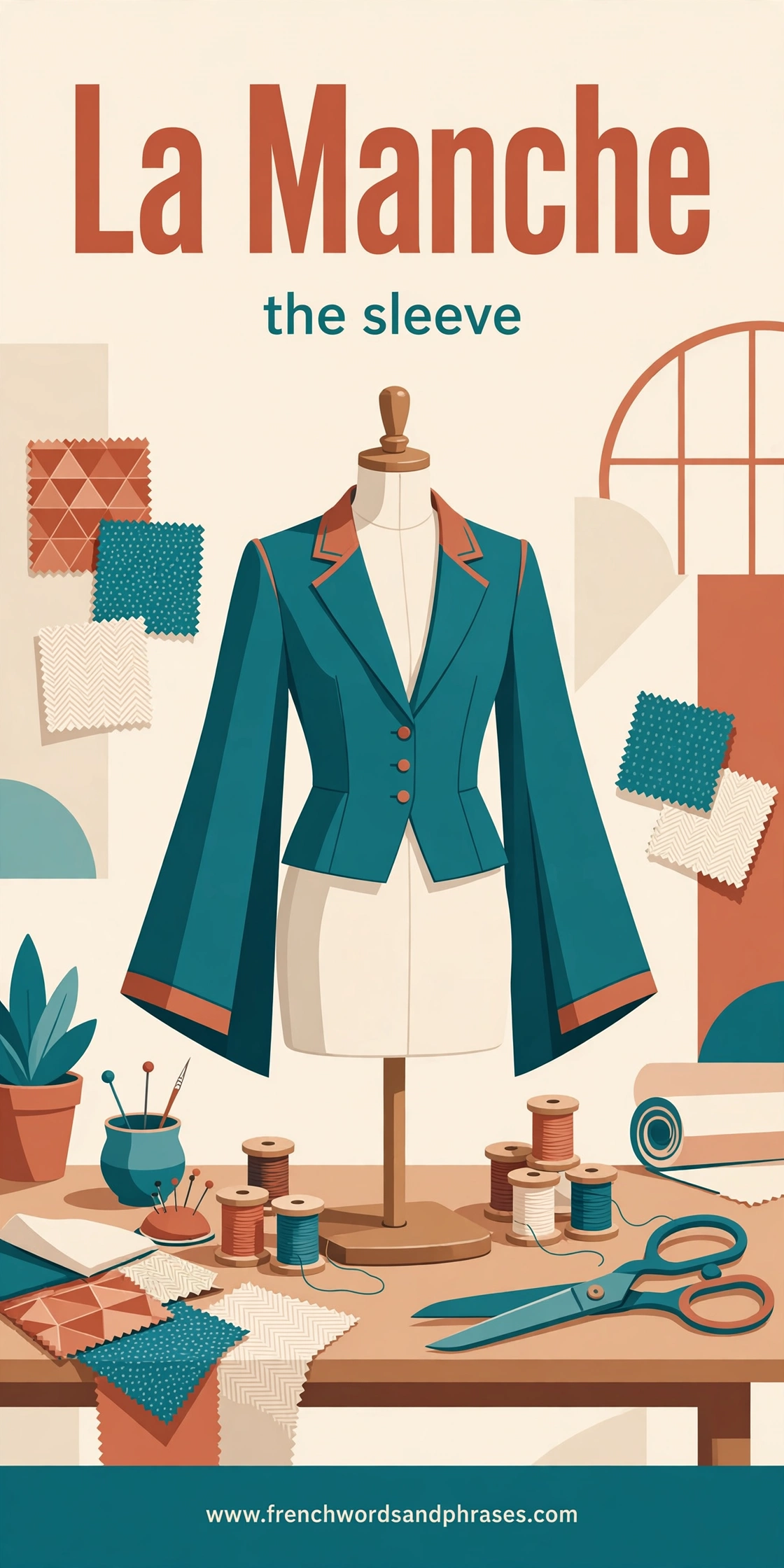
La manche means the sleeve.
The kitchen is chaos, the sauce is bubbling, and the cook does not hesitate: she pushes her sleeves up to the elbows and dives in. In French, that gesture has a name — retrousser ses manches — and it starts with la manche, the sleeve.
In this guide, you’ll learn what manche means in English, how to use it with its articles, how to form its plural, and how it appears in everyday French. Explore French examples, English translations, and practice quizzes.
Understanding the French Noun Manche
Manche is a feminine French noun, learned with its article: la manche, une manche. Do not confuse it with its near-twin le manche, masculine, which means a handle — the sleeve is feminine, the handle is masculine, and French keeps them carefully apart.
It means the sleeve — the part of a garment that covers the arm, from the short manche courte of a summer shirt to the long manche longue of a winter coat. A garment without any is sans manches, sleeveless. The word also names a round or leg of a contest — la première manche, the first round — but the sleeve is the sense to learn first.
Gender: Feminine — la manche, une manche
Plural: les manches
Watch out: le manche (masculine) is a handle, not a sleeve
Sleeveless: sans manches — un gilet sans manches, a sleeveless vest
Short / long: une manche courte, une manche longue
English equivalents: The sleeve; also a round, a leg (of a match)
One usage detail worth knowing: when French speakers roll up their sleeves to get to work, the verb is retrousser — retrousser ses manches. And if someone tells you « C’est une autre paire de manches ! », they mean that is a very different matter — literally, another pair of sleeves.
Experience the Word
Manche is where clothing meets gesture. A sleeve is never just fabric: it is what you roll up before work, what a magician hides cards in, what a child wipes a runny nose on when nobody is looking.
Imagine a tailor’s workshop in Lyon: bolts of silk, a jacket on a stand, and the tailor pinning one sleeve, then the other, turning the garment until both manches hang exactly alike.
You have not just named a piece of cloth. You have named the part of the garment that works hardest.
How to Use Manche in French: Complete Guide
Let’s explore how manche works in French, beginning with its articles — la for the sleeve, and never le, which belongs to the handle.
Manche with the Definite Article (La, Les)
The sleeve is feminine: la in the singular, les in the plural.
| Form | French |
|---|---|
| Feminine singular | la manche |
| Plural | les manches |
Example
La manche de sa chemise est déchirée.
The sleeve of his shirt is torn.
Manche with the Indefinite Article (Une, Des)
Used for a sleeve in general — une manche, a sleeve; des manches, sleeves.
| Form | French |
|---|---|
| Feminine singular | une manche |
| Plural | des manches |
Example
Je cherche une chemise avec des manches longues.
I’m looking for a shirt with long sleeves.
Manche with the Partitive and Quantities (Des, Une paire de…)
Sleeves come in pairs, so French counts them that way — and measures them by length.
| Quantity | French |
|---|---|
| a pair of sleeves | une paire de manches |
| short sleeves | des manches courtes |
| long sleeves | des manches longues |
| no sleeves at all | sans manches |
Example
Ce t-shirt a des manches courtes.
This t-shirt has short sleeves.
Quick Quiz 1
Complete the sentence:
Elle porte une robe sans ______.
Reveal the answer
manches
Elle porte une robe sans manches.
She is wearing a sleeveless dress — sans manches, with the plural, because a dress has two sleeves or none.
The Plural of Manche
Manche simply adds an -s in the plural — les manches, the two sleeves of a garment.
| Number | French |
|---|---|
| Singular | la manche |
| Plural | les manches |
Example
Les manches de ce manteau sont trop longues.
The sleeves of this coat are too long.
Manche with Possessive Adjectives (Ma, Ta, Sa…)
Possessives agree with the noun — manche is feminine, so it takes ma, ta, sa.
| Owner | French |
|---|---|
| my | ma manche |
| your (tu) | ta manche |
| his / her | sa manche |
| our | notre manche |
| your (vous) | votre manche |
| their | leur manche |
Example
Il a retroussé sa manche avant de plonger les mains dans l’eau.
He rolled up his sleeve before plunging his hands into the water.
Quick Quiz 2
Complete the sentence:
Retrousse ______ manches et aide-moi ! (your, tu form)
Reveal the answer
tes
Retrousse tes manches et aide-moi !
Roll up your sleeves and help me — tes, the plural possessive, because sleeves come in pairs.
Manche with Demonstrative Adjectives (Cette, Ces)
Used to point: cette manche, this sleeve; ces manches, these sleeves.
| Form | French |
|---|---|
| Feminine singular | cette manche |
| Plural | ces manches |
Example
Cette manche est plus courte que l’autre.
This sleeve is shorter than the other one.
Manche with Adjectives
Adjectives agree with manche — feminine forms, and most follow the noun.
| Adjective | With Manche |
|---|---|
| longue (long) | une manche longue |
| courte (short) | une manche courte |
| large (wide, loose) | une manche large |
| retroussée (rolled up) | une manche retroussée |
| déchirée (torn) | une manche déchirée |
Example
Elle porte une blouse aux manches larges et retroussées.
She is wearing a blouse with wide, rolled-up sleeves.
Quick Quiz 3
Complete the sentence:
Je préfère les chemises à manches ______. (long, feminine plural)
Reveal the answer
longues
Je préfère les chemises à manches longues.
I prefer shirts with long sleeves — longue becomes longues to agree with manches.
Everyday Expressions with Manche
Sleeves at work, sleeves in sayings — the manche phrases of daily life.
| Expression | In English |
|---|---|
| retrousser ses manches | to roll up your sleeves |
| c’est une autre paire de manches | that’s a very different matter |
| avoir quelqu’un dans sa manche | to have someone in your pocket, wrapped around your finger |
| une manche courte / longue | a short / long sleeve |
| sans manches | sleeveless |
| la première manche | the first round (of a game or contest) |
Example
Allez, on retrousse nos manches et on finit ce travail !
Come on, let’s roll up our sleeves and finish this job!
Words from the Same Family as Manche
Handles, cuffs and channels — the words that travel with manche.
| French | In English |
|---|---|
| le manche | the handle (masculine — the twin to avoid) |
| le manchon | the muff; the cuff |
| la Manche | the English Channel |
| un gilet sans manches | a sleeveless vest, a gilet |
| manchette | a cuff; also a headline |
Example
Le manche de la casserole est chaud, mais les manches de ma chemise sont retroussées.
The handle of the pan is hot, but my shirt sleeves are rolled up.
Quick Quiz 4
What does « C’est une autre paire de manches » mean?
Reveal the answer
That’s a very different matter — literally ‘that’s another pair of sleeves’.
Conduire une voiture, c’est facile ; conduire un camion, c’est une autre paire de manches !
Driving a car is easy; driving a lorry is another matter entirely!
Manche in Everyday French: Real-Life Examples
Now that you know the word, let’s see how manche appears in everyday French.
Example 1 — Getting dressed
Cette chemise a les manches trop longues pour moi.
This shirt’s sleeves are too long for me.
Example 2 — In the kitchen
Elle retrousse ses manches avant de pétrir la pâte.
She rolls up her sleeves before kneading the dough.
Example 3 — Summer shopping
Je cherche un haut sans manches pour les vacances.
I’m looking for a sleeveless top for the holidays.
Example 4 — At the tailor’s
Le tailleur raccourcit les manches de la veste.
The tailor is shortening the jacket sleeves.
Example 5 — A warning
Attention, ta manche trempe dans la soupe !
Careful, your sleeve is dipping in the soup!
Example 6 — Watching a match
Ils ont gagné la première manche facilement.
They won the first round easily.
Beyond Translation: The Meaning of Manche
La manche hides a famous trap: its masculine twin le manche means a handle, and the two words sit side by side in the dictionary like siblings who chose different lives. And capitalised, la Manche becomes geography — the sleeve of water between France and England, which the French naturally named after the shape of a sleeve widening at the shoulder.
To say manche is to feel the garment move with the arm.
It evokes tailors and seamstresses, rolled-up work shirts, magicians with cards up their sleeves — and that great French gesture of rolling up your manches when there is work to be done.
How to Remember the French Noun Manche
Remember it this way: Manche is the sleeve — feminine, la manche, and the word you meet every time a French speaker gets ready to work: retrousser ses manches.
- You wear it on your arm — la manche, une manche longue.
- You grip it in your hand — careful, that is le manche, the handle, masculine.
- You get to work — retrousser ses manches, roll them up.
The key idea is la manche — the sleeve you roll up before work.
Test Your Knowledge of Manche
Let’s see how much you’ve learned. Try answering these questions before revealing the answers.
Question 1
Is manche masculine or feminine?
Reveal the answer
Feminine — la manche, une manche. The masculine le manche means a handle.
Question 2
How do you say ‘sleeveless’ in French?
Reveal the answer
Sans manches — une robe sans manches, a sleeveless dress.
Question 3
Translate: Roll up your sleeves! (tu form)
Reveal the answer
Retrousse tes manches !
Question 4
What is une manche courte?
Reveal the answer
A short sleeve — courte is the feminine form of court, agreeing with manche.
Question 5
Complete the sentence:
Elle porte une veste à manches ______.
Reveal the answer
longues
Elle porte une veste à manches longues.
She is wearing a jacket with long sleeves.
Your Final Challenge
Can You Use It?
How would you say this in French?
“She rolls up her sleeves before washing the dishes.”
Reveal the answer
Elle retrousse ses manches avant de faire la vaisselle.
She rolls up her sleeves before washing the dishes.
A little French. A little curiosity. A richer everyday life.
LEARN FRENCH ONE WORD AT A TIME