A French Word to Live By
Translate Loup to English
/lu/
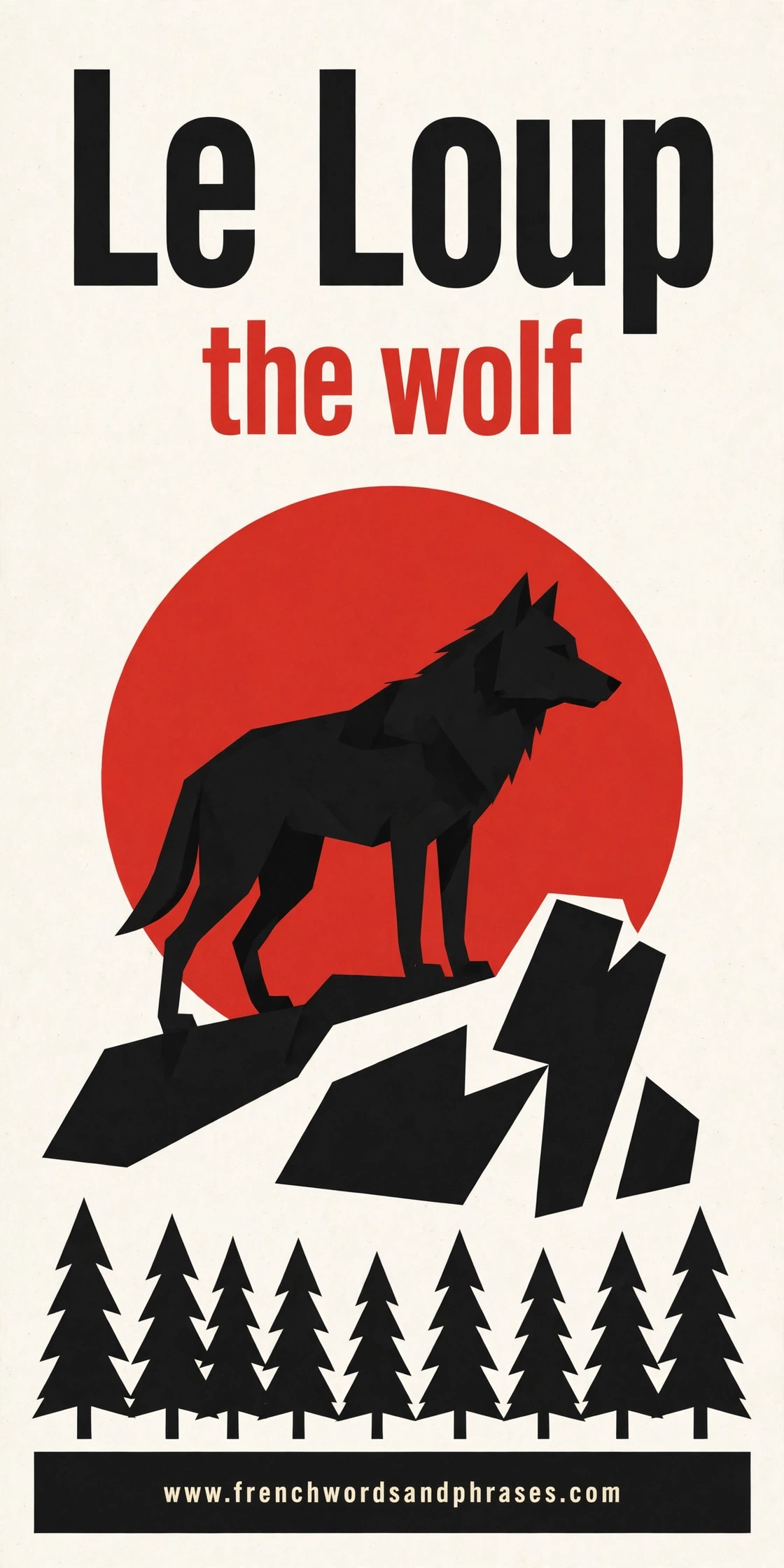
Le loup means the wolf.
Dusk falls on the mountain pasture, the sheep press close together, and the shepherd counts them one last time before dark. Somewhere beyond the ridge, a long note rises into the cold air. Everyone in the valley knows that voice — le loup.
In this guide, you’ll learn what loup means in English, how to use it with its articles, how to form its plural, and how it appears in everyday French. Explore French examples, English translations, and practice quizzes.
Understanding the French Noun Loup
Loup is a masculine French noun, learned with its article: le loup, un loup. The she-wolf has her own form: la louve, and the cub is le louveteau — also the name of a Cub Scout. The final -p of loup is silent: the word sounds like « lou ».
It means the wolf — the wild ancestor of the dog, hunter of the mountains and hero-villain of every fairy tale: le loup et l’agneau, le Petit Chaperon rouge (Little Red Riding Hood) and her grandmother’s famous visitor. After vanishing from France, the loup returned over the Alps in the 1990s and now lives again in the mountains — adored by naturalists, cursed by shepherds. And because the wolf haunts the French imagination, it haunts the language too: hunger, ambition, danger and dusk all borrow its name.
Gender: Masculine
Feminine: la louve — the she-wolf
Definite article: le — le loup (the wolf)
Indefinite article: un — un loup (a wolf)
Plural: les loups
English equivalents: The wolf.
One important usage detail: do not pronounce the -p — loup is « lou », /lu/. And learn the word’s second career: a jeune loup is an ambitious young climber in business or politics, while a loup de mer — a sea wolf — is either an old sailor or a sea bass on the menu. Context tells you whether to fear him or order him grilled.
Experience the Word
Loup is more than an animal. It is the shadow at the edge of the French forest — the creature of the fairy tales, the hunger of winter, the wildness that the tame dog dreams about.
Imagine the Mercantour at dawn: mist in the valley, a shepherd’s whistle, and far away, printed fresh in the mud of the path, the unmistakable paw marks of the night visitor.
You have not just named a beast. You have heard the oldest story in the mountains begin again.
How to Use Loup in French: Complete Guide
Let’s explore how loup works in French, beginning with its articles — from the fairy-tale forest to the shepherd’s pasture.
Loup with the Definite Article (Le, Les)
Used for the wolf of the story, the one everyone is talking about.
| Form | French |
|---|---|
| Singular | le loup |
| Feminine singular | la louve |
| Plural | les loups |
Example
Le loup traverse la prairie au lever du jour.
The wolf crosses the meadow at daybreak.
Loup with the Indefinite Article (Un, Des)
Used for a wolf in general — one wolf, somewhere in the mountains.
| Form | French |
|---|---|
| Singular | un loup |
| Feminine singular | une louve |
| Plural | des loups |
Example
Un loup a été aperçu près du village cet hiver.
A wolf was spotted near the village this winter.
Counting Loups: Packs and Quantities
Wolves live and hunt together, so French counts them in packs — la meute.
| Expression | In English |
|---|---|
| une meute de loups | a pack of wolves |
| un loup solitaire | a lone wolf |
| deux loups | two wolves |
| le chef de la meute | the leader of the pack |
| toute une meute | a whole pack |
Example
Une meute de loups chasse dans la vallée enneigée.
A pack of wolves is hunting in the snowy valley.
Quick Quiz 1
Complete the sentence:
Dans le conte, ______ loup souffle sur la maison des cochons.
Reveal the answer
le
Dans le conte, le loup souffle sur la maison des cochons.
In the tale, the wolf blows on the pigs’ house.
The Plural of Loup
Loup adds an -s in the plural — les loups — while the she-wolves become les louves.
| Number | French |
|---|---|
| Singular | le loup / la louve |
| Plural | les loups / les louves |
Example
Les loups hurlent à la lune dans la montagne.
The wolves are howling at the moon in the mountains.
Loup with Possessive Adjectives (Mon, Ton, Son…)
Possessives agree with the noun: mon loup for the male, ma louve for the female.
| Owner | French |
|---|---|
| my | mon loup / ma louve |
| your (tu) | ton loup / ta louve |
| his / her | son loup / sa louve |
| our | notre loup / notre louve |
| your (vous) | votre loup / votre louve |
| their | leur loup / leur louve |
Example
Le berger surveille son troupeau : son ennemi, c’est le loup.
The shepherd watches his flock: his enemy is the wolf.
Quick Quiz 2
Complete the sentence:
La louve protège ______ louveteaux. (her)
Reveal the answer
ses
La louve protège ses louveteaux.
The she-wolf protects her cubs — ses, because louveteaux is plural.
Loup with Demonstrative Adjectives (Ce, Ces)
Used to point: ce loup, this wolf — the one in the photograph, the one in the story.
| Form | French |
|---|---|
| Singular | ce loup |
| Feminine singular | cette louve |
| Plural | ces loups |
Example
Ce loup a été photographié dans les Alpes.
This wolf was photographed in the Alps.
Loup with Adjectives
Adjectives agree with the wolf — grey, hungry, solitary, famous.
| Adjective | With Loup |
|---|---|
| gris (grey) | un loup gris |
| affamé (starving) | un loup affamé |
| solitaire (solitary) | un loup solitaire |
| jeune (young) | un jeune loup |
| sauvage (wild) | une louve sauvage |
Example
Un loup affamé rôde autour de la bergerie.
A starving wolf is prowling around the sheepfold.
Quick Quiz 3
Complete the sentence:
La ______ protège ses petits. (she-wolf)
Reveal the answer
louve
La louve protège ses petits.
The she-wolf protects her young — louve is the feminine of loup.
Everyday Expressions with Loup
Danger, hunger and dusk — the loup phrases every French speaker knows.
| Expression | In English |
|---|---|
| se jeter dans la gueule du loup | to walk straight into danger |
| avoir une faim de loup | to be ravenous, as hungry as a wolf |
| un jeune loup | an ambitious young climber |
| à pas de loup | stealthily, on tiptoe |
| entre chien et loup | at dusk, in the twilight |
| crier au loup | to cry wolf |
Example
Après la randonnée, les enfants ont une faim de loup.
After the hike, the children are ravenous.
Words from the Same Family as Loup
She-wolves, cubs and sheepfolds — the words that travel with loup.
| French | In English |
|---|---|
| la louve | the she-wolf |
| le louveteau | the wolf cub; a Cub Scout |
| la meute | the pack |
| la bergerie | the sheepfold |
| hurler | to howl |
| le berger | the shepherd |
Example
La meute hurle au loin pendant la nuit.
The pack howls in the distance during the night.
Quick Quiz 4
What does avoir une faim de loup mean?
Reveal the answer
To be ravenous — to have a wolf’s hunger.
Je n’ai rien mangé de la journée, j’ai une faim de loup !
I haven’t eaten all day — I’m ravenous!
Loup in Everyday French: Real-Life Examples
Now that you know the word, let’s see how loup appears in everyday French.
Example 1 — In the mountains
On a entendu un loup hurler pendant la nuit.
We heard a wolf howling during the night.
Example 2 — A fairy tale
Le loup frappe à la porte de la grand-mère.
The wolf knocks at the grandmother’s door.
Example 3 — Hunger
Après le sport, les enfants ont une faim de loup.
After sport, the children are ravenous.
Example 4 — At work
Ce jeune loup veut devenir directeur avant trente ans.
That ambitious young man wants to be a director before he is thirty.
Example 5 — Protecting sheep
Le berger met le troupeau dans la bergerie avant la nuit.
The shepherd puts the flock in the sheepfold before nightfall.
Example 6 — Dusk
Entre chien et loup, on distingue mal les formes.
At dusk, you can barely make out shapes.
Beyond Translation: The Meaning of Loup
No animal owns a language the way the loup owns French. Latin lupus became the villain of La Fontaine’s fables and Perrault’s tales, the hunger of winter proverbs, the name of dusk itself — entre chien et loup, the hour when you cannot tell dog from wolf. Real wolves vanished from France for half a century, then walked back over the Italian border in 1992 and into a national argument that still runs today: the loup as protected wonder, the loup as the shepherd’s ruin. The word never left; now the animal is back to claim it.
To say loup is to call the wild by its first name.
It evokes fairy-tale forests and Alpine pastures, howling at the moon and paw prints in the mud — the oldest neighbour France ever had.
How to Remember the French Noun Loup
Remember it this way: Loup is the wolf — masculine, le loup, with a silent -p — and the she-wolf changes her name: la louve.
- You see the male — le loup, pronounced « lou », the -p sleeps.
- You see the female — la louve, and her babies are des louveteaux.
- You are starving — une faim de loup, a wolf’s hunger.
The key idea is le loup, la louve — the -p is silent.
Test Your Knowledge of Loup
Let’s see how much you’ve learned. Try answering these questions before revealing the answers.
Question 1
Is loup masculine or feminine?
Reveal the answer
Masculine — le loup, un loup. The female is la louve.
Question 2
How is loup pronounced?
Reveal the answer
/lu/ — like « lou »; the final -p is silent.
Question 3
Translate: The wolves are howling at the moon.
Reveal the answer
Les loups hurlent à la lune.
Question 4
What is une meute?
Reveal the answer
A pack — une meute de loups, a pack of wolves.
Question 5
Complete the sentence:
______ loup rôde près de la bergerie.
Reveal the answer
Le
Le loup rôde près de la bergerie.
The wolf is prowling near the sheepfold.
Your Final Challenge
Can You Use It?
How would you say this in French?
“The wolf is prowling around the sheepfold.”
Reveal the answer
Le loup rôde autour de la bergerie.
The wolf is prowling around the sheepfold.
A little French. A little curiosity. A richer everyday life.
LEARN FRENCH ONE WORD AT A TIME