A French Word to Live By
Translate L’été prochain to English
/le.te pʁɔ.ʃɛ̃/
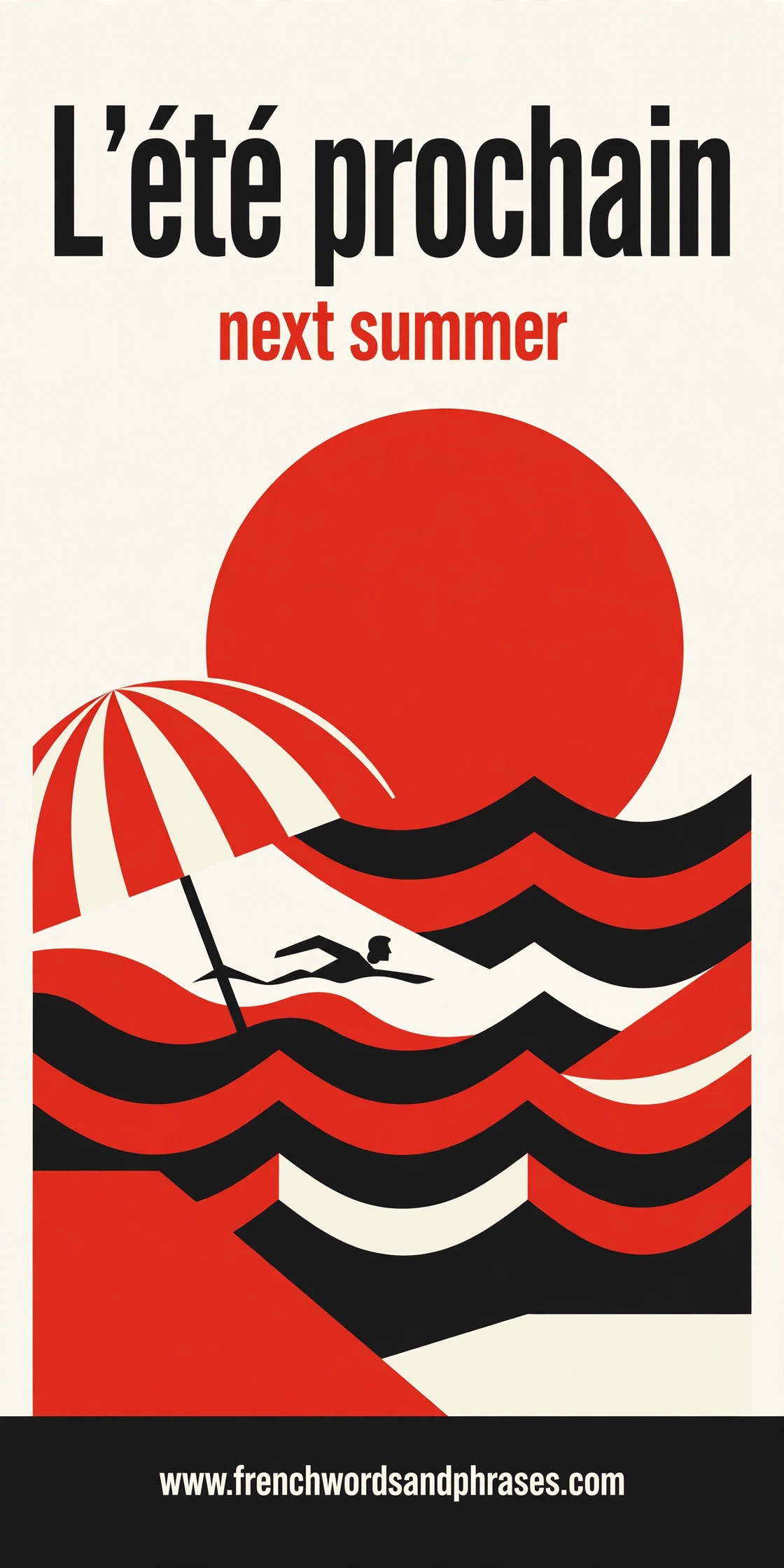
L’été prochain means next summer — the summer that follows the one we are in (or the last one).
It is the last evening of the holiday: suitcases by the door, sand still in the shoes, the sea going silver under a sky that refuses to hurry. Nobody wants to say the word ‘rentrée’. Then your daughter, shell in hand, makes the promise that saves the evening: « L’été prochain, on revient. »
Let’s explore how l’été prochain works in French, beginning with the whole phrase on one card.
Understanding the French Phrase L’été prochain
L’été prochain is a French time phrase built from l’été (the summer) and prochain (next — masculine, because été is a masculine noun). Prochain follows its noun: le printemps prochain, l’été prochain, l’automne prochain, l’hiver prochain — the whole year of seasons marches in the same formation.
It means next summer — the summer still to come, with its long evenings and open windows. The picture inside it is a promise made in warm weather: whatever this summer could not hold — the trip, the house by the sea, the finished novel — l’été prochain will hold it.
Type: Time phrase — seasons (été + prochain)
Answers the need: Placing plans and promises in the summer to come
Register: Neutral — safe everywhere, in speech and writing
Strength: Warm and hopeful — the season of promises in French
One important usage detail: été is masculine, so it is l’été prochain — but the article hides as l’ before the vowel, which tempts learners into prochaine. Compare la saison prochaine (feminine). And note the twin expressions: en été means in summer generally, every summer; l’été prochain pins the plan to one specific summer ahead.
Experience the Word
L’été prochain is the phrase holidays end with — the consolation prize every departure hands itself.
Imagine the campsite folding its tents in late August: chairs stacked, pegs pulled, children already measuring how tall they will be when they come back. L’été prochain hangs over the empty field like a reservation.
French plans its summers the way it plans its meals — early and with feeling. L’été prochain is booked in the heart long before it is booked anywhere else.
How to Use L’été prochain in French: Complete Guide
Let’s explore how l’été prochain works in French, beginning with the whole phrase on one card.
L’été prochain at a Glance
The Whole Phrase on One Card
Real meaning, inner picture, English twin and register — l’été prochain in five lines.
| Point | L’été prochain |
|---|---|
| What it really means | next summer — the summer still to come |
| Word for word | the next summer |
| English equivalent | next summer |
| Register | neutral — safe everywhere |
| Use it for | holidays, weddings, festivals, house projects and returns |
Example
L’été prochain, nous louerons une maison près de la mer.
Next summer, we will rent a house near the sea.
Word by Word: Building Next Summer
Three small pieces — take them one by one and the sun comes out.
| Word | Literal meaning | Its job in the phrase |
|---|---|---|
| l’ | the | the shortened article before a vowel — l’été, never le été |
| été | summer | a masculine noun hiding behind l’ — the season of long days |
| prochain | next (masculine) | masculine because été is masculine — and it follows the noun |
| dernier | last | the backward twin: l’été dernier, last summer |
Example
L’été dernier était chaud ; l’été prochain sera doux.
Last summer was hot; next summer will be mild.
Quick Quiz 1
Why is it l’été prochain and not l’été prochaine?
Reveal the answer
Because été is masculine — the l’ hides its gender, but prochain reveals it.
L’hiver prochain sera froid aussi.
Next winter will be cold too.
When You Say It: The Summer-Planning Moments
L’été prochain fires at moments like these — wherever a warm plan needs a date.
| Situation | Example |
|---|---|
| Booking the holiday | l’été prochain, on part en Bretagne — next summer, we’re off to Brittany |
| A wedding | ils se marient l’été prochain — they are getting married next summer |
| A house project | l’été prochain, on refait la terrasse — next summer, we’re redoing the terrace |
| A farewell promise | l’été prochain, on revient, promis — next summer, we’ll be back, promise |
| A festival | le festival aura lieu l’été prochain — the festival will take place next summer |
Example
L’été prochain, les enfants apprendront à nager.
Next summer, the children will learn to swim.
Make It Yours: Next for Every Season
Prochain walks through all four seasons — three masculine companions and one feminine season to watch.
| Form | French | In English |
|---|---|---|
| Next summer | l’été prochain | next summer |
| Last summer | l’été dernier | last summer |
| Next spring | le printemps prochain | next spring |
| Next autumn | l’automne prochain | next autumn |
| Next winter | l’hiver prochain | next winter |
| Next season | la saison prochaine | next season — saison is feminine |
Example
Le printemps prochain, puis l’été prochain : tout un programme.
Next spring, then next summer: quite a programme.
Quick Quiz 2
Which is ‘last summer’: l’été prochain or l’été dernier?
Reveal the answer
L’été dernier — dernier looks back; prochain looks forward.
L’été dernier, nous étions en Italie.
Last summer, we were in Italy.
Everyday Expressions: Building on Next Summer
L’été prochain slots into these everyday frames — each one ready to use as it stands.
| Frame | In English |
|---|---|
| l’été prochain | next summer |
| l’été dernier | last summer |
| en été | in summer (in general, every year) |
| cet été | this summer |
| les grandes vacances | the summer holidays |
Example
Cet été on reste ici ; l’été prochain, on voyage.
This summer we’re staying here; next summer, we travel.
Close Cousins: The Other Stops on the Calendar
French has a whole shelf of forward phrases — l’été prochain is the seasonal one; its cousins count in years, months and pure hope.
| Expression | The difference |
|---|---|
| l’été prochain | next summer — one named season ahead |
| l’année prochaine | next year — the whole calendar page, not just its summer |
| le mois prochain | next month — the nearest rung of the ladder |
| en été | in summer — the season in general, no particular year |
| un jour | someday — the same hope with no season attached |
Example
Le mois prochain on économise, et l’été prochain on part.
Next month we save, and next summer we leave.
Quick Quiz 3
What is the difference between en été and l’été prochain?
Reveal the answer
En été is summer in general — every year. L’été prochain is one specific summer: the next one.
En été, il fait chaud ; l’été prochain, on ira au lac.
In summer, it is hot; next summer, we will go to the lake.
L’été prochain and Its Neighbours
The season shelf around the phrase — the year French lives by.
| French | In English |
|---|---|
| le printemps | spring |
| l’été | summer |
| l’automne | autumn |
| l’hiver | winter |
| une saison | a season |
| les vacances | the holidays |
Example
Après l’hiver vient le printemps, puis l’été prochain.
After winter comes spring, then next summer.
Watch Out: The Traps Around L’été prochain
The traps: a hidden gender, a season that is also a verb form, and English word order.
| Trap | The truth |
|---|---|
| the hidden gender | l’ conceals it, but été is masculine: l’été prochain, never prochaine |
| été is also ‘been’ | été is the past participle of être too — j’ai été means I have been; context separates the season from the verb |
| prochain comes after | French order is noun first: l’été prochain, not le prochain été in this set phrase |
| en été is not next summer | en été describes summers in general — for the one ahead you need l’été prochain |
Example
J’ai été malade cet été ; l’été prochain sera meilleur.
I was ill this summer; next summer will be better.
Quick Quiz 4
True or false: all four seasons take prochain in the masculine.
Reveal the answer
True — printemps, été, automne and hiver are all masculine; only saison itself is feminine: la saison prochaine.
L’automne prochain, les feuilles tomberont tôt.
Next autumn, the leaves will fall early.
L’été prochain in Everyday French: Real-Life Examples
Now that you know the word, let’s see how l’été prochain appears in everyday French.
Example 1 — The return
L’été prochain, on revient au même camping.
Next summer, we’re coming back to the same campsite.
Example 2 — The wedding
Ils se marient l’été prochain, en juillet.
They are getting married next summer, in July.
Example 3 — The project
L’été prochain, nous construisons la véranda.
Next summer, we are building the veranda.
Example 4 — The promise
L’été prochain, je t’emmène voir la mer.
Next summer, I’ll take you to see the sea.
Example 5 — The festival
Le festival revient l’été prochain.
The festival returns next summer.
Example 6 — The comparison
L’été dernier était pluvieux ; l’été prochain sera ensoleillé.
Last summer was rainy; next summer will be sunny.
Beyond Translation: The Meaning of L’été prochain
English says next summer and moves on. French says it at the harbour wall, at the campsite gate, in the last photograph of August — the phrase is a small ceremony of hope performed at the exact moment summer ends.
L’été prochain is how the French refuse to say goodbye to the sun.
Every plan placed there is a promise that the warm season, and the people you spent it with, will meet again.
How to Remember the French Phrase L’été prochain
Remember it this way: L’été prochain is the promise made on the last evening of the holidays — été is masculine, so prochain keeps its masculine form.
- You unmask the l’ — été is masculine, so prochain without an e, like printemps, automne and hiver.
- You mirror it — l’été dernier looks back at the summer gone; l’été prochain books the one ahead.
- You separate the twins — en été is every summer; l’été prochain is the next one only.
The key idea is l’été prochain means next summer — été (masculine) plus prochain, after the noun.
Test Your Knowledge of L’été prochain
Let’s see how much you’ve learned. Try answering these questions before revealing the answers.
Question 1
What does l’été prochain mean?
Reveal the answer
Next summer — the summer still to come.
Question 2
Why prochain and not prochaine?
Reveal the answer
Because été is masculine — the l’ hides the gender, the adjective reveals it.
Question 3
How do you say ‘last summer’?
Reveal the answer
L’été dernier — dernier, last, mirrors prochain, next.
Question 4
What is the difference between en été and l’été prochain?
Reveal the answer
En été is summer in general, every year; l’été prochain is the one specific summer ahead.
Question 5
Complete the sentence:
L’été ______, nous irons en Espagne. (Next summer, we will go to Spain.)
Reveal the answer
prochain
L’été prochain, nous irons en Espagne.
Next summer, we will go to Spain.
Your Final Challenge
Can You Use It?
How would you say this in French?
“Next summer, we will return here.”
Reveal the answer
L’été prochain, nous reviendrons ici.
Next summer, we will return here.
A little French. A little curiosity. A richer everyday life.
LEARN FRENCH ONE WORD AT A TIME