A French Word to Live By
Translate Le to English
/lə/
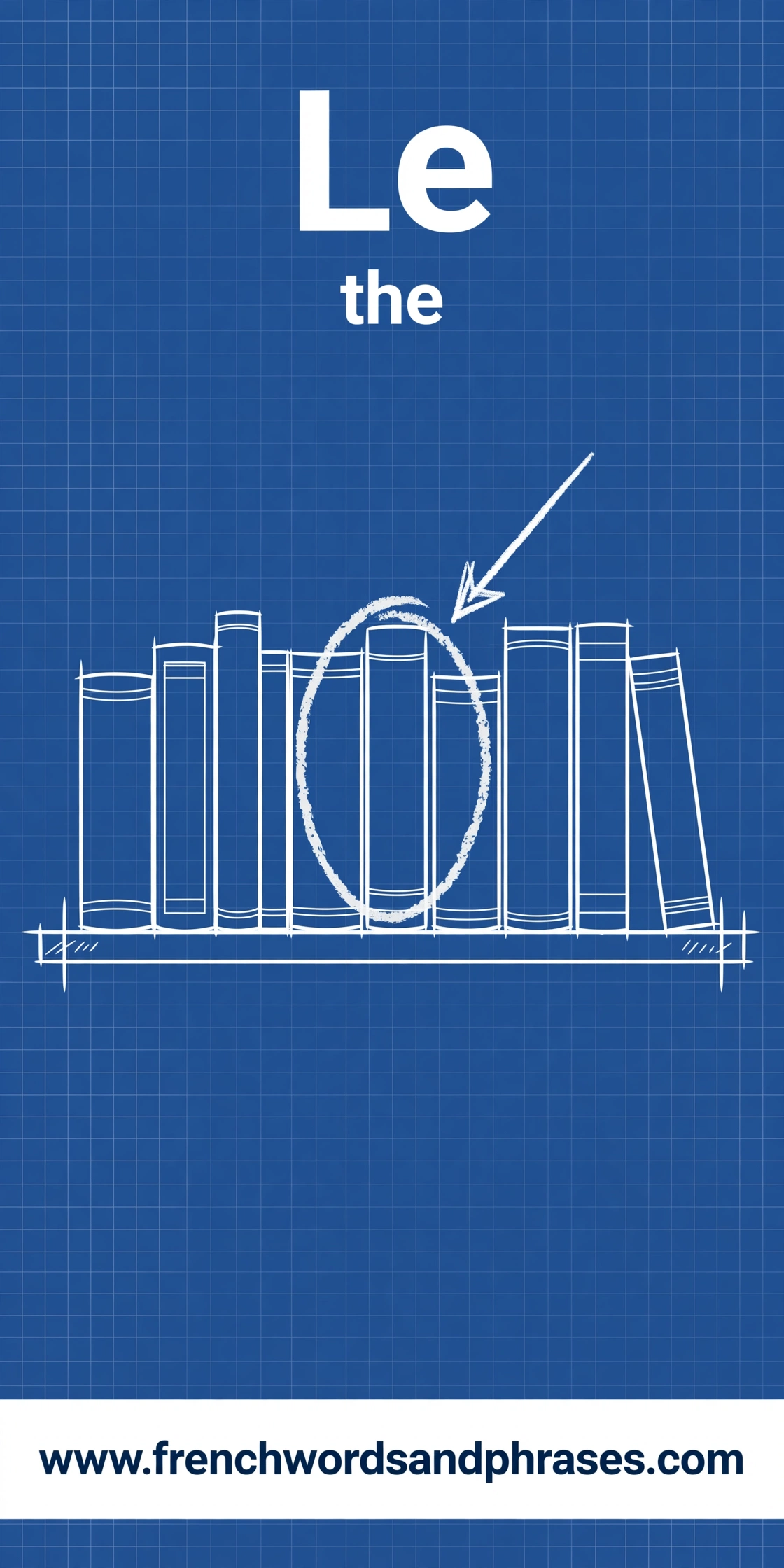
Le means the.
A farmer closes the gate of his field as the light fades over the hills. « Le soir tombe sur le village » — evening falls on the village. Look how often that one small word appears: French nouns rarely walk alone, and le is the companion of every masculine singular noun — the sun, the train, the morning itself.
Let’s explore how le works in French, beginning with the whole word on one card.
Understanding the French Determiner Le
Le is a French definite article — the masculine singular form of ‘the’. It stands in front of a noun and announces two things at once: the noun is masculine and singular, and it is a specific one, already known to the listener.
It means the. The picture it paints is a pointing finger: not a dog, not any dog, but le chien — the dog, that one, the one we have been talking about. English ‘the’ is a single word for everything; French hands the job to a small family — le, la, l’ and les — because the article must match the gender and number of its noun.
Type: Definite article — masculine singular
Answers the question: Lequel ? — Which one? (Answer: the specific one, not just any)
What follows it: A masculine singular noun: le livre, le soleil, le matin
Watch the pair: le (the, specific) vs un (a, unspecified) — le train = the train, un train = a train
One important usage detail: French keeps le in places where English drops ‘the’ altogether — general likes and truths: j’aime le chocolat (I like chocolate), le temps passe vite (time flies). If you mean the thing in general, French still wants its article.
Experience the Word
Le is the article of the known and the named — the sun, the moon, the one train the whole village is waiting for.
Imagine a small station at dawn: le train slows down, le chef de gare raises his flag, le soleil climbs over the hills — every noun steps forward with its little companion in front of it.
You have not just pointed at a thing. You have told your listener: you know this one, we have met it before.
How to Use Le in French: Complete Guide
Let’s explore how le works in French, beginning with the whole word on one card.
Le at a Glance
The Whole Word on One Card
Meaning, job, family and signal — le in four lines.
| Point | Le |
|---|---|
| Meaning | the |
| Job | definite article — marks a specific, known noun |
| The family | le (masc. sg.), la (fem. sg.), l’ (before a vowel), les (plural) |
| What it signals | this one, the one we know — not just any |
Example
Le train arrive à huit heures.
The train arrives at eight o’clock.
The Pattern in Action: The One We Know
Le connects a noun to shared knowledge — a specific thing, a general truth, a habit, a language.
| Pattern | Example |
|---|---|
| a specific thing | ferme le livre, s’il te plaît — close the book, please (this book, right here) |
| a general truth | le miel est doux — honey is sweet (honey in general) |
| a habit, with a day | le samedi, nous allons au marché — on Saturdays, we go to the market |
| a language | il apprend le japonais — he is learning Japanese |
Example
Le boulanger ouvre sa boutique à sept heures.
The baker opens his shop at seven o’clock.
Quick Quiz 1
In j’aime le chocolat, does le point to one specific chocolate?
Reveal the answer
No — le covers the general idea: chocolate in general, all of it.
J’aime le chocolat.
I like chocolate.
The Tricky Bit: When Le Changes Shape
Le is not always le — before a vowel it melts away, and after à or de it fuses into a new word.
| Situation | What happens |
|---|---|
| before a vowel or mute h, le becomes l’ | l’homme (the man), l’arbre (the tree), l’hôtel (the hotel) |
| before h aspiré, no elision | le héros (the hero), le haricot (the bean) — this h blocks the join |
| à + le contracts to au | je vais au cinéma — I am going to the cinema (never ‘à le’) |
| de + le contracts to du | le livre du professeur — the teacher’s book (never ‘de le’) |
Example
L’homme attend devant le cinéma.
The man is waiting in front of the cinema.
Where It Goes: Stuck to the Front of the Noun
Le leads the parade: article first, then any adjective, then the noun — and every noun gets its own.
| Position / pattern | Example |
|---|---|
| directly before the noun | le jardin, le village, le matin — the article leads, the noun follows |
| at the very front, adjectives included | le petit chien, le chien noir — le always stands first |
| agreement in gender and number | masculine singular takes le; feminine takes la, plural takes les: le frère, la sœur, les enfants |
| repeated before each noun | le père et le fils — the father and the son (each noun gets its own article) |
Example
Le vieux pont traverse la rivière.
The old bridge crosses the river.
Quick Quiz 2
“I am going to the cinema” — à le cinéma or au cinéma?
Reveal the answer
au cinéma — à + le always contracts to au.
Je vais au cinéma ce soir.
I am going to the cinema this evening.
Everyday Expressions with Le
Le runs the clock and the calendar — mornings, evenings, days and seasons all carry it.
| Expression | In English |
|---|---|
| le matin | in the morning |
| le soir | in the evening |
| le lundi | on Mondays (every Monday) |
| le printemps | spring |
| le français | French (the language) |
Example
Le matin, je bois un café sur la terrasse.
In the morning, I drink a coffee on the terrace.
Close Cousins: Le, Un, Du
Three small words before a masculine noun — the difference is how well you know the thing.
| Word | The difference |
|---|---|
| le | the — a specific, known thing: le gâteau sur la table (the cake on the table) |
| un | a / an — one of many, not yet identified: un gâteau (a cake, any cake) |
| du | some — an uncountable amount: du pain (some bread); it is also de + le fused |
| la / les | the same ‘the’ in other shapes: la (feminine singular), les (plural) |
Example
Je voudrais le gâteau au chocolat, pas un autre.
I would like the chocolate cake, not another one.
Quick Quiz 3
Which cousin means “a” — le or un?
Reveal the answer
un — un introduces a new, unspecified thing; le points to a known one.
Il y a un chat dans le jardin.
There is a cat in the garden.
Le and Its Neighbours
The article shelf: the whole family of ‘the’, with the indefinites next door.
| French | In English |
|---|---|
| le | the (masculine singular) |
| la | the (feminine singular) |
| l’ | the (before a vowel or mute h) |
| les | the (plural) |
| un / une / des | a, an / some (indefinite) |
Example
Le chat, la souris et les oiseaux vivent dans le même jardin.
The cat, the mouse and the birds live in the same garden.
Watch Out: The Traps Around Le
The traps: dropping le where French keeps it, and keeping it where French changes it.
| Trap | The truth |
|---|---|
| dropping the article in general statements | English says ‘I like tea’; French keeps the article: j’aime le thé |
| forgetting how languages behave | after parler the article drops (je parle français), but as a subject it stays: le français est beau |
| missing le in prices | les pommes coûtent deux euros le kilo — the apples cost two euros a kilo (le = per) |
| using le before a vowel | before a vowel or mute h, le becomes l’: l’école, l’ami — never ‘le école’ |
Example
Le bonheur ne s’achète pas.
Happiness cannot be bought.
Quick Quiz 4
Complete: ______ arbre est très vieux. (The tree is very old.)
Reveal the answer
L’ — arbre begins with a vowel, so le elides to l’.
L’arbre est très vieux.
The tree is very old.
Le in Everyday French: Real-Life Examples
Now that you know the word, let’s see how le appears in everyday French.
Example Example 1 — Morning
Le matin commence avec le chant des oiseaux.
The morning begins with the song of the birds.
Example Example 2 — At the station
Le train pour Lyon part dans dix minutes.
The train to Lyon leaves in ten minutes.
Example Example 3 — Weather
Le vent souffle fort ce soir.
The wind is blowing hard this evening.
Example Example 4 — A habit
Le dimanche, le village est très calme.
On Sundays, the village is very quiet.
Example Example 5 — School
Le professeur écrit la date au tableau.
The teacher writes the date on the board.
Example Example 6 — Nature
Le lac est magnifique au printemps.
The lake is magnificent in spring.
Beyond Translation: The Meaning of Le
English “the” does one quiet job; French splits it four ways — le, la, l’ and les — because every French noun carries a gender, and the article announces it before the noun itself even arrives. Le is the first announcement most learners ever hear.
To say le is to announce: masculine, singular, and already known to us both.
That is why le feels so certain. Le soleil rises every morning, le temps passes for everyone, and some things — le bonheur, le pain frais — need no introduction at all.
How to Remember the French Determiner Le
Remember it this way: Remember it this way: Le is the pointing finger — it singles out the one thing you both already know.
- You ask which one? — if the answer is ‘the one we know’, the word is le.
- You watch the next sound — a vowel or mute h turns le into l’: l’homme, l’arbre.
- You never write à le or de le — they fuse into au and du every time.
The key idea is le means the for a masculine singular noun — it becomes l’ before a vowel, and fuses with à and de into au and du.
Test Your Knowledge of Le
Let’s see how much you’ve learned. Try answering these questions before revealing the answers.
Question 1
What does le mean?
Reveal the answer
The — the definite article for a masculine singular noun.
Question 2
What are the four forms of ‘the’ in French?
Reveal the answer
Le, la, l’ and les — le (masculine singular), la (feminine singular), l’ (before a vowel), les (plural).
Question 3
Translate: The dog is in the garden.
Reveal the answer
Le chien est dans le jardin.
Question 4
What happens to le before a word beginning with a vowel?
Reveal the answer
It becomes l’ — l’arbre (the tree), l’hôtel (the hotel).
Question 5
Complete the sentence:
Je vais ______ marché. (I am going to the market.)
Reveal the answer
au
Je vais au marché.
I am going to the market.
Your Final Challenge
Can You Use It?
How would you say this in French?
“How would you say this in French?”
Reveal the answer
Le train arrive à huit heures.
The train arrives at eight o’clock.
A little French. A little curiosity. A richer everyday life.
LEARN FRENCH ONE WORD AT A TIME