A French Word to Live By
Translate Lapin to English
/la.pɛ̃/
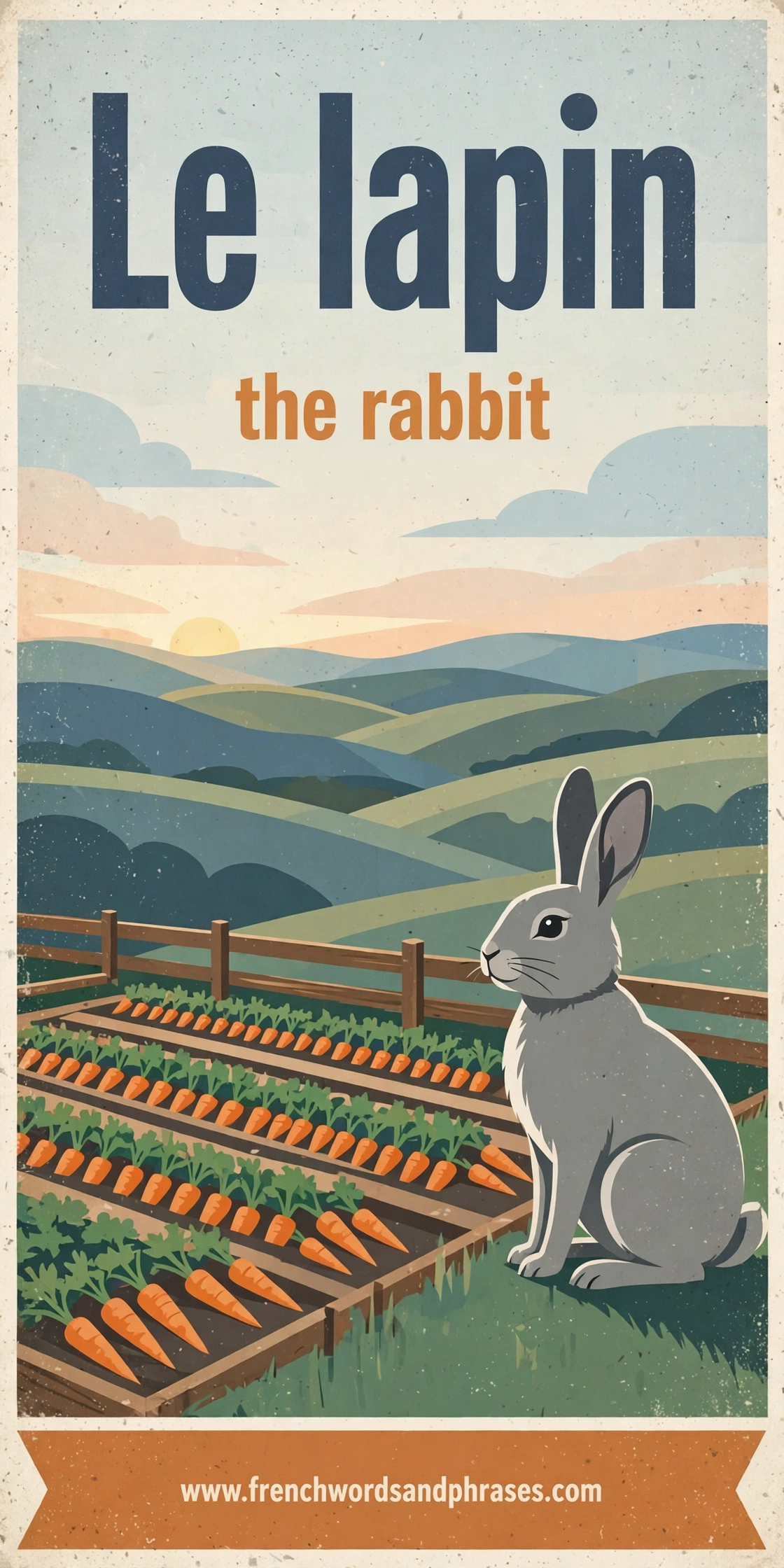
Le lapin means the rabbit.
Long ears up, nose twitching, ready to vanish into the hedge in one white flash: le lapin, the rabbit — the garden’s quickest guest, the Easter messenger, and the hero of a very French idiom about standing people up.
In this guide, you’ll learn what lapin means in English, how to use it with its articles, how to form its plural, and how it appears in everyday French. Explore French examples, English translations, and practice quizzes.
Understanding the French Noun Lapin
Lapin is a masculine French noun, learned with its article: le lapin, un lapin. The feminine is la lapine. The word is old French, probably from a word for the young of the animal. It must not be confused with le lièvre, the hare — the lapin’s bigger, wilder cousin of the open fields: the lapin lives in burrows and hutches, the lièvre in the open.
It means a rabbit — the small, long-eared animal of gardens, farms and children’s stories: un lapin blanc, a white rabbit, un lapin domestique, a pet rabbit, un lapin de garenne, a wild rabbit. The word also walks into the kitchen — le lapin à la moutarde, rabbit in mustard sauce, is a classic — and into the calendar: le lapin de Pâques brings the Easter eggs in many a garden. And in familiar French, poser un lapin à quelqu’un means to stand someone up.
Gender: Masculine — le lapin
Definite article: le — le lapin (the rabbit)
Indefinite article: un — un lapin (a rabbit)
Plural: les lapins — regular, with a simple -s
Spelling note: the feminine is la lapine; the wild cousin is le lièvre, the hare
The idiom: poser un lapin à quelqu’un — to stand someone up
English equivalents: The rabbit.
Two lapins to keep apart: the animal of the hutch and garden, and the appointment that never happens — il m’a posé un lapin, he stood me up, is a sentence every learner should recognise. At Easter the chocolate version rules: un lapin en chocolat. And a dwarf rabbit, the house pet of many French children, is un lapin nain.
Experience the Word
Lapin is speed wrapped in softness: still as a stone one second, gone in a zigzag the next, leaving only the white flag of its tail.
Imagine the garden at Easter dawn — children hunting eggs in the wet grass while, at the hedge, a real lapin watches the hunt with professional calm.
You have not just named an animal. You have named quickness itself — le lapin, the rabbit, here and gone.
How to Use Lapin in French: Complete Guide
Let’s explore how lapin works in French, beginning with its articles — le lapin, un lapin, le lapin de Pâques.
Lapin with the Definite Article (Le, Les)
Used for a specific rabbit — the one in the garden, the one that just vanished.
| Form | French |
|---|---|
| Masculine singular | le lapin |
| Plural | les lapins |
Example
Le lapin mange les salades du jardin.
The rabbit is eating the lettuces in the garden.
Lapin with the Indefinite Article (Un, Des)
Used for a rabbit in general — one animal among the warren.
| Form | French |
|---|---|
| Masculine singular | un lapin |
| Plural | des lapins |
Example
Un lapin traverse le chemin devant nous.
A rabbit crosses the path in front of us.
Kinds of Lapin (De garenne, domestique, nain…)
Rabbits are named by their world — wild warren, hutch, or the living-room carpet.
| Kind | French |
|---|---|
| a wild rabbit | un lapin de garenne |
| a pet rabbit | un lapin domestique |
| a dwarf rabbit | un lapin nain |
| a chocolate rabbit | un lapin en chocolat |
| the Easter bunny | le lapin de Pâques |
Example
Ma fille a un lapin nain qui s’appelle Caramel.
My daughter has a dwarf rabbit called Caramel.
Quick Quiz 1
Complete the sentence:
______ lapin de Pâques cache les œufs dans le jardin. (the)
Reveal the answer
Le
Le lapin de Pâques cache les œufs dans le jardin.
The Easter bunny hides the eggs in the garden — lapin is masculine, so le.
The Plural of Lapin
Lapin takes a regular plural in -s — rabbits famously travel in growing numbers.
| Number | French |
|---|---|
| Singular | le lapin |
| Plural | les lapins |
Example
Les lapins sortent de leur terrier le soir.
The rabbits come out of their burrow in the evening.
Lapin with Possessive Adjectives (Mon, Ton, Son…)
Possessives agree with the noun: lapin is masculine, so mon, ton, son in the singular.
| Owner | French |
|---|---|
| my | mon lapin |
| your (tu) | ton lapin |
| his / her | son lapin |
| our | notre lapin |
| your (vous) | votre lapin |
| their | leur lapin |
Example
Mon lapin adore les carottes et le persil.
My rabbit loves carrots and parsley.
Quick Quiz 2
Complete the sentence:
Elle a perdu ______ lapin dans le jardin. (her)
Reveal the answer
son
Elle a perdu son lapin dans le jardin.
She lost her rabbit in the garden — son, because lapin is masculine.
Lapin with Demonstrative Adjectives (Ce, Ces)
Used to point: ce lapin, this rabbit — the one eyeing your lettuces.
| Form | French |
|---|---|
| Masculine singular | ce lapin |
| Plural | ces lapins |
Example
Ce lapin est rapide, impossible de l’attraper.
This rabbit is fast, impossible to catch.
Lapin with Adjectives
Adjectives agree with lapin — masculine singular: un lapin blanc, un petit lapin.
| Adjective | With Lapin |
|---|---|
| blanc (white) | un lapin blanc |
| petit (small) | un petit lapin |
| gris (grey) | un lapin gris |
| rapide (fast) | un lapin rapide |
| doux (gentle) | un lapin doux |
Example
Un petit lapin gris se cache sous le buisson.
A small grey rabbit is hiding under the bush.
Quick Quiz 3
Complete the sentence:
C’est un lapin ______, il court très vite. (fast)
Reveal the answer
rapide
C’est un lapin rapide, il court très vite.
It’s a fast rabbit, it runs very fast — rapide agrees with the masculine noun.
Everyday Expressions with Lapin
Easter gardens, hutches and missed appointments — the lapin phrases of daily life.
| Expression | In English |
|---|---|
| poser un lapin à quelqu’un | to stand someone up |
| le lapin de Pâques | the Easter bunny |
| courir comme un lapin | to run like a rabbit — very fast |
| un lapin en chocolat | a chocolate rabbit |
| un élevage de lapins | a rabbit farm, rabbit breeding |
Example
Il m’a posé un lapin, je l’ai attendu une heure.
He stood me up, I waited an hour for him.
Words from the Same Family as Lapin
Burrows, hares and carrots — the words that travel with lapin.
| French | In English |
|---|---|
| le lièvre | the hare — the bigger wild cousin |
| la lapine | the female rabbit |
| le terrier | the burrow |
| la carotte | the carrot — the famous favourite |
| les oreilles | the ears — long, of course |
Example
Le lièvre court dans les champs, le lapin vit dans un terrier.
The hare runs in the fields, the rabbit lives in a burrow.
Quick Quiz 4
What does poser un lapin à quelqu’un mean?
Reveal the answer
To stand someone up — to not come to an appointment.
Elle m’a posé un lapin hier soir.
She stood me up last night.
Lapin in Everyday French: Real-Life Examples
Now that you know the word, let’s see how lapin appears in everyday French.
Example 1 — In the garden
Le lapin mange les salades encore une fois.
The rabbit is eating the lettuces again.
Example 2 — The pet
Mon lapin nain s’appelle Caramel.
My dwarf rabbit is called Caramel.
Example 3 — Easter
Le lapin de Pâques passe demain matin.
The Easter bunny comes tomorrow morning.
Example 4 — Stood up
Il m’a posé un lapin, incroyable.
He stood me up, unbelievable.
Example 5 — Fast
L’enfant court comme un lapin dans le jardin.
The child runs like a rabbit in the garden.
Example 6 — The burrow
Les lapins rentrent dans leur terrier.
The rabbits go back into their burrow.
Beyond Translation: The Meaning of Lapin
Lapin lives three lives in French: the animal, quick and soft, of gardens and hutches; the dish, honoured in mustard sauce at Sunday tables; and the idiom, poser un lapin, the rabbit you « put down » on someone who waits in vain — perhaps from the old card-table slang for a debt never paid. Add the Easter lapin, hiding eggs in gardens where in other countries a hare does the work, and the small animal carries a surprising share of the language. The hare, le lièvre, keeps the wild fields; the lapin keeps everything else.
To say lapin is to name the quick, the soft and the stood-up in one word.
It evokes the white tail in the hedge, the chocolate of Easter morning and the café chair that stayed empty.
How to Remember the French Noun Lapin
Remember it this way: Lapin is the rabbit — masculine: le lapin, un lapin. Its wild cousin is le lièvre, the hare.
- Always masculine — le lapin, un lapin, mon lapin; the female is la lapine.
- The idiom — poser un lapin à quelqu’un, to stand someone up.
- The cousin — le lièvre is the hare of the open fields.
The key idea is le lapin — the rabbit, masculine; poser un lapin = to stand someone up.
Test Your Knowledge of Lapin
Let’s see how much you’ve learned. Try answering these questions before revealing the answers.
Question 1
Is lapin masculine or feminine?
Reveal the answer
Masculine — le lapin, un lapin.
Question 2
How do you say the Easter bunny?
Reveal the answer
Le lapin de Pâques.
Question 3
Translate: My rabbit loves carrots.
Reveal the answer
Mon lapin adore les carottes.
Question 4
What is the difference between un lapin and un lièvre?
Reveal the answer
The lièvre is the hare — bigger and wild; the lapin is the rabbit of burrows and hutches.
Question 5
Complete the sentence:
______ lapins sortent le soir. (the)
Reveal the answer
Les
Les lapins sortent le soir.
The rabbits come out in the evening.
Your Final Challenge
Can You Use It?
How would you say this in French?
“The Easter bunny hides the eggs in the garden.”
Reveal the answer
Le lapin de Pâques cache les œufs dans le jardin.
The Easter bunny hides the eggs in the garden.
A little French. A little curiosity. A richer everyday life.
LEARN FRENCH ONE WORD AT A TIME