A French Word to Live By
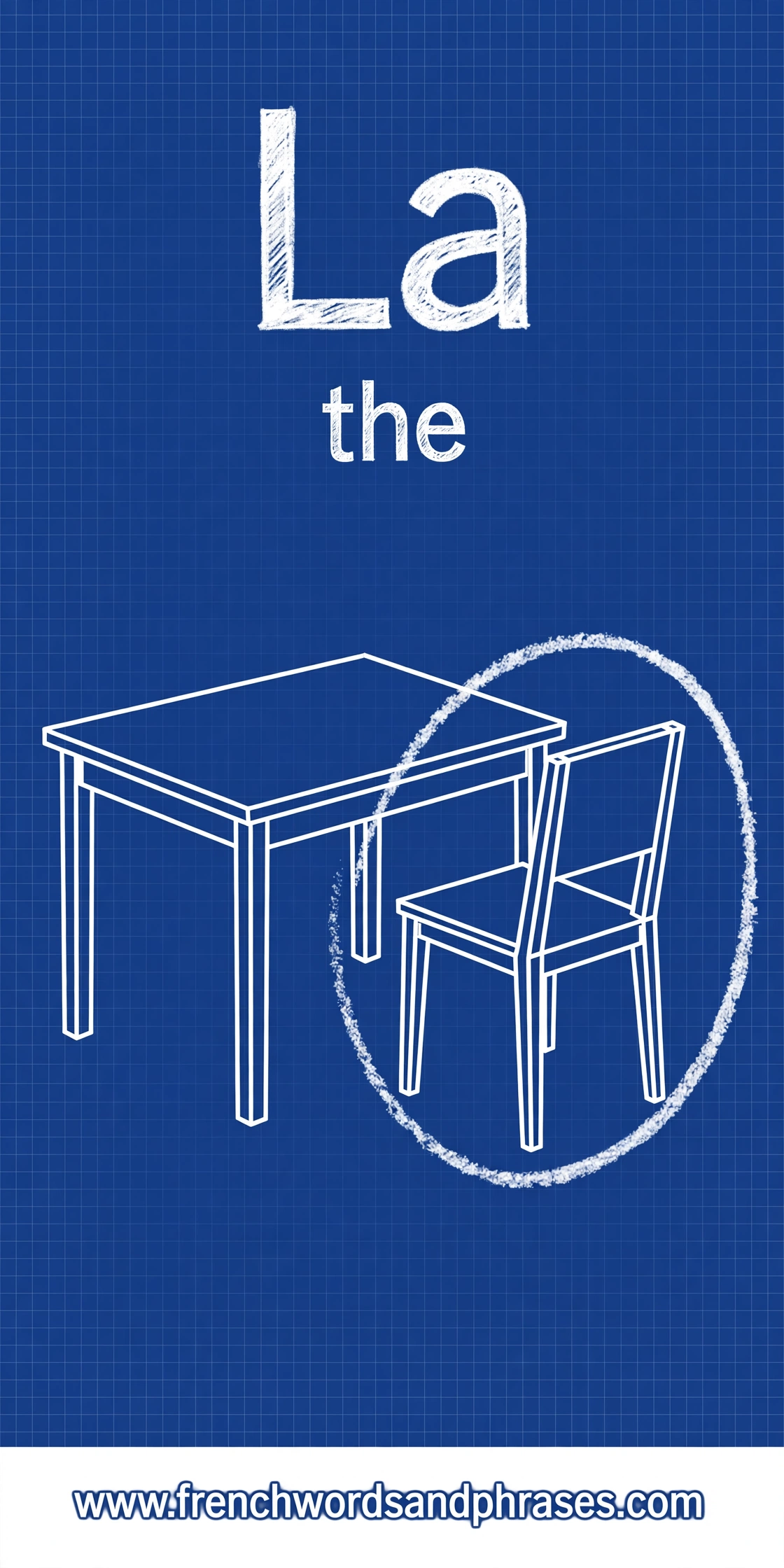
Translate La to English
/la/
La means the.
A child presses her nose to the window as the first snow begins to fall. « La neige arrive ! » — the snow is coming! French nouns rarely walk alone, and la is the companion of every feminine singular noun — the moon, the house, the night itself.
Let’s explore how la works in French, beginning with the whole word on one card.
Understanding the French Determiner La
La is a French definite article — the feminine singular form of ‘the’. It stands in front of a noun and announces two things at once: the noun is feminine and singular, and it is a specific one, already known to the listener.
It means the. The picture it paints is a pointing finger: not a house, not any house, but la maison — the house, that one, the one we have been talking about. English ‘the’ is a single word for everything; French hands the job to a small family — le, la, l’ and les — because the article must match the gender and number of its noun.
Type: Definite article — feminine singular
Answers the question: Laquelle ? — Which one? (Answer: the specific one, not just any)
What follows it: A feminine singular noun: la table, la lune, la maison
Watch the pair: la (the, specific) vs une (a, unspecified) — la pomme = the apple, une pomme = an apple
One important usage detail: before a vowel or a mute h, la melts into l’ just like le — l’amie (the friend), l’école (the school), l’histoire (the story). And French keeps la in general statements where English drops ‘the’: j’aime la musique (I like music).
Experience the Word
La is the article of the known and the named — the moon, the sea, the one house on the hill the whole village can see.
Imagine a village at dusk: la lune climbs over the roofs, la boulangerie closes its shutters, la voisine calls her children home — every feminine noun steps forward with its little companion in front of it.
You have not just pointed at a thing. You have told your listener: you know this one, we have met it before.
How to Use La in French: Complete Guide
Let’s explore how la works in French, beginning with the whole word on one card.
La at a Glance
The Whole Word on One Card
Meaning, job, family and signal — la in four lines.
| Point | La |
|---|---|
| Meaning | the |
| Job | definite article — marks a specific, known noun |
| The family | la (fem. sg.), le (masc. sg.), l’ (before a vowel), les (plural) |
| What it signals | this one, the one we know — not just any |
Example
La lune brille ce soir.
The moon is shining this evening.
The Pattern in Action: The One We Know
La connects a noun to shared knowledge — a specific thing, a general truth, a moment of the day.
| Pattern | Example |
|---|---|
| a specific thing | ferme la porte, s’il te plaît — close the door, please (this door, right here) |
| a general truth | la vie est belle — life is beautiful (life in general) |
| a part of the day | la nuit tombe vite en hiver — night falls quickly in winter |
| an abstract idea | la liberté n’a pas de prix — freedom has no price |
Example
La boulangerie ouvre à sept heures.
The bakery opens at seven o’clock.
Quick Quiz 1
In j’aime la musique, does la point to one specific piece of music?
Reveal the answer
No — la covers the general idea: music in general, all of it.
J’aime la musique.
I like music.
The Tricky Bit: When La Changes Shape
La is not always la — before a vowel it melts away, but after à or de it proudly stays whole.
| Situation | What happens |
|---|---|
| before a vowel or mute h, la becomes l’ | l’amie (the friend), l’école (the school), l’histoire (the story) |
| before h aspiré, no elision | la honte (the shame), la hache (the axe) — this h blocks the join |
| à + la does NOT contract | je vais à la maison — I am going home (à la stays à la, unlike au for le) |
| de + la does NOT contract | le toit de la maison — the roof of the house (de la stays de la, unlike du) |
Example
L’amie de ma sœur habite près de la gare.
My sister’s friend lives near the station.
Where It Goes: Stuck to the Front of the Noun
La leads the parade: article first, then any adjective, then the noun — and every noun gets its own.
| Position / pattern | Example |
|---|---|
| directly before the noun | la table, la maison, la nuit — the article leads, the noun follows |
| at the very front, adjectives included | la petite maison, la maison blanche — la always stands first |
| agreement in gender and number | feminine singular takes la; masculine takes le, plural takes les: la sœur, le frère, les enfants |
| repeated before each noun | la mère et la fille — the mother and the daughter (each noun gets its own article) |
Example
La vieille maison se trouve au bout de la rue.
The old house stands at the end of the street.
Quick Quiz 2
“I am going home” — au maison or à la maison?
Reveal the answer
à la maison — à + la never contracts; only à + le becomes au.
Je rentre à la maison.
I am going home.
Everyday Expressions with La
La runs the home and the calendar — houses, nights, first times and next weeks all carry it.
| Expression | In English |
|---|---|
| à la maison | at home |
| la nuit | the night / at night |
| la première fois | the first time |
| la semaine prochaine | next week |
| la vie | life |
Example
La première fois, j’étais très nerveux.
The first time, I was very nervous.
Close Cousins: La, Une, De la
Three small words before a feminine noun — the difference is how well you know the thing, and how much of it there is.
| Word | The difference |
|---|---|
| la | the — a specific, known thing: la pomme sur la table (the apple on the table) |
| une | a / an — one of many, not yet identified: une pomme (an apple, any apple) |
| de la | some — an uncountable amount: de la soupe (some soup) |
| le / les | the same ‘the’ in other shapes: le (masculine singular), les (plural) |
Example
Je voudrais la pomme rouge, pas une autre.
I would like the red apple, not another one.
Quick Quiz 3
Which cousin means “a” — la or une?
Reveal the answer
une — une introduces a new, unspecified thing; la points to a known one.
Il y a une pomme sur la table.
There is an apple on the table.
La and Its Neighbours
The article shelf: the whole family of ‘the’, with the indefinites next door.
| French | In English |
|---|---|
| le | the (masculine singular) |
| la | the (feminine singular) |
| l’ | the (before a vowel or mute h) |
| les | the (plural) |
| une / des | a, an / some (indefinite) |
Example
La souris, le chat et les oiseaux vivent dans le même jardin.
The mouse, the cat and the birds live in the same garden.
Watch Out: The Traps Around La
The traps: dropping la where French keeps it, and eliding it where French does not.
| Trap | The truth |
|---|---|
| dropping the article in general statements | English says ‘I like music’; French keeps the article: j’aime la musique |
| eliding before h aspiré | la honte and la hache keep la — the h blocks the elision: never ‘l’honte’ |
| trying to contract à la or de la | there is no contraction: à la maison, de la maison — au and du exist only for le and les |
| using la before a vowel | before a vowel or mute h, la becomes l’: l’école, l’amie — never ‘la école’ |
Example
La patience est la clé du bonheur.
Patience is the key to happiness.
Quick Quiz 4
Complete: ______ école est fermée aujourd’hui. (The school is closed today.)
Reveal the answer
L’ — école begins with a vowel, so la elides to l’.
L’école est fermée aujourd’hui.
The school is closed today.
La in Everyday French: Real-Life Examples
Now that you know the word, let’s see how la appears in everyday French.
Example Example 1 — Evening
La lune monte doucement au-dessus des toits.
The moon rises gently above the rooftops.
Example Example 2 — Shopping
La boulangerie vend la meilleure tarte du village.
The bakery sells the best tart in the village.
Example Example 3 — Weather
La pluie commence à tomber.
The rain is starting to fall.
Example Example 4 — The sea
La mer est calme ce matin.
The sea is calm this morning.
Example Example 5 — Neighbours
La voisine arrose ses fleurs tous les soirs.
The neighbour waters her flowers every evening.
Example Example 6 — Lost and found
La clé est sous le paillasson.
The key is under the doormat.
Beyond Translation: The Meaning of La
English “the” does one quiet job; French splits it four ways — le, la, l’ and les — because every French noun carries a gender, and the article announces it before the noun itself even arrives. La is the announcement for every feminine noun.
To say la is to announce: feminine, singular, and already known to us both.
That is why la feels so familiar. La lune rises every night, la vie goes on for everyone, and some things — la mer, la maison — need no introduction at all.
How to Remember the French Determiner La
Remember it this way: Remember it this way: La is the pointing finger for feminine nouns — it singles out the one thing you both already know.
- You ask which one? — if the answer is ‘the one we know’ and the noun is feminine, the word is la.
- You watch the next sound — a vowel or mute h turns la into l’: l’amie, l’école.
- You never contract it — à la and de la stay whole; only le and les fuse into au, aux, du, des.
The key idea is la means the for a feminine singular noun — it becomes l’ before a vowel, and à la / de la never contract.
Test Your Knowledge of La
Let’s see how much you’ve learned. Try answering these questions before revealing the answers.
Question 1
What does la mean?
Reveal the answer
The — the definite article for a feminine singular noun.
Question 2
What are the four forms of ‘the’ in French?
Reveal the answer
Le, la, l’ and les — le (masculine singular), la (feminine singular), l’ (before a vowel), les (plural).
Question 3
Translate: The house is at the end of the street.
Reveal the answer
La maison est au bout de la rue.
Question 4
What happens to la before a word beginning with a vowel?
Reveal the answer
It becomes l’ — l’école (the school), l’amie (the friend).
Question 5
Complete the sentence:
Je rentre ______ maison. (I am going home.)
Reveal the answer
à la
Je rentre à la maison.
I am going home.
Your Final Challenge
Can You Use It?
How would you say this in French?
“How would you say this in French?”
Reveal the answer
La maison de mes grands-parents est près de la mer.
My grandparents’ house is near the sea.
A little French. A little curiosity. A richer everyday life.
LEARN FRENCH ONE WORD AT A TIME