A French Word to Live By
Translate Kascher to English
/ka.ʃɛʁ/
Kascher means kosher.
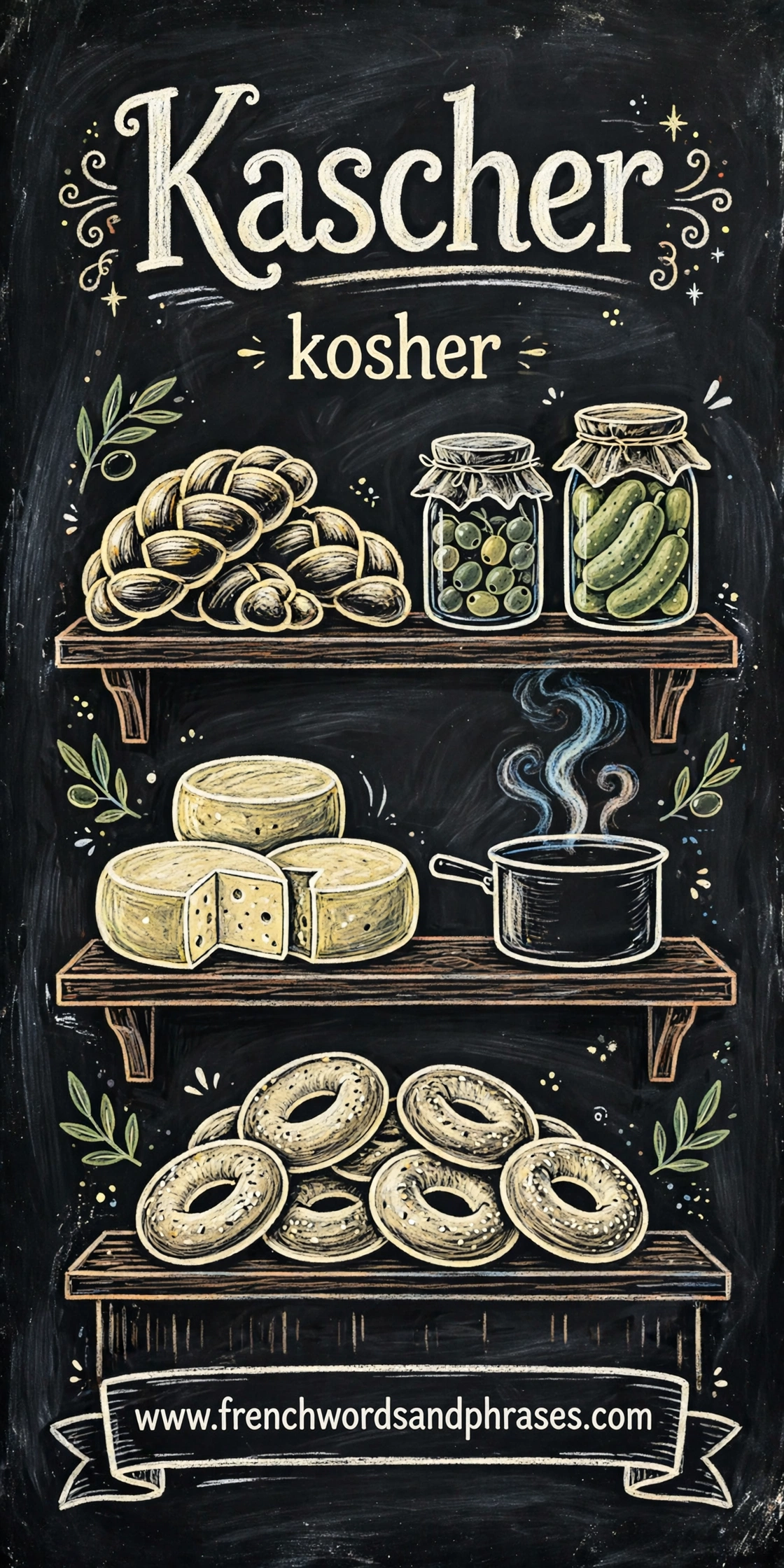
A small delicatessen in the Marais, the Jewish quarter of Paris: jars of pickles on wooden shelves, a certificate framed beside the counter, and the butcher wrapping a chicken in brown paper while a grandmother checks the label twice. Everything in this shop answers to one careful word: kascher.
In this guide, you’ll learn what kascher means in English, why it never changes its form — not for a lady, not for a crowd — how its three spellings work, and how the French borrowed it for a sly second meaning: something that is not quite above board. Explore French examples, English translations, and practice quizzes.
Understanding the French Adjective Kascher
Kascher is a French adjective borrowed from Hebrew, by way of Yiddish. It belongs to a small, liberating family: the invariable adjectives, words that refuse to agree. Masculine, feminine, singular, plural — kascher stays kascher, and the noun does all the changing on its own.
It means kosher — food prepared and certified according to Jewish dietary law: un plat kascher, une viande kascher, un restaurant kascher. And French, which loves a borrowed word with a double life, also uses it loosely: ce n’est pas très kascher — it is a bit dodgy, not quite above board.
Type: Adjective — borrowed word (Hebrew, via Yiddish)
Answers the question: Prepared according to Jewish dietary law? — kosher
Changes form: No — invariable: kascher for every gender and number
English equivalents: Kosher; (figurative) above board, legitimate.
One important usage detail: kascher stands AFTER the noun, like most French adjectives — un restaurant kascher, des produits kascher. It never takes an e, never takes an s: writing kaschère or kaschers is the classic learner’s mistake this page exists to prevent.
Experience the Word
Kascher is the adjective of trust at the table — a small word that tells a guest: this food was prepared with care, under rules older than the restaurant, older than the street it stands on.
Imagine the Friday queue at the delicatessen: challah bread, pickled cucumbers, a pot of soup carried home with both hands. Nobody asks what is in the bag. The word on the shop window has already answered: « c’est kascher ».
You have not just described a meal. You have given your word about how it was made.
How to Use Kascher in French: Complete Guide
Let’s explore how kascher works in French, beginning with the whole word on one card.
Kascher at a Glance
Before the details, here is the whole word on one card.
The Whole Word on One Card
Meaning, type, position and forms — kascher in four lines, and the forms line is the shortest on this site.
| Point | Kascher |
|---|---|
| Meaning | kosher |
| Type | adjective — borrowed, invariable |
| Usual position | after the noun — un plat kascher |
| Form | kascher — the same form everywhere |
Example
Ce restaurant est kascher.
This restaurant is kosher.
The Four Forms of Kascher — All One Form
Here is the agreement table, and it is gloriously empty of surprises: kascher never changes. The article and the noun carry the gender and the number; the adjective simply stands still.
| Form | Kascher | Example |
|---|---|---|
| Masculine singular | kascher | un plat kascher — a kosher dish |
| Feminine singular | kascher | une viande kascher — kosher meat |
| Masculine plural | kascher | des repas kascher — kosher meals |
| Feminine plural | kascher | des boucheries kascher — kosher butcher’s shops |
Example
Elle achète des produits kascher pour le repas de famille.
She buys kosher products for the family meal.
Quick Quiz 1
Which form of kascher goes with viande (feminine)?
Reveal the answer
kascher
Une viande kascher.
There is no feminine form — kascher never changes.
The Feminine of Kascher: There Isn’t One
Most French adjectives build a feminine with an added e. Kascher, a borrowed word, never learned the trick — and that is not a gap in the table, it IS the lesson of this page.
| What learners try | What French says |
|---|---|
| kaschère (adding an e) | wrong — the feminine is kascher |
| kaschers (adding an s) | wrong — the plural is kascher |
| une soupe kascher | right — the article shows the feminine |
| des plats kascher | right — the article shows the plural |
Example
Cette soupe est kascher, comme tous les plats de la maison.
This soup is kosher, like all the dishes of the house.
Where Kascher Goes: After the Noun
Kascher behaves like the great majority of French adjectives and follows its noun. After the verb être it simply stays where it is — unchanged, of course.
| Pattern | Example |
|---|---|
| noun + kascher | un restaurant kascher — a kosher restaurant |
| With a plural noun | des produits kascher — kosher products |
| After être | ce plat est kascher — this dish is kosher |
| Before the noun | un kascher plat — never; kascher goes after |
Example
Nous cherchons une boulangerie kascher près de l’hôtel.
We are looking for a kosher bakery near the hotel.
Quick Quiz 2
Where does kascher stand — before or after the noun?
Reveal the answer
After
Un plat kascher, une viande kascher.
A kosher dish, kosher meat.
More Kosher: Comparing with Kascher
Degrees come from the little words around kascher — très, plus, moins — never from kascher itself. The strictest kitchen is le plus kascher, with the word still untouched.
| Degree | Example |
|---|---|
| As kosher as | aussi kascher que — as kosher as |
| More kosher | plus kascher — stricter about the rules |
| Less kosher | moins kascher — less strict |
| The most kosher (masc.) | le plus kascher — le restaurant le plus kascher du quartier |
| The most kosher (fem.) | la plus kascher — la boucherie la plus kascher de Paris |
Example
C’est la boucherie la plus kascher du quartier.
It is the most strictly kosher butcher’s shop in the neighbourhood.
Everyday Expressions with Kascher
Kascher lives at the market and in the kitchen — and then slips out into the street with a wink, where it judges paperwork and excuses instead of food.
| Expression | In English |
|---|---|
| manger kascher | to eat kosher, to keep kosher |
| un restaurant kascher | a kosher restaurant |
| certifié kascher | certified kosher |
| la cuisine kascher | kosher cooking, kosher food |
| ce n’est pas très kascher | it’s a bit dodgy, not quite above board (figurative) |
| un truc pas kascher | a fishy business, something shady (informal) |
Example
Ses papiers n’étaient pas très kascher, alors la banque a dit non.
His paperwork was not quite above board, so the bank said no.
Quick Quiz 3
A colleague whispers « ce n’est pas très kascher » about a contract. What does she mean?
Reveal the answer
It is a bit dodgy — not quite above board
Used figuratively, kascher judges honesty, not food.
Ce contrat n’est pas très kascher — this contract looks a bit shady.
Kascher and Its Neighbours
First, the spelling family: French writes this word three ways, and all three are the same invariable adjective. Then the close relations — including halal, the word from Muslim dietary law.
| French | In English |
|---|---|
| kascher | kosher — the most common modern spelling |
| casher | kosher — the same word, older spelling |
| cascher | kosher — the same word, rarer spelling |
| halal | halal — prepared according to Muslim dietary law |
| non kascher | not kosher — the opposite |
Example
Le menu propose des plats kascher et des plats halal.
The menu offers kosher dishes and halal dishes.
Watch Out: The Traps Around Kascher
Three traps wait here: the endings learners cannot resist adding, the twin verb that hides things, and the figurative meaning that has nothing to do with dinner.
| Trap | The truth |
|---|---|
| kaschère, kaschers | never written — kascher is invariable, no e, no s |
| cacher | a different word entirely: the verb cacher means to hide |
| pas très kascher | figurative — dodgy, shady; it judges honesty, not food |
| trois spellings | kascher, casher and cascher are one word — pick one and stay with it |
Example
Il cache les bonbons, mais la soupe, elle, est bien kascher.
He hides the sweets, but the soup — that really is kosher.
Quick Quiz 4
How do you write ‘kosher meals’ — des repas kaschers or des repas kascher?
Reveal the answer
des repas kascher
Kascher never takes an s.
Des repas kascher — kosher meals.
Kascher in Everyday French: Real-Life Examples
Now that you know the word, let’s see how kascher appears in everyday French.
Example 1 — At the delicatessen
Tout est kascher ici, même les gâteaux au miel.
Everything is kosher here, even the honey cakes.
Example 2 — Booking a restaurant
Le restaurant près de la synagogue est kascher, on réserve pour vendredi ?
The restaurant near the synagogue is kosher, shall we book for Friday?
Example 3 — At the market
Je cherche une viande kascher pour le dîner de ce soir.
I am looking for kosher meat for tonight’s dinner.
Example 4 — A guest explains
Chez nous, on mange kascher, alors je prépare le poisson séparément.
At home we eat kosher, so I prepare the fish separately.
Example 5 — The figurative wink
Son excuse n’était pas très kascher, et tout le monde le savait.
His excuse was not quite above board, and everyone knew it.
Example 6 — Reading the label
Regarde le tampon sur l’emballage : ce fromage est certifié kascher.
Look at the stamp on the packaging: this cheese is certified kosher.
Beyond Translation: The Meaning of Kascher
English says kosher for the meaning of kascher — and English borrowed the word along the same road, from the Hebrew kasher, ‘fit, proper’. French took it in through the Jewish communities of Paris and North Africa, spelled it three ways — kascher, casher, cascher — and then, with typical French mischief, set it loose outside the kitchen.
A word that began by certifying food now certifies honesty itself.
When a Parisian shrugs « ce n’est pas très kascher » over a contract, an excuse or a too-good bargain, the delicatessen is far away — but the idea survives intact: some things are done properly, and some things are not quite kascher.
How to Remember the French Adjective Kascher
Remember it this way: Kascher is the adjective that never moves — one form for every noun in the language, because the rules it answers to are not grammar’s rules at all.
- You see one word on every label — kascher beside the soup, the meat, the bread, unchanged.
- You let the article do the work — un plat kascher, une viande kascher, des produits kascher.
- You hear the wink in the street — pas très kascher, not quite above board.
The key idea is kascher never changes — no feminine, no plural, and a figurative wink: not quite above board.
Test Your Knowledge of Kascher
Let’s see how much you’ve learned. Try answering these questions before revealing the answers.
Question 1
What does kascher mean?
Reveal the answer
Kosher — food prepared according to Jewish dietary law; figuratively, above board and legitimate.
Question 2
What are the forms of kascher?
Reveal the answer
Just one: kascher. It is invariable — the same for masculine, feminine, singular and plural.
Question 3
Translate: a kosher restaurant.
Reveal the answer
Un restaurant kascher.
Question 4
Which spelling is also correct for this word: casher, belle or kaschère?
Reveal the answer
casher — kascher, casher and cascher are three spellings of the same word. Kaschère does not exist.
Question 5
Complete the sentence:
Ces gâteaux sont ______, comme tout dans cette boutique.
Reveal the answer
kascher
Ces gâteaux sont kascher, comme tout dans cette boutique.
These cakes are kosher, like everything in this shop.
Your Final Challenge
Can You Use It?
How would you say this in French?
“This restaurant is kosher, and the meat is kosher too.”
Reveal the answer
Ce restaurant est kascher, et la viande est kascher aussi.
This restaurant is kosher, and the meat is kosher too.
A little French. A little curiosity. A richer everyday life.
LEARN FRENCH ONE WORD AT A TIME