
A French Word to Live By
Translate Justice to English
/ʒys.tis/
La justice means justice; the justice system.
On the evening news, a family stands on the courthouse steps, holding a photograph. They are not asking for revenge, the mother says, only for one thing — the word written in stone above the door behind her: la justice.
In this guide, you’ll learn what justice means in English, how to use it with its articles, how to form its plural, and how it appears in everyday French. Explore French examples, English translations, and practice quizzes.
Understanding the French Noun Justice
Justice is a feminine French noun. It is learned together with its article: la justice, une justice. It holds two meanings in one word: justice the idea — fairness, what is right — and Justice the institution, the courts and judges who administer it, often written with a capital J in French.
It means justice — fairness under the law and in life: demander justice, to demand justice; rendre justice à quelqu’un, to do someone justice, to give them the credit they deserve. As the justice system, it is the whole machinery of courts: la justice française, échapper à la justice, to escape justice.
Gender: Feminine
Definite article: la — la justice (justice)
Indefinite article: une — une justice (a justice, a system of justice)
Plural: les justices — rare, used when comparing systems
English equivalents: Justice, fairness; the justice system, the courts.
One important usage detail: watch the capital letter. Lower-case la justice is the idea — fairness itself. Capitalised, la Justice is the institution: the ministry, the courts, the judges. The same word stands on the courthouse steps and inside the courtroom.
Experience the Word
Justice is more than a verdict. It is the promise a society makes to its weakest members: that the truth will be heard, that the powerful will answer, that a wrong can be named and repaired.
Imagine the courtroom falling silent as the judge rises. Outside, cameras wait; inside, one family holds its breath. Whatever the verdict, something ancient is happening: a whole country, pausing to ask what is right.
You have not just said fairness. You have invoked la justice — the idea France carved above its courthouse doors.
How to Use Justice in French: Complete Guide
Let’s explore how justice works in French, beginning with its articles.
Justice with the Definite Article (La, Les)
Used for justice itself — the idea, and the institution everyone knows.
| Number | French |
|---|---|
| Singular | la justice |
| Plural | les justices (rare) |
Example
La justice est la même pour tous les citoyens.
Justice is the same for all citizens.
Justice with the Indefinite Article (Une, Des)
Used when justice takes a particular shape — swift, rough, or of a particular country.
| Number | French |
|---|---|
| Singular | une justice |
| Plural | des justices |
Example
Le peuple réclame une justice plus rapide.
The people are calling for a swifter justice.
The World of Justice
Courts, judges and verdicts — the machinery that carries the idea.
| French | In English |
|---|---|
| le tribunal | the court |
| le juge | the judge |
| le procès | the trial |
| la loi | the law |
| l’avocat | the lawyer |
| le verdict | the verdict |
Example
Le procès commence lundi au tribunal de Lyon.
The trial begins on Monday at the court in Lyon.
Quick Quiz 1
What is the difference between la justice and la Justice?
Reveal the answer
The capital letter marks the institution — la justice is fairness, the idea; la Justice is the courts and the ministry.
La Justice doit servir la justice.
The justice system must serve justice.
The Plural of Justice
Justice adds an -s in the plural, but the plural is rare — it appears when comparing the systems of different countries or eras.
| Number | French |
|---|---|
| Singular | la justice |
| Plural | les justices |
Example
Les justices des deux pays fonctionnent différemment.
The justice systems of the two countries work differently.
Justice with Possessive Adjectives (Ma, Ta, Sa…)
Possessives agree with the noun, not with the owner — and justice is feminine, so it takes ma, ta, sa.
| Owner | French |
|---|---|
| my | ma justice |
| your (tu) | ta justice |
| his / her | sa justice |
| our | notre justice |
| your (vous) | votre justice |
| their | leur justice |
Example
Chacun défend sa justice comme il peut.
Everyone defends their own sense of justice as best they can.
Quick Quiz 2
Complete the sentence:
______ justice est lente, mais elle arrive. (Our)
Reveal the answer
Notre
Notre justice est lente, mais elle arrive.
Our justice is slow, but it gets there.
Justice with Demonstrative Adjectives (Cette, Ces)
Used to point: this justice here — the one being demanded, the one on trial.
| Number | French |
|---|---|
| Singular | cette justice |
| Plural | ces justices |
Example
Cette justice à deux vitesses choque les citoyens.
This two-speed justice shocks citizens.
Justice with Adjectives
Adjectives agree with justice, feminine — sociale, aveugle, indépendante.
| Adjective | With Justice |
|---|---|
| sociale (social) | la justice sociale |
| aveugle (blind) | une justice aveugle |
| indépendante (independent) | une justice indépendante |
| lente (slow) | une justice lente |
| sévère (severe) | une justice sévère |
Example
Une justice indépendante protège tous les citoyens.
An independent justice system protects all citizens.
Quick Quiz 3
Complete the sentence:
Ils manifestent pour une justice plus ______. (fair — use juste’s cousin équitable)
Reveal the answer
équitable
Ils manifestent pour une justice plus équitable.
They are marching for a fairer justice.
Everyday Expressions with Justice
Demands, credit and courtrooms — the justice phrases of daily life.
| Expression | In English |
|---|---|
| demander justice | to demand justice |
| rendre justice à quelqu’un | to do someone justice, give them credit |
| faire justice | to bring to justice, to punish |
| se faire justice soi-même | to take the law into one’s own hands |
| échapper à la justice | to escape justice |
| la justice sociale | social justice |
Example
Pour lui rendre justice, il faut dire qu’il a tout essayé.
To do him justice, it must be said that he tried everything.
Words from the Same Family as Justice
Fairness, judgement and their opposites — the words that travel with justice.
| French | In English |
|---|---|
| juste | fair, right, just |
| l’injustice | injustice |
| le juge | the judge |
| juger | to judge |
| le jugement | judgement |
| injuste | unfair |
Example
Une décision injuste provoque toujours des protestations.
An unfair decision always provokes protests.
Quick Quiz 4
Someone « se fait justice lui-même ». What has he done?
Reveal the answer
He has taken the law into his own hands — punished someone himself instead of calling the courts.
Il ne faut jamais se faire justice soi-même.
You must never take the law into your own hands.
Justice in Everyday French: Real-Life Examples
Now that you know the word, let’s see how justice appears in everyday French.
Example 1 — On the news
La justice a condamné l’accusé à dix ans de prison.
The court sentenced the accused to ten years in prison.
Example 2 — A family’s demand
Les familles des victimes demandent justice.
The victims’ families are demanding justice.
Example 3 — Giving credit
Rendons-lui justice : son idée a sauvé l’entreprise.
Let us do him justice: his idea saved the company.
Example 4 — A school debate
En classe, nous débattons de la justice sociale.
In class, we are debating social justice.
Example 5 — A slow trial
La justice est lente, mais le verdict est tombé.
Justice is slow, but the verdict has come in.
Example 6 — An escaped suspect
Le suspect a échappé à la justice pendant des années.
The suspect escaped justice for years.
Beyond Translation: The Meaning of Justice
Justice is one of the three words of the French Republic’s moral furniture — carved on mairies, printed on coins, promised in the Declaration of the Rights of Man. French keeps the idea and the institution in a single word, as if to remind the courts, every day, what they are for.
To say justice is to hold the powerful to a promise.
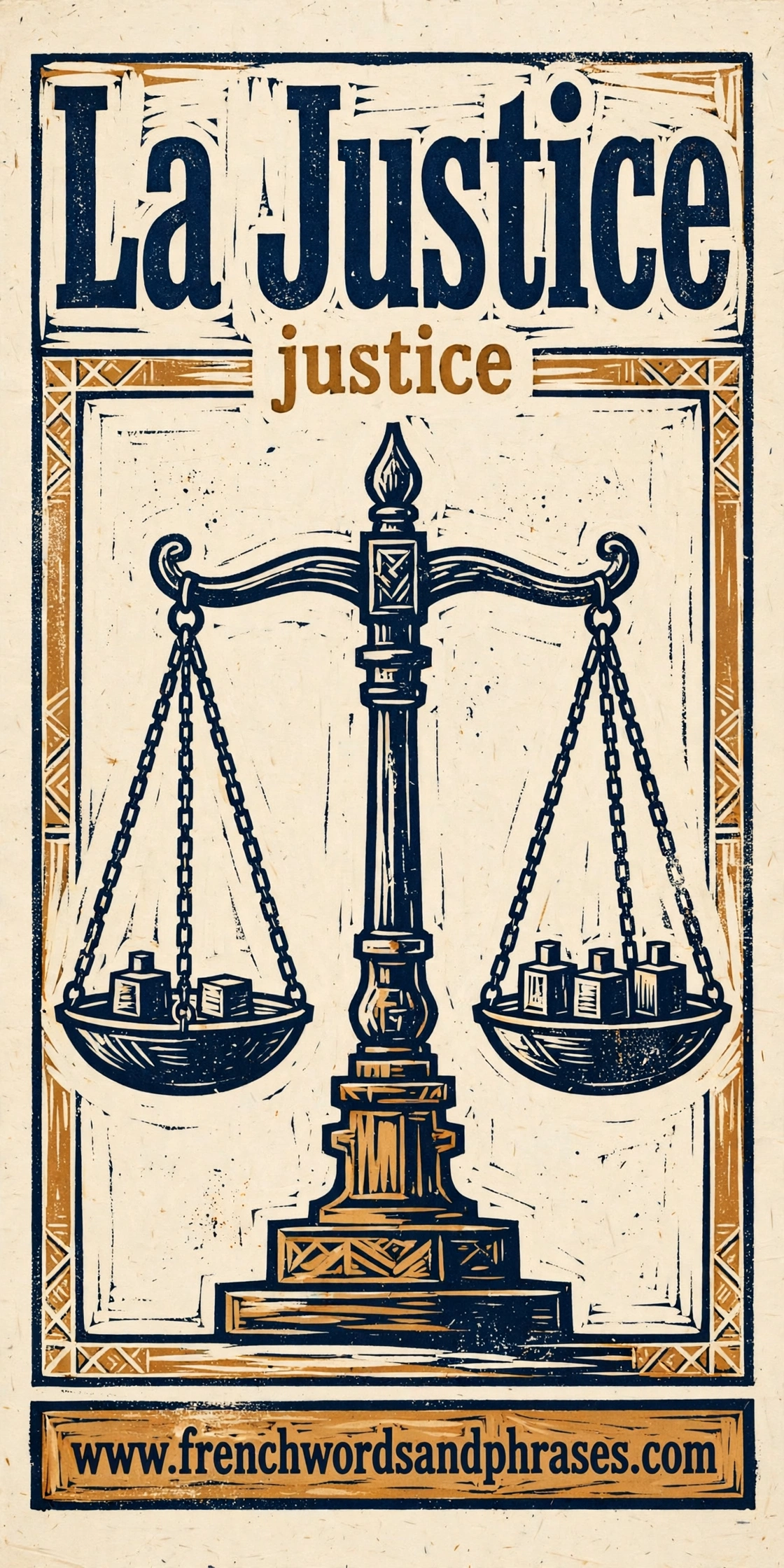
It evokes the blindfolded statue with her scales, the family on the courthouse steps, and the small phrase rendre justice — which slides, in daily speech, from the courtroom to a compliment: giving a person the credit they are owed.
How to Remember the French Noun Justice
Remember it this way: Justice is justice — feminine, both the idea of fairness and, with a capital J, the courts that serve it.
- You demand it — demander justice, sur les marches du tribunal.
- You give it as credit — rendre justice à quelqu’un, lui donner ce qu’il mérite.
- You never take it yourself — se faire justice soi-même is forbidden.
The key idea is la justice is the idea — la Justice is the institution.
Test Your Knowledge of Justice
Let’s see how much you’ve learned. Try answering these questions before revealing the answers.
Question 1
Is justice masculine or feminine?
Reveal the answer
Feminine — la justice, une justice.
Question 2
How do you say to demand justice in French?
Reveal the answer
Demander justice — the cry of victims and their families.
Question 3
Translate: The families demand justice.
Reveal the answer
Les familles demandent justice.
Question 4
What does rendre justice à quelqu’un mean in everyday speech?
Reveal the answer
To do someone justice — to give them the credit they deserve.
Question 5
Complete the sentence:
Le voleur a échappé à ______ justice pendant cinq ans. (the)
Reveal the answer
la
Le voleur a échappé à la justice pendant cinq ans.
The thief escaped justice for five years.
Your Final Challenge
Can You Use It?
How would you say this in French?
“The families demand justice.”
Reveal the answer
Les familles demandent justice.
The families demand justice.
A little French. A little curiosity. A richer everyday life.
LEARN FRENCH ONE WORD AT A TIME




