A French Word to Live By
Translate Jus to English
/ʒy/
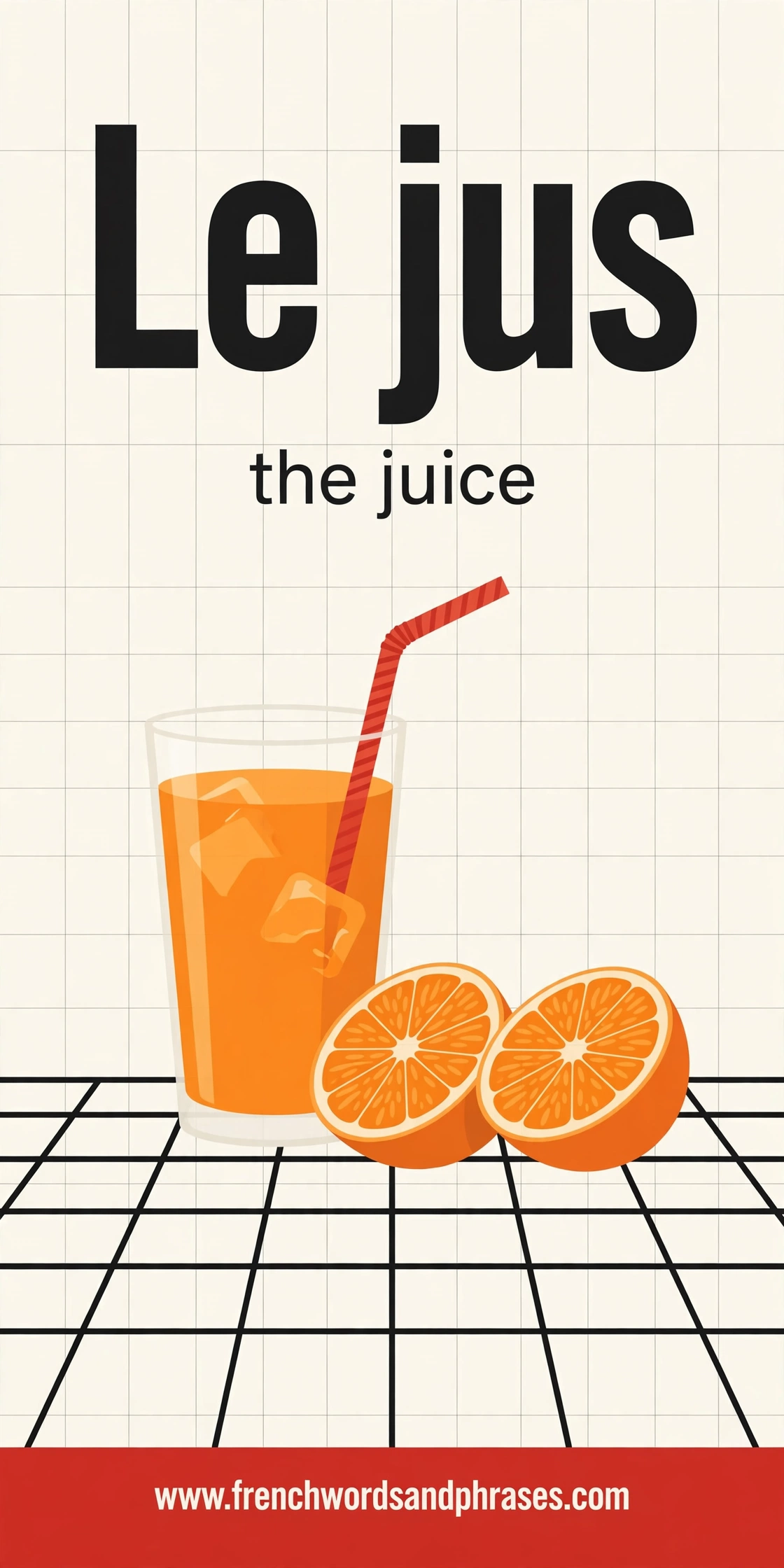
Le jus means the juice.
The oranges roll under the press, the handle comes down, and a bright stream fills the glass to the brim. Nothing in the fridge says morning quite like le jus.
In this guide, you’ll learn what jus means in English, how to use it with its articles, how to form its plural, and how it appears in everyday French. Explore French examples, English translations, and practice quizzes.
Understanding the French Noun Jus
Jus is a masculine French noun. It is learned together with its article: le jus, un jus. The final -s is part of the word and is never pronounced; the plural is written the same way: les jus. For an amount, French uses the partitive: du jus.
It means the juice — the liquid pressed from fruit: le jus d’orange, le jus de pomme, le jus de raisin. But jus has a second kitchen life: le jus de viande is the rich cooking juice of a roast, the liquid gold at the bottom of the dish.
Gender: Masculine
Definite article: le — le jus (the juice)
Indefinite article: un — un jus (a juice)
Plural: les jus — same spelling, the -s is already there
Partitive: du jus — some juice
English equivalents: The juice; juice. Also: the cooking juices of a roast.
One construction does all the work: jus de plus a fruit for pressed juices — jus de pomme, jus de citron — but jus d’orange, with d’, because orange begins with a vowel. And in slang, le jus can even mean electricity: il n’y a plus de jus, the power has gone.
Experience the Word
Jus is more than a drink. It is the sound of the press at breakfast, the colour of a just-cut orange, the glass emptied in three gulps before school.
Imagine the Sunday roast: the chicken rests, the dish is tilted, and the jus — dark, glossy, full of flavour — is spooned over everything like a signature.
You have not just had a drink. You have tasted the fruit itself — le jus, fraîchement pressé.
How to Use Jus in French: Complete Guide
Let’s explore how jus works in French, beginning with its articles — and the little de that names every flavour.
Jus with the Definite Article (Le, Les)
Used for the juice in front of you — le jus est sur la table.
| Form | French |
|---|---|
| Singular | le jus |
| Plural | les jus |
Example
Le jus est au frais, sers-toi un verre.
The juice is chilled, pour yourself a glass.
Jus with the Partitive and Indefinite Articles (Du, Un)
Du jus for some juice; un jus for one glass or one carton ordered.
| Form | French |
|---|---|
| Partitive | du jus |
| Indefinite singular | un jus |
| Plural | des jus |
Example
Au café, il commande un jus d’orange pressé.
At the café, he orders a freshly squeezed orange juice.
Choosing Your Jus: Kinds of Juice
Orange, apple or grape — the jus vocabulary of the breakfast table.
| French | In English |
|---|---|
| le jus d’orange | orange juice |
| le jus de pomme | apple juice |
| le jus de raisin | grape juice |
| le jus de citron | lemon juice |
| le jus de fruits | fruit juice |
| le jus de viande | the meat juices, the gravy juices |
Example
Les enfants adorent le jus de raisin bien frais.
The children love well-chilled grape juice.
Quick Quiz 1
Complete the sentence:
Au petit déjeuner, les enfants boivent ______. (some juice)
Reveal the answer
du jus
Au petit déjeuner, les enfants boivent du jus.
At breakfast, the children drink juice — du jus, the partitive.
The Plural of Jus
Jus already ends in -s, so the plural is written identically — only the article changes.
| Number | French |
|---|---|
| Singular | le jus |
| Plural | les jus |
Example
Tous les jus de ce bar sont pressés à la minute.
All the juices in this bar are squeezed to order.
Jus with Possessive Adjectives (Mon, Ton, Son…)
Possessives agree with the noun: jus is masculine, so it takes mon, ton, son.
| Owner | French |
|---|---|
| my | mon jus |
| your (tu) | ton jus |
| his / her | son jus |
| our | notre jus |
| your (vous) | votre jus |
| their | leur jus |
Example
Ne bois pas mon jus, prends le tien !
Don’t drink my juice, take yours!
Quick Quiz 2
Complete the sentence:
______ jus d’orange est délicieux, il est fait maison. (This)
Reveal the answer
Ce
Ce jus d’orange est délicieux, il est fait maison.
This orange juice is delicious, it is homemade.
Jus with Demonstrative Adjectives (Ce, Ces)
Used to point: ce jus, this juice here.
| Form | French |
|---|---|
| Singular | ce jus |
| Plural | ces jus |
Example
Ce jus de pomme vient de notre verger.
This apple juice comes from our orchard.
Jus with Adjectives
Adjectives agree with jus, masculine: frais, pressé, sucré.
| Adjective | With Jus |
|---|---|
| frais (fresh) | un jus frais |
| pressé (squeezed) | un jus pressé |
| sucré (sweet) | un jus sucré |
| acide (tart) | un jus acide |
| maison (homemade) | un jus maison |
Example
Rien de meilleur qu’un jus pressé le matin.
Nothing beats a freshly squeezed juice in the morning.
Quick Quiz 3
Complete the sentence:
Ce jus de citron est très ______. (tart)
Reveal the answer
acide
Ce jus de citron est très acide.
This lemon juice is very tart.
Everyday Expressions with Jus
Breakfast presses and power cuts — the jus phrases of daily life.
| Expression | In English |
|---|---|
| un jus d’orange pressé | a freshly squeezed orange juice |
| être dans son jus | to be in its original state, untouched |
| un coup de jus | an electric shock (informal) |
| il n’y a plus de jus | the power has gone, there’s no juice left |
| le jus de cuisson | the cooking juices |
| du jus de chaussette | dishwater coffee (slang, literally sock juice) |
Example
La vieille maison est restée dans son jus, rien n’a changé.
The old house has stayed in its original state, nothing has changed.
Words from the Same Family as Jus
Presses, juiciness and fruit — the words that travel with jus.
| French | In English |
|---|---|
| presser | to squeeze, to press |
| le presse-agrumes | the citrus press |
| juteux | juicy |
| le fruit | the fruit |
| extraire | to extract |
| la pulpe | the pulp |
Example
Cette orange est très juteuse, parfaite pour le jus.
This orange is very juicy, perfect for juice.
Quick Quiz 4
What is le jus de viande?
Reveal the answer
The meat juices — the flavourful liquid from a roast, spooned over the dish.
Verse le jus de viande sur le poulet rôti.
Pour the meat juices over the roast chicken.
Jus in Everyday French: Real-Life Examples
Now that you know the word, let’s see how jus appears in everyday French.
Example 1 — At breakfast
Les enfants boivent du jus d’orange au petit déjeuner.
The children drink orange juice at breakfast.
Example 2 — Squeezing
Il presse trois oranges pour faire du jus frais.
He squeezes three oranges to make fresh juice.
Example 3 — Ordering
Un jus de pomme bien frais, s’il vous plaît.
A well-chilled apple juice, please.
Example 4 — The roast
Elle arrose le rôti avec son jus de cuisson.
She bastes the roast with its cooking juices.
Example 5 — A power cut
Plus de jus dans tout le quartier depuis une heure !
No power in the whole neighbourhood for an hour!
Example 6 — Tart
Ce jus de citron est trop acide pour les enfants.
This lemon juice is too tart for the children.
Beyond Translation: The Meaning of Jus
Jus lives a double life in French: the bright drink of breakfast and the dark treasure at the bottom of the roasting dish. Chefs guard the second jealously — the jus of a roast chicken, skimmed and reduced, is a sauce all by itself. Slang took the word further still: electricity became du jus, a shock un coup de jus, and truly awful coffee earned the immortal name jus de chaussette, sock juice.
To say jus is to squeeze the best out of whatever you are given.
Fruit, roast or battery — in French, everything worth having has du jus in it.
How to Remember the French Noun Jus
Remember it this way: Jus is the juice — masculine, spelled with its -s in singular and plural alike, and named by jus de plus the fruit.
- You drink some — du jus au petit déjeuner.
- You name the fruit — jus de pomme, but jus d’orange before a vowel.
- You keep the roast’s treasure — le jus de viande, the cooking juices.
The key idea is le jus, du jus — jus de + fruit names them all.
Test Your Knowledge of Jus
Let’s see how much you’ve learned. Try answering these questions before revealing the answers.
Question 1
How do you say orange juice in French?
Reveal the answer
Le jus d’orange — jus d’, because orange begins with a vowel.
Question 2
Is jus masculine or feminine?
Reveal the answer
Masculine — le jus, du jus.
Question 3
Translate: The children drink apple juice.
Reveal the answer
Les enfants boivent du jus de pomme.
Question 4
What does il n’y a plus de jus mean in slang?
Reveal the answer
The power has gone — jus is slang for electricity.
Question 5
Complete the sentence:
Elle presse des citrons pour faire ______.
Reveal the answer
du jus
Elle presse des citrons pour faire du jus.
She squeezes lemons to make juice.
Your Final Challenge
Can You Use It?
How would you say this in French?
“The children drink orange juice at breakfast.”
Reveal the answer
Les enfants boivent du jus d’orange au petit déjeuner.
The children drink orange juice at breakfast.
A little French. A little curiosity. A richer everyday life.
LEARN FRENCH ONE WORD AT A TIME