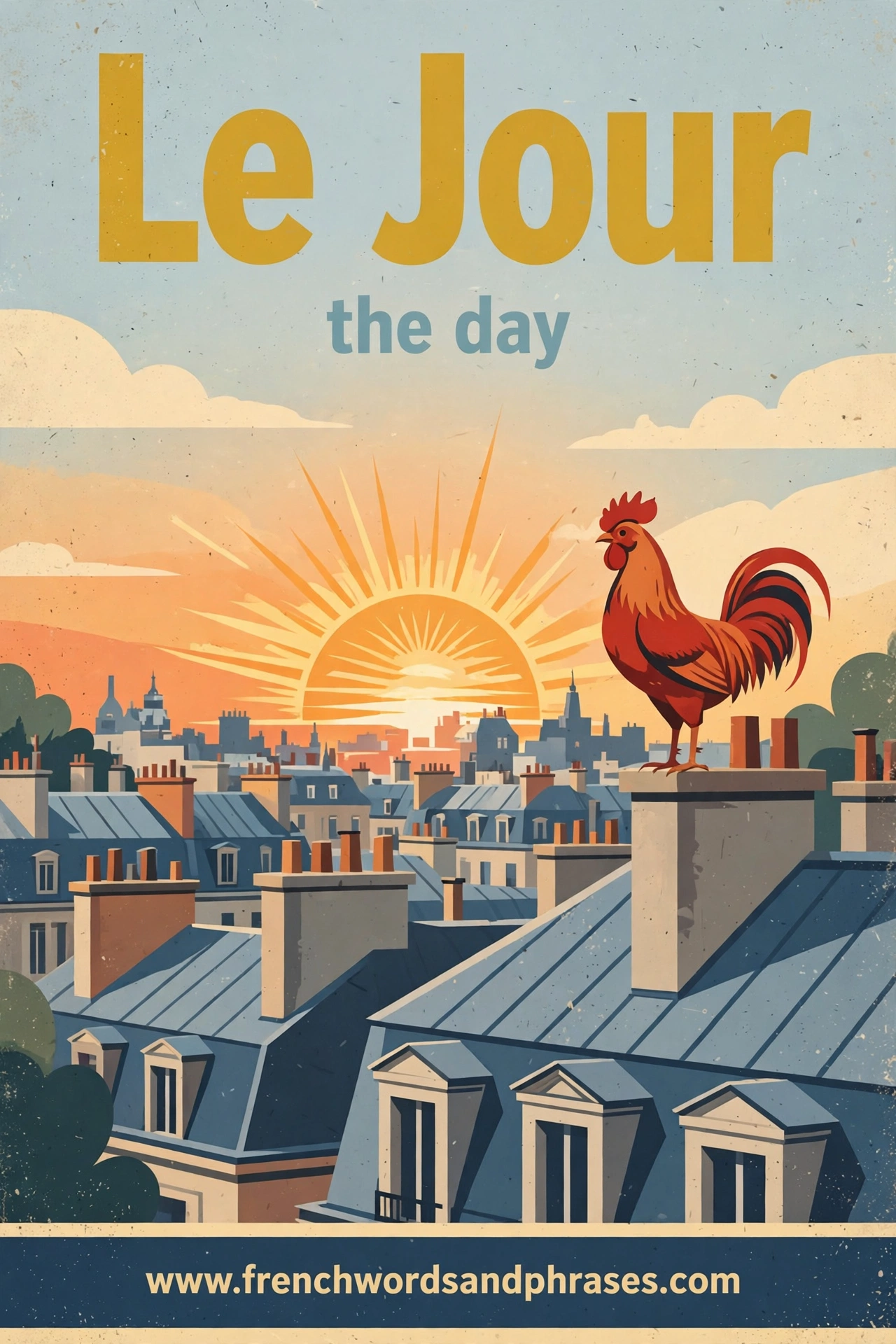
A French Word to Live By
Translate Jour to English
/ʒuʁ/
Le jour means a day.
First light at the shutters, bread still warm at breakfast, the long gold of evening settling on the fields. A single turning of the earth, filled from dawn to dark — that is le jour.
In this guide, you’ll learn what jour means in English, how to use it with its articles, how to form its plural, and how it appears in everyday French. Explore French examples, English translations, and practice quizzes.
Understanding the French Noun Jour
Jour is a masculine French noun. Like every French noun, it has a gender, and it is learned together with its article: le jour.
It means a day — one of the seven in a week, the daylight hours as opposed to the night, and also a date on the calendar. French asks quel jour sommes-nous ? — what day is it? — and answers in the rhythm of ordinary life: tous les jours, every day.
Gender: Masculine
Definite article: le — le jour (the day)
Indefinite article: un — un jour (a day)
Plural: les jours (the days)
English equivalents: A day.
One classic distinction: jour and journée both mean a day, but they look at it differently. Jour counts days and dates them — trois jours, three days; le jour de son mariage, his wedding day. Journée fills the day with everything that happens inside it — une journée de travail, a working day; bonne journée !, have a good day!
Experience the Word
Jour is more than twenty-four hours. It is one whole chance: a morning to begin again, an afternoon to fill, and an evening to remember.
Imagine a market day in a small town — the stalls set up at dawn, the church bells at noon, the children home from school at dusk — a whole world fitted between sunrise and sunset.
You have not just measured time. You have lived a day.
How to Use Jour in French: Complete Guide
Let’s explore how jour works in French, beginning with its articles.
Jour and Its Articles
French nouns are almost never used alone. The small word in front of the noun — the article — does a great deal of work.
Jour with the Definite Article (Le, Les)
Used for a particular day both speakers know about, or for the day in general — the daylight itself.
| Number | French |
|---|---|
| Singular | le jour |
| Plural | les jours |
Example
Le jour se lève tôt en été.
The day breaks early in summer.
Jour with the Indefinite Article (Un, Des)
Used to introduce a day for the first time: one day, or some days.
| Number | French |
|---|---|
| Singular | un jour |
| Plural | des jours |
Example
Un jour, je visiterai le Japon.
One day, I will visit Japan.
Jour with Numbers and Quantities
Jour is a count noun — you count days one by one, so instead of a partitive article, French uses numbers and quantity words.
| Quantity | French |
|---|---|
| deux (two) | deux jours |
| trois (three) | trois jours |
| plusieurs (several) | plusieurs jours |
| quelques (a few) | quelques jours |
| tous les (every) | tous les jours |
| chaque (each) | chaque jour |
Example
Le voyage dure trois jours.
The journey lasts three days.
Quick Quiz 1
How do you say two days in French?
Reveal the answer
deux jours
Il reste deux jours avant les vacances.
There are two days left before the holidays.
The Plural of Jour
Like most French nouns, jour simply adds an -s in the plural — a letter you see but do not hear.
| Number | French |
|---|---|
| Singular | le jour |
| Plural | les jours |
Example
Les jours rallongent au printemps.
The days grow longer in spring.
Jour with Possessive Adjectives (Mon, Ton, Son…)
Possessives agree with the noun, not with the owner — and jour is masculine, so it takes mon, ton, son in the singular.
| Owner | French |
|---|---|
| my | mon jour |
| your (tu) | ton jour |
| his / her | son jour |
| our | notre jour |
| your (vous) | votre jour |
| their | leur jour |
Example
C’est ton jour de chance !
It is your lucky day!
Quick Quiz 2
Complete the sentence:
______ grand jour est enfin arrivé. (our)
Reveal the answer
Notre
Notre grand jour est enfin arrivé.
Our big day has finally arrived.
Jour with Demonstrative Adjectives (Ce, Ces)
Used to point: this day here, those days there.
| Number | French |
|---|---|
| Singular | ce jour |
| Plural | ces jours |
Example
Ce jour-là, tout a changé.
On that day, everything changed.
Jour with Adjectives
Adjectives agree with the noun. Most come after it — un jour férié, un jour ensoleillé — but grand comes before it: le grand jour, the big day.
| Adjective | With Jour |
|---|---|
| férié (public holiday) | un jour férié |
| ouvrable (working) | un jour ouvrable |
| grand (big) | le grand jour |
| ensoleillé (sunny) | un jour ensoleillé |
| libre (free) | un jour libre |
| ordinaire (ordinary) | un jour ordinaire |
Example
Demain est un jour férié.
Tomorrow is a public holiday.
Quick Quiz 3
Complete the sentence:
Demain est un jour ______ (public holiday).
Reveal the answer
férié
Demain est un jour férié.
Tomorrow is a public holiday. (Férié is masculine and comes after the noun.)
Everyday Expressions with Jour
Jour measures milestones and menus alike — here are the phrases you will meet first.
| Expression | In English |
|---|---|
| le jour J | the big day, D-Day |
| de jour en jour | day by day |
| au jour le jour | from day to day, one day at a time |
| le plat du jour | the dish of the day |
| le jour de l’An | New Year’s Day |
| un jour ou l’autre | one day or another |
Example
Le plat du jour, c’est le poulet rôti.
The dish of the day is roast chicken.
Words from the Same Family as Jour
Learn these together and the whole rhythm of French daily life falls into place.
| French | In English |
|---|---|
| une journée | a day, as it is lived |
| un journal | a newspaper, a diary |
| aujourd’hui | today |
| quotidien / quotidienne | daily |
| bonjour | hello, good day |
| un séjour | a stay |
Example
Je lis le journal tous les matins.
I read the newspaper every morning.
Quick Quiz 4
What does de jour en jour mean?
Reveal the answer
Day by day
Le bébé grandit de jour en jour.
The baby grows day by day.
Jour in Everyday French: Real-Life Examples
Now that you know the word, let’s see how jour appears in everyday French.
Example 1 — A beautiful day
Quel beau jour pour une promenade !
What a beautiful day for a walk!
Example 2 — Every day
Il se lève tôt tous les jours.
He gets up early every day.
Example 3 — The wedding day
Le jour de son mariage, elle était radieuse.
On her wedding day, she was radiant.
Example 4 — Day by day
Le bébé grandit de jour en jour.
The baby grows day by day.
Example 5 — A day off
Demain est un jour férié.
Tomorrow is a public holiday.
Example 6 — One day
Un jour, tu comprendras.
One day, you’ll understand.
Beyond Translation: The Meaning of Jour
English says day for the meaning of jour — but the French word also carries the daylight itself: il fait jour, it is light, it is daytime.
To say jour is to say the light between two nights.
It evokes the greeting bonjour — literally good day — offered a hundred times before noon, and the great milestones of a life: le grand jour, the big day, and le jour J, the day itself.
How to Remember the French Noun Jour
Remember it this way: Jour is the day counted and dated, masculine — journée is the same day filled with living.
- You ask the date — quel jour sommes-nous ?
- You repeat something daily — tu le fais tous les jours.
- You wish someone well in the morning — bonne journée !
The key idea is le jour for the day and the date, tous les jours for every day.
Test Your Knowledge of Jour
Let’s see how much you’ve learned. Try answering these questions before revealing the answers.
Question 1
Is jour masculine or feminine?
Reveal the answer
Masculine — le jour.
Question 2
How do you say every day in French?
Reveal the answer
Tous les jours.
Question 3
Translate: We spent three days by the sea.
Reveal the answer
Nous avons passé trois jours au bord de la mer.
Question 4
What does le plat du jour mean?
Reveal the answer
The dish of the day.
Question 5
Complete the sentence:
Il se lève tôt ______ les jours. (every)
Reveal the answer
tous
Il se lève tôt tous les jours.
He gets up early every day.
Your Final Challenge
Can You Use It?
How would you say this in French?
“He gets up early every day.”
Reveal the answer
Il se lève tôt tous les jours.
He gets up early every day.
A little French. A little curiosity. A richer everyday life.
LEARN FRENCH ONE WORD AT A TIME