A French Word to Live By
Translate Ce n’est pas grave to English
/sə nɛ pa ɡʁav/
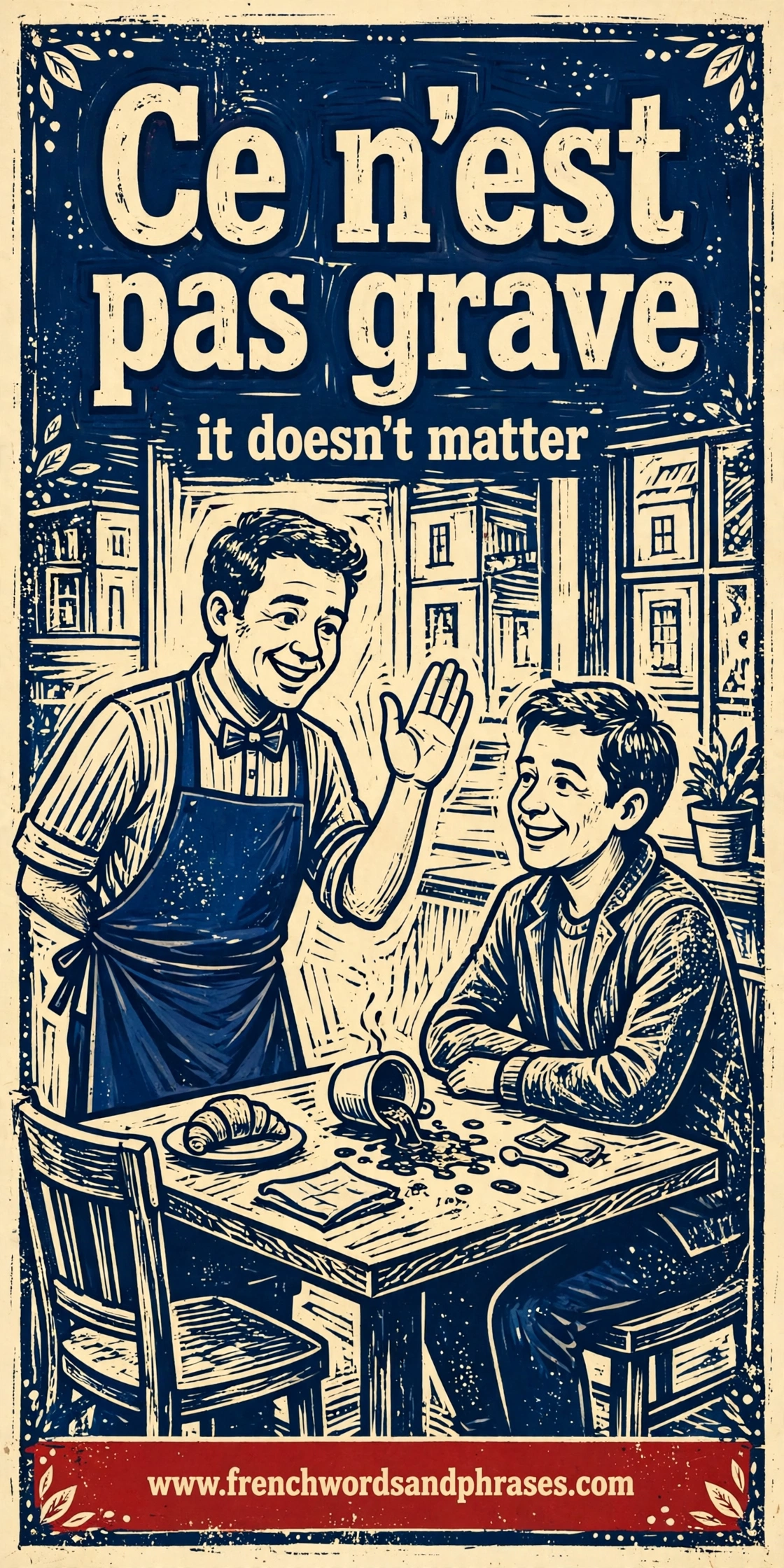
Ce n’est pas grave means it doesn’t matter — no big deal.
A café terrace, a clumsy elbow, and a glass of water tips across your notebook. Your friend’s face falls — « Pardon, pardon ! » You smile, mop the page with a napkin, and wave the whole thing away: « Ce n’est pas grave. » Four small words, and the accident shrinks back to its real size: nothing.
Let’s explore how ce n’est pas grave works in French, beginning with the whole phrase on one card.
Understanding the French Phrase Ce n’est pas grave
Ce n’est pas grave is a French reassurance formula — a negative statement built from ce (it), être (to be) and grave (serious). It is the standard French answer to an apology, a small accident or a forgotten thing: the verbal wave of the hand that says the damage is zero.
It means it doesn’t matter, no big deal — literally, ‘it is not serious’. A spilt coffee, a friend ten minutes late, a broken cheap glass: ce n’est pas grave measures the mishap and finds it weighs nothing. It is one of the kindest phrases in everyday French.
Type: A reassurance formula — a negative statement: ce n’est pas grave
Answers the need: Telling someone their mistake, mishap or lateness does not matter
Register: Neutral and warm — safe everywhere, from family to office
Strength: Gentle — a wave of the hand; add vraiment or du tout to insist
One important usage detail: ce n’est pas grave is a reply — it answers apologies (pardon, excuse-moi, je suis désolé) and confessions (j’ai oublié, j’ai cassé). It also answers small injuries: tu t’es fait mal ? — non, ce n’est pas grave. In relaxed speech the ne often disappears: c’est pas grave.
Experience the Word
Ce n’est pas grave is social first aid — four words that close a small wound before it can grow.
Imagine a child in a bakery knocking a croissant to the floor, eyes wide, waiting for anger. The baker laughs: « Ce n’est pas grave, tiens, en voilà un autre. » No big deal — here, have another.
French politeness runs on minimising. The phrase shrinks the accident and rescues the person in a single breath.
How to Use Ce n’est pas grave in French: Complete Guide
Let’s explore how ce n’est pas grave works in French, beginning with the whole phrase on one card.
Ce n’est pas grave at a Glance
The Whole Phrase on One Card
Real meaning, literal build, English twin and register — ce n’est pas grave in five lines.
| Point | Ce n’est pas grave |
|---|---|
| What it really means | it doesn’t matter — no big deal |
| Word for word | it is not serious |
| English equivalent | no big deal / it doesn’t matter / don’t worry about it |
| Register | neutral and warm — safe everywhere |
| Use it for | answering apologies, small accidents, forgotten things |
Example
Ce n’est pas grave, ça arrive à tout le monde.
It’s no big deal, it happens to everyone.
Word by Word: Building the Reassurance
Four small pieces — a pointer, a negative, and one key word that does all the measuring.
| Word | Literal meaning | Its job in the phrase |
|---|---|---|
| ce | it / that | points at the mishap — the spill, the lateness, the mistake |
| n’est | is not (ne + est) | est from être, to be — with ne wrapped around it |
| pas | not | the second half of the French negative, the word that carries the ‘no’ |
| grave | serious | the key word — it measures the damage and finds it small |
Example
Ce n’est pas grave, le verre était déjà vieux.
It’s no big deal, the glass was already old.
Quick Quiz 1
What does grave mean in ce n’est pas grave?
Reveal the answer
Serious — the phrase literally says ‘it is not serious’; grave here has nothing to do with a tomb.
Ce n’est pas grave, vraiment.
It’s really no big deal.
When You Say It: The Small-Accident Moments
Ce n’est pas grave fires at moments like these — someone apologises, and you shrink the damage to zero.
| Situation | Example |
|---|---|
| A spilt drink | tu as renversé ton café ? ce n’est pas grave — you spilt your coffee? no big deal |
| A friend arriving late | tu as dix minutes de retard ? ce n’est pas grave — you’re ten minutes late? it doesn’t matter |
| A broken glass | j’ai cassé un verre… — ce n’est pas grave — I broke a glass… — no big deal |
| A forgotten document | j’ai oublié le dossier — ce n’est pas grave, on l’enverra demain — I forgot the file — no problem, we’ll send it tomorrow |
| A bumped foot | pardon, je t’ai marché sur le pied ! — ce n’est pas grave — sorry, I stepped on your foot! — it’s nothing |
Example
Ce n’est pas grave, je viens d’arriver aussi.
No big deal, I only just arrived myself.
Make It Yours: Softer, Stronger, Spoken and Past
The phrase stretches — insist with du tout, drop the ne in speech, or move it into the past.
| Form | French | In English |
|---|---|---|
| The classic | ce n’est pas grave | it’s no big deal |
| Stronger reassurance | ce n’est vraiment pas grave / ce n’est pas grave du tout | it’s really nothing at all |
| Everyday spoken form | c’est pas grave | no big deal (the ne drops in speech) |
| In the past | ce n’était pas grave | it wasn’t a big deal |
| Paired with comfort | ne t’inquiète pas, ce n’est pas grave | don’t worry, it’s no big deal |
| The question it answers | c’est grave ? | is it serious? |
Example
C’est pas grave, on recommence.
No big deal, we’ll start again.
Quick Quiz 2
How does the phrase usually sound in relaxed, everyday speech?
Reveal the answer
C’est pas grave — the ne disappears, as it does in most spoken negatives.
T’inquiète, c’est pas grave.
Don’t worry, it’s no big deal.
Everyday Expressions: Building on the Phrase
Ce n’est pas grave slots into these everyday frames — each one ready to use as it stands.
| Frame | In English |
|---|---|
| ce n’est pas grave, ça arrive | no big deal, these things happen |
| ce n’est pas grave, je t’assure | it’s nothing, I assure you |
| ce n’est pas grave pour cette fois | no big deal this time |
| ce n’est pas grave, on recommence | no big deal, we’ll start over |
| mais non, ce n’est pas grave | oh no, it’s nothing (the warm opener) |
Example
Ce n’est pas grave, ça arrive même aux meilleurs.
It’s no big deal, it happens to the best of us.
Close Cousins: The Other Ways to Wave It Away
French keeps a whole drawer of minimisers — ce n’est pas grave measures the damage; its cousins aim at slightly different targets.
| Expression | The difference |
|---|---|
| ce n’est pas grave | it’s not serious — about the mishap itself |
| ce n’est rien | it’s nothing — even lighter, the damage is zero |
| pas de souci | no worries — answers thanks as well as apologies |
| ne t’inquiète pas | don’t worry — comforts the person, not the thing |
| ça ne fait rien | it doesn’t matter — a slightly old-fashioned twin |
| tant pis | too bad / oh well — accepts a loss instead of forgiving one |
Example
Tant pis pour le concert, mais ce n’est pas grave.
Too bad about the concert, but it’s no big deal.
Quick Quiz 3
A friend missed the last train home. Do you comfort them with ce n’est pas grave or tant pis?
Reveal the answer
Tant pis for the lost train — it accepts a loss; ce n’est pas grave reassures a person that their mistake does not matter.
Tant pis, tu dors chez moi ce soir.
Oh well, you’re sleeping at my place tonight.
Ce n’est pas grave and Its Neighbours
The apology shelf around the phrase — the sorries it answers, and the serious end it turns away from.
| French | In English |
|---|---|
| pardon / excuse-moi | sorry / excuse me (what it answers) |
| je suis désolé | I’m sorry (the fuller apology) |
| ce n’est pas grave | it’s no big deal (the forgiveness) |
| ce n’est rien | it’s nothing (even lighter) |
| ça arrive | these things happen (the shrug that follows) |
| c’est grave | it IS serious (the true opposite) |
Example
Pardon ! — Ce n’est rien, ce n’est pas grave.
Sorry! — It’s nothing, no big deal.
Watch Out: The Traps Around Ce n’est pas grave
The traps: a famous false friend, a missing pas, and the moments when the phrase is too light.
| Trap | The truth |
|---|---|
| hearing grave as the English ‘grave’ | false friend — grave means serious; a tomb is une tombe |
| dropping the pas | ce n’est grave is broken French — the negative needs both ne and pas (in writing) |
| using it for genuinely bad news | at a real accident or sad news it sounds dismissive — say je suis désolé instead |
| confusing it with the accent | un accent grave is the falling accent on è — same word, grammar meaning |
| answering thanks with it | for a favour received, pas de souci or de rien fits better — this one forgives mishaps |
Example
Ce n’est pas grave, mais conduis plus doucement.
It’s no big deal, but drive more slowly.
Quick Quiz 4
True or false: grave in this phrase refers to a tomb, like the English word.
Reveal the answer
False — grave means serious; the phrase says ‘it is not serious’. A tomb is une tombe.
Ce n’est pas grave, c’est juste une erreur.
It’s no big deal, it’s just a mistake.
Ce n’est pas grave in Everyday French: Real-Life Examples
Now that you know the word, let’s see how ce n’est pas grave appears in everyday French.
Example Example 1 — Spilt coffee
Tu as renversé un peu de café ? Ce n’est pas grave.
You spilt a bit of coffee? It’s no big deal.
Example Example 2 — A late friend
Ce n’est pas grave, je viens d’arriver aussi.
No big deal, I only just arrived too.
Example Example 3 — A broken glass
J’ai cassé un verre… — Ce n’est pas grave, il y en a d’autres.
I broke a glass… — No big deal, there are more.
Example Example 4 — A forgotten umbrella
J’ai oublié ton parapluie. — Ce n’est pas grave, je le prendrai demain.
I forgot your umbrella. — No problem, I’ll get it tomorrow.
Example Example 5 — A stepped-on foot
Pardon, je t’ai marché sur le pied ! — Ce n’est pas grave.
Sorry, I stepped on your foot! — It’s nothing.
Example Example 6 — The wrong file
Je t’ai envoyé le mauvais document. — Ce n’est pas grave, envoie-moi le bon.
I sent you the wrong document. — No big deal, send me the right one.
Beyond Translation: The Meaning of Ce n’est pas grave
Underneath ce n’est pas grave sits a whole philosophy of French daily life: most accidents are small, most apologies are sincere, and the fastest way back to a good day is to declare the damage zero.
To say ce n’est pas grave is to measure the mishap out loud — and find it weighs nothing.
Learn to say it warmly and you will hear it everywhere: in bakeries, on trains, in playgrounds — the small change of French kindness, passed back and forth all day long.
How to Remember the French Phrase Ce n’est pas grave
Remember it this way: Remember it this way: Ce n’est pas grave is a pair of scales — it weighs the accident and announces: not serious.
- You translate the key word first — grave means serious, never a tomb.
- You keep both halves of the negative — ne and pas in writing, pas alone in relaxed speech.
- You save it for small things — real bad news deserves je suis désolé.
The key idea is ce n’est pas grave means it’s no big deal — literally, it is not serious.
Test Your Knowledge of Ce n’est pas grave
Let’s see how much you’ve learned. Try answering these questions before revealing the answers.
Question 1
What does ce n’est pas grave mean?
Reveal the answer
It doesn’t matter — no big deal. Literally, ‘it is not serious’.
Question 2
What does grave mean in this phrase?
Reveal the answer
Serious. It is a false friend: the English ‘grave’ (a tomb) is une tombe in French.
Question 3
How does the phrase sound in relaxed speech?
Reveal the answer
C’est pas grave — the ne of the negative drops away, as in most spoken French.
Question 4
When should you NOT use ce n’est pas grave?
Reveal the answer
At genuinely serious news — a real accident or a loss; there it sounds dismissive, and je suis désolé is the kind phrase.
Question 5
Complete the sentence:
Pardon, j’ai cassé ton verre. — Ce n’est pas ______. (Sorry, I broke your glass. — It’s no big deal.)
Reveal the answer
grave
Ce n’est pas grave.
It’s no big deal.
Your Final Challenge
Can You Use It?
How would you say this in French?
“How would you say this in French?”
Reveal the answer
Ce n’est pas grave, ça arrive à tout le monde.
It’s no big deal, it happens to everyone.
A little French. A little curiosity. A richer everyday life.
LEARN FRENCH ONE WORD AT A TIME