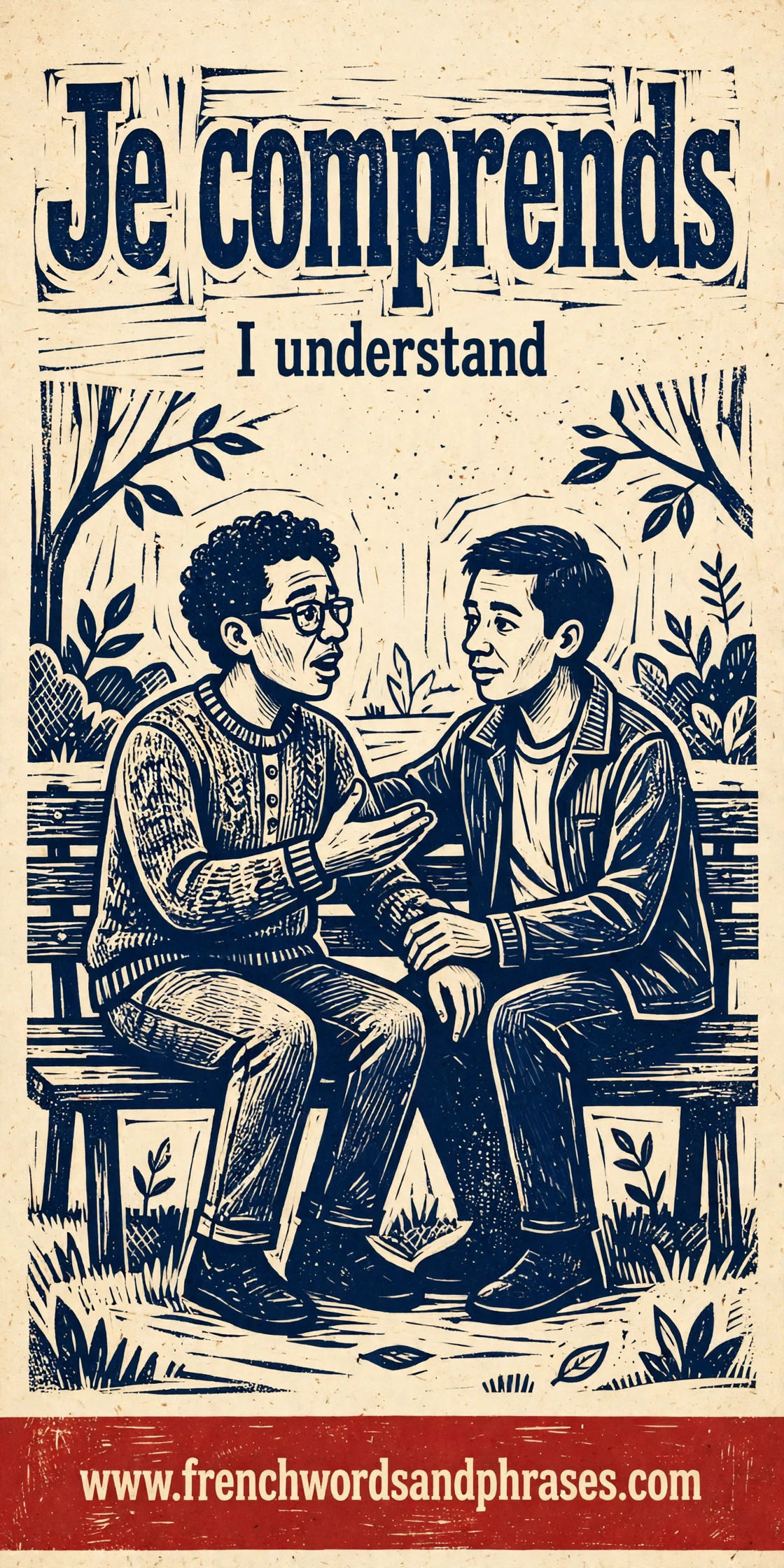
A French Word to Live By
Translate Je comprends to English
/ʒə kɔ̃.pʁɑ̃/
Je comprends means I understand.
Your friend is explaining, a little embarrassed, why she cannot come to your birthday dinner — the babysitter cancelled, the car is broken, the week has been impossible. You can see her bracing for disappointment. Instead you nod: « Je comprends. » I understand. Two words, and the friendship is safe.
Let’s explore how je comprends works in French, beginning with the whole phrase on one card.
Understanding the French Phrase Je comprends
Je comprends is a French present-tense statement — the verb comprendre (to understand) in the present, first person. Comprendre is built from the prendre family (to take): understanding, in the old Latin picture, is taking an idea in. The present tense makes it a state: the light is on, and stays on.
It means I understand. Said during an explanation, it confirms you are following; said to someone’s reasons, it acknowledges them — I see why, I take your point. A poster may gloss it ‘Fair enough!’, and as a reply to someone’s reasons that is exactly the feeling — but the phrase itself simply and fully means I understand.
Type: A present-tense statement — comprendre (to understand) in the present
Answers the need: Saying you follow an explanation — or that you take someone’s point
Register: Neutral — safe in every conversation, from classroom to kitchen
Strength: Calm acknowledgement — te comprends adds empathy, bien adds emphasis
One important usage detail: the poster’s ‘Fair enough!’ gloss is a loose, situational fit. When a friend explains why they cannot come, je comprends acknowledges their reasons — and English reaches for ‘fair enough’ at that same moment. But je comprends is not a translation of fair enough; it is I understand, used everywhere understanding happens. For empathy — I know what you are going through — French adds the person: je te comprends.
Experience the Word
Je comprends is the steadiest phrase in French conversation — it follows lessons, absorbs explanations and forgives cancellations.
Imagine a teacher scanning the class after a difficult explanation: « Vous comprenez ? » — and the quiet, honest nod back: « Oui, je comprends. » The lesson can move on.
It is also the phrase that keeps disagreements civilised. Je comprends, mais… is the door through which every polite French argument walks.
How to Use Je comprends in French: Complete Guide
Let’s explore how je comprends works in French, beginning with the whole phrase on one card.
Je comprends at a Glance
The Whole Phrase on One Card
Real meaning, literal build, English twin and register — je comprends in five lines.
| Point | Je comprends |
|---|---|
| What it really means | I understand — I follow, I take the point |
| Word for word | I understand (present tense of comprendre) |
| English equivalent | I understand / I get it / (replying to reasons) fair enough |
| Register | neutral — safe in every setting |
| Use it for | following explanations, acknowledging reasons and feelings |
Example
Je comprends, ne t’inquiète pas.
I understand, don’t worry.
Word by Word: Building the Statement
Two pieces only — but the verb’s ending carries a spelling lesson worth learning now.
| Word | Literal meaning | Its job in the phrase |
|---|---|---|
| je | I | the speaker — the one doing the understanding |
| comprends | understand | present tense of comprendre; the -ds ending belongs to je and tu |
| comprendre | to understand | the verb itself — from the prendre family: to take in, to grasp |
| comprend | understands | the il/elle form — the s drops away: il comprend |
Example
Elle comprend très bien le français.
She understands French very well.
Quick Quiz 1
Is je comprends present or past — a state, or a finished event?
Reveal the answer
Present — a state. The finished click of understanding is the passé composé: j’ai compris.
Je comprends la question.
I understand the question.
When You Say It: The Following-Along Moments
Je comprends fires at moments like these — a lesson, an explanation, a friend’s difficult reasons.
| Situation | Example |
|---|---|
| In class | vous comprenez ? — oui, je comprends — do you understand? — yes, I understand |
| A friend’s cancellation | je comprends, ne t’inquiète pas — I understand, don’t worry |
| Listening to a problem | je te comprends, c’est dur — I understand you, it’s hard |
| On the phone with an office | je comprends, merci pour l’explication — I understand, thanks for explaining |
| Before disagreeing politely | je comprends, mais je vois les choses autrement — I understand, but I see things differently |
Example
Je comprends ton point de vue.
I understand your point of view.
Make It Yours: Persons, the Negative and Empathy
The verb dresses for each person — and one small te turns information into empathy.
| Form | French | In English |
|---|---|---|
| Asking a friend | tu comprends ? | do you understand? / you see? |
| Third person | il comprend / elle comprend | he / she understands (no s!) |
| A group | nous comprenons | we understand |
| The negative | je ne comprends pas | I don’t understand |
| With emphasis | je comprends bien | I understand perfectly well |
| With empathy | je te comprends | I understand you — I know what you mean |
Example
Je ne comprends pas ce mot, tu peux répéter ?
I don’t understand this word, can you repeat it?
Quick Quiz 2
How do you turn je comprends into empathy — ‘I understand what you’re going through’?
Reveal the answer
Je te comprends — adding te aims the understanding at the person, not the facts.
Je te comprends, c’est une période difficile.
I understand, it’s a difficult time.
Everyday Expressions: Building on the Phrase
Je comprends slots into these everyday frames — each one ready to use as it stands.
| Frame | In English |
|---|---|
| je comprends, ne t’inquiète pas | I understand, don’t worry |
| je comprends ton point de vue | I understand your point of view |
| je comprends mieux maintenant | I understand better now |
| je comprends, mais je ne suis pas d’accord | I understand, but I don’t agree (polite disagreement) |
| si je comprends bien… | if I understand correctly… |
Example
Si je comprends bien, le train part à neuf heures.
If I understand correctly, the train leaves at nine.
Close Cousins: The Understanding Family
French separates kinds of ‘getting it’ carefully — je comprends is the steady state; its cousins catch the click, the agreement and the belief.
| Expression | The difference |
|---|---|
| je comprends | I understand — the present state, the light is on |
| j’ai compris | I got it — the finished click when the explanation landed |
| je vois | I see — following along, lighter and less committal |
| ça a du sens | it makes sense — judges the idea, not your state |
| d’accord | agreed — accepts a proposal; understanding is not required |
| je te crois | I believe you — trust in the person, not grasp of the facts |
Example
Je vois, je comprends, d’accord.
I see, I understand, agreed.
Quick Quiz 3
« Je comprends, mais je ne suis pas d’accord » — what does this famous pairing prove?
Reveal the answer
That understanding is not agreement — je comprends takes the point in; being d’accord is a separate, second step.
Je comprends ton avis, mais je garde le mien.
I understand your view, but I’m keeping mine.
Je comprends and Its Neighbours
The conversation shelf around the phrase — from listening in, to lost completely.
| French | In English |
|---|---|
| je t’écoute | I’m listening (the open door) |
| explique-moi encore | explain it to me again |
| je comprends | I understand (the steady state) |
| je suis d’accord | I agree (one step further) |
| je ne comprends pas | I don’t understand (the honest opposite) |
| je n’y comprends rien | I don’t understand a thing about it (the full fog) |
Example
Je t’écoute, et je comprends.
I’m listening, and I understand.
Watch Out: The Traps Around Je comprends
The traps: a poster’s loose gloss, a wandering s, and the click that wants the other phrase.
| Trap | The truth |
|---|---|
| learning it as ‘fair enough’ | the poster’s gloss is situational — je comprends means I understand; ‘fair enough’ is just what English says at the same moment |
| writing il comprends | the s belongs to je and tu only — il comprend, no s |
| using it for the finished click | after instructions, the snappy confirmation is j’ai compris — the event, not the state |
| hearing tu comprends as a question every time | in speech it is often a softener — ‘you know, you see’ — sprinkled through explanations |
| confusing comprendre with apprendre | apprendre is to learn (or teach); comprendre is to understand — first the learning, then the understanding |
Example
Il comprend vite, c’est un bon élève.
He understands quickly, he’s a good pupil.
Quick Quiz 4
Spot the mistake: “il comprends le français“.
Reveal the answer
The s — il comprend drops it; the -ds ending belongs to je and tu only.
Il comprend le français et l’espagnol.
He understands French and Spanish.
Je comprends in Everyday French: Real-Life Examples
Now that you know the word, let’s see how je comprends appears in everyday French.
Example Example 1 — In class
Vous comprenez ? — Oui, je comprends.
Do you understand? — Yes, I understand.
Example Example 2 — A friend’s reasons
Je comprends, ne t’inquiète pas.
I understand, don’t worry.
Example Example 3 — With empathy
Je te comprends, c’est une période difficile.
I understand, it’s a difficult time.
Example Example 4 — On the phone
Je comprends, merci pour l’explication.
I understand, thank you for the explanation.
Example Example 5 — Polite disagreement
Je comprends ton avis, mais je vois les choses autrement.
I understand your view, but I see things differently.
Example Example 6 — Following a recipe
Je comprends, on mélange doucement.
I understand, we mix gently.
Beyond Translation: The Meaning of Je comprends
There is a reason je comprends does so much quiet work in French life: it separates two things English often fuses — grasping what someone means, and agreeing with it. French keeps the steps apart, and the first step costs nothing.
To say je comprends is to open the door; agreement can decide later whether to walk through.
That is why the phrase appears at the hardest moments as well as the easiest — at cancellations, at explanations, at the start of arguments that stay kind. Understanding first: it is the courtesy the whole conversation stands on.
How to Remember the French Phrase Je comprends
Remember it this way: Remember it this way: Je comprends is the light switched on — a present state, with a -ds ending for je and tu.
- You keep the state and the click apart — je comprends is on; j’ai compris is the moment it switched on.
- You guard the s — je comprends, tu comprends, but il comprend without it.
- You add te for the heart — je te comprends means you understand the person, not just the facts.
The key idea is je comprends means I understand — the present state of comprendre.
Test Your Knowledge of Je comprends
Let’s see how much you’ve learned. Try answering these questions before revealing the answers.
Question 1
What does je comprends mean?
Reveal the answer
I understand. The present tense of comprendre — a state of following and taking in.
Question 2
How do you write ‘he understands’?
Reveal the answer
Il comprend — the s of comprends belongs to je and tu only.
Question 3
What is the difference between je comprends and j’ai compris?
Reveal the answer
Je comprends is the ongoing state; j’ai compris is the finished click — the moment an explanation landed.
Question 4
How do you say ‘I understand you’ with empathy?
Reveal the answer
Je te comprends — the added te aims the understanding at the person and their situation.
Question 5
Complete the sentence:
Je ______ ton point de vue, mais je ne suis pas d’accord. (I understand your point of view, but I don’t agree.)
Reveal the answer
comprends
Je comprends ton point de vue, mais je ne suis pas d’accord.
I understand your point of view, but I don’t agree.
Your Final Challenge
Can You Use It?
How would you say this in French?
“How would you say this in French?”
Reveal the answer
Je comprends, merci de m’avoir expliqué.
I understand, thank you for explaining it to me.
A little French. A little curiosity. A richer everyday life.
LEARN FRENCH ONE WORD AT A TIME