A French Word to Live By
Translate Jambon to English
/ʒɑ̃.bɔ̃/
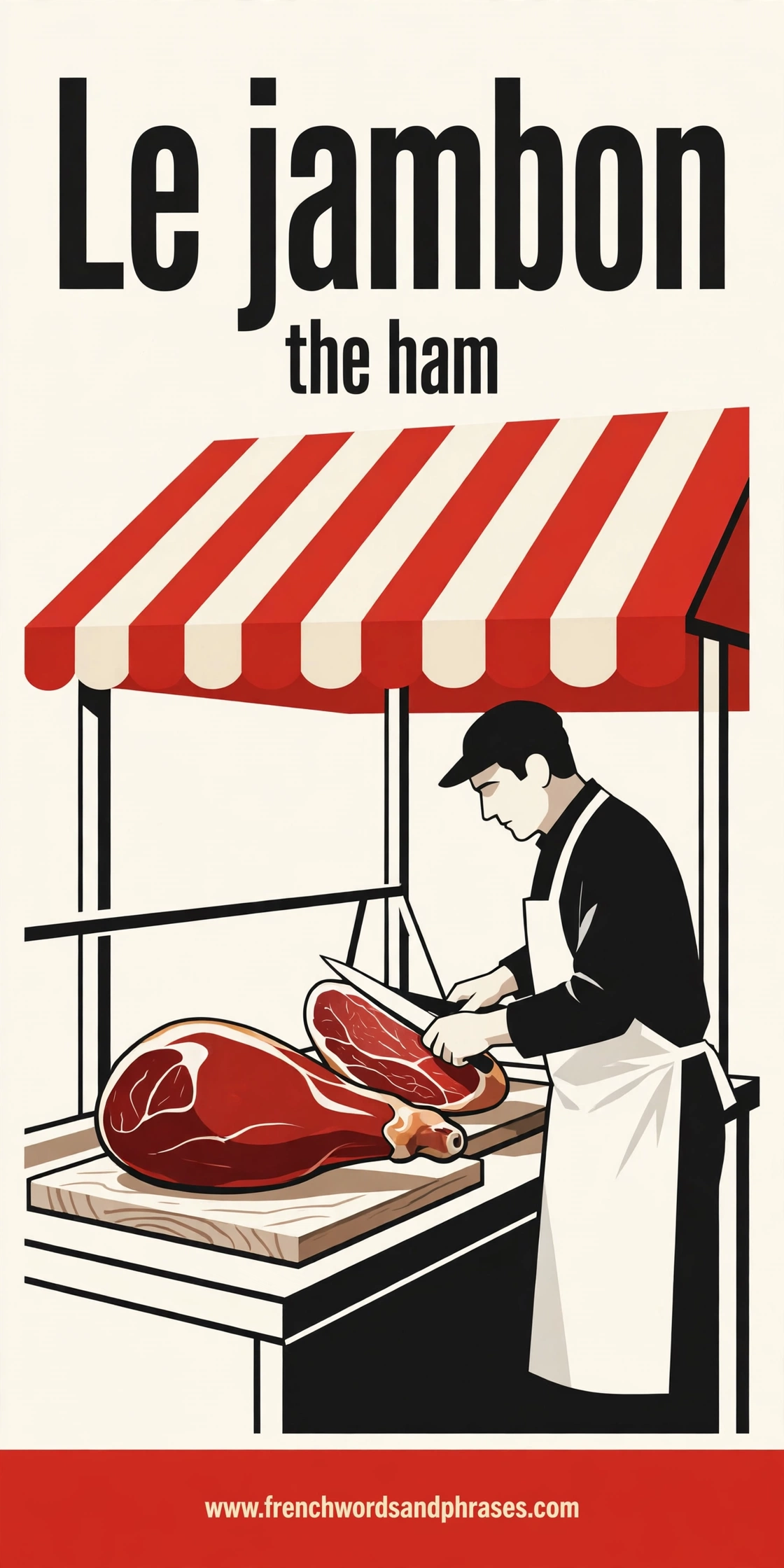
Le jambon means ham.
At the charcuterie counter, great hams hang in a row — pale, rosy, deep red — while the slicer hums and the first transparent slices fall like silk. The customer points: « Du jambon, s’il vous plaît. »
In this guide, you’ll learn what jambon means in English, how to use it with its articles, how to form its plural, and how it appears in everyday French. Explore French examples, English translations, and practice quizzes.
Understanding the French Noun Jambon
Jambon is a masculine French noun, learned with its article: le jambon. At the table it behaves as a mass noun — you eat du jambon (some ham) — while a whole leg on the bone is countable: un jambon. It comes from la jambe, the leg, which is exactly what it is.
It means ham — the cured or cooked leg of pork that anchors the French charcuterie counter. There is le jambon blanc (cooked ham, the pink slices of the famous jambon-beurre sandwich), le jambon cru (raw cured ham, like the jambon de Bayonne), and le jambon fumé (smoked ham). A slice is une tranche de jambon.
Gender: Masculine
Definite article: le — le jambon (ham, the ham)
Indefinite article: un — un jambon (a whole ham, a leg of ham)
Partitive article: du — du jambon (some ham, at the table)
Plural: les jambons — whole hams hanging at the charcuterie
English equivalents: Ham; a slice is une tranche de jambon.
One important usage detail: French distinguishes the two great families — le jambon blanc, cooked and pink, for sandwiches and croque-monsieur; and le jambon cru, cured raw and sliced thin, for the apéritif plate. Asking simply for « du jambon » at a Paris café gets you the jambon-beurre: a baguette, butter, jambon blanc — the classic lunch of the capital.
Experience the Word
Jambon is more than a charcuterie. It is the sandwich of Paris — half the city’s lunch hours run on jambon-beurre — and the pride of Bayonne, where hams cure slowly in the mountain air.
Imagine the first slice cut from a jambon cru: deep red, marbled, salty and sweet at once, melting before you have even chewed.
You have not just eaten ham. You have tasted a tradition — affinée, matured slowly, the jambon’s way.
How to Use Jambon in French: Complete Guide
Let’s explore how jambon works in French, beginning with its articles — du jambon on the plate, un jambon on the hook.
Jambon with the Definite Article (Le, Les)
Used for ham in general, or the particular ham at the counter.
| Form | French |
|---|---|
| Singular | le jambon |
| Plural | les jambons |
Example
Le jambon de Bayonne est protégé par une appellation.
Bayonne ham is protected by an official label.
Jambon with the Indefinite and Partitive Articles (Un, Du)
Un jambon is the whole leg; du jambon is the portion on your plate — the partitive is the everyday form.
| Form | French |
|---|---|
| A whole ham | un jambon |
| Some, to eat | du jambon |
| Plural | des jambons |
Example
Je voudrais du jambon blanc, quatre tranches, s’il vous plaît.
I would like some cooked ham, four slices, please.
At the Charcuterie: Words of the Jambon
Slices, sandwiches and cures — the vocabulary that surrounds the jambon.
| French | In English |
|---|---|
| la tranche | the slice |
| le jambon blanc | cooked ham |
| le jambon cru | cured raw ham |
| le jambon fumé | smoked ham |
| la charcuterie | the pork butcher’s shop |
| le jambon-beurre | the ham-and-butter baguette sandwich |
Example
Une tranche de jambon cru accompagne parfaitement le melon.
A slice of cured ham goes perfectly with melon.
Quick Quiz 1
Complete the sentence:
Pour le pique-nique, nous achetons ______ jambon et du fromage.
Reveal the answer
du
Pour le pique-nique, nous achetons du jambon et du fromage.
For the picnic, we are buying some ham and some cheese — du, the partitive.
The Plural of Jambon
The plural les jambons means whole hams — the row hanging at the charcuterie.
| Number | French |
|---|---|
| Singular (portion) | le jambon / du jambon |
| Plural (whole hams) | les jambons / des jambons |
Example
Les jambons sèchent lentement dans la cave fraîche.
The hams are drying slowly in the cool cellar.
Jambon with Possessive Adjectives (Mon, Ton, Son…)
Possessives agree with the noun: jambon is masculine, so it takes mon, ton, son.
| Owner | French |
|---|---|
| my | mon jambon |
| your (tu) | ton jambon |
| his / her | son jambon |
| our | notre jambon |
| your (vous) | votre jambon |
| their | leur jambon |
Example
Mon jambon-beurre m’attend dans mon sac.
My ham sandwich is waiting in my bag.
Quick Quiz 2
Complete the sentence:
______ jambon cru vient du Pays basque. (Their)
Reveal the answer
Leur
Leur jambon cru vient du Pays basque.
Their cured ham comes from the Basque Country.
Jambon with Demonstrative Adjectives (Ce, Ces)
Used to point: ce jambon, this ham here at the counter.
| Form | French |
|---|---|
| Singular | ce jambon |
| Plural | ces jambons |
Example
Ce jambon fumé a un parfum délicieux.
This smoked ham has a delicious aroma.
Jambon with Adjectives
Adjectives agree with the masculine noun: blanc, cru, fumé, sec.
| Adjective | With Jambon |
|---|---|
| blanc (cooked, white) | du jambon blanc |
| cru (raw, cured) | du jambon cru |
| fumé (smoked) | du jambon fumé |
| sec (dry-cured) | du jambon sec |
| délicieux (delicious) | un jambon délicieux |
Example
Ce jambon sec est affiné depuis dix-huit mois.
This dry-cured ham has been matured for eighteen months.
Quick Quiz 3
What is the difference between le jambon blanc and le jambon cru?
Reveal the answer
Le jambon blanc is cooked; le jambon cru is cured raw and sliced very thin.
Le jambon-beurre se fait avec du jambon blanc.
The jambon-beurre is made with cooked ham.
Everyday Expressions with Jambon
Sandwiches and starters — the jambon phrases of daily life.
| Expression | In English |
|---|---|
| un jambon-beurre | a ham-and-butter baguette |
| une tranche de jambon | a slice of ham |
| le jambon de Bayonne | Bayonne cured ham |
| jambon-fromage | ham and cheese (the classic pairing) |
| un croque-monsieur au jambon | a ham croque-monsieur |
| du jambon de pays | country cured ham |
Example
À midi, il mange un jambon-beurre au comptoir du café.
At midday, he eats a ham sandwich at the café counter.
Words from the Same Family as Jambon
Legs, pigs and charcuterie — the words that travel with jambon.
| French | In English |
|---|---|
| la jambe | the leg |
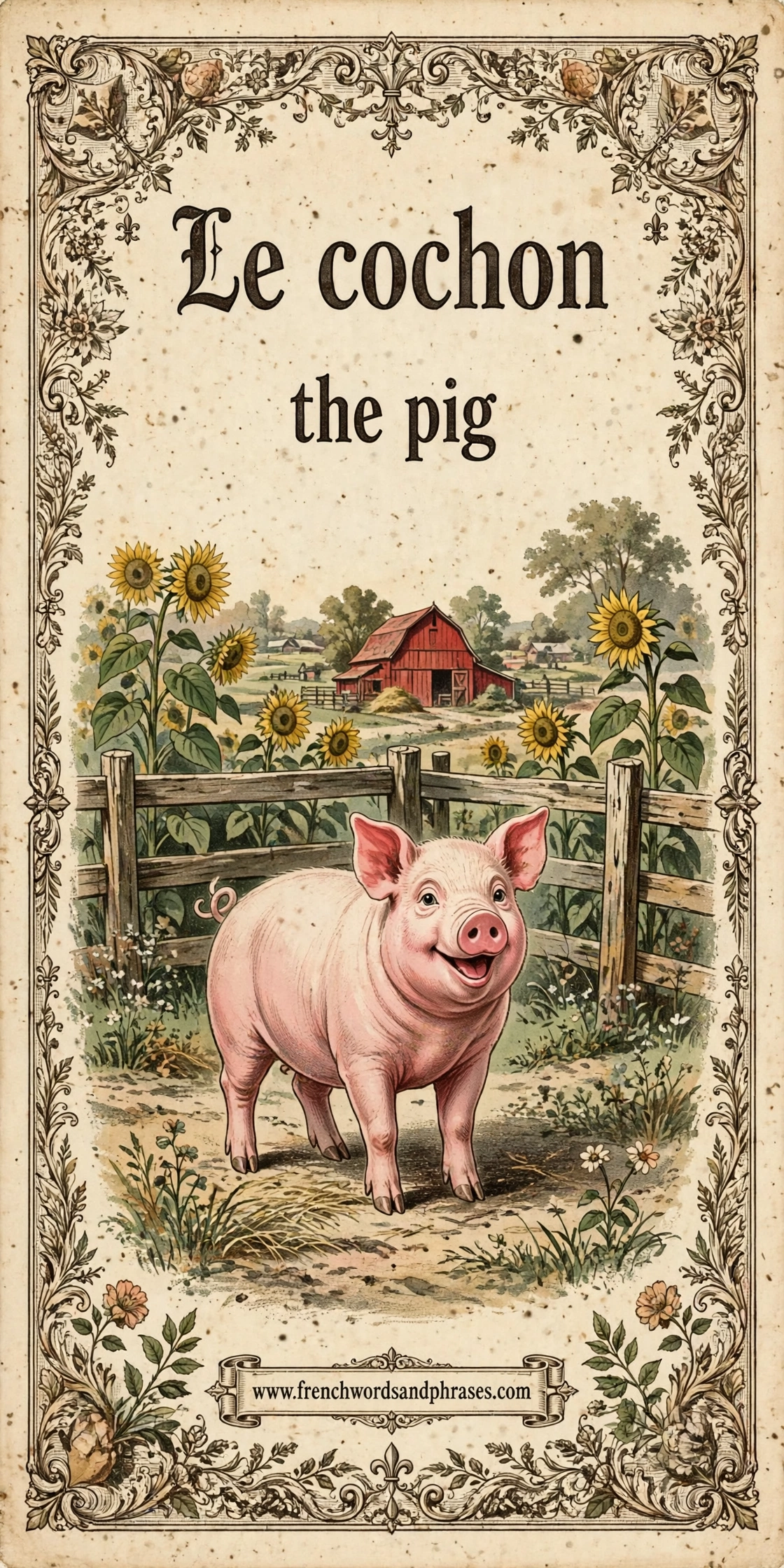
| le cochon | the pig |
| le porc | pork |
| la charcuterie | the pork butcher’s shop |
| le saucisson | the dry cured sausage |
| salé | salted, savoury |
Example
Le jambon vient de la jambe du cochon — le mot le dit.
Ham comes from the pig’s leg — the word says it.
Quick Quiz 4
What is un jambon-beurre?
Reveal the answer
The classic Paris ham sandwich — a baguette, butter and cooked ham, nothing else.
Le jambon-beurre est le sandwich préféré des Parisiens.
The jambon-beurre is Parisians’ favourite sandwich.
Jambon in Everyday French: Real-Life Examples
Now that you know the word, let’s see how jambon appears in everyday French.
Example 1 — At the counter
Je voudrais six tranches de jambon blanc, s’il vous plaît.
I would like six slices of cooked ham, please.
Example 2 — Lunch
Elle prépare des jambon-beurre pour le pique-nique.
She is making ham baguettes for the picnic.
Example 3 — A starter
Le melon au jambon cru est une entrée classique.
Melon with cured ham is a classic starter.
Example 4 — Cooking
Il ajoute du jambon fumé dans la soupe de pois.
He adds some smoked ham to the pea soup.
Example 5 — At the market
Ces jambons de pays sèchent depuis un an.
These country hams have been drying for a year.
Example 6 — A crêpe
La crêpe jambon-fromage est la préférée des enfants.
The ham-and-cheese crêpe is the children’s favourite.
Beyond Translation: The Meaning of Jambon
No sandwich is more Parisian than the jambon-beurre: a crisp baguette, good butter, jambon blanc — three ingredients and a whole philosophy. Across the south-west, Bayonne has cured its jambon cru since the Middle Ages, salted with the salt of Salies-de-Béarn and dried in the mountain wind, until the European Union gave it a protected name.
To say jambon is to name the leg that became France’s favourite lunch.
It evokes café counters at noon, cellars of hanging hams, and the silk of a slice cut thin enough to read through.
How to Remember the French Noun Jambon
Remember it this way: Jambon is ham — masculine; du jambon on the plate, un jambon for the whole leg, and it comes from la jambe, the leg.
- You hear the leg inside it — jambe becomes jambon.
- You split the family — jambon blanc cooked, jambon cru cured raw.
- You order the classic — un jambon-beurre, Paris’s sandwich.
The key idea is le jambon — from la jambe; blanc is cooked, cru is cured.
Test Your Knowledge of Jambon
Let’s see how much you’ve learned. Try answering these questions before revealing the answers.
Question 1
Is jambon masculine or feminine?
Reveal the answer
Masculine — le jambon, du jambon.
Question 2
Translate: I would like some ham, please.
Reveal the answer
Je voudrais du jambon, s’il vous plaît.
Question 3
What is une tranche de jambon?
Reveal the answer
A slice of ham — la tranche is the slice.
Question 4
Which word for « leg » hides inside jambon?
Reveal the answer
La jambe — ham is the pig’s leg, and the word remembers it.
Question 5
Complete the sentence:
______ jambon de Bayonne est célèbre. (The)
Reveal the answer
Le
Le jambon de Bayonne est célèbre.
Bayonne ham is famous.
Your Final Challenge
Can You Use It?
How would you say this in French?
“She buys some ham at the charcuterie.”
Reveal the answer
Elle achète du jambon à la charcuterie.
She buys some ham at the charcuterie.
A little French. A little curiosity. A richer everyday life.
LEARN FRENCH ONE WORD AT A TIME