A French Word to Live By
Translate Cochon to English
/kɔ.ʃɔ̃/
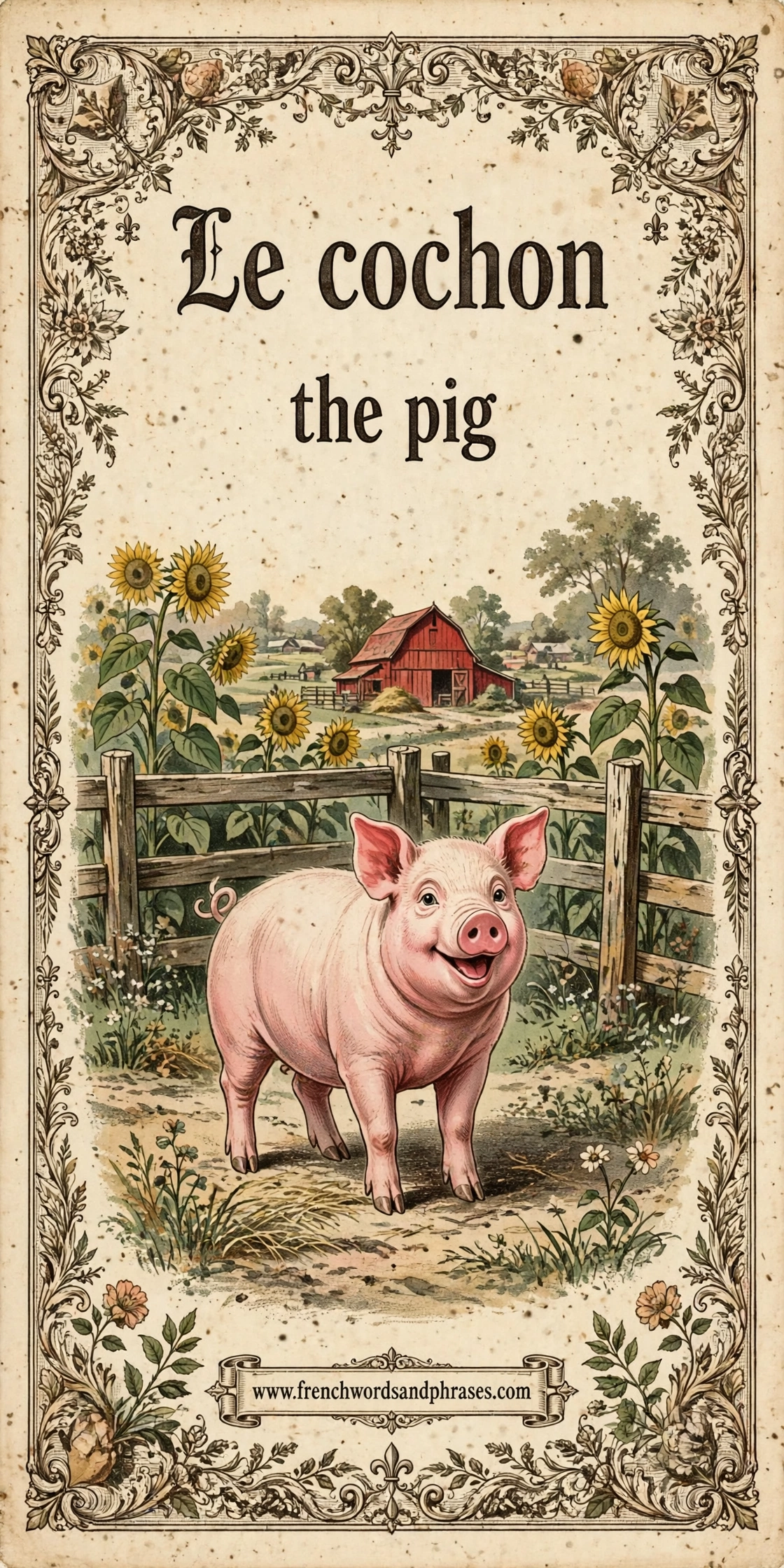
Le cochon means the pig.
Behind the farm fence, in a patch of warm mud, a round pink shape grunts with deep satisfaction. The children press against the rails, delighted: le cochon is taking his afternoon bath — in mud.
In this guide, you’ll learn what cochon means in English, how to use it with its articles, how to form its plural, and how it appears in everyday French. Explore French examples, English translations, and practice quizzes.
Understanding the French Noun Cochon
Cochon is a masculine French noun, learned with its article: le cochon, un cochon. It is the everyday word for the farm pig. The meat on the plate keeps the same name: du cochon is pork in general, while the cuts have their own words.
It means the pig — the farm animal raised for its meat, famous for its appetite, its mud baths and its intelligence. The female is la truie (the sow) and the babies are des porcelets (piglets). In the kitchen, cochon gives le jambon, les saucisses and le pâté — hence the old saying that in the pig, everything is good: « Tout est bon dans le cochon. »
Gender: Masculine
Definite article: le — le cochon (the pig)
Indefinite article: un — un cochon (a pig)
Partitive article: du cochon — some pork, at the table
Plural: les cochons
English equivalents: The pig; pork (as meat, du cochon).
One important usage detail: cochon also lives a double life as an adjective in familiar speech — un temps de cochon is filthy weather, and calling someone un cochon means he is dirty, greedy or rude. Children hear the gentle version: the guinea pig is un cochon d’Inde, and the money box is une tirelire cochon when it is pig-shaped.
Experience the Word
Cochon is more than a farm animal. In the French countryside he is almost a member of the household economy — fed on scraps all year, honoured in every charcuterie in the village.
Imagine the farmyard in the morning: the grunt of greeting, the rush to the trough, and the famous mud bath taken with the seriousness of a spa treatment.
You have not just seen a pig. You have met the farm’s favourite — le cochon, contented and clever.
How to Use Cochon in French: Complete Guide
Let’s explore how cochon works in French, beginning with its articles — the pig, his mud, and his many expressions.
Cochon with the Definite Article (Le, Les)
Used for the pig everyone in the conversation knows — the one in the pen by the farm.
| Form | French |
|---|---|
| Singular | le cochon |
| Plural | les cochons |
Example
Le cochon se roule dans la boue avec plaisir.
The pig rolls in the mud with pleasure.
Cochon with the Indefinite Article (Un, Des)
Used for pigs in general — un cochon at the farm, des cochons in the field.
| Form | French |
|---|---|
| Singular | un cochon |
| Plural | des cochons |
Example
Cette ferme élève des cochons et des poules.
This farm raises pigs and hens.
At the Farm: Words of the Cochon
Troughs, piglets and mud — the vocabulary that surrounds the cochon.
| French | In English |
|---|---|
| la truie | the sow |
| le porcelet | the piglet |
| la boue | the mud |
| la ferme | the farm |
| l’auge | the trough |
| grogner | to grunt |
Example
La truie surveille ses porcelets près de l’auge.
The sow watches over her piglets near the trough.
Quick Quiz 1
Complete the sentence:
______ cochon dort dans la paille.
Reveal the answer
Le
Le cochon dort dans la paille.
The pig is sleeping in the straw.
The Plural of Cochon
Cochon adds an -s in the plural — les cochons, the whole cheerful troop.
| Number | French |
|---|---|
| Singular | le cochon / un cochon |
| Plural | les cochons / des cochons |
Example
Les cochons accourent quand le fermier arrive.
The pigs come running when the farmer arrives.
Cochon with Possessive Adjectives (Mon, Ton, Son…)
Possessives agree with the noun: cochon is masculine, so it takes mon, ton, son.
| Owner | French |
|---|---|
| my | mon cochon |
| your (tu) | ton cochon |
| his / her | son cochon |
| our | notre cochon |
| your (vous) | votre cochon |
| their | leur cochon |
Example
Mon cochon reconnaît ma voix et vient tout de suite.
My pig recognises my voice and comes at once.
Quick Quiz 2
Complete the sentence:
______ cochons sont dans le pré derrière la grange. (Their)
Reveal the answer
Leurs
Leurs cochons sont dans le pré derrière la grange.
Their pigs are in the meadow behind the barn.
Cochon with Demonstrative Adjectives (Ce, Ces)
Used to point: ce cochon, the one snoring in the corner.
| Form | French |
|---|---|
| Singular | ce cochon |
| Plural | ces cochons |
Example
Ce cochon est le plus gros de la ferme.
This pig is the biggest on the farm.
Cochon with Adjectives
Adjectives agree with the masculine noun: gros, rose, sale.
| Adjective | With Cochon |
|---|---|
| gros (big, fat) | un gros cochon |
| rose (pink) | un cochon rose |
| petit (small) | un petit cochon |
| sale (dirty) | un cochon sale |
| content (happy) | un cochon content |
Example
Un petit cochon rose suit sa mère partout.
A little pink pig follows its mother everywhere.
Quick Quiz 3
Complete the sentence:
C’est un cochon très ______. (happy)
Reveal the answer
content
C’est un cochon très content.
It is a very happy pig — content in its mud.
Everyday Expressions with Cochon
Sayings, pets and filthy weather — the cochon phrases of daily life.
| Expression | In English |
|---|---|
| tout est bon dans le cochon | everything is good in the pig (every part is used) |
| un cochon d’Inde | a guinea pig |
| un temps de cochon | filthy weather (familiar) |
| manger comme un cochon | to eat like a pig (familiar) |
| copains comme cochons | as thick as thieves (familiar) |
| une tirelire cochon | a piggy bank |
Example
Quel temps de cochon aujourd’hui, il pleut sans arrêt !
What filthy weather today, it just won’t stop raining!
Words from the Same Family as Cochon
Pork, farms and charcuterie — the words that travel with cochon.
| French | In English |
|---|---|
| le porc | pork; the pig (formal, butchery) |
| la charcuterie | the pork butcher’s shop; cured pork |
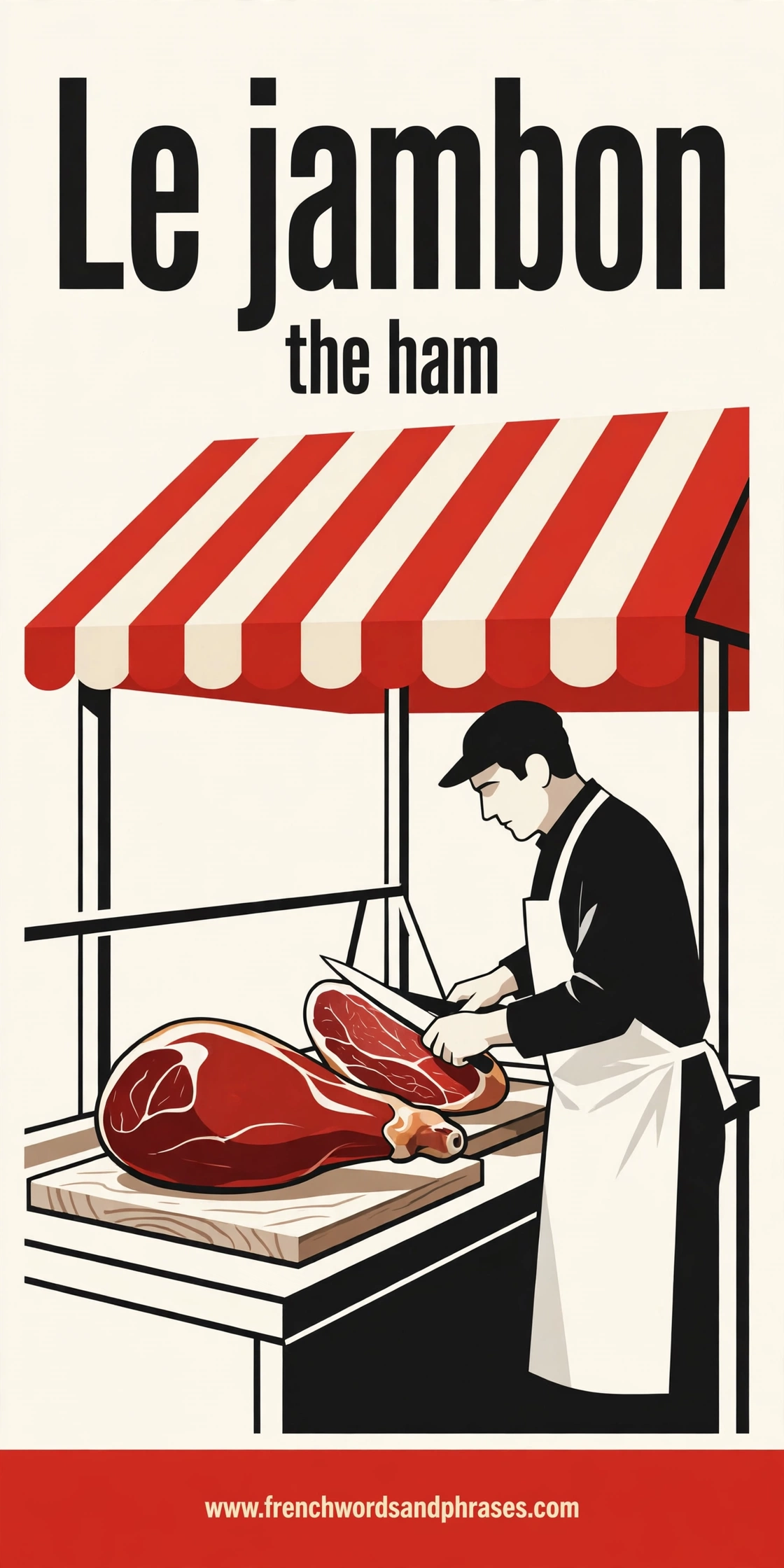
| le jambon | ham |
| la saucisse | the sausage |
| la truie | the sow |
| le porcelet | the piglet |
Example
La charcuterie vend du jambon et des saucisses de la ferme.
The pork butcher’s sells ham and sausages from the farm.
Quick Quiz 4
What is un cochon d’Inde?
Reveal the answer
A guinea pig — literally a « pig from India », though it comes from South America.
Sa fille a un cochon d’Inde très doux.
Her daughter has a very gentle guinea pig.
Cochon in Everyday French: Real-Life Examples
Now that you know the word, let’s see how cochon appears in everyday French.
Example 1 — At the farm
Le cochon grogne quand on approche de sa barrière.
The pig grunts when you approach its fence.
Example 2 — Talking about pets
Mon cochon d’Inde adore les carottes.
My guinea pig loves carrots.
Example 3 — The weather
Nous avons eu un temps de cochon tout le week-end.
We had filthy weather all weekend.
Example 4 — At the table
Ce soir, nous mangeons du cochon rôti avec des pommes.
This evening we are eating roast pork with apples.
Example 5 — Friendship
Ces deux-là sont copains comme cochons depuis l’école.
Those two have been as thick as thieves since school.
Example 6 — Saving money
L’enfant met une pièce dans sa tirelire cochon.
The child puts a coin in his piggy bank.
Beyond Translation: The Meaning of Cochon
The cochon holds a paradoxical place in French hearts: mocked in a dozen expressions, yet honoured at every table. The old country saying « Tout est bon dans le cochon » — everything in the pig is good — sums up a peasant wisdom that wasted nothing and turned the farm pig into jambon, saucisson, pâté and rillettes. He is also, scientists insist, one of the cleverest animals on the farm.
To say cochon is to name the farm’s provider — mocked, loved and entirely used.
It evokes mud baths and charcuterie windows, piggy banks and guinea pigs, and a grunting philosopher perfectly content with his lot.
How to Remember the French Noun Cochon
Remember it this way: Cochon is the pig — masculine; as meat it is du cochon, and as an adjective in familiar speech it means dirty or awful.
- You see the mud — le cochon in his bath of boue.
- You learn the family — la truie, the sow; le porcelet, the piglet.
- You keep the pet apart — un cochon d’Inde is a guinea pig.
The key idea is le cochon — the pig; un cochon d’Inde is a guinea pig.
Test Your Knowledge of Cochon
Let’s see how much you’ve learned. Try answering these questions before revealing the answers.
Question 1
Is cochon masculine or feminine?
Reveal the answer
Masculine — le cochon, un cochon.
Question 2
Translate: The pig is sleeping in the straw.
Reveal the answer
Le cochon dort dans la paille.
Question 3
What does un temps de cochon mean?
Reveal the answer
Filthy weather — rain and wind, in familiar speech.
Question 4
What is a sow, the female pig, in French?
Reveal the answer
La truie — and her babies are des porcelets.
Question 5
Complete the sentence:
______ cochon est énorme. (This)
Reveal the answer
Ce
Ce cochon est énorme.
This pig is enormous.
Your Final Challenge
Can You Use It?
How would you say this in French?
“The pig rolls happily in the mud.”
Reveal the answer
Le cochon se roule joyeusement dans la boue.
The pig rolls happily in the mud.
A little French. A little curiosity. A richer everyday life.
LEARN FRENCH ONE WORD AT A TIME