A French Word to Live By
Translate Jambe to English
/ʒɑ̃b/
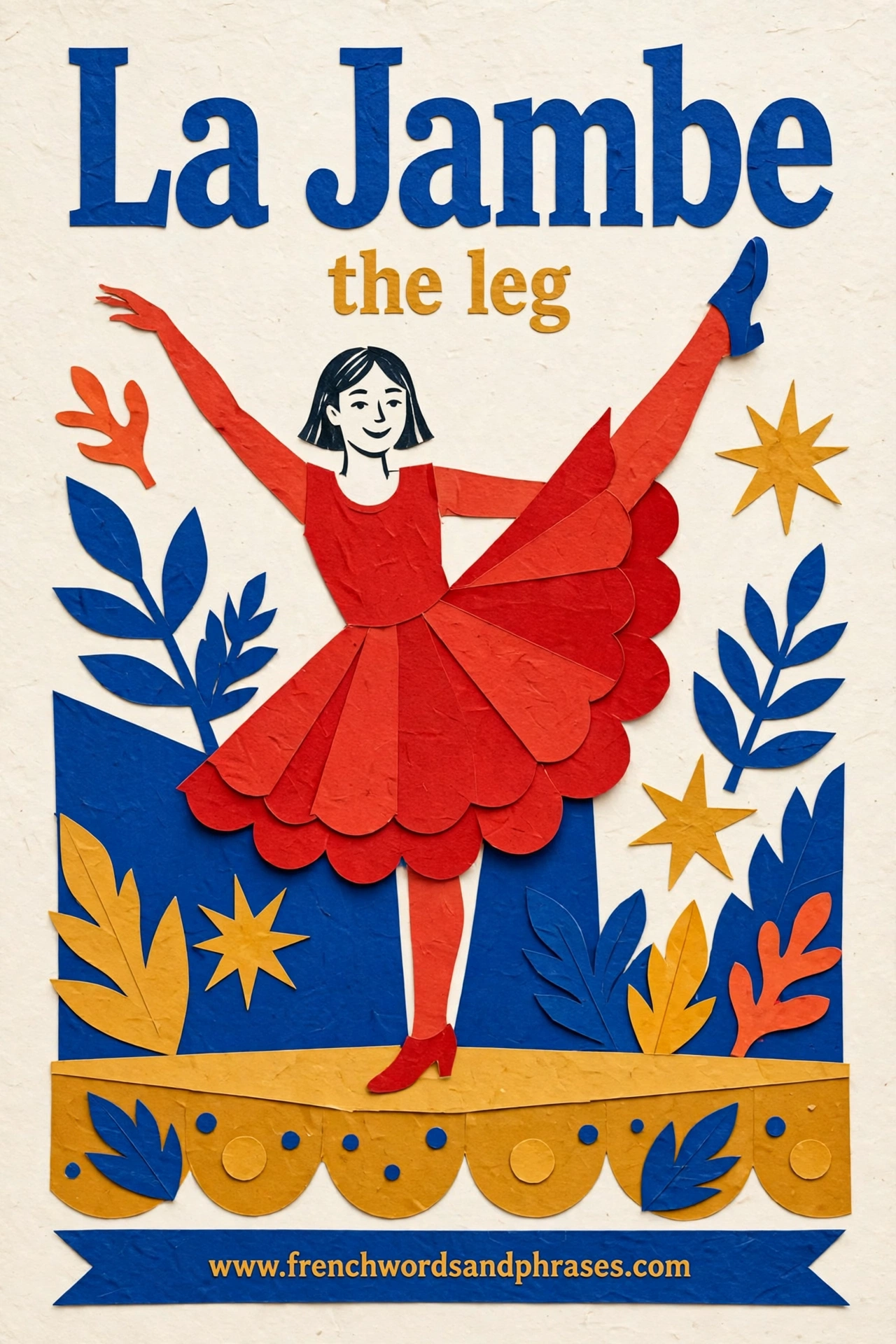
La jambe means the leg.
The whistle blows, the striker is through, and a hundred thousand people watch two legs do their work — ses jambes carry him past the last defender and the ball is in the net.
In this guide, you’ll learn what jambe means in English, how to use it with its articles, how to form its plural, and how it appears in everyday French. Explore French examples, English translations, and practice quizzes.
Understanding the French Noun Jambe
Jambe is a feminine French noun, learned with its article: la jambe, une jambe. It names the whole lower limb, from the hip to the foot — the leg that walks, runs, dances and kicks.
It means the leg — the limb that carries you through the world, two to a person, working in turns with every step. The jambe has its geography: la cuisse (the thigh) above, le genou (the knee) in the middle, le mollet (the calf) and la cheville (the ankle) below. Tables and chairs have jambes too in French workshops — les jambes d’une table.
Gender: Feminine
Definite article: la — la jambe (the leg)
Indefinite article: une — une jambe (a leg)
Plural: les jambes
Parts: La cuisse above, le genou in the middle, le mollet and la cheville below
English equivalents: The leg.
One important usage detail: the great French escape is prendre ses jambes à son cou — literally « to take one’s legs to one’s neck » — to run away as fast as you can. And after a long sitting, you stand up to se dégourdir les jambes, to stretch your legs.
Experience the Word
Jambe is the body’s travelling gear. Feet touch the ground, but it is the jambes that do the journey — kilometres of walking, dancing, climbing and fleeing, all in a day’s work.
Imagine the marathon runner at kilometre thirty, jambes lourdes, or the dancer whose legs seem to have their own music.
You have not just walked somewhere. You have travelled on your jambes — the two pillars that take you everywhere.
How to Use Jambe in French: Complete Guide
Let’s explore how jambe works in French, beginning with its articles — then run, stretch and take our jambes à notre cou.
Jambe with the Definite Article (La, Les)
Used for a specific leg — the left one, the broken one, the one that hurts.
| Form | French |
|---|---|
| Feminine singular | la jambe |
| Plural | les jambes |
La jambe gauche du joueur est bandée.
The player’s left leg is bandaged.
Jambe with the Indefinite Article (Une, Des)
Used for a leg in general — une jambe, a leg like any other.
| Form | French |
|---|---|
| Feminine singular | une jambe |
| Plural | des jambes |
Example
Une jambe musclée aide le coureur dans les montées.
A muscular leg helps the runner on the climbs.
Jambe with Quantities and Pairs
Legs come in pairs and are counted by journeys — the quantities of walking life.
| Quantity | French |
|---|---|
| one leg | une jambe |
| both legs | les deux jambes |
| on one leg | sur une jambe |
| a pair of legs | une paire de jambes |
| ten kilometres on foot | dix kilomètres dans les jambes |
Example
Le flamant dort debout sur une jambe.
The flamingo sleeps standing on one leg.
Quick Quiz 1
Complete the sentence:
Elle s’est cassé ______ jambe en skiant. (the — her leg)
Reveal the answer
la
Elle s’est cassé la jambe en skiant.
She broke her leg skiing — la jambe, because jambe is feminine and French uses the article with body parts.
The Plural of Jambe
Jambe adds an -s in the plural — les jambes, the pair that carries you.
| Number | French |
|---|---|
| Singular | la jambe |
| Plural | les jambes |
Example
Les jambes des danseurs sont fortes et souples.
The dancers’ legs are strong and supple.
Jambe with Possessive Adjectives (Ma, Ta, Sa…)
Possessives agree with the noun: jambe is feminine, so it takes ma, ta, sa.
| Owner | French |
|---|---|
| my | ma jambe |
| your (tu) | ta jambe |
| his / her | sa jambe |
| our | notre jambe |
| your (vous) | votre jambe |
| their | leur jambe |
Example
Ma jambe droite est plus forte que la gauche.
My right leg is stronger than the left.
Quick Quiz 2
Complete the sentence:
Après la randonnée, ______ jambes sont lourdes. (our)
Reveal the answer
nos
Après la randonnée, nos jambes sont lourdes.
After the hike, our legs are heavy — nos jambes, plural.
Jambe with Demonstrative Adjectives (Cette, Ces)
Used to point: cette jambe, ces jambes.
| Form | French |
|---|---|
| Feminine singular | cette jambe |
| Plural | ces jambes |
Example
Cette jambe de table est plus courte que les autres.
This table leg is shorter than the others.
Jambe with Adjectives
Adjectives agree with jambe: longue, fine, lourde — feminine forms with their -e.
| Adjective | With Jambe |
|---|---|
| longue (long) | une jambe longue |
| fine (slim) | une jambe fine |
| lourde (heavy) | une jambe lourde |
| cassée (broken) | une jambe cassée |
| musclée (muscular) | une jambe musclée |
Example
Après la course, elle a les jambes lourdes et douloureuses.
After the race, her legs are heavy and sore.
Quick Quiz 3
Complete the sentence:
C’est une jambe très ______. (muscular)
Reveal the answer
musclée
C’est une jambe très musclée.
It’s a very muscular leg — musclée, with the feminine -e.
Everyday Expressions with Jambe
Running away, stretching and heavy legs — the jambe phrases of daily life.
| Expression | In English |
|---|---|
| prendre ses jambes à son cou | to run away as fast as possible |
| se dégourdir les jambes | to stretch one’s legs |
| avoir les jambes lourdes | to have heavy, tired legs |
| tenir la jambe à quelqu’un | to keep someone talking, to buttonhole them |
| les jambes en coton | legs like jelly (after effort or fear) |
| traîner les jambes | to drag one’s legs, to trudge |
Example
À la vue du chien, le chat a pris ses jambes à son cou.
At the sight of the dog, the cat took to its heels.
Words from the Same Family as Jambe
Ham, strides and shin guards — the words that travel with jambe.
| French | In English |
|---|---|
| le jambon | ham (the pig’s leg) |
| l’enjambée | the stride |
| enjamber | to step over, to stride over |
| la jambière | the shin guard; the leg warmer |
| la cuisse | the thigh |
Example
Il enjambe la flaque d’un pas léger.
He steps over the puddle with a light stride.
Quick Quiz 4
What does « prendre ses jambes à son cou » mean?
Reveal the answer
To run away as fast as you can — literally, to take your legs up to your neck.
Le voleur a pris ses jambes à son cou.
The thief took to his heels.
Jambe in Everyday French: Real-Life Examples
Now that you know the word, let’s see how jambe appears in everyday French.
Example 1 — At the stadium
L’attaquant court, les jambes rapides, vers le but.
The striker runs, legs flying, towards the goal.
Example 2 — After the hike
Nous avons vingt kilomètres dans les jambes ce soir.
We have twenty kilometres in our legs this evening.
Example 3 — A break
Levons-nous et dégourdissons-nous les jambes un peu.
Let’s stand up and stretch our legs a bit.
Example 4 — At the doctor’s
Elle montre sa jambe blessée au médecin.
She shows her injured leg to the doctor.
Example 5 — The flamingo
Le flamant rose dort sur une jambe au bord de l’étang.
The pink flamingo sleeps on one leg at the edge of the pond.
Example 6 — Jelly legs
Après l’ascension, j’avais les jambes en coton.
After the climb, my legs were like jelly.
Beyond Translation: The Meaning of Jambe
Jambe comes from the late Latin gamba — a horse’s leg, a hock — a word riders brought into French. The animal echo never left: the pig’s leg became le jambon, ham, on every charcuterie board in France. And the word stretched beyond the body long ago — tables, chairs and compasses all stand on jambes in French, as if furniture too needed to walk.
To say jambe is to name the limb that turns a body into a traveller.
It evokes the striker’s sprint, the hiker’s tired evening legs, and the great comic escape — les jambes à son cou.
How to Remember the French Noun Jambe
Remember it this way: Jambe is the leg — feminine, from the hip to the foot: la jambe, les jambes, toujours par deux.
- You run — prendre ses jambes à son cou, the fastest escape in French.
- You rest — se dégourdir les jambes, stretch your legs.
- You eat — le jambon, ham, is the pig’s jambe.
The key idea is la jambe — two to a person, and made for journeys.
Test Your Knowledge of Jambe
Let’s see how much you’ve learned. Try answering these questions before revealing the answers.
Question 1
Is jambe masculine or feminine?
Reveal the answer
Feminine — la jambe, une jambe.
Question 2
How do you say « the legs » in French?
Reveal the answer
Les jambes — jambe adds an -s in the plural.
Question 3
Translate: She broke her leg.
Reveal the answer
Elle s’est cassé la jambe.
Question 4
What is une enjambée?
Reveal the answer
A stride — the length of one long step of the jambes.
Question 5
Complete the sentence:
Après la course, ______ jambes sont lourdes. (my)
Reveal the answer
mes
Après la course, mes jambes sont lourdes.
After the race, my legs are heavy — mes jambes, plural.
Your Final Challenge
Can You Use It?
How would you say this in French?
“After the long walk, their legs are heavy.”
Reveal the answer
Après la longue marche, leurs jambes sont lourdes.
After the long walk, their legs are heavy.
A little French. A little curiosity. A richer everyday life.
LEARN FRENCH ONE WORD AT A TIME