A French Word to Live By
Translate Isolé to English
/izɔle/
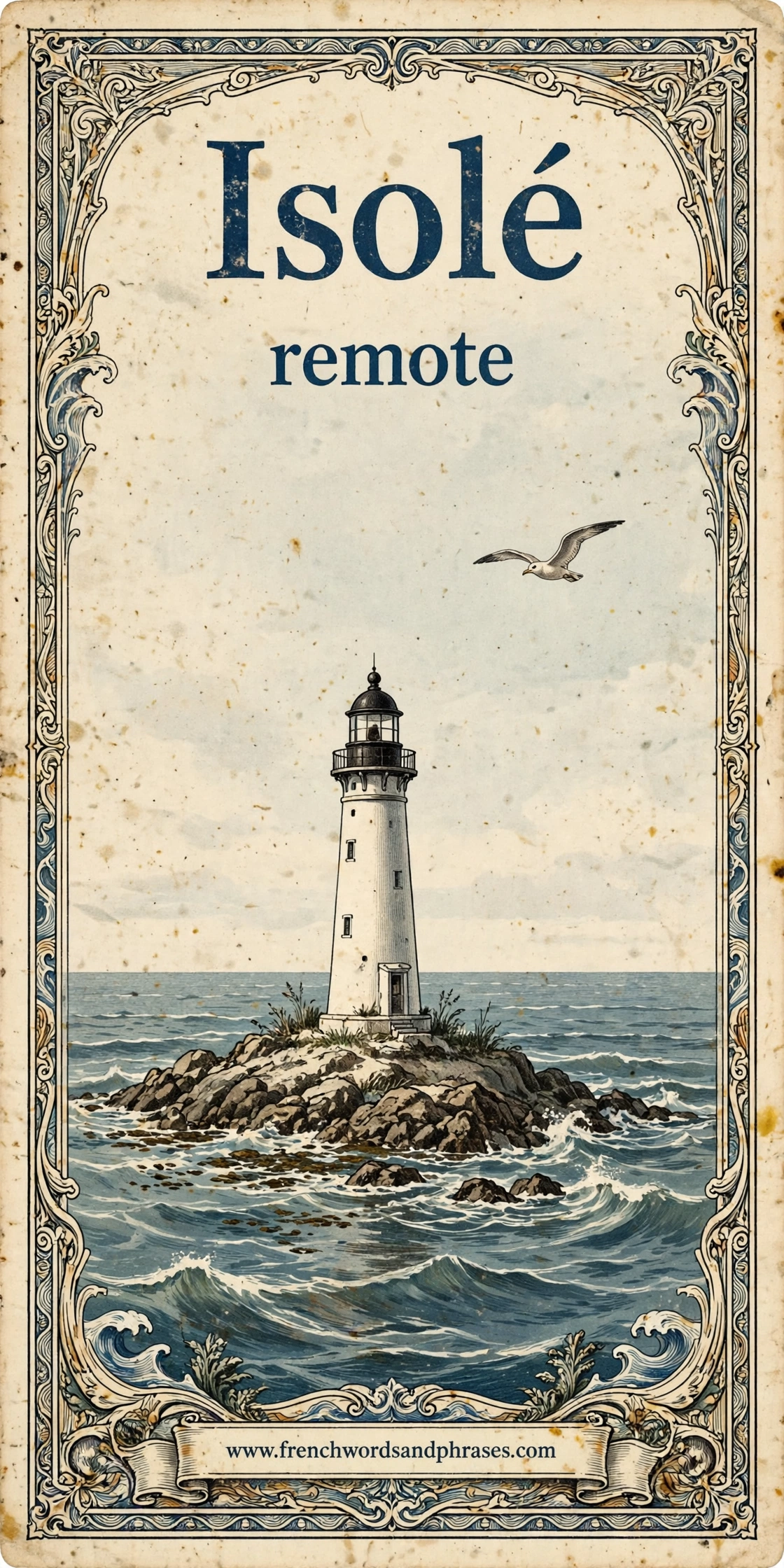
Isolé means remote.
The road gives up an hour before the village does: first the phone signal dies, then the petrol stations stop, then the road itself narrows to a ribbon between pines. At the end of it, a dozen chimneys, one church, and silence you can hear. The village is isolé — and its inhabitants would not change it for the world.
In this guide, you’ll learn what isolé means in English, how its regular feminine is formed, where it stands in the sentence, and how the same word describes both a faraway hamlet and a single house at the end of a lane. Explore French examples, English translations, and practice quizzes.
Understanding the French Adjective Isolé
Isolé is a French adjective of quality — the adjective of distance and separation. It agrees in the regular -é way: isolé, isolée, isolés, isolées. It is the past participle of isoler, to isolate: an isolé place is one that has been cut off from the rest.
It means remote — far from towns and people, cut off. It describes places (un village isolé, a remote village; une maison isolée, an isolated house; un hameau isolé, a remote hamlet) and, of people, lonely or isolated (se sentir isolé, to feel isolated). On this page the place sense leads: an isolé village is one the road reaches last, if at all.
Type: Adjective of quality — distance and separation
Answers the question: What is it like? — remote
Changes form: Yes — isolé, isolée, isolés, isolées
Feminine: isolée
English equivalents: Remote; isolated; secluded, cut off.
One important usage detail: isolé stands AFTER the noun — un village isolé — and it often names what it is cut off from: isolé du monde, cut off from the world; isolé dans la montagne, isolated in the mountains. In winter, whole valleys become isolées by the snow.
Experience the Word
Isolé is the adjective of the last house on the road — the farm beyond the last lamp-post, the lighthouse on its rock, the village the bus visits twice a week.
Imagine a hamlet of nine houses at the end of a mountain valley. The bread van comes on Tuesdays, the snow stays until April, and the silence is so complete that visitors whisper for the first hour. By the second day, they understand: isolé is not a complaint here. It is the whole point.
You have not just described a faraway place. You have described a place the world must make an effort to reach.
How to Use Isolé in French: Complete Guide
Let’s explore how isolé works in French, beginning with the whole word on one card.
Isolé at a Glance
Before the details, here is the whole word on one card.
The Whole Word on One Card
Meaning, type, position and forms — isolé in four lines.
| Point | Isolé |
|---|---|
| Meaning | remote |
| Type | adjective of quality — distance and separation |
| Usual position | after the noun — un village isolé |
| Form | isolé / isolée / isolés / isolées |
Example
C’est un village isolé.
It’s a remote village.
The Four Forms of Isolé
Isolé agrees with the noun it describes, following the regular pattern of adjectives in -é: the feminine adds an e, the plurals add an s.
| Form | Isolé | Example |
|---|---|---|
| Masculine singular | isolé | un village isolé — a remote village |
| Feminine singular | isolée | une maison isolée — an isolated house |
| Masculine plural | isolés | des hameaux isolés — remote hamlets |
| Feminine plural | isolées | des fermes isolées — isolated farms |
Example
Ce hameau est isolé et cette ferme est isolée.
This hamlet is remote and this farm is isolated.
Quick Quiz 1
Which form of isolé goes with maison (feminine)?
Reveal the answer
isolée
Une maison isolée.
An isolated house.
Isolée: The Regular Feminine in -ée
The feminine of isolé is formed by adding a single e. It changes the spelling only — isolé and isolée sound exactly alike.
| Situation | Example |
|---|---|
| The rule | just add -e — isolé → isolée |
| The sound | isolé and isolée sound exactly the same |
| Masculine plural | isolés — des villages isolés |
| Feminine plural | isolées — des vallées isolées |
Example
La vallée est isolée par la neige en hiver.
The valley is cut off by snow in winter.
Where Isolé Goes: After the Noun
Isolé follows the noun it describes, and it often brings a complement with it — du monde, dans la montagne, par la neige — naming the thing that does the cutting off.
| Pattern | Example |
|---|---|
| After the noun | un hameau isolé — a remote hamlet |
| After être | ce village est isolé — this village is remote |
| With a complement | isolé du monde — cut off from the world |
| Before the noun | un isolé village — not in everyday French |
Example
Ils habitent dans un village isolé du monde.
They live in a village cut off from the world.
Quick Quiz 2
What does isolé du monde mean?
Reveal the answer
Cut off from the world
Un monastère isolé du monde.
A monastery cut off from the world.
More Remote: Comparing with Isolé
Isolé compares the regular way, with plus, moins and aussi — and the superlative agrees as usual: le plus isolé, la plus isolée.
| Degree | Example |
|---|---|
| As remote as | aussi isolé que — as remote as |
| More remote | plus isolé — more remote |
| Less remote | moins isolé — less remote |
| The most remote (masc.) | le plus isolé — le plus isolé des villages |
| The most remote (fem.) | la plus isolée — la plus isolée des vallées |
Example
Ce village est plus isolé que le nôtre.
This village is more remote than ours.
Everyday Expressions with Isolé
Isolé belongs to mountain weather reports, property adverts dreaming of peace, and the directions locals give with a shrug: ‘c’est isolé, là-haut’.
| Expression | In English |
|---|---|
| un village isolé | a remote village |
| une maison isolée | an isolated house — no neighbours in sight |
| isolé du monde | cut off from the world |
| un cas isolé | an isolated case — one-off, of events |
| se sentir isolé | to feel isolated — of people |
| perdu | lost, in the middle of nowhere — the familiar cousin |
Example
C’est un cas isolé, le village n’est pas dangereux.
It’s an isolated case, the village isn’t dangerous.
Quick Quiz 3
What does un cas isolé mean?
Reveal the answer
An isolated case
Ne t’inquiète pas, c’est un cas isolé.
Don’t worry, it’s an isolated case.
Isolé and Its Neighbours
Isolé shares the far end of the map with perdu and reculé; at the other end, peuplé and central are everything it is far from.
| French | In English |
|---|---|
| perdu | lost, godforsaken — un village perdu, a village in the middle of nowhere |
| reculé | remote, out-of-the-way — a written synonym |
| écarté | outlying, off the beaten track — un hameau écarté |
| peuplé | populated — the opposite in company |
| central | central — the opposite in position |
| animé | lively — the opposite in atmosphere |
Example
Un village perdu, isolé, mais très animé en été.
A remote, isolated village, but very lively in summer.
Watch Out: The Traps Around Isolé
The traps here are the lonely person hiding inside the place word, and the English ‘isolated’ tempting you to add letters French does not use.
| Trap | The truth |
|---|---|
| People too | se sentir isolé means to feel isolated, lonely — the word works for feelings as well as places |
| Spelling | one s, one l — isolé, from isoler; never ‘issolé’ |
| un cas isolé | of events it means a one-off case, not a remote place |
| Agreement | maison is feminine: une maison isolée, with the extra e |
Example
Elle se sent isolée dans sa maison isolée.
She feels isolated in her isolated house.
Quick Quiz 4
How do you say ‘a remote village’?
Reveal the answer
un village isolé
Isolé follows the noun and agrees with it.
A remote village.
Isolé in Everyday French: Real-Life Examples
Now that you know the word, let’s see how isolé appears in everyday French.
Example 1 — A village
Ce village isolé se trouve au bout de la vallée.
This remote village lies at the end of the valley.
Example 2 — A house
Ils ont acheté une maison isolée près de la forêt.
They bought an isolated house near the forest.
Example 3 — Winter
En hiver, la vallée est isolée par la neige.
In winter, the valley is cut off by snow.
Example 4 — A hamlet
Le hameau isolé n’a que neuf habitants.
The remote hamlet has only nine inhabitants.
Example 5 — A lighthouse
Le phare isolé sur son rocher garde la côte.
The isolated lighthouse on its rock guards the coast.
Example 6 — Feelings
Sans voiture, on se sent vite isolé ici.
Without a car, you quickly feel isolated here.
Beyond Translation: The Meaning of Isolé
English says remote for the meaning of isolé — but the French word is built on an island: isoler comes from the Latin insula, and an isolé village is an island that happens to stand in a sea of mountains or fields.
To call a place isolé is to say it must be reached on purpose, never by accident.
That is why the word carries no automatic sadness in French. For the property hunter it is a promise — une maison isolée, no neighbours, no noise — and for the nine inhabitants of the hamlet, it is simply the address of their freedom.
How to Remember the French Adjective Isolé
Remember it this way: Isolé is the island adjective — regular -ée feminine, its place behind the noun, and an island (insula) buried in its family tree.
- You picture the island — isolé comes from insula; the village is an island on land.
- You add one e for the feminine — une maison isolée, and it sounds the same.
- You put it after the noun — un village isolé, un hameau isolé.
The key idea is isolé means remote or isolated — an island of a place — and it stands after the noun.
Test Your Knowledge of Isolé
Let’s see how much you’ve learned. Try answering these questions before revealing the answers.
Question 1
What does isolé mean?
Reveal the answer
Remote — isolated, far from towns and people, cut off.
Question 2
What is the feminine of isolé?
Reveal the answer
isolée — just add an e; the sound does not change.
Question 3
Translate: a remote village.
Reveal the answer
Un village isolé.
Question 4
Complete the sentence:
Cette ferme est ______ dans la montagne.
Reveal the answer
isolée
Cette ferme est isolée dans la montagne.
This farm is isolated in the mountains.
Question 5
What does un cas isolé mean?
Reveal the answer
An isolated case — a one-off event, not a pattern.
Your Final Challenge
Can You Use It?
How would you say this in French?
“Their remote village is quiet, but its people are welcoming.”
Reveal the answer
Leur village isolé est calme, mais ses habitants sont accueillants.
Their remote village is quiet, but its people are welcoming.
A little French. A little curiosity. A richer everyday life.
LEARN FRENCH ONE WORD AT A TIME