A French Word to Live By
Translate Irlandais to English
/iʁlɑ̃dɛ/
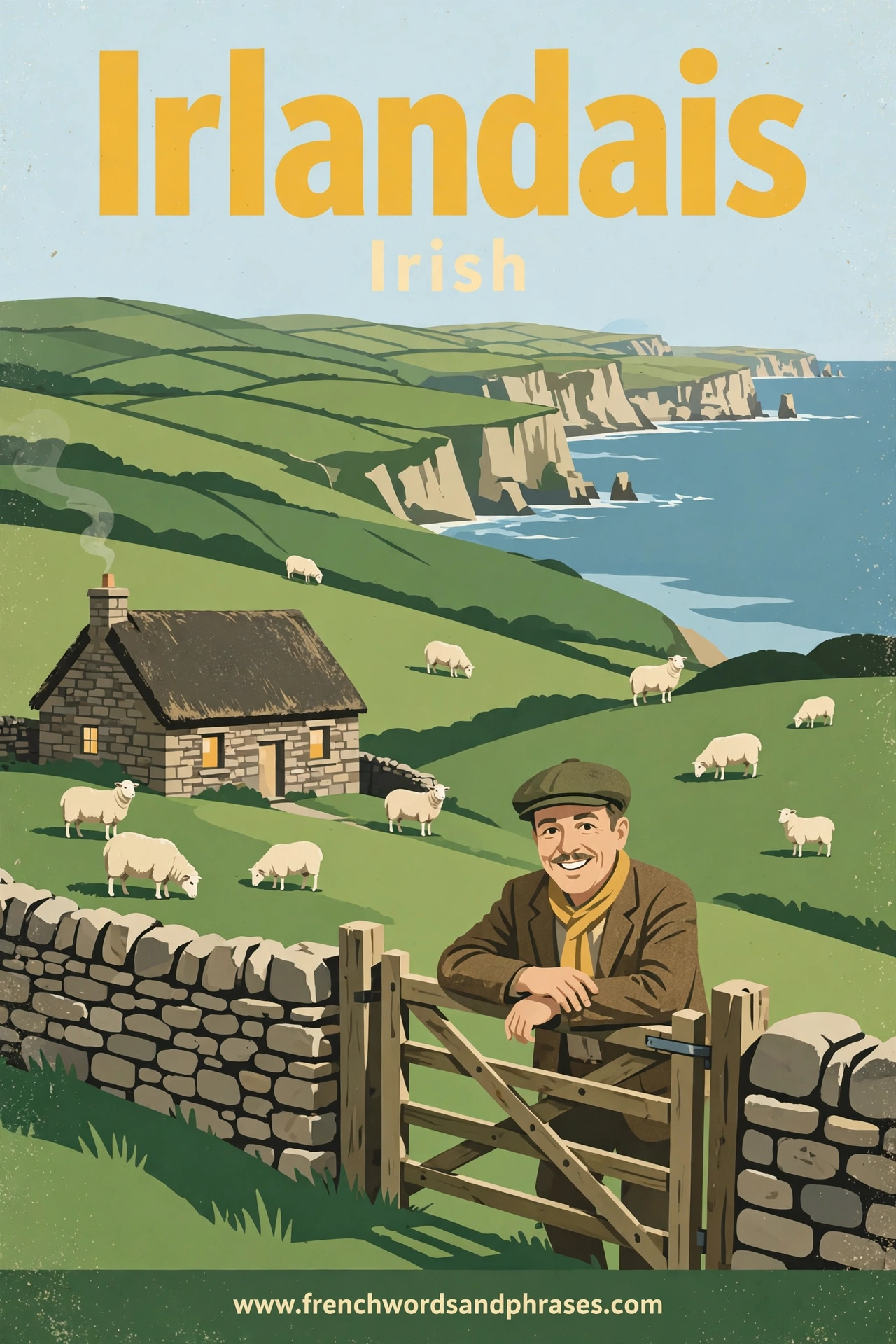
Irlandais means Irish.
A small pub in Dublin on a rainy evening: a fiddle starts up in the corner, the whole room joins the chorus, and a stranger at the bar is treated like a cousin within five minutes. Warmth, music and talk — French sums the whole atmosphere up in one word: irlandais.
In this guide, you’ll learn what irlandais means in English, how its feminine adds a simple e, where it stands in the sentence, and why the people take a capital letter while the adjective stays small. Explore French examples, English translations, and practice quizzes.
Understanding the French Adjective Irlandais
Irlandais is a French nationality adjective — the adjective of Ireland. Masculine: irlandais; feminine: irlandaise. It agrees with the noun it describes: un pub irlandais, une musique irlandaise, des accents irlandais, des chansons irlandaises.
It means Irish — from Ireland, or in the Irish way. It describes people (un musicien irlandais, an Irish musician), things (un café irlandais, an Irish coffee) and atmospheres (une soirée irlandaise, an Irish evening). The country itself is l’Irlande, and the people are les Irlandais.
Type: Nationality adjective — Ireland
Answers the question: Where is it from? — Irish
Masculine: irlandais
Feminine: irlandaise
Changes form: Yes — irlandais, irlandaise, irlandais, irlandaises
English equivalents: Irish.
One important usage detail: the adjective stays lower-case — un film irlandais — but the people take a capital letter: un Irlandais, une Irlandaise, an Irishman, an Irishwoman. The language of Ireland is also called l’irlandais (Irish Gaelic), lower-case like every language: elle apprend l’irlandais, she is learning Irish.
Experience the Word
Irlandais is the adjective of the green island — of fiddles in pubs, of storytellers who turn a bus ride into a saga, of rain that never quite manages to spoil the evening.
Imagine the west coast of Ireland in October: grey sea, green fields, and a village where the pub door opens every few minutes onto laughter. The visitor who planned to stay one night is still there a week later, learning the chorus.
You have not just named a country. You have named a way of welcoming the world.
How to Use Irlandais in French: Complete Guide
Let’s explore how irlandais works in French, beginning with the whole word on one card.
Irlandais at a Glance
Before the details, here is the whole word on one card.
The Whole Word on One Card
Meaning, type, position and forms — irlandais in four lines.
| Point | Irlandais |
|---|---|
| Meaning | Irish |
| Type | nationality adjective — Ireland (l’Irlande) |
| Usual position | after the noun — un pub irlandais |
| Form | irlandais / irlandaise / irlandais / irlandaises |
Example
C’est un pub irlandais.
It’s an Irish pub.
The Four Forms of Irlandais
Irlandais agrees with the noun it describes. The feminine adds an e and sounds the final s; the masculine plural changes nothing at all.
| Form | Irlandais | Example |
|---|---|---|
| Masculine singular | irlandais | un accent irlandais — an Irish accent |
| Feminine singular | irlandaise | une chanson irlandaise — an Irish song |
| Masculine plural | irlandais | des musiciens irlandais — Irish musicians |
| Feminine plural | irlandaises | des chansons irlandaises — Irish songs |
Example
Un musicien irlandais joue une chanson irlandaise.
An Irish musician is playing an Irish song.
Quick Quiz 1
Which form of irlandais goes with musique (feminine)?
Reveal the answer
irlandaise
La musique irlandaise.
Irish music.
Irlandaise: The Feminine Adds an E
Nationality adjectives in -ais build their feminine in -aise: the silent s of irlandais wakes up and sounds like a z. The masculine plural, ending in s already, does not change.
| Situation | Example |
|---|---|
| The rule | add -e — irlandais → irlandaise |
| The sound | the final s sounds: irlandaise ends in /ɛz/ |
| Masculine plural | irlandais — unchanged, des pubs irlandais |
| Feminine plural | irlandaises — des bières irlandaises |
Example
Elle chante une vieille chanson irlandaise.
She is singing an old Irish song.
Where Irlandais Goes: After the Noun
Nationality adjectives follow the noun in French, always — and they stay lower-case, even though English writes Irish with a capital I.
| Pattern | Example |
|---|---|
| After the noun | un café irlandais — an Irish coffee |
| After être | il est irlandais — he is Irish |
| With a capital (people) | un Irlandais — an Irishman |
| Before the noun | un irlandais pub — not in French |
Example
Ce café irlandais est célèbre dans tout le quartier.
This Irish pub is famous throughout the neighbourhood.
Quick Quiz 2
Which is correct — un irlandais or un Irlandais for a man from Ireland?
Reveal the answer
un Irlandais
The people take a capital letter; the adjective stays small.
Un Irlandais — an Irishman.
The Noun: Un Irlandais, Une Irlandaise
Used as a noun with a capital letter, irlandais names the people themselves — and lower-case, it can also name Ireland’s own language, Irish Gaelic.
| Use | Example |
|---|---|
| A man | un Irlandais — an Irishman |
| A woman | une Irlandaise — an Irishwoman |
| The people | les Irlandais — the Irish |
| The language | l’irlandais — Irish Gaelic, lower-case like all languages |
Example
Une Irlandaise nous a appris la chanson.
An Irishwoman taught us the song.
Everyday Expressions with Irlandais
Irlandais appears wherever Ireland exports its pleasures — music, pubs, coffee and coasts.
| Expression | In English |
|---|---|
| la musique irlandaise | Irish music |
| un pub irlandais | an Irish pub |
| un café irlandais | an Irish coffee |
| la côte irlandaise | the Irish coast |
| un accent irlandais | an Irish accent |
| la Saint-Patrick | Saint Patrick’s Day — Ireland’s great festival |
Example
Le soir, on écoute de la musique irlandaise au pub.
In the evening, we listen to Irish music at the pub.
Quick Quiz 3
What does les Irlandais mean?
Reveal the answer
The Irish (people)
Les Irlandais aiment la musique.
The Irish love music.
Irlandais and Its Neighbours
Around irlandais stand the other peoples of the British Isles — and one umbrella word, britannique, that covers them all.
| French | In English |
|---|---|
| anglais | English — from England |
| écossais | Scottish — from Scotland |
| gallois | Welsh — from Wales (le pays de Galles) |
| britannique | British — the umbrella adjective |
| nord-irlandais | Northern Irish |
| européen | European |
Example
Un Irlandais, un Écossais et un Gallois chantent ensemble.
An Irishman, a Scotsman and a Welshman are singing together.
Watch Out: The Traps Around Irlandais
The traps here are the capital letter that English uses everywhere and French uses only for people, and the country name that hides inside the word.
| Trap | The truth |
|---|---|
| The capital | adjective lower-case (un film irlandais), people capitalised (un Irlandais) |
| The country | Ireland is l’Irlande — je vais en Irlande, I am going to Ireland |
| The language | Irish Gaelic is l’irlandais — do not confuse it with l’anglais |
| Masculine plural | irlandais already ends in s — never ‘irlandaiss’ |
Example
Elle est irlandaise, elle vient d’Irlande.
She is Irish, she comes from Ireland.
Quick Quiz 4
How do you say ‘an Irish song’?
Reveal the answer
une chanson irlandaise
Irlandais follows the noun and agrees with it.
An Irish song.
Irlandais in Everyday French: Real-Life Examples
Now that you know the word, let’s see how irlandais appears in everyday French.
Example 1 — Music
La musique irlandaise est célèbre dans le monde entier.
Irish music is famous all over the world.
Example 2 — At the pub
Nous avons passé la soirée dans un pub irlandais.
We spent the evening in an Irish pub.
Example 3 — People
Mon voisin est irlandais, il vient de Dublin.
My neighbour is Irish, he comes from Dublin.
Example 4 — A woman
C’est une chanteuse irlandaise très connue.
She is a very well-known Irish singer.
Example 5 — Travel
La côte irlandaise est magnifique en été.
The Irish coast is magnificent in summer.
Example 6 — The language
Elle apprend l’irlandais avec sa grand-mère.
She is learning Irish with her grandmother.
Beyond Translation: The Meaning of Irlandais
English says Irish for the meaning of irlandais — but French draws a line English does not: the adjective stays modestly lower-case, while the person rises to a capital, un Irlandais.
In French, it is the people who carry the capital letter, not the description.
And irlandais does double duty, naming both the people and their ancient language — the Gaelic that grandparents still pass to grandchildren at kitchen tables from Donegal to Kerry.
How to Remember the French Adjective Irlandais
Remember it this way: Irlandais is Ireland’s adjective — irlandaise for the feminine, a capital letter only for the people, and its place behind the noun.
- You add an e for the feminine — irlandais, irlandaise, and the sleeping s wakes up.
- You capitalise the people, never the adjective — un Irlandais, un film irlandais.
- You keep it after the noun — un pub irlandais, une chanson irlandaise.
The key idea is irlandais / irlandaise — capital letter for the people (un Irlandais), small letter for the adjective.
Test Your Knowledge of Irlandais
Let’s see how much you’ve learned. Try answering these questions before revealing the answers.
Question 1
What does irlandais mean?
Reveal the answer
Irish — from Ireland.
Question 2
What is the feminine of irlandais?
Reveal the answer
irlandaise — add an e, and the final s is heard.
Question 3
Translate: an Irish pub.
Reveal the answer
Un pub irlandais.
Question 4
Complete the sentence:
C’est une chanson ______ .
Reveal the answer
irlandaise
C’est une chanson irlandaise.
It’s an Irish song.
Question 5
How do you write ‘an Irishman’?
Reveal the answer
un Irlandais — the people take a capital letter.
Your Final Challenge
Can You Use It?
How would you say this in French?
“My neighbour is Irish, and she sings Irish songs.”
Reveal the answer
Ma voisine est irlandaise, et elle chante des chansons irlandaises.
My neighbour is Irish, and she sings Irish songs.
A little French. A little curiosity. A richer everyday life.
LEARN FRENCH ONE WORD AT A TIME