
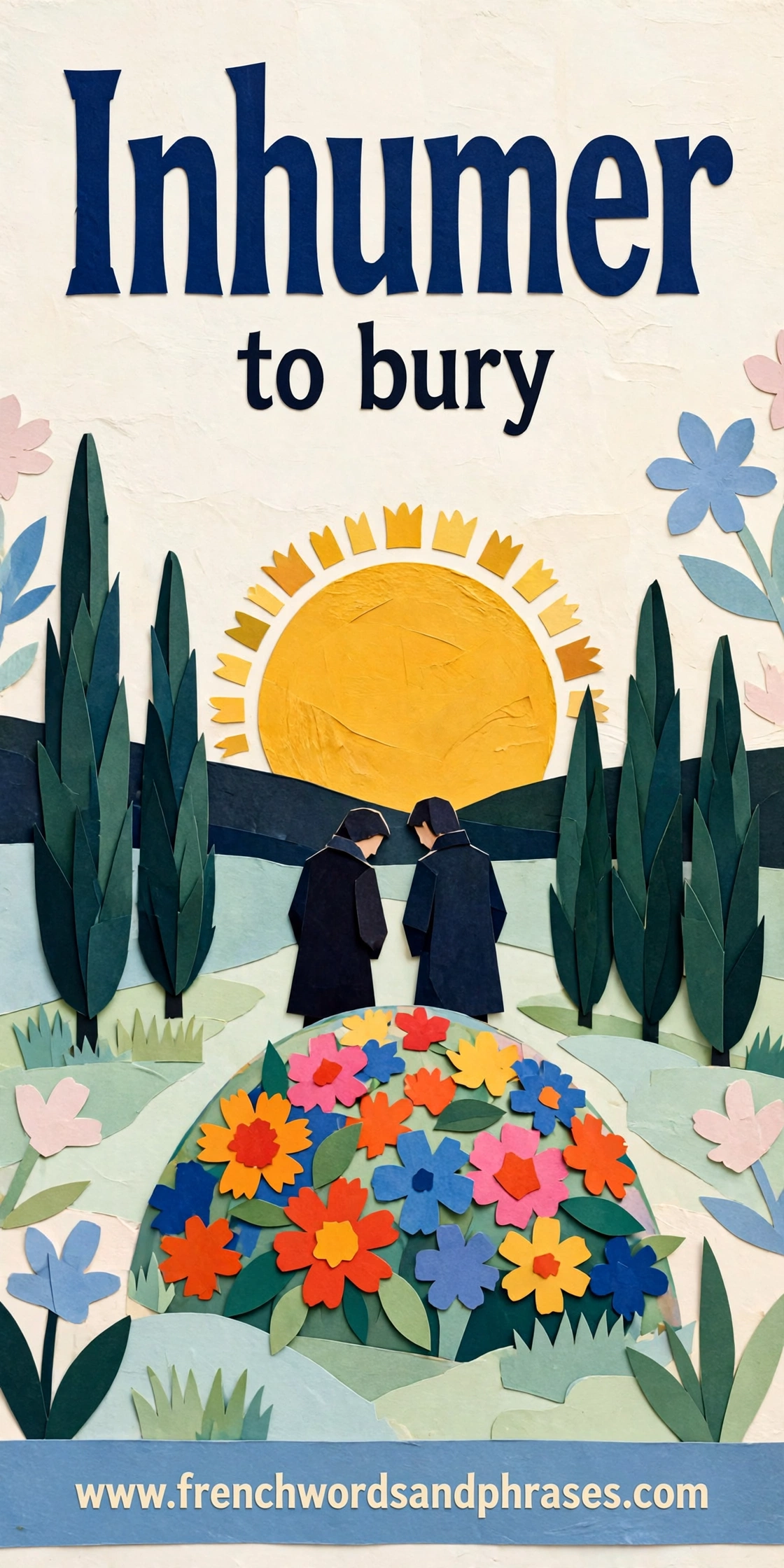
A French Word to Live By
How to Conjugate Inhumer in French
/i.ny.me/
Inhumer means to inter, to bury — to place a dead body in the ground with ceremony, the formal, official word where everyday French says enterrer.
A cemetery in the rain, a line in a death notice, a form at the mairie — inhumer is the verb of official burial: respectful, administrative, and always at one remove from the grief that enterrer carries in everyday speech.
In this guide, you’ll learn how to conjugate inhumer in all the major French tenses and moods. Explore complete conjugation tables, French examples, English translations, and practice quizzes.
Understanding the French Verb Inhumer
Inhumer is a regular French verb belonging to the first group of verbs, those ending in-er.
It means to inter, to bury. Use it wherever burial is official: death notices, military honours, archaeology reports and the paperwork of cemeteries. It is almost never the word of intimate grief — a widow says enterrer; the commune’s register says inhumer. The passive is its most common shape: il sera inhumé mardi, he will be buried on Tuesday.
Verb classification: First group (-er)
Auxiliary verb: Avoir
Past participle: inhumé
Present participle: inhumant
English equivalents: To inter, to bury; inhumer un corps — to inter a body; être inhumé au cimetière — to be buried in the cemetery; l’inhumation aura lieu mardi — the burial will take place on Tuesday; inhumer un soldat — to bury a soldier with honours.
One important detail: inhumer begins with a silent h and elides like a vowel-initial verb: j’inhume, nous inhumons. It is perfectly regular: il inhume, ils inhument, past participle inhumé. Know its family: the ceremony itself is l’inhumation, and its dark opposite is exhumer, to dig up. Register is the real lesson — a family enterrer its dead in conversation, but the death notice, the cemetery office and the law inhument them.
Experience the Word
Inhumer is burial in its official clothes — the same earth, the same farewell, but spoken by the register and the notice, not by the family.
Imagine a village death notice pinned at the mairie: « Monsieur Henri Blanc, décédé à 94 ans, sera inhumé au cimetière du village, mardi à quinze heures. » Ninety-four years of life, closed by one formal verb — inhumé — exactly as thousands of notices have closed before it.
The grief is the family’s. The word is the village’s — inhumé, entered in the record, with honours and in order.
How to Conjugate Inhumer: Complete French Conjugation Guide
Let’s explore every major conjugation of inhumer, beginning with the indicative mood.
How to Conjugate Inhumer in the Indicative Mood
The indicative mood is used to express facts, observations, actions, and events.
How to Conjugate Inhumer in the Present Tense (Présent)
Used for actions happening now, habitual actions, and general truths.
| Subject | Conjugation |
|---|---|
| je | inhume |
| tu | inhumes |
| il / elle | inhume |
| nous | inhumons |
| vous | inhumez |
| ils / elles | inhument |
Example
La commune inhume les soldats inconnus avec les honneurs.
The commune inters unknown soldiers with honours.
Quick Quiz 1
Complete the sentence:
Nous ______ les victimes avec respect.
Reveal the answer
inhumons
Nous inhumons les victimes avec respect.
We bury the victims with respect.
How to Conjugate Inhumer in the Passé Composé
Used for completed actions in the past. Inhumer takes the auxiliary verb avoir.
| Subject | Conjugation |
|---|---|
| j’ | ai inhumé |
| tu | as inhumé |
| il / elle | a inhumé |
| nous | avons inhumé |
| vous | avez inhumé |
| ils / elles | ont inhumé |
Example
On a inhumé le vieux maire au cimetière du village.
They buried the old mayor in the village cemetery.
How to Conjugate Inhumer in the Imparfait (Imperfect Tense)
Used for habitual past actions, descriptions, and ongoing situations in the past.
| Subject | Conjugation |
|---|---|
| je | inhumais |
| tu | inhumais |
| il / elle | inhumait |
| nous | inhumions |
| vous | inhumiez |
| ils / elles | inhumaient |
Example
Autrefois, on inhumait les rois dans la cathédrale.
In the past, kings were interred in the cathedral.
Quick Quiz 2
Choose the correct form:
They buried the mayor in the cemetery.
On ______ le maire au cimetière. (a inhumé / est inhumé)
Reveal the answer
a inhumé
On a inhumé le maire au cimetière.
Inhumer takes avoir.
How to Conjugate Inhumer in the Plus-que-parfait
Used to describe an action that had already been completed before another past event.
| Subject | Conjugation |
|---|---|
| j’ | avais inhumé |
| tu | avais inhumé |
| il / elle | avait inhumé |
| nous | avions inhumé |
| vous | aviez inhumé |
| ils / elles | avaient inhumé |
Example
Elle avait inhumé son mari avant de quitter le pays.
She had buried her husband before leaving the country.
How to Conjugate Inhumer in the Passé Simple
Primarily used in formal writing, literature, and historical narratives. It is rarely used in everyday conversation.
| Subject | Conjugation |
|---|---|
| je | inhumai |
| tu | inhumas |
| il / elle | inhuma |
| nous | inhumâmes |
| vous | inhumâtes |
| ils / elles | inhumèrent |
Example
Le village inhuma son poète sous les applaudissements.
The village buried its poet to applause.
How to Conjugate Inhumer in the Passé Antérieur
A literary tense used to express an action completed immediately before another past action, generally in the passé simple.
| Subject | Conjugation |
|---|---|
| j’ | eus inhumé |
| tu | eus inhumé |
| il / elle | eut inhumé |
| nous | eûmes inhumé |
| vous | eûtes inhumé |
| ils / elles | eurent inhumé |
Example
Quand on eut inhumé le soldat, la fanfare se tut.
When the soldier had been interred, the band fell silent.
How to Conjugate Inhumer in the Future Tense (Futur Simple)
Used to describe actions that will take place in the future.
| Subject | Conjugation |
|---|---|
| je | inhumerai |
| tu | inhumeras |
| il / elle | inhumera |
| nous | inhumerons |
| vous | inhumerez |
| ils / elles | inhumeront |
Example
On inhumera le président dans la crypte nationale.
They will inter the president in the national crypt.
How to Conjugate Inhumer in the Futur Antérieur (Future Perfect)
Used for an action that will have been completed before a particular point in the future.
| Subject | Conjugation |
|---|---|
| j’ | aurai inhumé |
| tu | auras inhumé |
| il / elle | aura inhumé |
| nous | aurons inhumé |
| vous | aurez inhumé |
| ils / elles | auront inhumé |
Example
À midi, on aura inhumé le cercueil depuis une heure.
By midday, the coffin will have been interred for an hour.
How to Conjugate Inhumer in the Near Future (Futur Proche)
Used to describe something that is going to happen soon. Formed with aller + infinitive.
| Subject | Conjugation |
|---|---|
| je | vais inhumer |
| tu | vas inhumer |
| il / elle | va inhumer |
| nous | allons inhumer |
| vous | allez inhumer |
| ils / elles | vont inhumer |
Example
Demain, on va inhumer l’ancien instituteur du village.
Tomorrow, they are going to bury the village’s former schoolteacher.
How to Conjugate Inhumer in the Conditional Mood
The conditional mood expresses what would happen under certain circumstances. It is also frequently used to make polite requests or express wishes.
How to Conjugate Inhumer in the Present Conditional
| Subject | Conjugation |
|---|---|
| je | inhumerais |
| tu | inhumerais |
| il / elle | inhumerait |
| nous | inhumerions |
| vous | inhumeriez |
| ils / elles | inhumeraient |
Example
Sans ce cimetière, on inhumerait les morts loin d’ici.
Without this cemetery, the dead would be buried far from here.
How to Conjugate Inhumer in the Past Conditional
| Subject | Conjugation |
|---|---|
| j’ | aurais inhumé |
| tu | aurais inhumé |
| il / elle | aurait inhumé |
| nous | aurions inhumé |
| vous | auriez inhumé |
| ils / elles | auraient inhumé |
Example
On l’aurait inhumé dans son village natal s’il l’avait demandé.
They would have buried him in his native village if he had asked.
Inhumer in the Literary Past Conditional Form
This less common literary form uses the imperfect subjunctive of avoir.
| Subject | Conjugation |
|---|---|
| j’ | eusse inhumé |
| tu | eusses inhumé |
| il / elle | eût inhumé |
| nous | eussions inhumé |
| vous | eussiez inhumé |
| ils / elles | eussent inhumé |
Example
Le roi inhumât ses ancêtres dans la même crypte.
The king would inter his ancestors in the same crypt.
How to Conjugate Inhumer in the Subjunctive Mood
The subjunctive is used to express wishes, emotions, doubts, necessity, and uncertainty. It frequently follows expressions such as il faut que (it is necessary that) or bien que (although).
How to Conjugate Inhumer in the Present Subjunctive
| Subject | Conjugation |
|---|---|
| que je | inhume |
| que tu | inhumes |
| qu’il / qu’elle | inhume |
| que nous | inhumions |
| que vous | inhumiez |
| qu’ils / qu’elles | inhument |
Example
La famille souhaite qu’on inhume le corps près de la mer.
The family wishes the body to be interred near the sea.
Quick Quiz 3
Complete the sentence using the subjunctive:
La famille souhaite qu’on ______ le corps près de la mer.
Reveal the answer
inhume
La famille souhaite qu’on inhume le corps près de la mer.
The family wishes the body to be interred near the sea.
How to Conjugate Inhumer in the Imperfect Subjunctive
A literary tense, rarely encountered in modern spoken French.
| Subject | Conjugation |
|---|---|
| que je | inhumasse |
| que tu | inhumasses |
| qu’il / qu’elle | inhumât |
| que nous | inhumassions |
| que vous | inhumassiez |
| qu’ils / qu’elles | inhumassent |
Example
Il demandait qu’on l’inhumât dans son village.
He asked to be buried in his village.
How to Conjugate Inhumer in the Pluperfect Subjunctive
A literary construction used to express an action completed before another past action.
| Subject | Conjugation |
|---|---|
| que j’ | eusse inhumé |
| que tu | eusses inhumé |
| qu’il / qu’elle | eût inhumé |
| que nous | eussions inhumé |
| que vous | eussiez inhumé |
| qu’ils / qu’elles | eussent inhumé |
Example
On racontait qu’on eût inhumé le trésor avec le roi.
People said the treasure had been buried with the king.
How to Conjugate Inhumer in the Past Subjunctive
| Subject | Conjugation |
|---|---|
| que j’ | aie inhumé |
| que tu | aies inhumé |
| qu’il / qu’elle | ait inhumé |
| que nous | ayons inhumé |
| que vous | ayez inhumé |
| qu’ils / qu’elles | aient inhumé |
Example
Je suis ému qu’on ait inhumé le soldat avec les honneurs.
I am moved that the soldier was buried with honours.
How to Conjugate Inhumer in the Imperative
The imperative is used to give commands, instructions, invitations, or suggestions. Subject pronouns are omitted.
How to Conjugate Inhumer in the Present Imperative
| Person | Conjugation |
|---|---|
| (tu) | inhume |
| (nous) | inhumons |
| (vous) | inhumez |
Example
Inhume ce soldat avec les honneurs qu’il mérite !
Inter this soldier with the honours he deserves!
Quick Quiz 4
How would you say Inter this soldier with honours (tu form)?
Reveal the answer
Inhume ce soldat avec les honneurs !
French Participles of Inhumer
Participles are verb forms that can be used in compound tenses and other grammatical constructions.
Present Participle of Inhumer
inhumant
En inhumant les victimes, les secouristes observèrent une minute de silence.
While burying the victims, the rescuers observed a minute’s silence.
Past Participle of Inhumer
inhumé
Inhumé au cimetière du village, le poète repose près de l’église.
Buried in the village cemetery, the poet rests near the church.
Inhumer in Everyday French: Real-Life Examples
Now that you know the conjugations, let’s see how inhumer appears in everyday French.
Example 1 — Present
La commune inhume les soldats avec les honneurs.
The commune inters the soldiers with honours.
Example 2 — Passé composé
On a inhumé le maire au cimetière.
They buried the mayor in the cemetery.
Example 3 — Imparfait
On inhumait les rois dans la cathédrale.
Kings were interred in the cathedral.
Example 4 — Future
On inhumera le président dans la crypte.
They will inter the president in the crypt.
Example 5 — Conditional
On l’aurait inhumé dans son village.
They would have buried him in his village.
Example 6 — Imperative
Inhume ce soldat avec les honneurs !
Inter this soldier with honours!
Beyond Translation: The Meaning of Inhumer
English inter is the same formal word — Latin in + humus, into the earth — and French inhumer keeps that earth visible in its spelling.
Enterrer is the family’s word; inhumer is the record’s.
Learn to hear the difference and you have learned a whole register of French: the language of notices, ceremonies and registers, where even grief is written in the third person and the passive voice.
How to Remember the French Verb Inhumer
Remember it this way: Inhumer is about the death notice at the mairie — burial in its official clothes.
- Silent h, elision everywhere: j’inhume, nous inhumons.
- Formal register: death notices and registers say inhumer; families say enterrer.
- The ceremony is l’inhumation; the dark opposite is exhumer, to dig up.
The key idea is the death notice at the mairie — burial in its official clothes.
Test Your Knowledge of Inhumer
Let’s see how much you’ve learned. Try answering these questions before revealing the answers.
Question 1
What is the everyday French verb that usually replaces inhumer?
Reveal the answer
Enterrer — inhumer is the formal, official word of notices and registers.
Question 2
How do you say They buried the old mayor in French (formal)?
Reveal the answer
On a inhumé le vieux maire au cimetière du village.
Question 3
Translate: Kings were interred in the cathedral.
Reveal the answer
On inhumait les rois dans la cathédrale.
Question 4
What is the past participle of inhumer?
Reveal the answer
Inhumé.
Question 5
Complete the sentence:
Il demandait qu’on l’______ dans son village.
Reveal the answer
inhumât
Il demandait qu’on l’inhumât dans son village.
He asked to be buried in his village.
Your Final Challenge
Can You Use It?
How would you say this in French?
The old poet will be buried on Tuesday, in the village cemetery, between the church and the sea he sang so much.
Reveal the answer
Le vieux poète sera inhumé mardi, au cimetière du village, entre l’église et la mer qu’il a tant chantée.
The old poet will be buried on Tuesday, in the village cemetery, between the church and the sea he sang so much.
A little French. A little curiosity. A richer everyday life.
LEARN FRENCH ONE WORD AT A TIME




