
A French Word to Live By
How to Conjugate Inhiber in French
/i.ni.be/
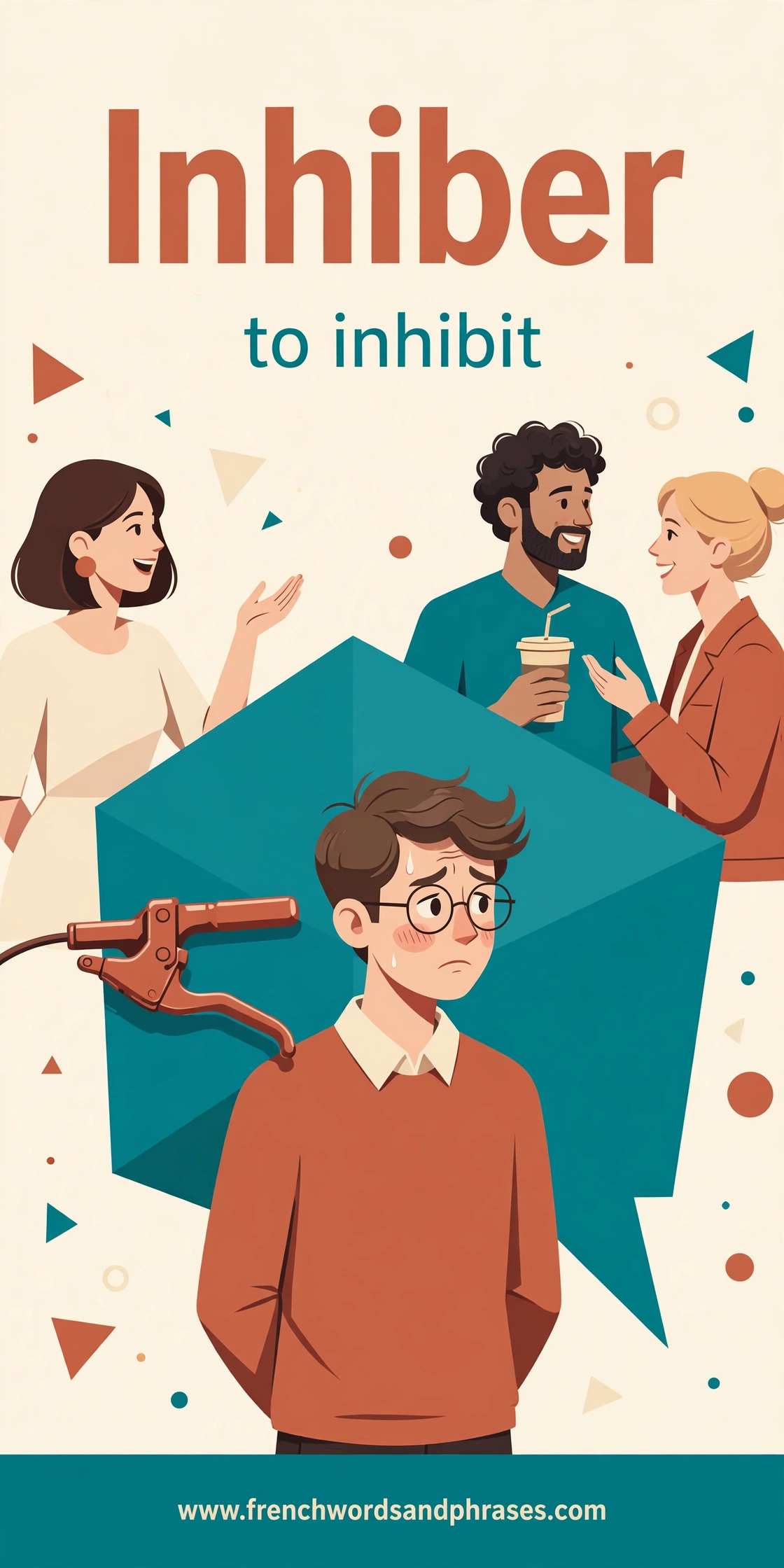
Inhiber means to inhibit — to hold back, slow down or block a process, an impulse or a reaction, the word science uses for everything that puts a brake on something else.
A molecule that slows an enzyme, a shy man who cannot speak in public, a law that holds back trade — inhiber is the verb of the brake pedal: wherever something is restrained from within, this is the word the reports reach for.
In this guide, you’ll learn how to conjugate inhiber in all the major French tenses and moods. Explore complete conjugation tables, French examples, English translations, and practice quizzes.
Understanding the French Verb Inhiber
Inhiber is a regular French verb belonging to the first group of verbs, those ending in-er.
It means to inhibit. The verb lives in three territories: chemistry and biology, where one substance inhibe the action of another; medicine, where reflexes and functions are inhibited; and psychology, where people are inhibés — held back by shyness or fear. In all three, the picture is the same: not destruction from outside, but restraint from within.
Verb classification: First group (-er)
Auxiliary verb: Avoir
Past participle: inhibé
Present participle: inhibant
English equivalents: To inhibit, to hold back, to restrain; inhiber une réaction — to inhibit a reaction; inhiber la croissance — to inhibit growth; inhiber les réflexes — to inhibit reflexes; être inhibé — to be inhibited, shy and held back.
One important detail: like inhaler, inhiber begins with a silent h and behaves as if it started with a vowel: j’inhibe, nous inhibons. It is perfectly regular: il inhibe, ils inhibent, past participle inhibé. Its family does the talking in modern French: une inhibition is the brake itself, un inhibiteur is a substance that applies it, and a person described as inhibé is someone whose own brakes never come off — shy, blocked, unable to let go.
Experience the Word
Inhiber is the verb of the internal brake — nothing is smashed or forbidden; something is simply, quietly held back.
Imagine a brilliant young researcher at her first conference. She knows the answer to every question, her slides are perfect — but when the microphone comes, la timidité l’inhibe: the words stay inside, and a less prepared colleague takes the floor.
Nothing has attacked her from outside. She has been inhibited — inhibée, braked from within by her own shyness.
How to Conjugate Inhiber: Complete French Conjugation Guide
Let’s explore every major conjugation of inhiber, beginning with the indicative mood.
How to Conjugate Inhiber in the Indicative Mood
The indicative mood is used to express facts, observations, actions, and events.
How to Conjugate Inhiber in the Present Tense (Présent)
Used for actions happening now, habitual actions, and general truths.
| Subject | Conjugation |
|---|---|
| je | inhibe |
| tu | inhibes |
| il / elle | inhibe |
| nous | inhibons |
| vous | inhibez |
| ils / elles | inhibent |
Example
Ce médicament inhibe l’action de l’enzyme.
This medicine inhibits the action of the enzyme.
Quick Quiz 1
Complete the sentence:
Nous ______ cette réaction avec un produit spécial.
Reveal the answer
inhibons
Nous inhibons cette réaction avec un produit spécial.
We inhibit this reaction with a special product.
How to Conjugate Inhiber in the Passé Composé
Used for completed actions in the past. Inhiber takes the auxiliary verb avoir.
| Subject | Conjugation |
|---|---|
| j’ | ai inhibé |
| tu | as inhibé |
| il / elle | a inhibé |
| nous | avons inhibé |
| vous | avez inhibé |
| ils / elles | ont inhibé |
Example
La peur a inhibé toutes ses réactions.
Fear inhibited all his reactions.
How to Conjugate Inhiber in the Imparfait (Imperfect Tense)
Used for habitual past actions, descriptions, and ongoing situations in the past.
| Subject | Conjugation |
|---|---|
| je | inhibais |
| tu | inhibais |
| il / elle | inhibait |
| nous | inhibions |
| vous | inhibiez |
| ils / elles | inhibaient |
Example
Autrefois, la honte inhibait beaucoup de jeunes gens.
In the past, shame inhibited many young people.
Quick Quiz 2
Choose the correct form:
Fear inhibited his reactions.
La peur ______ ses réactions. (a inhibé / est inhibé)
Reveal the answer
a inhibé
La peur a inhibé ses réactions.
Inhiber takes avoir.
How to Conjugate Inhiber in the Plus-que-parfait
Used to describe an action that had already been completed before another past event.
| Subject | Conjugation |
|---|---|
| j’ | avais inhibé |
| tu | avais inhibé |
| il / elle | avait inhibé |
| nous | avions inhibé |
| vous | aviez inhibé |
| ils / elles | avaient inhibé |
Example
Le froid avait inhibé la croissance des plantes.
The cold had inhibited the growth of the plants.
How to Conjugate Inhiber in the Passé Simple
Primarily used in formal writing, literature, and historical narratives. It is rarely used in everyday conversation.
| Subject | Conjugation |
|---|---|
| je | inhibai |
| tu | inhibas |
| il / elle | inhiba |
| nous | inhibâmes |
| vous | inhibâtes |
| ils / elles | inhibèrent |
Example
Sa présence inhiba soudain toute la salle.
His presence suddenly inhibited the whole room.
How to Conjugate Inhiber in the Passé Antérieur
A literary tense used to express an action completed immediately before another past action, generally in the passé simple.
| Subject | Conjugation |
|---|---|
| j’ | eus inhibé |
| tu | eus inhibé |
| il / elle | eut inhibé |
| nous | eûmes inhibé |
| vous | eûtes inhibé |
| ils / elles | eurent inhibé |
Example
Quand le produit eut inhibé la réaction, l’expérience s’arrêta.
When the product had inhibited the reaction, the experiment stopped.
How to Conjugate Inhiber in the Future Tense (Futur Simple)
Used to describe actions that will take place in the future.
| Subject | Conjugation |
|---|---|
| je | inhiberai |
| tu | inhiberas |
| il / elle | inhibera |
| nous | inhiberons |
| vous | inhiberez |
| ils / elles | inhiberont |
Example
Ce traitement inhibera la production de l’hormone.
This treatment will inhibit the production of the hormone.
How to Conjugate Inhiber in the Futur Antérieur (Future Perfect)
Used for an action that will have been completed before a particular point in the future.
| Subject | Conjugation |
|---|---|
| j’ | aurai inhibé |
| tu | auras inhibé |
| il / elle | aura inhibé |
| nous | aurons inhibé |
| vous | aurez inhibé |
| ils / elles | auront inhibé |
Example
À la fin du mois, le froid aura inhibé toute la végétation.
By the end of the month, the cold will have inhibited all the vegetation.
How to Conjugate Inhiber in the Near Future (Futur Proche)
Used to describe something that is going to happen soon. Formed with aller + infinitive.
| Subject | Conjugation |
|---|---|
| je | vais inhiber |
| tu | vas inhiber |
| il / elle | va inhiber |
| nous | allons inhiber |
| vous | allez inhiber |
| ils / elles | vont inhiber |
Example
Ce bruit va inhiber sa concentration.
This noise is going to inhibit his concentration.
How to Conjugate Inhiber in the Conditional Mood
The conditional mood expresses what would happen under certain circumstances. It is also frequently used to make polite requests or express wishes.
How to Conjugate Inhiber in the Present Conditional
| Subject | Conjugation |
|---|---|
| je | inhiberais |
| tu | inhiberais |
| il / elle | inhiberait |
| nous | inhiberions |
| vous | inhiberiez |
| ils / elles | inhiberaient |
Example
Sans ce frein naturel, rien n’inhiberait la réaction.
Without this natural brake, nothing would inhibit the reaction.
How to Conjugate Inhiber in the Past Conditional
| Subject | Conjugation |
|---|---|
| j’ | aurais inhibé |
| tu | aurais inhibé |
| il / elle | aurait inhibé |
| nous | aurions inhibé |
| vous | auriez inhibé |
| ils / elles | auraient inhibé |
Example
La timidité l’aurait inhibé même devant un petit public.
Shyness would have inhibited him even before a small audience.
Inhiber in the Literary Past Conditional Form
This less common literary form uses the imperfect subjunctive of avoir.
| Subject | Conjugation |
|---|---|
| j’ | eusse inhibé |
| tu | eusses inhibé |
| il / elle | eût inhibé |
| nous | eussions inhibé |
| vous | eussiez inhibé |
| ils / elles | eussent inhibé |
Example
La peur inhibât les plus courageux.
Fear would inhibit the bravest.
How to Conjugate Inhiber in the Subjunctive Mood
The subjunctive is used to express wishes, emotions, doubts, necessity, and uncertainty. It frequently follows expressions such as il faut que (it is necessary that) or bien que (although).
How to Conjugate Inhiber in the Present Subjunctive
| Subject | Conjugation |
|---|---|
| que je | inhibe |
| que tu | inhibes |
| qu’il / qu’elle | inhibe |
| que nous | inhibions |
| que vous | inhibiez |
| qu’ils / qu’elles | inhibent |
Example
Il faut que ce produit inhibe la bactérie sans nuire au patient.
This product must inhibit the bacterium without harming the patient.
Quick Quiz 3
Complete the sentence using the subjunctive:
Il faut que vous ______ la croissance de cette bactérie.
Reveal the answer
inhibiez
Il faut que vous inhibiez la croissance de cette bactérie.
You must inhibit the growth of this bacterium.
How to Conjugate Inhiber in the Imperfect Subjunctive
A literary tense, rarely encountered in modern spoken French.
| Subject | Conjugation |
|---|---|
| que je | inhibasse |
| que tu | inhibasses |
| qu’il / qu’elle | inhibât |
| que nous | inhibassions |
| que vous | inhibassiez |
| qu’ils / qu’elles | inhibassent |
Example
On craignait que le froid inhibât la floraison.
People feared the cold might inhibit the flowering.
How to Conjugate Inhiber in the Pluperfect Subjunctive
A literary construction used to express an action completed before another past action.
| Subject | Conjugation |
|---|---|
| que j’ | eusse inhibé |
| que tu | eusses inhibé |
| qu’il / qu’elle | eût inhibé |
| que nous | eussions inhibé |
| que vous | eussiez inhibé |
| qu’ils / qu’elles | eussent inhibé |
Example
On savait que la peur eût inhibé ses réflexes.
People knew fear had inhibited his reflexes.
How to Conjugate Inhiber in the Past Subjunctive
| Subject | Conjugation |
|---|---|
| que j’ | aie inhibé |
| que tu | aies inhibé |
| qu’il / qu’elle | ait inhibé |
| que nous | ayons inhibé |
| que vous | ayez inhibé |
| qu’ils / qu’elles | aient inhibé |
Example
Je suis étonné que la honte l’ait inhibé à ce point.
I am amazed shame inhibited him to that extent.
How to Conjugate Inhiber in the Imperative
The imperative is used to give commands, instructions, invitations, or suggestions. Subject pronouns are omitted.
How to Conjugate Inhiber in the Present Imperative
| Person | Conjugation |
|---|---|
| (tu) | inhibe |
| (nous) | inhibons |
| (vous) | inhibez |
Example
Inhibe cette réaction avant qu’elle s’emballe !
Inhibit this reaction before it runs away!
Quick Quiz 4
How would you say Inhibit this reaction (tu form)?
Reveal the answer
Inhibe cette réaction !
French Participles of Inhiber
Participles are verb forms that can be used in compound tenses and other grammatical constructions.
Present Participle of Inhiber
inhibant
En inhibant l’enzyme, le médicament ralentit la maladie.
By inhibiting the enzyme, the medicine slows the disease.
Past Participle of Inhiber
inhibé
Inhibé par la timidité, il n’a rien osé dire.
Inhibited by shyness, he dared not say anything.
Inhiber in Everyday French: Real-Life Examples
Now that you know the conjugations, let’s see how inhiber appears in everyday French.
Example 1 — Present
Ce médicament inhibe l’enzyme.
This medicine inhibits the enzyme.
Example 2 — Passé composé
La peur a inhibé ses réactions.
Fear inhibited his reactions.
Example 3 — Imparfait
La honte inhibait les jeunes gens.
Shame inhibited young people.
Example 4 — Future
Ce traitement inhibera l’hormone.
This treatment will inhibit the hormone.
Example 5 — Conditional
Rien n’inhiberait la réaction sans ce frein.
Nothing would inhibit the reaction without this brake.
Example 6 — Imperative
Inhibe cette réaction !
Inhibit this reaction!
Beyond Translation: The Meaning of Inhiber
English inhibit is the same Latin brake — inhibere, to hold in — and French inhiber runs it through the laboratory and the soul alike.
An enzyme and a shy man can both be inhibés.
That double life is the verb’s usefulness: the chemist’s inhibiteur and the psychologist’s patient obey one picture — a force present, active, and held back from inside, waiting for whatever releases the brake.
How to Remember the French Verb Inhiber
Remember it this way: Inhiber is about the brake pedal inside — the enzyme and the shy researcher.
- Silent h, elision everywhere: j’inhibe, nous inhibons — as if the word began with a vowel.
- The picture is a brake from within: a substance, a reflex, a person held back.
- Regular -er: il inhibe, ils inhibent, past participle inhibé; a shy person is un inhibé.
The key idea is the brake pedal inside — the enzyme and the shy researcher.
Test Your Knowledge of Inhiber
Let’s see how much you’ve learned. Try answering these questions before revealing the answers.
Question 1
How do you write je + inhiber, and why?
Reveal the answer
J’inhibe — the h of inhiber is silent, so elision applies as before a vowel.
Question 2
How do you say This medicine inhibits the enzyme in French?
Reveal the answer
Ce médicament inhibe l’enzyme.
Question 3
Translate: Fear inhibited all his reactions.
Reveal the answer
La peur a inhibé toutes ses réactions.
Question 4
What is the past participle of inhiber?
Reveal the answer
Inhibé — as an adjective it describes a shy, held-back person.
Question 5
Complete the sentence:
Il faut que ce produit ______ la bactérie.
Reveal the answer
inhibe
Il faut que ce produit inhibe la bactérie.
This product must inhibit the bacterium.
Your Final Challenge
Can You Use It?
How would you say this in French?
Inhibited by years of mockery, the young man still did not dare to speak in public.
Reveal the answer
Inhibé par des années de moqueries, le jeune homme n’osait toujours pas prendre la parole en public.
Inhibited by years of mockery, the young man still did not dare to speak in public.
A little French. A little curiosity. A richer everyday life.
LEARN FRENCH ONE WORD AT A TIME




