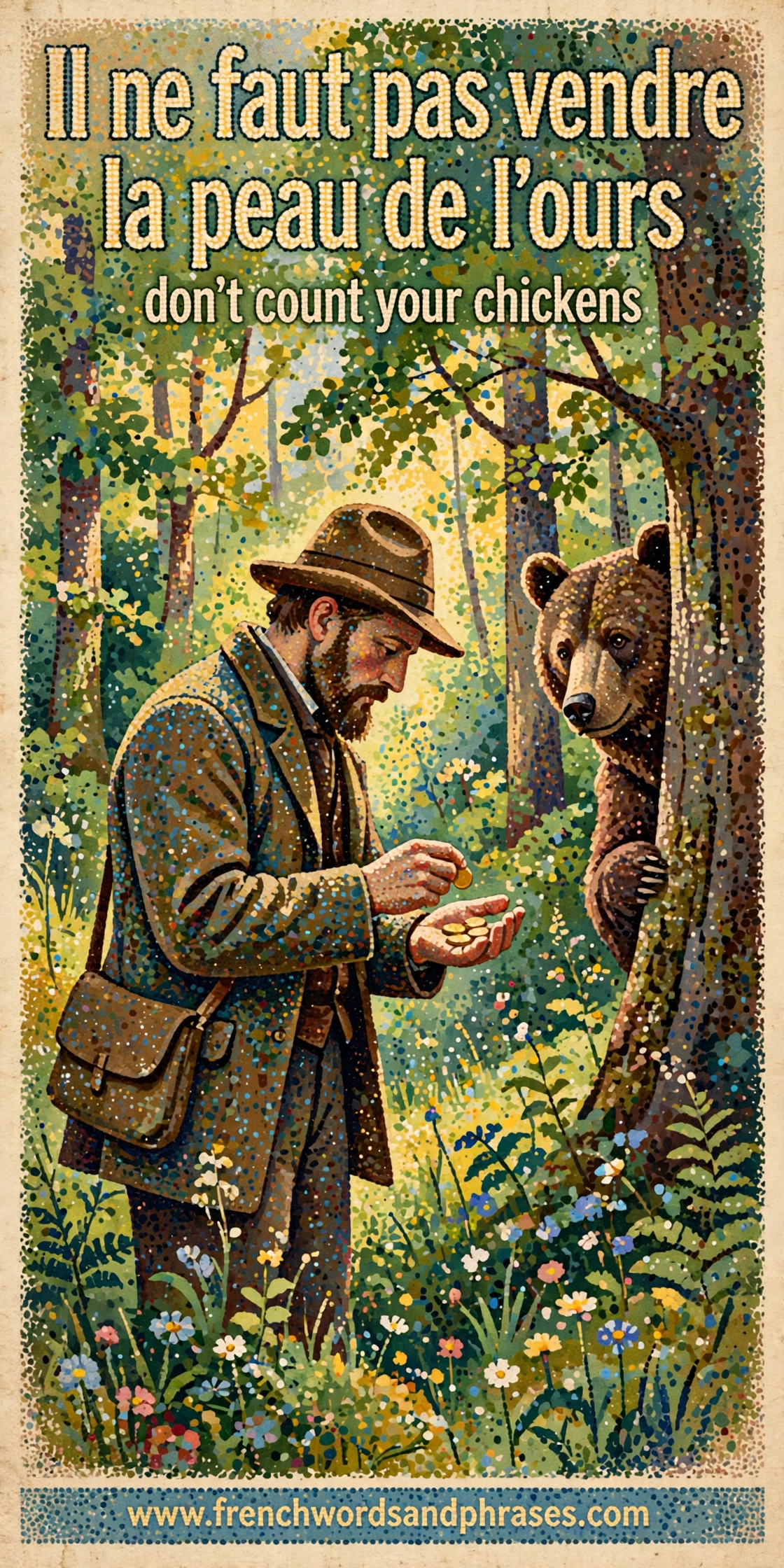
A French Word to Live By
Translate Il ne faut pas vendre la peau de l’ours to English
/il nə fo pa vɑ̃dʁ la po də luʁs/
Il ne faut pas vendre la peau de l’ours means don’t count your chickens before they’re hatched — do not celebrate before the thing is won.
The village lottery results come out tonight, and your neighbour has already ordered a new car, promised his son a motorbike and booked a cruise — all before the draw. His wife, watching the delivery van measure the driveway, shakes her head: « Il ne faut pas vendre la peau de l’ours. »
Let’s explore how il ne faut pas vendre la peau de l’ours works in French, beginning with the whole phrase on one card.
Understanding the French Phrase Il ne faut pas vendre la peau de l’ours
Il ne faut pas vendre la peau de l’ours is a French proverb built from il ne faut pas (one must not), vendre (to sell), la peau (the skin, the hide) and l’ours (the bear). It comes from an old fable — two hunters sold a bear’s skin to a furrier before the hunt, then met the bear, very much alive.
It means do not count on a success before you actually have it — the French twin of ‘don’t count your chickens before they’re hatched’. The bear is still in the forest: the exam is not passed, the contract is not signed, the money is not in the bank. Sell the skin only when the hunt is truly over.
Type: Proverb — premature celebration (il ne faut pas = one must not)
Answers the need: Warning someone who is celebrating or spending too soon
Register: Neutral — safe everywhere; often said with a smile, sometimes shortened
Strength: Firm — a real warning, softened by the story inside it
One important usage detail: French speakers very often add the ending before you have killed it — il ne faut pas vendre la peau de l’ours avant de l’avoir tué — and just as often shorten the whole proverb to vendre la peau de l’ours, used as a verb phrase: arrête de vendre la peau de l’ours, stop counting your chickens. The bear is masculine: un ours.
Experience the Word
Il ne faut pas vendre la peau de l’ours is the proverb of every victory speech written too early — the forest always gets a vote.
Imagine the football fans printing championship scarves before the final, and the other team scoring in the last minute. The scarves become cleaning rags, and somewhere an old supporter mutters about a bear whose skin changed hands in the eighty-ninth minute.
The fable’s hunters escaped up a tree. The modern bear is quieter — an unsigned contract, an unopened results envelope — but it climbs just as well.
How to Use Il ne faut pas vendre la peau de l’ours in French: Complete Guide
Let’s explore how il ne faut pas vendre la peau de l’ours works in French, beginning with the whole phrase on one card.
Il ne faut pas vendre la peau de l’ours at a Glance
The Whole Phrase on One Card
Real meaning, literal picture, English twin and register — il ne faut pas vendre la peau de l’ours in five lines.
| Point | Il ne faut pas vendre la peau de l’ours |
|---|---|
| What it really means | do not count on a result before you actually have it |
| Word for word | one must not sell the bear’s skin |
| English equivalent | don’t count your chickens before they’re hatched |
| Register | neutral — a classic warning, often said smiling |
| Use it for | early celebrations, unsigned deals, unopened results, promised money |
Example
Le contrat n’est pas signé : ne vends pas la peau de l’ours.
The contract is not signed: don’t count your chickens.
Word by Word: Building the Bear
Five small pieces — take them one by one and the bear stays safely in the forest.
| Word | Literal meaning | Its job in the phrase |
|---|---|---|
| il ne faut pas | one must not | the impersonal warning — falloir, the verb of necessity, negated |
| vendre | to sell | the premature act — spending a victory you do not own yet |
| la peau | the skin, the hide | the prize itself, still walking around on its owner |
| de l’ours | of the bear | the bear — masculine, un ours, and still very much alive |
Example
La peau de l’ours attendra la fin de la chasse.
The bear’s skin can wait until the end of the hunt.
Quick Quiz 1
What does il ne faut pas mean, word for word?
Reveal the answer
One must not / you should not — il faut is the impersonal ‘it is necessary’, and ne… pas turns it into a prohibition.
Il ne faut pas crier victoire trop tôt.
You must not shout victory too soon.
When You Say It: The Too-Soon Moments
Il ne faut pas vendre la peau de l’ours fires at moments like these — wherever a celebration has started one step early.
| Situation | Example |
|---|---|
| Exam results pending | les résultats arrivent vendredi : ne vends pas la peau de l’ours — results come Friday: don’t count your chickens |
| A deal not yet signed | rien n’est signé, calme-toi — nothing is signed, calm down |
| Spending promised money | il dépense déjà sa prime, avant même de l’avoir — he is already spending his bonus, before even having it |
| A match not yet finished | il reste dix minutes : pas encore de peau d’ours — ten minutes left: no bearskin yet |
| A job interview gone well | l’entretien s’est bien passé, mais attends la réponse — the interview went well, but wait for the answer |
Example
Attends la lettre officielle avant de fêter ton examen.
Wait for the official letter before celebrating your exam.
Make It Yours: The Proverb in Use
The proverb bends into a verb phrase — vendre la peau de l’ours can be ordered, begged and confessed.
| Form | French | In English |
|---|---|---|
| The full proverb | il ne faut pas vendre la peau de l’ours | don’t count your chickens before they’re hatched |
| With the ending | il ne faut pas vendre la peau de l’ours avant de l’avoir tué | don’t sell the bear’s skin before you have killed it |
| As an order | ne vends pas la peau de l’ours | don’t count your chickens |
| Accusing gently | tu vends la peau de l’ours, là | you’re counting your chickens, there |
| Confessing | j’ai vendu la peau de l’ours, je sais | I counted my chickens, I know |
Example
Tu vends la peau de l’ours : le client n’a encore rien confirmé.
You’re counting your chickens: the client has not confirmed anything yet.
Quick Quiz 2
What ending do French speakers often add — avant de l’avoir tué or après la fête?
Reveal the answer
Avant de l’avoir tué — before you have killed it: the full warning names exactly when the skin may be sold.
Ne vends pas la peau de l’ours avant de l’avoir tué.
Don’t count your chickens before they’re hatched.
Everyday Expressions: Building on the Bear
Il ne faut pas vendre la peau de l’ours slots into these everyday frames — each one ready to use as it stands.
| Frame | In English |
|---|---|
| vendre la peau de l’ours | to count your chickens — to bank on an unconfirmed result |
| ne pas crier victoire trop tôt | not to shout victory too soon |
| ne pas vendre la mèche | not to give the game away — a different trap: the secret, not the result |
| attendre la confirmation | to wait for confirmation |
| c’est pas encore gagné | it’s not won yet — informal, literally ‘not yet in the bag’ |
Example
C’est pas encore gagné : le jury délibère toujours.
It’s not won yet: the jury is still deliberating.
Close Cousins: The Other Caution Sayings
French has a whole shelf of caution sayings — the bear guards results; its cousins guard secrets, hopes and promises.
| Expression | The difference |
|---|---|
| il ne faut pas vendre la peau de l’ours | don’t count your chickens — about results not yet secured |
| ne pas crier victoire | don’t shout victory — the same warning without the bear, for contests and games |
| il ne faut pas vendre la mèche | don’t give the game away — about keeping a secret, not awaiting a result |
| promettre la lune | to promise the moon — the fault of the one making the early promise |
| compter sur quelque chose trop tôt | to count on something too soon — the plain, proverb-free version |
Example
Il promet la lune à ses clients, puis il vend la peau de l’ours.
He promises his clients the moon, then he counts his chickens.
Quick Quiz 3
A friend nearly reveals the surprise party. Peau de l’ours or vendre la mèche?
Reveal the answer
Vendre la mèche — to give the game away. The bear’s skin is about results you do not have yet, not secrets you must keep.
Chut, ne vends pas la mèche pour la fête de samedi.
Shh, don’t give the game away about Saturday’s party.
Il ne faut pas vendre la peau de l’ours and Its Neighbours
The forest shelf around the proverb — from the bear itself to the hunter’s patience.
| French | In English |
|---|---|
| un ours | a bear — masculine |
| la peau | the skin, the hide |
| un chasseur | a hunter |
| une proie | a prey, a catch |
| la victoire | victory |
| un résultat | a result |
Example
Le chasseur patient attend le résultat avant de parler de victoire.
The patient hunter waits for the result before talking of victory.
Watch Out: The Traps Around Il ne faut pas vendre la peau de l’ours
The traps: a skin that is also a hide, a bear with a fixed gender, and a cousin about secrets that sounds like a twin.
| Trap | The truth |
|---|---|
| la peau’s two lives | la peau is skin on a person and hide on an animal — here it is the bear’s hide, the furrier’s prize |
| the bear is masculine | un ours, l’ours — and the added ending keeps it so: avant de l’avoir tué, with tué in the masculine |
| not the secret trap | vendre la mèche means giving away a secret — a different sale entirely; check which warning you need |
| il faut is impersonal | il ne faut pas addresses everyone and no one — that is why it warns without accusing |
Example
Il ne faut ni vendre la peau de l’ours, ni vendre la mèche.
You must neither count your chickens, nor give the game away.
Quick Quiz 4
True or false: un ours is feminine in French.
Reveal the answer
False — ours is masculine: un ours, l’ours, and avant de l’avoir tué.
Un ours prudent ne sort pas avant le printemps.
A cautious bear does not come out before spring.
Il ne faut pas vendre la peau de l’ours in Everyday French: Real-Life Examples
Now that you know the word, let’s see how il ne faut pas vendre la peau de l’ours appears in everyday French.
Example 1 — Before the results
Les résultats sont demain : ne vends pas la peau de l’ours.
The results are tomorrow: don’t count your chickens.
Example 2 — The unsigned contract
Il a déjà commandé le champagne, mais rien n’est signé : la peau de l’ours, toujours.
He has already ordered the champagne, but nothing is signed: the bearskin, as always.
Example 3 — The football final
À la mi-temps, les supporters fêtent déjà : ils vendent la peau de l’ours.
At half-time, the fans are already celebrating: they’re counting their chickens.
Example 4 — The promised bonus
Elle dépense sa prime avant de l’avoir reçue : vendre la peau de l’ours.
She is spending her bonus before receiving it: counting her chickens.
Example 5 — Grandmother’s advice
Ma grand-mère répète : il ne faut pas vendre la peau de l’ours avant de l’avoir tué.
My grandmother keeps saying: don’t count your chickens before they’re hatched.
Example 6 — The job offer
L’offre est verbale, pas écrite : je ne vends pas la peau de l’ours.
The offer is verbal, not written: I’m not counting my chickens.
Beyond Translation: The Meaning of Il ne faut pas vendre la peau de l’ours
English counts chickens — small, countable, farmyard hopes. French sells a bearskin — one enormous, dangerous prize that is still attached to its owner. The French version carries a story inside it: two hunters, a furrier, a debt, and a bear standing up in the trees. The English warns you about arithmetic; the French warns you about storytelling — the tale you tell before the ending is written.
Every premature celebration is a small sale of a skin you do not own.
That is why the proverb survives every exam season and every transfer window: the bears change, the forest does not.
How to Remember the French Phrase Il ne faut pas vendre la peau de l’ours
Remember it this way: Il ne faut pas vendre la peau de l’ours is the hunter’s warning — the bear is still in the forest, and its skin is still its own.
- You picture the living bear — the skin can only be sold after the hunt, never before it.
- You add the full ending when it matters — avant de l’avoir tué, before you have killed it.
- You separate the two sales — the peau de l’ours guards results; vendre la mèche guards secrets.
The key idea is il ne faut pas vendre la peau de l’ours means don’t count your chickens before they’re hatched.
Test Your Knowledge of Il ne faut pas vendre la peau de l’ours
Let’s see how much you’ve learned. Try answering these questions before revealing the answers.
Question 1
What does il ne faut pas vendre la peau de l’ours mean?
Reveal the answer
Don’t count your chickens before they’re hatched — do not rely on a result before you have it.
Question 2
What is the literal, word-for-word meaning?
Reveal the answer
One must not sell the bear’s skin — la peau is the hide, and l’ours is the bear, still alive in the forest.
Question 3
How do you say ‘you’re counting your chickens’ to a friend?
Reveal the answer
Tu vends la peau de l’ours — the proverb shortens into a verb phrase you can aim at a person.
Question 4
What is the difference between vendre la peau de l’ours and vendre la mèche?
Reveal the answer
The bear guards results; the mèche guards secrets — vendre la mèche means to give the game away.
Question 5
Complete the sentence:
Il ne faut pas vendre la ______ de l’ours. (Don’t count your chickens.)
Reveal the answer
peau
Il ne faut pas vendre la peau de l’ours.
Don’t count your chickens before they’re hatched.
Your Final Challenge
Can You Use It?
How would you say this in French?
“Don’t count your chickens before they’re hatched.”
Reveal the answer
Il ne faut pas vendre la peau de l’ours.
Don’t count your chickens before they’re hatched.
A little French. A little curiosity. A richer everyday life.
LEARN FRENCH ONE WORD AT A TIME