
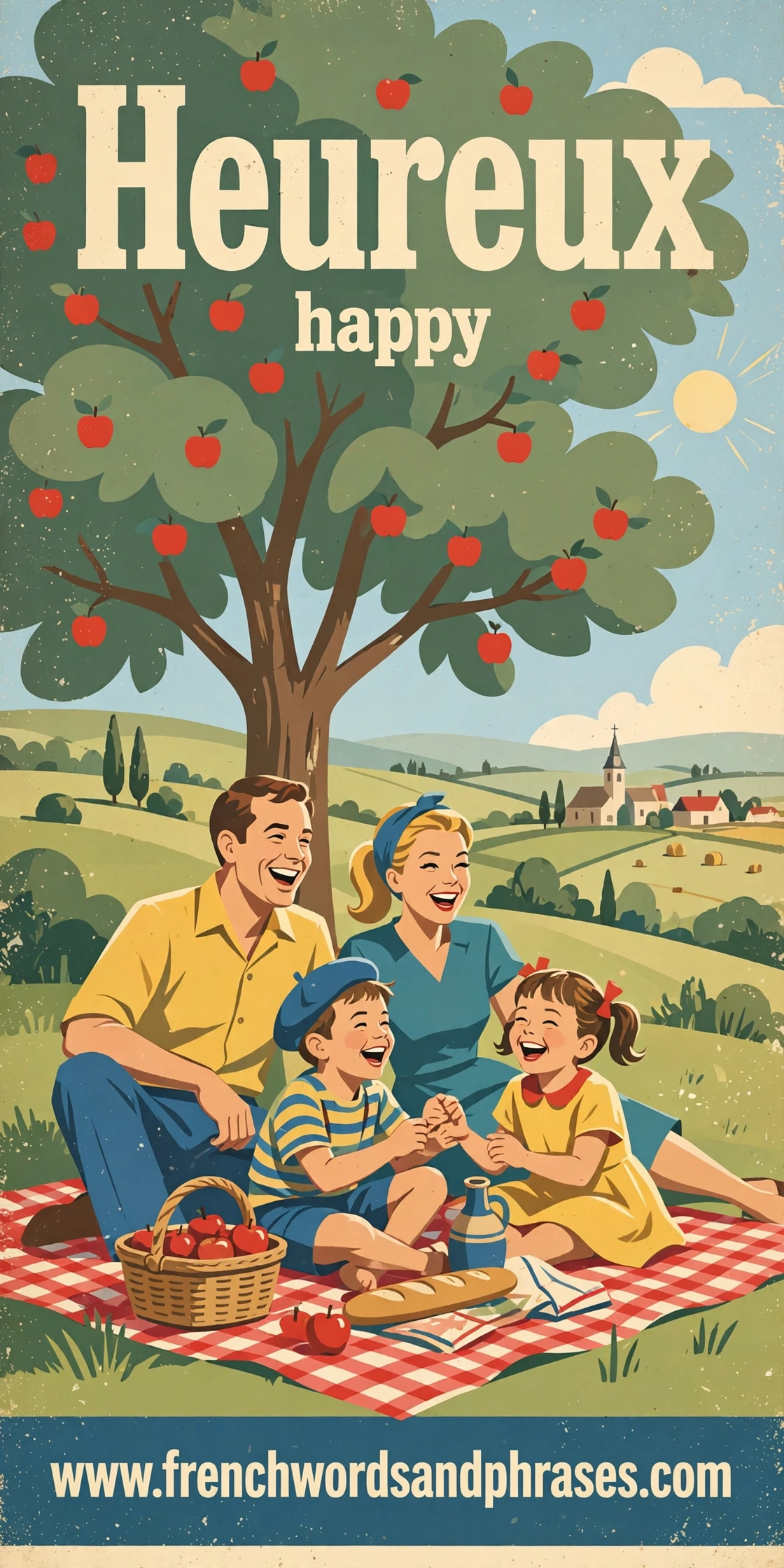
A French Word to Live By
Translate Heureux to English
/œ.ʁø/
Heureux means happy.
Late summer, a long table under the plane trees: grandparents, cousins, neighbours, a dog asleep in the shade, plates empty and glasses full. Nobody is checking the time. The old man at the head of the table looks down its whole length and smiles. He is heureux.
In this guide, you’ll learn what heureux means in English, how its feminine heureuse is formed, the pattern heureux de that carries the reason for the happiness, and how heureux differs from its everyday cousin content. Explore French examples, English translations, and practice quizzes.
Understanding the French Adjective Heureux
Heureux is a French adjective of feeling — the adjective of deep happiness. It changes for the feminine: heureux becomes heureuse, and the final -x melts into an -s sound, as if the word relaxed into a smile.
It means happy — but a deeper happy than content. Content is the pleasure of the moment (a good meal, good news); heureux is the happiness of a life, a marriage, a home: un mariage heureux, une enfance heureuse, un homme heureux. It is the word of toasts and endings: ils vécurent heureux — they lived happily.
Type: Adjective of feeling — deep happiness
Answers the question: What is he/she like? — happy
Changes form: Yes — heureux, heureuse; plurals heureux / heureuses
English equivalents: Happy; fortunate, lucky (in set phrases).
One important usage detail: heureux is followed by de + infinitive for the reason — je suis heureux de te voir, I am happy to see you. With a noun, de works too: heureux de son succès. And note the plural: masculine heureux does not change — des hommes heureux.
Experience the Word
Heureux is the adjective of the long table and the long life — happiness that has had time to settle, like wine in a cellar.
Imagine the last page of a story told at bedtime: the storm is over, the house is warm, everyone is home. The storyteller closes the book on the oldest sentence in French storytelling: « Ils vécurent heureux. » They lived happily — ever after is understood.
You have not just felt a good mood. You have taken stock of a life, and found it good.
How to Use Heureux in French: Complete Guide
Let’s explore how heureux works in French, beginning with the whole word on one card.
Heureux at a Glance
Before the details, here is the whole word on one card.
The Whole Word on One Card
Meaning, type, position and forms — heureux in four lines.
| Point | Heureux |
|---|---|
| Meaning | happy |
| Type | adjective of feeling — deep happiness |
| Usual position | after the noun — un homme heureux |
| Form | heureux / heureuse / heureux / heureuses |
Example
C’est un homme heureux, entouré de sa famille.
He is a happy man, surrounded by his family.
The Four Forms of Heureux
Heureux hides a small surprise: the masculine plural is identical to the singular — heureux, heureux — while the feminine, heureuse, changes the -eux into -euse, in sound and in spelling.
| Form | Heureux | Example |
|---|---|---|
| Masculine singular | heureux | un homme heureux — a happy man |
| Feminine singular | heureuse | une femme heureuse — a happy woman |
| Masculine plural | heureux | des hommes heureux — happy men (the same form) |
| Feminine plural | heureuses | des femmes heureuses — happy women |
Example
Ils sont heureux ensemble depuis cinquante ans.
They have been happy together for fifty years.
Quick Quiz 1
What is the feminine of heureux?
Reveal the answer
heureuse
Une enfance heureuse.
A happy childhood.
The Feminine of Heureux: Heureuse
Adjectives ending in -eux form their feminine in -euse: the x melts into an s, and the word softens. Heureux is the model of a whole cheerful family.
| Pattern | Example |
|---|---|
| Masculine -eux | heureux — un jour heureux |
| Feminine -euse | heureuse — une journée heureuse |
| The same family | sérieux → sérieuse, généreux → généreuse, amoureux → amoureuse |
| Masculine plural | heureux — no change: des jours heureux |
Example
C’était une période heureuse de sa vie.
It was a happy period of her life.
Where Heureux Goes: After the Noun
Heureux follows the noun it describes, and after être it brings de with it, carrying the reason for the happiness.
| Pattern | Example |
|---|---|
| noun + heureux | un mariage heureux — a happy marriage |
| être + heureux | Elle est heureuse. — She is happy. |
| heureux de + infinitive | heureux de te voir — happy to see you |
| heureux de + noun | heureux de son succès — happy about his success |
Example
Nous sommes heureux de vous accueillir chez nous.
We are happy to welcome you to our home.
Quick Quiz 2
Complete: je suis heureux ___ vous voir. (to)
Reveal the answer
de
Je suis heureux de vous voir.
I am happy to see you.
Happier Still: Comparing with Heureux
Heureux compares the regular way — plus heureux is a wish French makes at every wedding and every New Year.
| Degree | Example |
|---|---|
| As happy as | aussi heureux que — as happy as |
| Happier | plus heureux — happier |
| Less happy | moins heureux — less happy |
| The happiest (masc.) | le plus heureux — le plus heureux des hommes |
| The happiest (fem.) | la plus heureuse — la plus heureuse des femmes |
Example
Depuis leur mariage, ils sont plus heureux que jamais.
Since their wedding, they are happier than ever.
Everyday Expressions with Heureux
Heureux blesses the calendar — birthdays, New Years, journeys — and closes the fairy tales.
| Expression | In English |
|---|---|
| joyeux anniversaire / heureux anniversaire | happy birthday — both are used |
| bonne et heureuse année | a good and happy New Year |
| un heureux événement | a happy event — the classic announcement of a baby on the way |
| heureux au jeu, malheureux en amour | lucky at cards, unlucky in love — the old proverb |
| ils vécurent heureux | they lived happily — the fairy-tale ending |
| par un heureux hasard | by a lucky chance, happily |
Example
Par un heureux hasard, nous nous sommes rencontrés à la gare.
By a lucky chance, we met at the station.
Quick Quiz 3
What happy event does un heureux événement announce?
Reveal the answer
A baby on the way
On attend un heureux événement.
A happy event is expected — a birth.
Heureux and Its Neighbours
Heureux stands at the deep end of the happiness shelf. Content, its cousin, is lighter — the happiness of a moment, not of a life.
| French | In English |
|---|---|
| content | glad, pleased — happy about something now: content de te voir |
| joyeux | joyful, merry — noisy happiness: un joyeux anniversaire |
| ravi | delighted — thrilled by news |
| enchanté | delighted — also ‘pleased to meet you’ |
| malheureux | unhappy — the direct opposite |
| triste | sad — the quiet opposite |
Example
Elle est contente de la nouvelle, et heureuse dans sa vie.
She is glad about the news, and happy in her life.
Watch Out: The Traps Around Heureux
Heureux’s traps are gentle ones: a plural that doesn’t change, and a cousin — content — that English speakers reach for too often.
| Trap | The truth |
|---|---|
| the masculine plural | heureux stays heureux: des hommes heureux — never ‘heureuxs’ |
| heureux vs content | content = pleased right now; heureux = deep, lasting happiness — choose the depth |
| heureux de, not heureux à | the pattern is heureux de + infinitive: heureuse de partir |
| English ‘happy’ for luck | heureux also covers lucky in set phrases: un heureux hasard, a lucky chance |
Example
Des parents heureux, des enfants contents : la maison est pleine de joie.
Happy parents, glad children: the house is full of joy.
Quick Quiz 4
Which is deeper — content or heureux?
Reveal the answer
heureux
Content is the pleasure of the moment; heureux is the happiness of a life.
Une vie heureuse — a happy life.
Heureux in Everyday French: Real-Life Examples
Now that you know the word, let’s see how heureux appears in everyday French.
Example 1 — At a wedding
Les mariés sont heureux, et tout le monde danse.
The newlyweds are happy, and everyone is dancing.
Example 2 — Meeting a friend
Je suis heureux de te revoir après tout ce temps !
I am happy to see you again after all this time!
Example 3 — At home
Les enfants ont eu une enfance heureuse à la campagne.
The children had a happy childhood in the countryside.
Example 4 — Good news
Elle est heureuse : son livre va être publié.
She is happy: her book is going to be published.
Example 5 — A toast
À votre santé — soyez heureux, aujourd’hui et toujours !
To your health — be happy, today and always!
Example 6 — The story ending
Et ils vécurent heureux, dans la petite maison près de la mer.
And they lived happily, in the little house by the sea.
Beyond Translation: The Meaning of Heureux
English says happy for the meaning of heureux — but French splits the feeling in two, and heureux takes the deeper half. Content is the smile of an afternoon; heureux is the verdict of a lifetime.
To call a life heureuse is the highest compliment French can pay it.
It is fitting that the fairy tales end with it — ils vécurent heureux — as if the language had decided that happiness, the deep kind, is the only true ending.
How to Remember the French Adjective Heureux
Remember it this way: Heureux is the deep happy word — its x melts into an s for the feminine, like ice melting in spring.
- You melt the x for her — heureux → heureuse, like sérieux → sérieuse.
- You keep de ready — heureux de te voir, heureux de son succès.
- You leave the masculine plural alone — des hommes heureux, no extra letters.
The key idea is heureux, heureuse — deep happiness, with de for the reason.
Test Your Knowledge of Heureux
Let’s see how much you’ve learned. Try answering these questions before revealing the answers.
Question 1
What does heureux mean?
Reveal the answer
Happy — the deep, lasting happiness of a life, not just a moment.
Question 2
What are the forms of heureux?
Reveal the answer
heureux, heureuse, heureux, heureuses — the masculine plural does not change.
Question 3
Translate: a happy woman.
Reveal the answer
Une femme heureuse.
Question 4
Complete: nous sommes heureux ______ partir en vacances.
Reveal the answer
de
Nous sommes heureux de partir en vacances.
We are happy to go on holiday.
Question 5
How do French fairy tales end — ils vécurent contents or ils vécurent heureux?
Reveal the answer
Ils vécurent heureux — they lived happily.
Your Final Challenge
Can You Use It?
How would you say this in French?
“I am happy to see you: we are happy together, and she is the happiest of all.”
Reveal the answer
Je suis heureux de te voir : nous sommes heureux ensemble, et elle est la plus heureuse de tous.
I am happy to see you: we are happy together, and she is the happiest of all.
A little French. A little curiosity. A richer everyday life.
LEARN FRENCH ONE WORD AT A TIME




