A French Word to Live By
Translate Herbe to English
/ɛʁb/
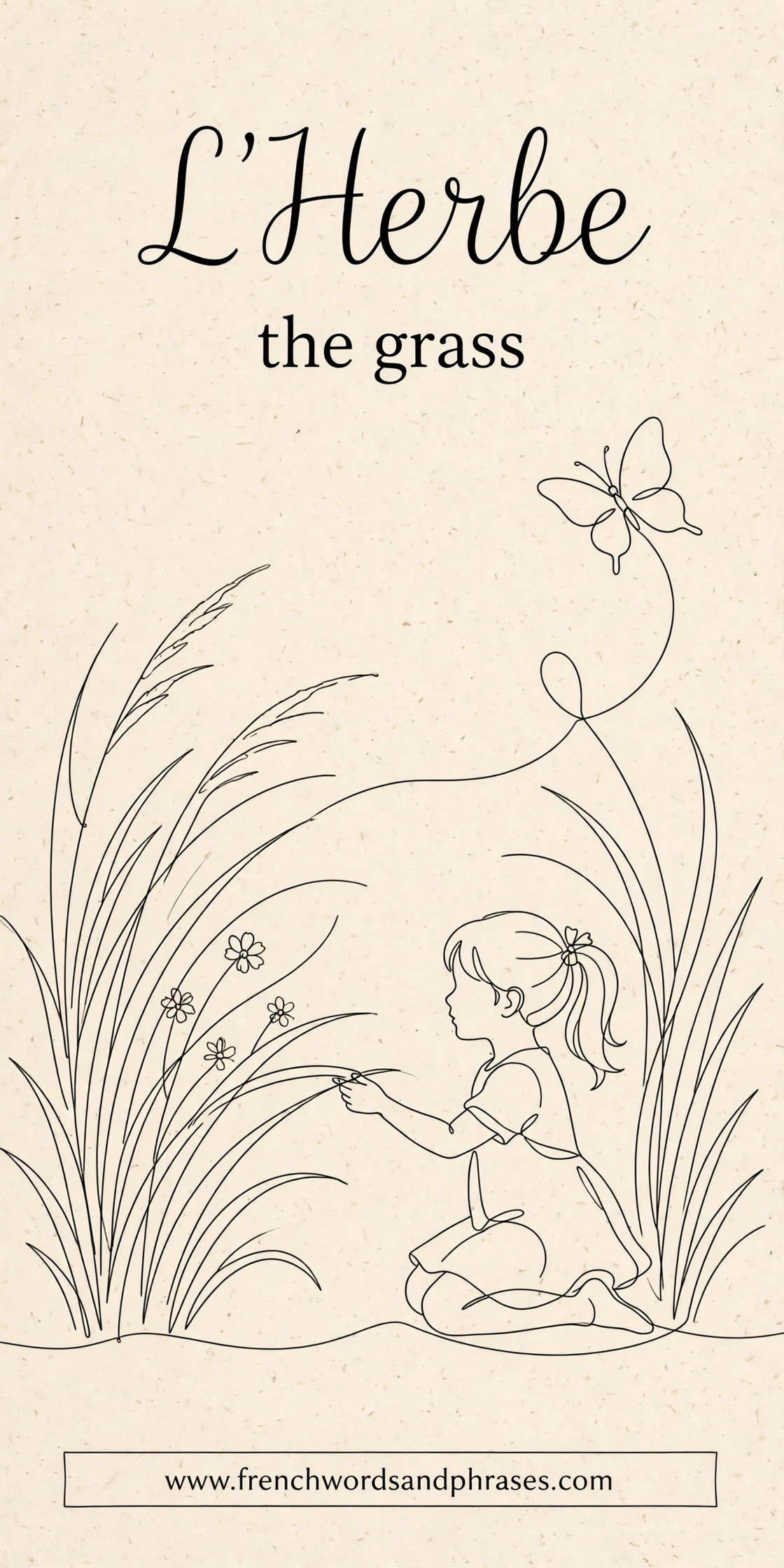
L’herbe means the grass.
April morning, the garden gate opens, and the smell arrives before anything else — green, fresh, just cut. Bare feet on cool green: l’herbe. It is the carpet of every French garden, the stage of every picnic, and the first green word of spring.
In this guide, you’ll learn what herbe means in English, how to use it with its articles, how to form its plural, and how it appears in everyday French. Explore French examples, English translations, and practice quizzes.
Understanding the French Noun Herbe
Herbe is a feminine French noun. It begins with a silent h, so the article melts into it: l’herbe, never « la herbe ». As a mass of grass it is usually uncountable — de l’herbe, some grass — but in the plural, les herbes, it also names the herbs of the kitchen garden: parsley, chives and thyme.
It means grass — the green blades under your feet: l’herbe verte, l’herbe haute, couper l’herbe (to cut the grass). By extension it covers herbs and plants in general: les fines herbes are the delicate cooking herbs, les herbes aromatiques the fragrant ones, and une mauvaise herbe is a weed — literally « a bad grass ». And in the idiom from this run, couper l’herbe sous le pied de quelqu’un — to cut the grass under someone’s feet — means to steal their advantage before they can use it.
Gender: Feminine
Definite article: l’ — l’herbe (the grass), because the h is silent
Indefinite article: une — une herbe (a herb, a blade of grass)
Plural: les herbes (grass in kinds; herbs)
Usual form: de l’herbe — the partitive, for grass in general
English equivalents: The grass; herbs (in the plural).
One important usage detail: the silent h changes everything around the word. You say l’herbe, de l’herbe, and — because the word behaves as if it began with a vowel — even « my grass » is mon herbe, not « ma herbe », just as with the infirmière in the model pages. Listen for it: French speakers glide straight from the article into the word.
Experience the Word
Herbe is more than a lawn. It is the green floor of French childhood — the picnic blanket spread on it, the daisy chains, the football games, the first barefoot run of the year when the ground finally warms.
Imagine the meadow in June: the herbe is high and full of flowers, the cows move slowly through it, and the air smells of summer itself — foin, warmth and holidays.
You have not just named a plant. You have stepped onto the green carpet of the French countryside.
How to Use Herbe in French: Complete Guide
Let’s explore how herbe works in French, beginning with its articles — and mind the silent h, which changes the words around it.
Herbe with the Definite Article (L’, Les)
The silent h means le and la shrink to l’ — l’herbe, the grass at your feet.
| Form | French |
|---|---|
| Singular | l’herbe |
| Plural | les herbes |
Example
L’herbe est encore mouillée par la rosée.
The grass is still wet with dew.
Herbe with the Indefinite Article (Une, Des)
Une herbe singles out one plant or herb — a blade, a sprig, a species.
| Form | French |
|---|---|
| Singular | une herbe |
| Plural | des herbes |
Example
Elle ajoute une herbe parfumée à la salade.
She adds a fragrant herb to the salad.
Herbe with the Partitive and Quantities (De l’herbe…)
Grass is gathered, not counted: some grass, a blade of grass, a tuft of grass.
| Expression | In English |
|---|---|
| de l’herbe | some grass |
| un brin d’herbe | a blade of grass |
| une touffe d’herbe | a tuft of grass |
| une poignée d’herbe | a handful of grass |
| un tapis d’herbe | a carpet of grass |
| sans herbe | without grass, grassless |
Example
Le lapin mange un brin d’herbe après l’autre.
The rabbit eats one blade of grass after another.
Quick Quiz 1
Complete the sentence:
Les enfants jouent sur ______ herbe du jardin.
Reveal the answer
l’
Les enfants jouent sur l’herbe du jardin.
The children are playing on the grass in the garden — the silent h makes la become l’.
The Plural of Herbe
Herbe adds an -s — and les herbes doubles as the herbs of the kitchen: parsley, thyme, mint.
| Number | French |
|---|---|
| Singular | l’herbe |
| Plural | les herbes |
Example
Les herbes du jardin parfument la soupe.
The herbs from the garden flavour the soup.
Herbe with Possessive Adjectives (Mon, Ton, Son…)
A famous exception: herbe begins with a vowel sound, so even the feminine takes mon, ton, son — mon herbe, never « ma herbe ».
| Owner | French |
|---|---|
| my | mon herbe |
| your (tu) | ton herbe |
| his / her | son herbe |
| our | notre herbe |
| your (vous) | votre herbe |
| their | leur herbe |
Example
Le chat dort toujours sur mon herbe préférée, près de la porte.
The cat always sleeps on my favourite grass, near the door.
Quick Quiz 2
Complete the sentence:
______ herbe est plus verte que la nôtre. (Their)
Reveal the answer
Leur
Leur herbe est plus verte que la nôtre.
Their grass is greener than ours.
Herbe with Demonstrative Adjectives (Cette, Ces)
Used to point: cette herbe, this grass — or this herb in the cook’s hand.
| Form | French |
|---|---|
| Singular | cette herbe |
| Plural | ces herbes |
Example
Cette herbe sent bon, c’est de la menthe.
This herb smells lovely — it’s mint.
Herbe with Adjectives
Adjectives agree with herbe — green grass, tall grass, fresh herbs.
| Adjective | With Herbe |
|---|---|
| verte (green) | l’herbe verte |
| haute (tall) | l’herbe haute |
| fraîche (fresh) | une herbe fraîche |
| sèche (dry) | l’herbe sèche |
| fine (fine, delicate) | les fines herbes |
Example
Au printemps, l’herbe verte couvre toute la prairie.
In spring, the green grass covers the whole meadow.
Quick Quiz 3
Complete the sentence:
Il coupe l’herbe ______ du jardin. (tall)
Reveal the answer
haute
Il coupe l’herbe haute du jardin.
He is cutting the tall grass in the garden — haute agrees with herbe, feminine.
Everyday Expressions with Herbe
Lawns, herbs and one act of sabotage — the herbe phrases of daily life.
| Expression | In English |
|---|---|
| les fines herbes | fine herbs (parsley, chives, tarragon, chervil) |
| une mauvaise herbe | a weed |
| couper l’herbe sous le pied de quelqu’un | to cut the ground from under someone |
| l’herbe est toujours plus verte ailleurs | the grass is always greener elsewhere |
| tondre l’herbe | to mow the grass |
| un brin d’herbe | a blade of grass |
Example
Elle a annoncé la nouvelle avant lui : elle lui a coupé l’herbe sous le pied.
She announced the news before him: she cut the ground from under his feet.
Words from the Same Family as Herbe
Meadows, herb gardens and herbivores — the words that travel with herbe.
| French | In English |
|---|---|
| herbeux | grassy |
| l’herbier | a herbarium; a collection of dried plants |
| herbivore | herbivorous; a herbivore |
| désherber | to weed |
| le foin | hay |
| la prairie | the meadow |
Example
Le jardinier désherbe les allées chaque semaine.
The gardener weeds the paths every week.
Quick Quiz 4
What is une mauvaise herbe?
Reveal the answer
A weed — literally « a bad grass », the plant the gardener did not invite.
Les mauvaises herbes envahissent le potager.
The weeds are taking over the vegetable garden.
Herbe in Everyday French: Real-Life Examples
Now that you know the word, let’s see how herbe appears in everyday French.
Example 1 — Spring morning
L’herbe est toute verte après la pluie.
The grass is all green after the rain.
Example 2 — Gardening
Il tond l’herbe du jardin le samedi matin.
He mows the garden grass on Saturday morning.
Example 3 — Cooking
Ajoute les fines herbes à la fin de la cuisson.
Add the fine herbs at the end of the cooking.
Example 4 — A picnic
Ils étendent la nappe sur l’herbe, à l’ombre.
They spread the cloth on the grass, in the shade.
Example 5 — A weed problem
Les mauvaises herbes poussent entre les tomates.
The weeds are growing between the tomatoes.
Example 6 — The idiom
Elle m’a coupé l’herbe sous le pied avec son annonce.
She cut the ground from under me with her announcement.
Beyond Translation: The Meaning of Herbe
Herbe descends from the Latin herba — grass, green shoots — and French never stopped trusting it: it feeds the cows, flavours the omelette (une omelette aux fines herbes is a small national treasure) and fills the proverb every language shares, about the grass being greener elsewhere. Its silent h is a quiet lesson in French itself: the letter is written, never heard, yet it bends every article and possessive around it.
To say herbe is to step barefoot into the French spring.
It evokes wet lawns and herb gardens, picnic shade and garden weeds — the humblest plant in the language, and one of the busiest.
How to Remember the French Noun Herbe
Remember it this way: Herbe is the grass — feminine, but the silent h makes it l’herbe, and its possessive is mon herbe, as if it began with a vowel.
- You see the silent h — l’herbe, de l’herbe, mon herbe.
- You cook — les fines herbes, parsley, chives, tarragon.
- You sabotage politely — couper l’herbe sous le pied, cut the grass from under their feet.
The key idea is l’herbe — silent h, so l’ and mon.
Test Your Knowledge of Herbe
Let’s see how much you’ve learned. Try answering these questions before revealing the answers.
Question 1
Why do we say l’herbe and not la herbe?
Reveal the answer
Because the h is silent — herbe behaves as if it began with a vowel, so la becomes l’.
Question 2
Is herbe masculine or feminine?
Reveal the answer
Feminine — une herbe, cette herbe — even though it takes mon, ton, son before its vowel sound.
Question 3
Translate: The grass is green in spring.
Reveal the answer
L’herbe est verte au printemps.
Question 4
What are les fines herbes?
Reveal the answer
Fine herbs — the classic mix of parsley, chives, tarragon and chervil.
Question 5
Complete the sentence:
Les enfants courent sur ______ herbe mouillée.
Reveal the answer
l’
Les enfants courent sur l’herbe mouillée.
The children are running on the wet grass.
Your Final Challenge
Can You Use It?
How would you say this in French?
“The children are playing on the grass.”
Reveal the answer
Les enfants jouent sur l’herbe.
The children are playing on the grass.
A little French. A little curiosity. A richer everyday life.
LEARN FRENCH ONE WORD AT A TIME