
A French Word to Live By
Translate Gingembre to English
/ʒɛ̃.ʒɑ̃bʁ/
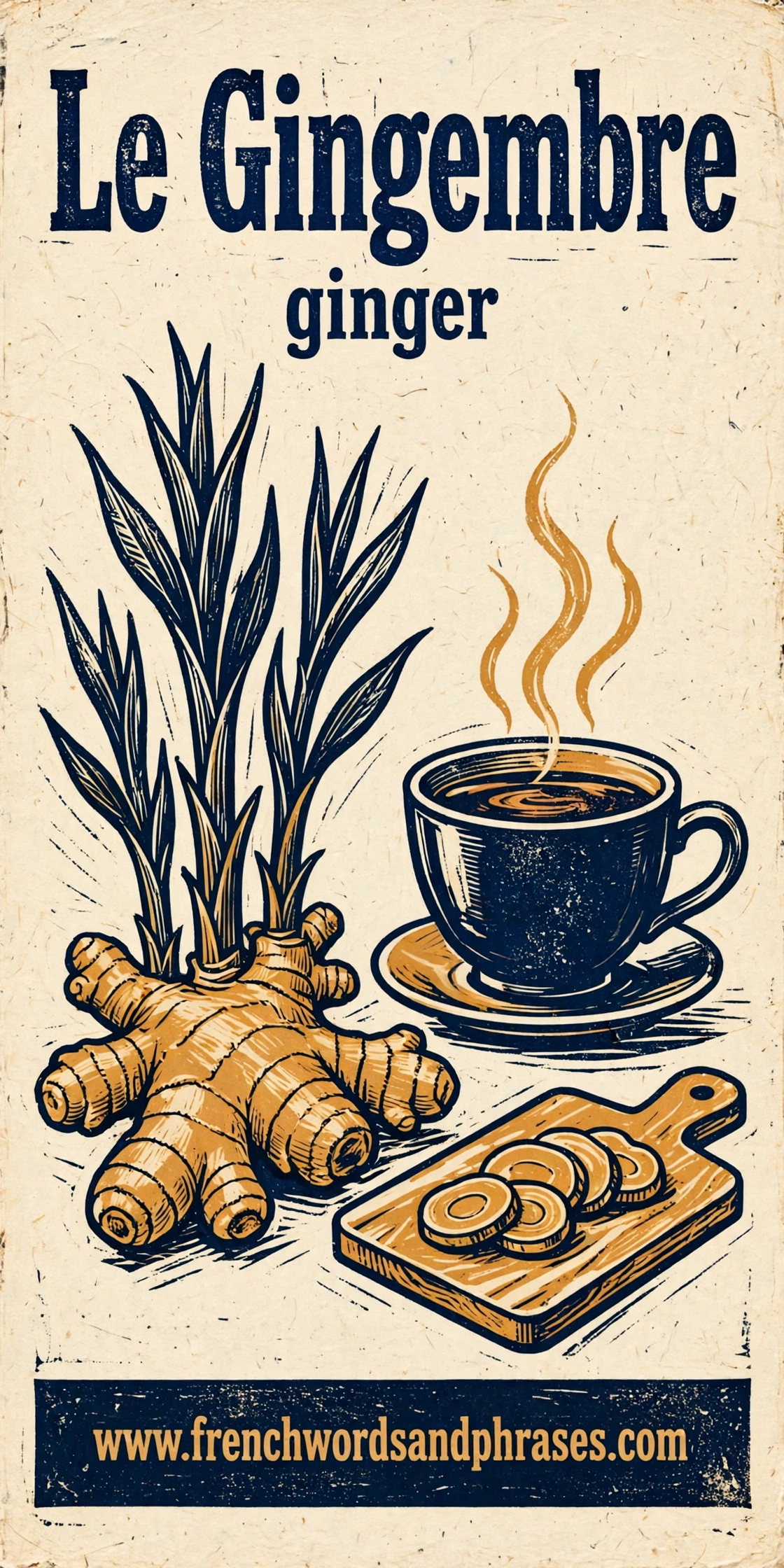
Le gingembre means ginger.
At the market stall, between the lemons and the chillies, sits a knobbly beige root that looks like a tiny sculpture — le gingembre, ginger, the spice that bites back, warm and lemony at once.
In this guide, you’ll learn what gingembre means in English, how to use it with its articles, how to form its plural, and how it appears in everyday French. Explore French examples, English translations, and practice quizzes.
Understanding the French Noun Gingembre
Gingembre is a masculine French noun. It is learned together with its article: le gingembre, un gingembre. What the shops call the root of ginger is really a rhizome — an underground stem — but in the kitchen everyone says le gingembre frais, fresh ginger, and grates it by the spoonful.
It means ginger — grated fresh into stir-fries and marinades, sliced into teas and infusions, dried and ground as le gingembre en poudre, or candied as le gingembre confit. In France it is the traveller of the spice rack: it arrived from Asia and now perfumes everything from spiced biscuits to the ginger shots of Paris juice bars.
Gender: Masculine
Definite article: le — le gingembre (ginger)
Indefinite article: un — un gingembre (a ginger root)
Plural: les gingembres
English equivalents: Ginger.
One important usage detail: le gingembre is a mass word in the kitchen — you rarely count gingers. French measures it instead: un morceau de gingembre, a piece of ginger; une cuillère de gingembre râpé, a spoonful of grated ginger; du gingembre frais, some fresh ginger. Reserve the plural les gingembres for whole roots on the market stall.
Experience the Word
Gingembre is more than a spice. It is a small fire in the hand — the root that wakes up a soup, a tea, a whole winter afternoon.
Imagine grating it over a pan of carrots: the lemony heat rises with the steam, sharper than pepper, warmer than citrus, and suddenly the whole dish is awake.
You have not just added a spice. You have turned the lights on.
How to Use Gingembre in French: Complete Guide
Let’s explore how gingembre works in French, beginning with its articles.
Gingembre with the Definite Article (Le, Les)
Used for the ginger everyone in the conversation knows — the root on the counter, the piece in the fridge.
| Number | French |
|---|---|
| Singular | le gingembre |
| Plural | les gingembres |
Example
Le gingembre frais est à côté des citrons.
The fresh ginger is next to the lemons.
Gingembre with the Indefinite Article (Un, Des)
Used for a ginger root in general — the one you choose at the stall, firm and heavy in the hand.
| Number | French |
|---|---|
| Singular | un gingembre |
| Plural | des gingembres |
Example
Elle achète un gingembre bien ferme au marché.
She buys a nice firm ginger root at the market.
Gingembre with the Partitive Article (Du)
Ginger is usually measured, not counted, so French uses the partitive: du gingembre — some ginger.
| Quantity | French |
|---|---|
| some | du gingembre |
| a little | un peu de gingembre |
| a lot | beaucoup de gingembre |
| too much | trop de gingembre |
Example
Mets du gingembre dans la soupe, ça réchauffe.
Put some ginger in the soup, it warms you up.
Quick Quiz 1
What is le gingembre râpé?
Reveal the answer
Grated ginger — fresh ginger rubbed on the grater until it becomes a juicy, fiery paste. It is the form French cooks use most.
Une cuillère de gingembre râpé suffit pour la marinade.
A spoonful of grated ginger is enough for the marinade.
The Plural of Gingembre
Gingembre adds an -s in the plural — les gingembres, the whole roots lined up on the stall.
| Number | French |
|---|---|
| Singular | le gingembre |
| Plural | les gingembres |
Example
Les gingembres du marché viennent de loin.
The ginger roots at the market come from far away.
Gingembre with Possessive Adjectives (Mon, Ton, Son…)
Possessives agree with the noun, not with the owner — and gingembre is masculine, so it takes mon, ton, son.
| Owner | French |
|---|---|
| my | mon gingembre |
| your (tu) | ton gingembre |
| his / her | son gingembre |
| our | notre gingembre |
| your (vous) | votre gingembre |
| their | leur gingembre |
Example
Il râpe son gingembre directement dans la poêle.
He grates his ginger straight into the pan.
Quick Quiz 2
Complete the sentence:
Tu as mis ______ gingembre dans le thé ? (your)
Reveal the answer
ton
Tu as mis ton gingembre dans le thé ?
Did you put your ginger in the tea?
Gingembre with Demonstrative Adjectives (Ce, Ces)
Used to point: this ginger root here, those ginger roots there.
| Number | French |
|---|---|
| Singular | ce gingembre |
| Plural | ces gingembres |
Example
Ce gingembre est énorme, il pèse presque un kilo.
This ginger root is enormous, it weighs almost a kilo.
Gingembre with Adjectives
Adjectives agree with gingembre, masculine — frais, râpé, confit.
| Adjective | With Gingembre |
|---|---|
| frais (fresh) | du gingembre frais |
| râpé (grated) | du gingembre râpé |
| confit (candied) | le gingembre confit |
| moulu (ground) | du gingembre moulu |
| piquant (hot, pungent) | un gingembre piquant |
Example
Le gingembre frais râpé parfume tout le plat.
Fresh grated ginger flavours the whole dish.
Quick Quiz 3
Complete the sentence:
Je préfère le gingembre ______ au gingembre en poudre. (fresh)
Reveal the answer
frais
Je préfère le gingembre frais au gingembre en poudre.
I prefer fresh ginger to ground ginger.
Everyday Expressions with Gingembre
Grating, infusing and candied treats — the gingembre phrases of daily life.
| Expression | In English |
|---|---|
| râper du gingembre | to grate ginger |
| un morceau de gingembre | a piece of ginger |
| le gingembre confit | candied ginger |
| une infusion de gingembre | a ginger infusion, ginger tea |
| le gingembre en poudre | ground ginger |
| un jus au gingembre | a ginger juice, a ginger shot |
Example
Une infusion de gingembre et de citron, voilà le remède de grand-mère.
A ginger and lemon infusion — that is grandmother’s remedy.
Words from the Same Family as Gingembre
Graters, cousins and marinades — the words that travel with gingembre.
| French | In English |
|---|---|
| râper | to grate |
| la râpe | the grater |
| le curcuma | turmeric, its golden cousin |
| le citron | the lemon |
| confit | candied |
| la marinade | the marinade |
Example
Le gingembre et le curcuma sont cousins dans la même famille.
Ginger and turmeric are cousins in the same family.
Quick Quiz 4
Your grandmother serves une infusion de gingembre for your cold. Is it a cake?
Reveal the answer
No — it is a hot drink. An infusion of ginger, often with lemon and honey, is the classic French home remedy for a winter cold.
Bois ton infusion de gingembre pendant qu’elle est chaude.
Drink your ginger infusion while it is hot.
Gingembre in Everyday French: Real-Life Examples
Now that you know the word, let’s see how gingembre appears in everyday French.
Example 1 — At the market
Ce gingembre est bien frais, je le prends.
This ginger is really fresh, I’ll take it.
Example 2 — In the kitchen
Il râpe du gingembre dans la marinade.
He grates ginger into the marinade.
Example 3 — Tea time
Une infusion de gingembre pour mon rhume, s’il te plaît.
A ginger infusion for my cold, please.
Example 4 — Baking
Les biscuits au gingembre confit sont délicieux.
The biscuits with candied ginger are delicious.
Example 5 — At the juice bar
Un jus de pomme et de gingembre, sans sucre.
An apple and ginger juice, no sugar.
Example 6 — A winter remedy
Le gingembre réchauffe quand on a froid.
Ginger warms you up when you are cold.
See le gingembre in a story: Spices: French Vocabulary (Les Épices) — a cook restocking her spice drawer.
Beyond Translation: The Meaning of Gingembre
Ginger reached Europe along the spice routes so long ago that medieval French cooks were already sweetening it into confit and baking it into spiced breads. Today it leads a double life in France: grandmother’s remedy for colds, and the juice bar’s favourite wake-up call.
To say gingembre is to strike a small, warm match.
It evokes the knobbly root on the market stall, the steam of a winter infusion, and the bright bite that wakes a whole dish from its sleep.
How to Remember the French Noun Gingembre
Remember it this way: Gingembre is ginger — masculine, with le and un, measured in pieces and spoonfuls rather than counted.
- You grate it fresh — du gingembre râpé, straight into the pan.
- You measure it — un morceau de gingembre, a piece, not a crowd.
- You drink it — une infusion de gingembre, grandmother’s cold remedy.
The key idea is le gingembre you grate — du gingembre you measure.
Test Your Knowledge of Gingembre
Let’s see how much you’ve learned. Try answering these questions before revealing the answers.
Question 1
Is gingembre masculine or feminine?
Reveal the answer
Masculine — le gingembre, un gingembre.
Question 2
What is un morceau de gingembre?
Reveal the answer
A piece of ginger — the way French measures this mass word, instead of counting it.
Question 3
Translate: He grates ginger into the soup.
Reveal the answer
Il râpe du gingembre dans la soupe.
Question 4
What is le gingembre confit?
Reveal the answer
Candied ginger — ginger preserved in sugar, eaten as a sweet or chopped into biscuits.
Question 5
Complete the sentence:
Mets ______ gingembre dans le thé. (some)
Reveal the answer
du
Mets du gingembre dans le thé.
Put some ginger in the tea.
Your Final Challenge
Can You Use It?
How would you say this in French?
“A piece of fresh ginger wakes up the whole soup.”
Reveal the answer
Un morceau de gingembre frais réveille toute la soupe.
A piece of fresh ginger wakes up the whole soup.
A little French. A little curiosity. A richer everyday life.
LEARN FRENCH ONE WORD AT A TIME




