A French Word to Live By
Translate Gens to English
/ʒɑ̃/
Les gens means people.
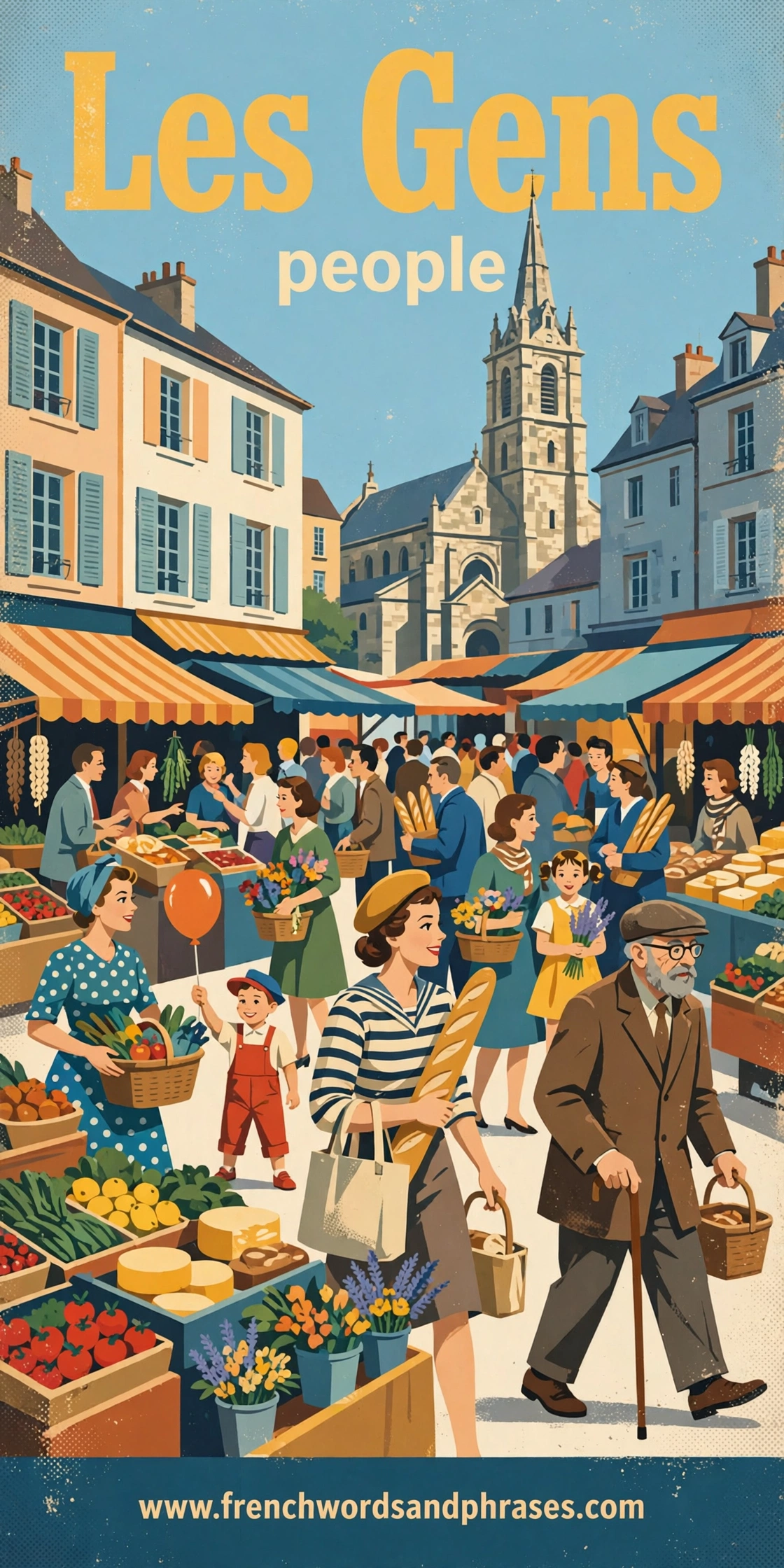
The café terrace is full — neighbours greeting neighbours, children weaving between the tables, an old man reading his newspaper aloud to no one in particular. All of them together — that is les gens.
In this guide, you’ll learn what gens means in English, how to use it with its articles, how to form its plural, and how it appears in everyday French. Explore French examples, English translations, and practice quizzes.
Understanding the French Noun Gens
Gens is a special French noun: it exists only in the plural. It has no singular form, and it is learned together with its article: les gens — there is no le gen.
It means people — people in general, the people around you, people as a crowd rather than as counted individuals. Where English says people are…, French says les gens sont…, with a plural verb, always. For one single person, French switches to a different word: une personne.
Gender: Plural only — it behaves as a masculine plural
Definite article: les — les gens (the people)
Indefinite article: des — des gens (some people, people)
Plural: gens is already plural — it has no singular form
English equivalents: People; folks.
One important rule: gens is always plural, so the verb is plural too — les gens sont, never les gens est. And one famous quirk: an adjective placed BEFORE gens is feminine — les vieilles gens, les bonnes gens — while an adjective placed after it is masculine — les gens âgés, les gens heureux.
Experience the Word
Gens is more than a crowd. It is the warm noise of a market morning, the queue at the bakery, the whole village turned out for the fête.
Imagine a small square at aperitif time. The cafés fill, glasses rise, and a hundred conversations weave into one happy murmur.
You are not just looking at strangers. You are among people — les gens.
How to Use Gens in French: Complete Guide
Let’s explore how gens works in French, beginning with the words that go around it.
Gens and the Words Around It
Gens has no singular, so every little word around it — articles, adjectives, verbs — is plural too.
Gens with the Definite Article (Les)
There is only one form to learn — gens is born plural.
| Form | French |
|---|---|
| Plural | les gens |
| Plural — the people here | les gens d’ici |
Example
Les gens du village sont très gentils.
The people of the village are very kind.
Gens with the Indefinite Article (Des)
For people in general, without pointing at a particular group, French uses des gens.
| Meaning | French |
|---|---|
| some people | des gens |
| no people (after a negative) | de gens |
Example
Il y a des gens qui ne savent pas conduire.
There are people who cannot drive.
Gens and Where They Come From
Gens takes no partitive article — instead, French loves to pin it to a place with de. Watch the adjectives before gens: they turn feminine.
| Expression | In English |
|---|---|
| les gens d’ici | the people from around here |
| les gens du village | the village people |
| les jeunes gens | young people |
| les vieilles gens | old people, old folks |
Example
Les gens d’ici sont accueillants.
The people from around here are welcoming.
Quick Quiz 1
Complete the sentence:
Les gens ______ très gentils ici.
Reveal the answer
sont
Les gens sont très gentils ici.
The people are very kind here. (Gens is plural, so the verb is plural.)
Gens with Quantities (Beaucoup de gens…)
Gens has no plural to form — it already is one. To count people loosely, French uses a quantity word + de + gens.
| Quantity | French |
|---|---|
| a lot of people | beaucoup de gens |
| few people | peu de gens |
| too many people | trop de gens |
| loads of people | plein de gens |
| most people | la plupart des gens |
| how many people | combien de gens |
Example
Il y avait beaucoup de gens au marché.
There were a lot of people at the market.
Gens with Possessive Adjectives (Ses gens, Leurs gens…)
These forms are rarer — you will meet them in books and older speech, meaning someone’s people: their household, their followers.
| Owner | French |
|---|---|
| my | mes gens |
| your (tu) | tes gens |
| his / her | ses gens |
| our | nos gens |
| your (vous) | vos gens |
| their | leurs gens |
Example
Le fermier et ses gens travaillaient dès l’aube.
The farmer and his people worked from dawn.
Quick Quiz 2
How do you say a lot of people in French?
Reveal the answer
beaucoup de gens
Il y avait beaucoup de gens au marché.
There were a lot of people at the market.
Gens with Demonstrative Adjectives (Ces)
Used to point: these people here, those people over there.
| Form | French |
|---|---|
| These people | ces gens |
| Those people | ces gens-là |
Example
Ces gens-là ne sont pas d’ici.
Those people are not from around here.
Gens with Adjectives
Adjectives after gens are masculine plural — les gens heureux. Adjectives before gens are feminine — les vieilles gens. Both patterns are alive and well.
| Adjective | With Gens |
|---|---|
| heureux (happy) | les gens heureux |
| gentils (kind) | les gens gentils |
| âgés (elderly) | les gens âgés |
| prudents (careful) | les gens prudents |
| jeunes (young) | les jeunes gens |
| honnêtes (honest) | les honnêtes gens |
Example
Les honnêtes gens paient toujours leurs dettes.
Honest people always pay their debts.
Quick Quiz 3
Complete the sentence:
Les ______ gens du village se réunissent le dimanche.
Reveal the answer
vieilles
Les vieilles gens du village se réunissent le dimanche.
The old folks of the village get together on Sundays. (An adjective before gens is feminine.)
Everyday Expressions with Gens
Gens gathers expressions about neighbours, locals and ordinary folk.
| Expression | In English |
|---|---|
| les gens d’ici | local people, the people from here |
| chez les gens | at people’s homes |
| les petites gens | ordinary folk, humble people |
| les braves gens | good, decent folk |
| les gens de lettres | writers, literary people |
| les gens du voyage | the travelling community |
Example
Les petites gens ont aussi leurs fêtes.
Ordinary folk have their celebrations too.
Words from the Same Family as Gens
Learn these together and the whole crowd falls into place.
| French | In English |
|---|---|
| une personne | a person (one individual) |
| tout le monde | everyone |
| la foule | the crowd |
| le peuple | the people (a nation) |
| quelqu’un | someone |
| un habitant | an inhabitant, a resident |
Example
Tout le monde connaît les gens du village.
Everyone knows the people of the village.
Quick Quiz 4
How do you say most people in French?
Reveal the answer
la plupart des gens
La plupart des gens aiment le café.
Most people like coffee.
Gens in Everyday French: Real-Life Examples
Now that you know the word, let’s see how gens appears in everyday French.
Example 1 — On the square
Les gens discutent tranquillement sur la place du village.
People are chatting quietly in the village square.
Example 2 — The metro
Il y a beaucoup de gens dans le métro ce matin.
There are a lot of people on the metro this morning.
Example 3 — Local people
Les gens d’ici sont très accueillants.
The people from around here are very welcoming.
Example 4 — A secret place
Peu de gens connaissent ce petit restaurant.
Few people know this little restaurant.
Example 5 — Young people
Les jeunes gens jouent au foot dans le parc.
The young people play football in the park.
Example 6 — Most people
La plupart des gens préfèrent le café le matin.
Most people prefer coffee in the morning.
Beyond Translation: The Meaning of Gens
English says people for gens — a word with no singular, no patience for the usual rules, and a verb that must always follow it in the plural.
To say les gens is to step into the crowd.
It is the word of markets and terraces, of les gens d’ici — the people from here — who decide, in the end, what a place really is.
How to Remember the French Noun Gens
Remember it this way: Gens is people — always plural, always with a plural verb.
- You look at a busy terrace — il y a beaucoup de gens.
- You greet the locals — les gens d’ici.
- You describe the neighbours — les gens sont gentils.
The key idea is les gens sont — plural word, plural verb, every time.
Test Your Knowledge of Gens
Let’s see how much you’ve learned. Try answering these questions before revealing the answers.
Question 1
Does gens have a singular form?
Reveal the answer
No — gens is always plural: les gens.
Question 2
Complete the sentence:
Les gens ______ contents.
Reveal the answer
sont
Les gens sont contents.
The people are pleased.
Question 3
Translate: There were too many people.
Reveal the answer
Il y avait trop de gens.
Question 4
How do you say the people from around here in French?
Reveal the answer
Les gens d’ici.
Question 5
Why is it les vieilles gens but les gens âgés?
Reveal the answer
An adjective placed before gens is feminine; an adjective placed after gens is masculine plural.
Your Final Challenge
Can You Use It?
How would you say this in French?
“There are a lot of people at the market today.”
Reveal the answer
Il y a beaucoup de gens au marché aujourd’hui.
There are a lot of people at the market today.
A little French. A little curiosity. A richer everyday life.
LEARN FRENCH ONE WORD AT A TIME