
A French Word to Live By
How to Conjugate Frire in French
/fʁiʁ/
Frire means to fry.
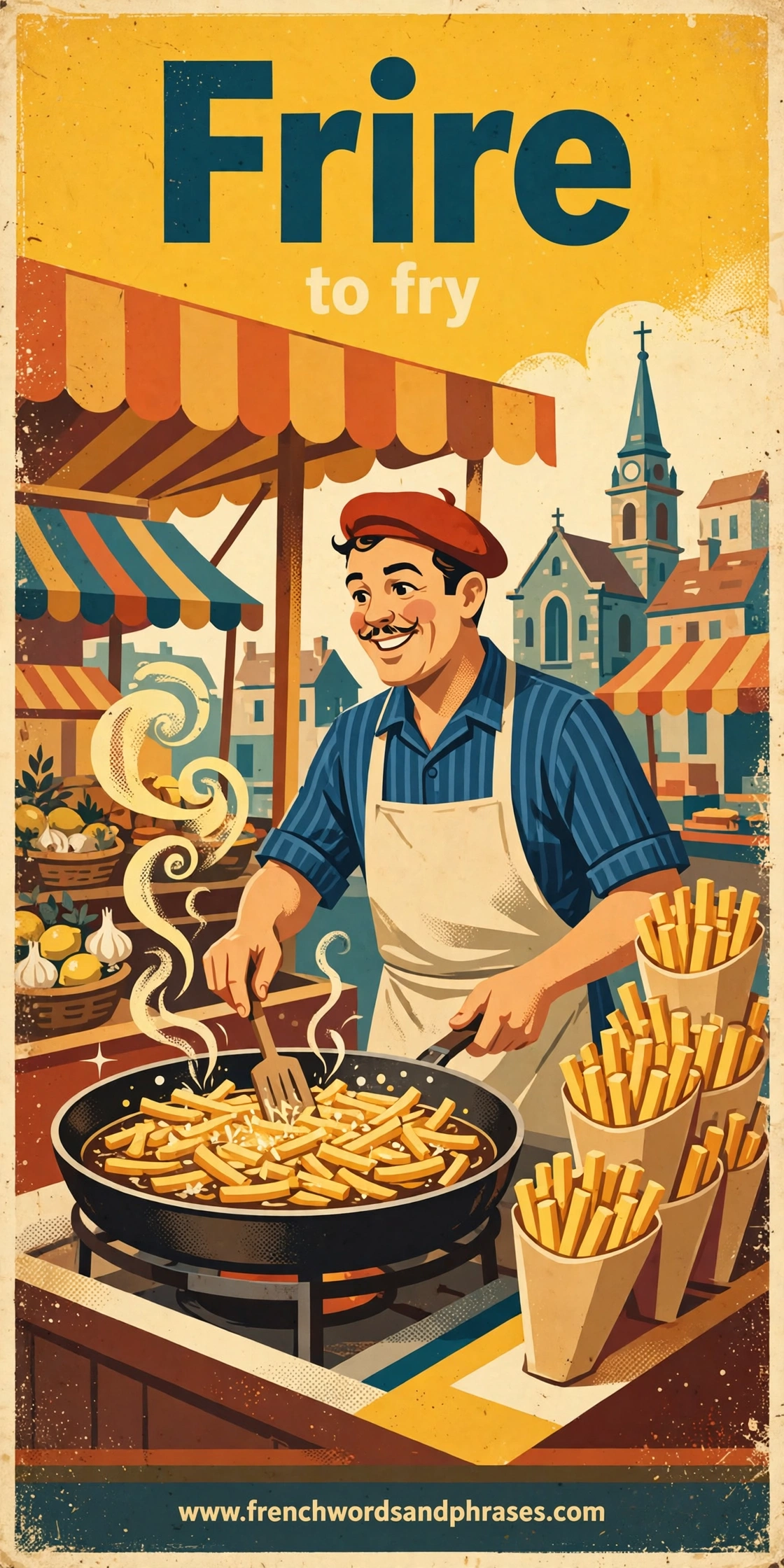
Chips crackling in a Brussels fryer, beignets puffing up in hot oil, a fish turning gold in the pan — frire is the verb of hot oil and crisp edges, the sound of a kitchen at full sizzle.
In this guide, you’ll learn how to conjugate frire in all the major French tenses and moods. Explore complete conjugation tables, French examples, English translations, and practice quizzes.
Understanding the French Verb Frire
Frire is a French verb belonging to the third group of verbs, those ending in -ire.
It means to fry. It is commonly used for chips and fries (les frites), doughnuts and beignets, fried fish and eggs, and in the participle as an adjective — poisson frit, poulet frit — wherever crisp and golden is the goal.
Verb classification: Third group (-ire)
Auxiliary verb: Avoir
Past participle: frit
Present participle: frisant
English equivalents: To fry, to deep-fry; faire frire, to have something fried / to fry (common everyday alternative).
One important detail: frire is a verb of good forms and shy habits. Everyday French uses it mostly in the infinitive, the past participle frit and the singular present — je fris, il frit. The plural present forms exist (nous frisons, vous frisez) but sound rare; most speakers say faire frire instead: je fais frire les pommes de terre.
Experience the Word
Frire is the verb of transformation by oil — thirty seconds of sizzle and the pale becomes golden.
Imagine a chip stand at a fair in Lille. The cook lowers the basket, the oil roars, and a minute later the frites come up crisp, salted, and gone within five minutes.
It went in soft and pale. It came out crisp, golden and irresistible.
How to Conjugate Frire: Complete French Conjugation Guide
Let’s explore every major conjugation of frire, beginning with the indicative mood.
How to Conjugate Frire in the Indicative Mood
The indicative mood is used to express facts, observations, actions, and events.
How to Conjugate Frire in the Present Tense (Présent)
Used for actions happening now, habitual actions, and general truths.
| Subject | Conjugation |
|---|---|
| je | fris |
| tu | fris |
| il / elle | frit |
| nous | frisons |
| vous | frisez |
| ils / elles | frisent |
Example
Le cuisinier frit le poisson dans l’huile d’olive.
The cook fries the fish in olive oil.
Quick Quiz 1
Complete the sentence:
Le cuisinier ______ le poisson.
Reveal the answer
frit
Le cuisinier frit le poisson.
The cook fries the fish.
How to Conjugate Frire in the Passé Composé
Used for completed actions in the past. Frire takes the auxiliary verb avoir.
| Subject | Conjugation |
|---|---|
| j’ | ai frit |
| tu | as frit |
| il / elle | a frit |
| nous | avons frit |
| vous | avez frit |
| ils / elles | ont frit |
Example
Elle a frit des pommes de terre pour tout le monde.
She fried potatoes for everyone.
How to Conjugate Frire in the Imparfait (Imperfect Tense)
Used for habitual past actions, descriptions, and ongoing situations in the past.
| Subject | Conjugation |
|---|---|
| je | frisais |
| tu | frisais |
| il / elle | frisait |
| nous | frisions |
| vous | frisiez |
| ils / elles | frisaient |
Example
Le dimanche, grand-père frisait les petits poissons du lac.
On Sundays, grandfather used to fry the little fish from the lake.
Quick Quiz 2
Choose the correct form:
She fried the potatoes.
Elle ______ les pommes de terre. (a frit / a frite)
Reveal the answer
a frit
Elle a frit les pommes de terre.
The past participle is frit.
How to Conjugate Frire in the Plus-que-parfait
Used to describe an action that had already been completed before another past event.
| Subject | Conjugation |
|---|---|
| j’ | avais frit |
| tu | avais frit |
| il / elle | avait frit |
| nous | avions frit |
| vous | aviez frit |
| ils / elles | avaient frit |
Example
Nous avions frit les oignons avant l’arrivée des invités.
We had fried the onions before the guests arrived.
How to Conjugate Frire in the Passé Simple
Primarily used in formal writing, literature, and historical narratives. It is rarely used in everyday conversation.
| Subject | Conjugation |
|---|---|
| je | fris |
| tu | fris |
| il / elle | frit |
| nous | frîmes |
| vous | frîtes |
| ils / elles | frirent |
Example
Elle frit les beignets un à un, sans se presser.
She fried the doughnuts one by one, unhurriedly.
How to Conjugate Frire in the Passé Antérieur
A literary tense used to express an action completed immediately before another past action, generally in the passé simple.
| Subject | Conjugation |
|---|---|
| j’ | eus frit |
| tu | eus frit |
| il / elle | eut frit |
| nous | eûmes frit |
| vous | eûtes frit |
| ils / elles | eurent frit |
Example
Quand il eut frit le poisson, il appela les enfants.
When he had fried the fish, he called the children.
How to Conjugate Frire in the Future Tense (Futur Simple)
Used to describe actions that will take place in the future.
| Subject | Conjugation |
|---|---|
| je | frirai |
| tu | friras |
| il / elle | frira |
| nous | frirons |
| vous | frirez |
| ils / elles | friront |
Example
Demain, nous frirons des frites maison.
Tomorrow, we will fry homemade chips.
How to Conjugate Frire in the Futur Antérieur (Future Perfect)
Used for an action that will have been completed before a particular point in the future.
| Subject | Conjugation |
|---|---|
| j’ | aurai frit |
| tu | auras frit |
| il / elle | aura frit |
| nous | aurons frit |
| vous | aurez frit |
| ils / elles | auront frit |
Example
À huit heures, elle aura frit tous les beignets.
By eight o’clock, she will have fried all the doughnuts.
How to Conjugate Frire in the Near Future (Futur Proche)
Used to describe something that is going to happen soon. Formed with aller + infinitive.
| Subject | Conjugation |
|---|---|
| je | vais frire |
| tu | vas frire |
| il / elle | va frire |
| nous | allons frire |
| vous | allez frire |
| ils / elles | vont frire |
Example
Je vais frire les oignons, attention aux éclaboussures !
I am going to fry the onions — mind the splashes!
How to Conjugate Frire in the Conditional Mood
The conditional mood expresses what would happen under certain circumstances. It is also frequently used to make polite requests or express wishes.
How to Conjugate Frire in the Present Conditional
| Subject | Conjugation |
|---|---|
| je | frirais |
| tu | frirais |
| il / elle | frirait |
| nous | fririons |
| vous | fririez |
| ils / elles | friraient |
Example
Avec une friteuse, tu frirais sans odeur.
With a deep fryer, you would fry without the smell.
How to Conjugate Frire in the Past Conditional
| Subject | Conjugation |
|---|---|
| j’ | aurais frit |
| tu | aurais frit |
| il / elle | aurait frit |
| nous | aurions frit |
| vous | auriez frit |
| ils / elles | auraient frit |
Example
Ils auraient frit le poisson s’il avait été frais.
They would have fried the fish if it had been fresh.
Frire in the Literary Past Conditional Form
This less common literary form uses the imperfect subjunctive of avoir.
| Subject | Conjugation |
|---|---|
| j’ | eusse frit |
| tu | eusses frit |
| il / elle | eût frit |
| nous | eussions frit |
| vous | eussiez frit |
| ils / elles | eussent frit |
Example
Elle eût frit les beignets dès l’aube.
She would have fried the doughnuts at dawn.
How to Conjugate Frire in the Subjunctive Mood
The subjunctive is used to express wishes, emotions, doubts, necessity, and uncertainty. It frequently follows expressions such as il faut que (it is necessary that) or bien que (although).
How to Conjugate Frire in the Present Subjunctive
| Subject | Conjugation |
|---|---|
| que je | frise |
| que tu | frises |
| qu’il / qu’elle | frise |
| que nous | frisions |
| que vous | frisiez |
| qu’ils / qu’elles | frisent |
Example
Il faut que vous frisiez les frites deux fois.
You must fry the chips twice.
Quick Quiz 3
Complete the sentence using the subjunctive:
Il faut que tu ______ les oignons doucement.
Reveal the answer
frises
Il faut que tu frises les oignons doucement.
You must fry the onions gently.
How to Conjugate Frire in the Imperfect Subjunctive
A literary tense, rarely encountered in modern spoken French.
| Subject | Conjugation |
|---|---|
| que je | frisse |
| que tu | frisses |
| qu’il / qu’elle | frît |
| que nous | frissions |
| que vous | frissiez |
| qu’ils / qu’elles | frissent |
Example
Je craignais qu’elle frît trop les oignons.
I feared she might fry the onions too much.
How to Conjugate Frire in the Pluperfect Subjunctive
A literary construction used to express an action completed before another past action.
| Subject | Conjugation |
|---|---|
| que j’ | eusse frit |
| que tu | eusses frit |
| qu’il / qu’elle | eût frit |
| que nous | eussions frit |
| que vous | eussiez frit |
| qu’ils / qu’elles | eussent frit |
Example
Il regrettait que nous eussions frit si tôt.
He regretted that we had fried so early.
How to Conjugate Frire in the Past Subjunctive
| Subject | Conjugation |
|---|---|
| que j’ | aie frit |
| que tu | aies frit |
| qu’il / qu’elle | ait frit |
| que nous | ayons frit |
| que vous | ayez frit |
| qu’ils / qu’elles | aient frit |
Example
Je suis content que tu aies frit les pommes de terre.
I am glad you fried the potatoes.
How to Conjugate Frire in the Imperative
The imperative is used to give commands, instructions, invitations, or suggestions. Subject pronouns are omitted.
How to Conjugate Frire in the Present Imperative
| Person | Conjugation |
|---|---|
| (tu) | fris |
| (nous) | frisons |
| (vous) | frisez |
Example
Fris les oignons doucement !
Fry the onions gently!
Quick Quiz 4
How would you say Fry them (tu form)?
Reveal the answer
Fris-les !
French Participles of Frire
Participles are verb forms that can be used in compound tenses and other grammatical constructions.
Present Participle of Frire
frisant
En frisant le poisson, il surveillait la couleur dorée.
While frying the fish, he watched for the golden colour.
Past Participle of Frire
frit
Frit à la perfection, le poisson croustillait.
Fried to perfection, the fish was crisp.
Frire in Everyday French: Real-Life Examples
Now that you know the conjugations, let’s see how frire appears in everyday French.
Example 1 — Present
On frit les frites deux fois, en Belgique.
In Belgium, chips are fried twice.
Example 2 — Passé composé
J’ai frit des œufs ce matin.
I fried eggs this morning.
Example 3 — Imparfait
Elle frisait les beignets le dimanche.
She used to fry doughnuts on Sundays.
Example 4 — Future
Nous frirons le poisson ce soir.
We will fry the fish this evening.
Example 5 — Conditional
Tu frirais mieux avec cette huile.
You would fry better with this oil.
Example 6 — Imperative
Ne fris pas tout à la fois !
Do not fry everything at once!
Beyond Translation: The Meaning of Frire
English fry is a kitchen workhorse; French frire is a specialist — so specialised that everyday speech often hands the job to faire frire.
But its participle conquered the menu.
Frit is everywhere: les frites themselves are just ‘the fried ones’, feminine and plural. A whole national dish is named by this verb’s past participle.
How to Remember the French Verb Frire
Remember it this way: Frire is about hot oil — je fris, and les frites themselves.
- Past participle frit — les frites are literally ‘the fried ones’.
- Everyday speech prefers faire frire for nous/vous forms.
- Singular present: je fris, il frit — like je dis, il dit.
The key idea is hot oil — je fris, and les frites themselves.
Test Your Knowledge of Frire
Let’s see how much you’ve learned. Try answering these questions before revealing the answers.
Question 1
What are les frites, literally?
Reveal the answer
The fried ones — frit is the past participle of frire.
Question 2
How do you say I fried eggs this morning in French?
Reveal the answer
J’ai frit des œufs ce matin.
Question 3
Translate: We will fry the fish this evening.
Reveal the answer
Nous frirons le poisson ce soir.
Question 4
What is the past participle of frire?
Reveal the answer
Frit.
Question 5
Complete the sentence:
Il faut que vous ______ les frites deux fois.
Reveal the answer
frisiez
Il faut que vous frisiez les frites deux fois.
You must fry the chips twice.
Your Final Challenge
Can You Use It?
How would you say this in French?
On Sundays, we fry doughnuts and the whole house smells good.
Reveal the answer
Le dimanche, on frit les beignets et toute la maison sent bon.
On Sundays, we fry doughnuts and the whole house smells good.
A little French. A little curiosity. A richer everyday life.
LEARN FRENCH ONE WORD AT A TIME




