
A French Word to Live By
How to Conjugate Enduire in French
/ɑ̃.dɥiʁ/
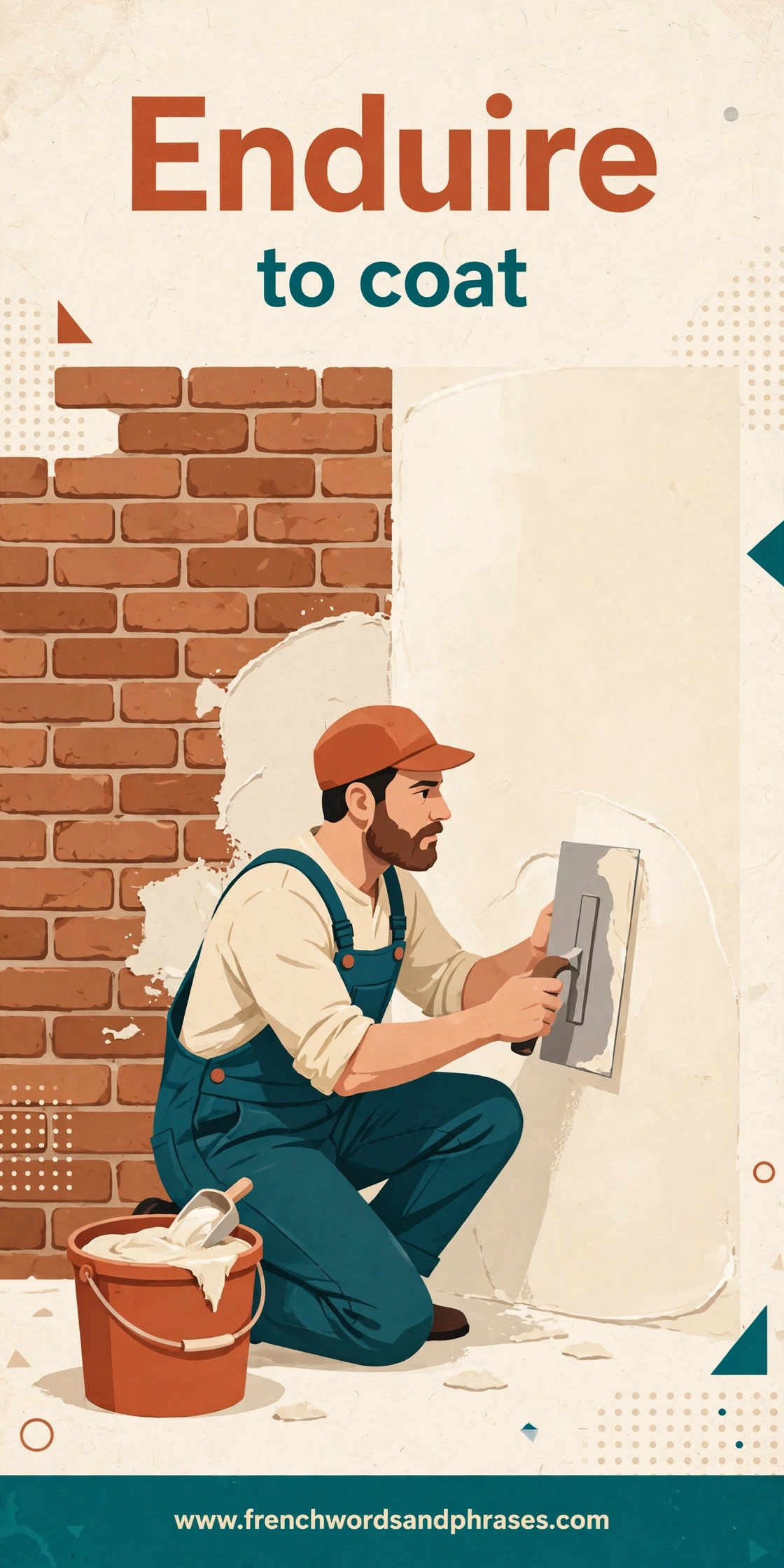
Enduire means to coat — to spread a layer over a surface.
Jam spread thick on toast, plaster smoothed over a wall, tar brushed onto a boat’s hull — enduire is the verb of the layer: whatever the surface, whatever the spread, one even coat changes everything.
In this guide, you’ll learn how to conjugate enduire in all the major French tenses and moods. Explore complete conjugation tables, French examples, English translations, and practice quizzes.
Understanding the French Verb Enduire
Enduire is a regular French verb belonging to the third group of verbs, those ending in -uire.
It means to coat, to smear, to plaster. It is commonly used in the kitchen for butter, jam, honey and chocolate spread thick, on building sites for plaster and render, and by boat owners coating hulls with tar or antifouling paint.
Verb classification: Third group (-uire)
Auxiliary verb: Avoir
Past participle: enduit
Present participle: enduisant
English equivalents: To coat, to spread, to smear; to plaster, to render (a wall).
One important detail: enduire names what you spread with de — enduire le pain de beurre, to coat the bread with butter; enduire un mur de plâtre, to plaster a wall. Its noun is a builder’s everyday word: un enduit is the coating itself — the render or skim coat on a wall.
Experience the Word
Enduire is the verb of the satisfying layer — the spatula’s smooth pass that turns a bare surface into a finished one.
Imagine a kitchen in Provence at breakfast. The bread is thick, the butter is soft, and grandfather enduit each slice so generously that the knife slows down. Across town, a plasterer does exactly the same gesture on a wall, with exactly the same pride.
The surface has not changed hands. It has been enduit — covered, protected, made delicious or made new.
How to Conjugate Enduire: Complete French Conjugation Guide
Let’s explore every major conjugation of enduire, beginning with the indicative mood.
How to Conjugate Enduire in the Indicative Mood
The indicative mood is used to express facts, observations, actions, and events.
How to Conjugate Enduire in the Present Tense (Présent)
Used for actions happening now, habitual actions, and general truths.
| Subject | Conjugation |
|---|---|
| je | enduis |
| tu | enduis |
| il / elle | enduit |
| nous | enduisons |
| vous | enduisez |
| ils / elles | enduisent |
Example
Il enduit la tartine de confiture.
He coats the slice of toast with jam.
Quick Quiz 1
Complete the sentence:
Nous ______ le mur de plâtre.
Reveal the answer
enduisons
Nous enduisons le mur de plâtre.
We are coating the wall with plaster.
How to Conjugate Enduire in the Passé Composé
Used for completed actions in the past. Enduire takes the auxiliary verb avoir.
| Subject | Conjugation |
|---|---|
| j’ | ai enduit |
| tu | as enduit |
| il / elle | a enduit |
| nous | avons enduit |
| vous | avez enduit |
| ils / elles | ont enduit |
Example
Nous avons enduit le mur de plâtre.
We coated the wall with plaster.
How to Conjugate Enduire in the Imparfait (Imperfect Tense)
Used for habitual past actions, descriptions, and ongoing situations in the past.
| Subject | Conjugation |
|---|---|
| je | enduisais |
| tu | enduisais |
| il / elle | enduisait |
| nous | enduisions |
| vous | enduisiez |
| ils / elles | enduisaient |
Example
Elle enduisait les moules de beurre avant de verser la pâte.
She used to grease the tins with butter before pouring in the batter.
Quick Quiz 2
Choose the correct form:
She coated the cake with chocolate.
Elle ______ le gâteau de chocolat. (a enduit / a enduite)
Reveal the answer
a enduit
Elle a enduit le gâteau de chocolat.
With avoir, the participle stays enduit before a following object.
How to Conjugate Enduire in the Plus-que-parfait
Used to describe an action that had already been completed before another past event.
| Subject | Conjugation |
|---|---|
| j’ | avais enduit |
| tu | avais enduit |
| il / elle | avait enduit |
| nous | avions enduit |
| vous | aviez enduit |
| ils / elles | avaient enduit |
Example
Ils avaient enduit la coque de goudron.
They had coated the hull with tar.
How to Conjugate Enduire in the Passé Simple
Primarily used in formal writing, literature, and historical narratives. It is rarely used in everyday conversation.
| Subject | Conjugation |
|---|---|
| je | enduisis |
| tu | enduisis |
| il / elle | enduisit |
| nous | enduisîmes |
| vous | enduisîtes |
| ils / elles | enduisirent |
Example
L’ouvrier enduisit la façade en une matinée.
The workman rendered the facade in one morning.
How to Conjugate Enduire in the Passé Antérieur
A literary tense used to express an action completed immediately before another past action, generally in the passé simple.
| Subject | Conjugation |
|---|---|
| j’ | eus enduit |
| tu | eus enduit |
| il / elle | eut enduit |
| nous | eûmes enduit |
| vous | eûtes enduit |
| ils / elles | eurent enduit |
Example
Quand elle eut enduit le gâteau de chocolat, elle le mit au frais.
When she had coated the cake with chocolate, she put it somewhere cool.
How to Conjugate Enduire in the Future Tense (Futur Simple)
Used to describe actions that will take place in the future.
| Subject | Conjugation |
|---|---|
| je | enduirai |
| tu | enduiras |
| il / elle | enduira |
| nous | enduirons |
| vous | enduirez |
| ils / elles | enduiront |
Example
Demain, j’enduirai le plafond.
Tomorrow, I will skim-coat the ceiling.
How to Conjugate Enduire in the Futur Antérieur (Future Perfect)
Used for an action that will have been completed before a particular point in the future.
| Subject | Conjugation |
|---|---|
| j’ | aurai enduit |
| tu | auras enduit |
| il / elle | aura enduit |
| nous | aurons enduit |
| vous | aurez enduit |
| ils / elles | auront enduit |
Example
À la fin de la semaine, ils auront enduit toutes les pièces.
By the end of the week, they will have plastered all the rooms.
How to Conjugate Enduire in the Near Future (Futur Proche)
Used to describe something that is going to happen soon. Formed with aller + infinitive.
| Subject | Conjugation |
|---|---|
| je | vais enduire |
| tu | vas enduire |
| il / elle | va enduire |
| nous | allons enduire |
| vous | allez enduire |
| ils / elles | vont enduire |
Example
Je vais enduire la poêle d’huile.
I am going to coat the pan with oil.
How to Conjugate Enduire in the Conditional Mood
The conditional mood expresses what would happen under certain circumstances. It is also frequently used to make polite requests or express wishes.
How to Conjugate Enduire in the Present Conditional
| Subject | Conjugation |
|---|---|
| je | enduirais |
| tu | enduirais |
| il / elle | enduirait |
| nous | enduirions |
| vous | enduiriez |
| ils / elles | enduiraient |
Example
Sans pinceau large, tu enduirais moins bien.
Without a wide brush, you would not coat it as well.
How to Conjugate Enduire in the Past Conditional
| Subject | Conjugation |
|---|---|
| j’ | aurais enduit |
| tu | aurais enduit |
| il / elle | aurait enduit |
| nous | aurions enduit |
| vous | auriez enduit |
| ils / elles | auraient enduit |
Example
Elle aurait enduit le pain de miel pour les enfants.
She would have spread honey on the bread for the children.
Enduire in the Literary Past Conditional Form
This less common literary form uses the imperfect subjunctive of avoir.
| Subject | Conjugation |
|---|---|
| j’ | eusse enduit |
| tu | eusses enduit |
| il / elle | eût enduit |
| nous | eussions enduit |
| vous | eussiez enduit |
| ils / elles | eussent enduit |
Example
Il eût enduit la coque entière avant la tempête.
He would have coated the whole hull before the storm.
How to Conjugate Enduire in the Subjunctive Mood
The subjunctive is used to express wishes, emotions, doubts, necessity, and uncertainty. It frequently follows expressions such as il faut que (it is necessary that) or bien que (although).
How to Conjugate Enduire in the Present Subjunctive
| Subject | Conjugation |
|---|---|
| que je | enduise |
| que tu | enduises |
| qu’il / qu’elle | enduise |
| que nous | enduisions |
| que vous | enduisiez |
| qu’ils / qu’elles | enduisent |
Example
Il faut que vous enduisiez le moule avant la pâte.
You must grease the tin before the batter.
Quick Quiz 3
Complete the sentence using the subjunctive:
Il faut que tu ______ la poêle d’huile.
Reveal the answer
enduises
Il faut que tu enduises la poêle d’huile.
You must coat the pan with oil.
How to Conjugate Enduire in the Imperfect Subjunctive
A literary tense, rarely encountered in modern spoken French.
| Subject | Conjugation |
|---|---|
| que je | enduisse |
| que tu | enduisses |
| qu’il / qu’elle | enduisît |
| que nous | enduissions |
| que vous | enduissiez |
| qu’ils / qu’elles | enduissent |
Example
Je voulais qu’il enduisît le mur jusqu’en haut.
I wanted him to plaster the wall right to the top.
How to Conjugate Enduire in the Pluperfect Subjunctive
A literary construction used to express an action completed before another past action.
| Subject | Conjugation |
|---|---|
| que j’ | eusse enduit |
| que tu | eusses enduit |
| qu’il / qu’elle | eût enduit |
| que nous | eussions enduit |
| que vous | eussiez enduit |
| qu’ils / qu’elles | eussent enduit |
Example
Il regrettait que nous eussions enduit la mauvaise surface.
He regretted that we had coated the wrong surface.
How to Conjugate Enduire in the Past Subjunctive
| Subject | Conjugation |
|---|---|
| que j’ | aie enduit |
| que tu | aies enduit |
| qu’il / qu’elle | ait enduit |
| que nous | ayons enduit |
| que vous | ayez enduit |
| qu’ils / qu’elles | aient enduit |
Example
Je suis content que tu aies enduit les tartines.
I am glad you spread the toast.
How to Conjugate Enduire in the Imperative
The imperative is used to give commands, instructions, invitations, or suggestions. Subject pronouns are omitted.
How to Conjugate Enduire in the Present Imperative
| Person | Conjugation |
|---|---|
| (tu) | enduis |
| (nous) | enduisons |
| (vous) | enduisez |
Example
Enduis le plat de beurre !
Grease the dish with butter!
Quick Quiz 4
How would you say Grease the dish (tu form)?
Reveal the answer
Enduis le plat !
French Participles of Enduire
Participles are verb forms that can be used in compound tenses and other grammatical constructions.
Present Participle of Enduire
enduisant
En enduisant le mur, il chantait.
While plastering the wall, he was singing.
Past Participle of Enduire
enduit
Enduit de miel, le pain d’épices brillait.
Coated with honey, the gingerbread gleamed.
Enduire in Everyday French: Real-Life Examples
Now that you know the conjugations, let’s see how enduire appears in everyday French.
Example 1 — Present
J’enduis la tartine de beurre.
I spread butter on the toast.
Example 2 — Passé composé
Il a enduit le mur de plâtre.
He plastered the wall.
Example 3 — Imparfait
On enduisait la coque de goudron.
People used to coat the hull with tar.
Example 4 — Future
Nous enduirons la façade demain.
We will render the facade tomorrow.
Example 5 — Conditional
Tu enduirais mieux avec une spatule.
You would spread it better with a spatula.
Example 6 — Imperative
Enduisez le moule avant de verser !
Grease the tin before pouring!
Beyond Translation: The Meaning of Enduire
English separates the kitchen from the building site — spread for toast, plaster for walls; French enduire sees one gesture in both: a layer, spread evenly, that covers and protects.
Its noun is on every building site.
Un enduit — a coat of render — is what French walls wear. And a cook who asks for the enduit of a cake means its glossy coating: one word for every finish.
How to Remember the French Verb Enduire
Remember it this way: Enduire is about the layer — enduire de beurre, de plâtre.
- Same family as conduire: j’enduis, nous enduisons, participle enduit.
- Enduire DE — the spread is named with de: enduire de beurre, de plâtre, de colle.
- Un enduit — the coating itself: plaster render on a wall, glaze on a cake.
The key idea is the layer — enduire de beurre, de plâtre.
Test Your Knowledge of Enduire
Let’s see how much you’ve learned. Try answering these questions before revealing the answers.
Question 1
Which preposition names what you spread with enduire?
Reveal the answer
De — enduire le pain de beurre, to coat the bread with butter.
Question 2
How do you say He plastered the wall in French?
Reveal the answer
Il a enduit le mur de plâtre.
Question 3
Translate: I am going to coat the pan with oil.
Reveal the answer
Je vais enduire la poêle d’huile.
Question 4
What is the past participle of enduire?
Reveal the answer
Enduit.
Question 5
Complete the sentence:
Il faut que vous ______ le moule.
Reveal the answer
enduisiez
Il faut que vous enduisiez le moule.
You must grease the tin.
Your Final Challenge
Can You Use It?
How would you say this in French?
In the morning, she spreads her toast with golden honey.
Reveal the answer
Le matin, elle enduit ses tartines de miel doré.
In the morning, she spreads her toast with golden honey.
A little French. A little curiosity. A richer everyday life.
LEARN FRENCH ONE WORD AT A TIME




