A French Word to Live By
Translate Être en train de to English
/ɛtʁ ɑ̃ tʁɛ̃ də/
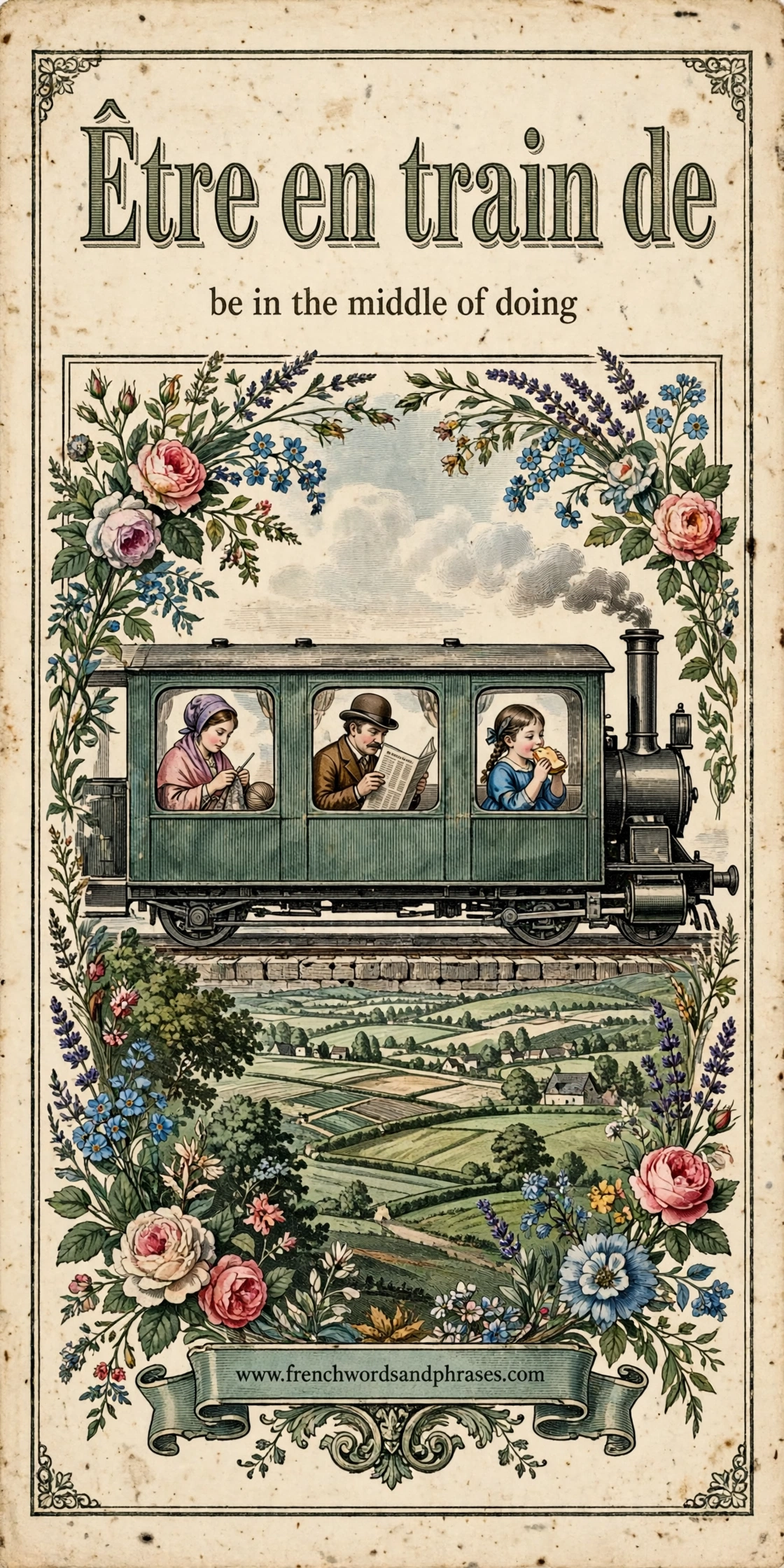
Être en train de means to be in the middle of doing something — the French way of saying ‘be doing’ (I am eating, she is working).
The phone rings in the middle of dinner. Your friend picks up, fork still in hand, and says: « Tu m’appelles toujours quand je suis en train de manger ! » — you always call when I’m in the middle of eating. That little structure, être en train de, is how French zooms in on an action happening right now, this very second.
Let’s explore how être en train de works in French, beginning with the whole structure on one card.
Understanding the French Phrase Être en train de
Être en train de is not a true idiom — and this page says so honestly. It is a grammar structure, the French progressive: the verb être, conjugated for the person and the tense, + en train de + the infinitive of the main verb. It means ‘to be in the middle of doing’ — je suis en train de manger, I am (in the middle of) eating. The source list included it because it confuses learners, and it earns its page for exactly that reason.
It means to be doing something right now — the equivalent of the English ‘be + -ing’ form. One honest warning before anything else: French does not need this structure nearly as often as English needs ‘-ing’. The simple present (je mange) already covers both ‘I eat’ and ‘I am eating’. Être en train de is the zoom lens: it insists that the action is in progress at this very moment, often because someone has interrupted it.
Type: Grammar structure — NOT a true idiom: être (conjugated) + en train de + infinitive
Answers the need: Saying an action is in progress right now, in the middle of happening
Register: Neutral — safe everywhere, speech and writing
Strength: Emphatic zoom — underlines ‘right now, in the middle of it’; optional, never automatic
One important usage detail: only être conjugates. En train de never changes, and the main verb always stays in the infinitive — « nous sommes en train de partir », never a conjugated verb after de. Change the tense by changing être alone: j’étais en train de dormir — I was (in the middle of) sleeping.
Experience the Word
Être en train de is heard most at doorways and on telephones — anywhere an action gets interrupted and has to explain itself.
Imagine a painter up a ladder, brush in the air, when the doorbell rings for the third time. She does not shout ‘je peins’ — she shouts down the stairs: « Je suis en train de peindre, deux minutes ! » The structure is doing real work: it says my hands are busy now.
French is economical with its zoom lens. Where English says ‘I am doing’ by habit, French reaches for en train de only when the middle of the action is the point.
How to Use Être en train de in French: Complete Guide
Let’s explore how être en train de works in French, beginning with the whole structure on one card.
Être en train de at a Glance
The Whole Structure on One Card
What it is, how it is built, its English twin and its one big warning — être en train de in five lines.
| Point | Être en train de |
|---|---|
| What it really is | a grammar structure (the French progressive), not a true idiom |
| How it is built | être conjugated + en train de + infinitive |
| English equivalent | to be doing — be + verb-ing |
| Register | neutral — safe everywhere |
| The big warning | French often just uses the simple present; en train de is a zoom, not a default |
Example
Chut, le bébé est en train de dormir.
Shh, the baby is sleeping (right now).
Word by Word: Building the Structure
Four pieces — and one of them is a trap for the eyes.
| Word | Literal meaning | Its job in the phrase |
|---|---|---|
| être | to be | the only conjugated verb — it carries the person and the tense |
| en train de | in the process of | the fixed middle — train here is an old word for process or course of action |
| de | of, to | the hinge that joins the structure to the main verb |
| + infinitive | the action itself | the main verb, always unconjugated: manger, lire, partir |
Example
Vous êtes en train de lire la bonne page.
You are (in the middle of) reading the right page.
Quick Quiz 1
Which verb conjugates in être en train de — and what form does the main verb take?
Reveal the answer
Only être conjugates; the main verb stays in the infinitive after de.
Nous sommes en train de partir.
We are (in the middle of) leaving.
When You Say It: The Interrupted Moments
Être en train de belongs to moments where the middle of the action is exactly the point.
| Situation | Example |
|---|---|
| Answering ‘what are you doing?’ | qu’est-ce que tu es en train de faire ? — what are you doing (right now)? |
| Explaining an interruption | je ne peux pas venir, je suis en train de travailler — I can’t come, I’m in the middle of working |
| On the phone | tu es en train de manger ? je te rappelle après — are you eating? I’ll call you back later |
| Narrating the present | regardez, elle est en train de peindre le portrait — look, she is painting the portrait (as we speak) |
| A gentle reproach | tu es en train de rêver, là ! — you’re daydreaming, you know! |
Example
Ne le dérange pas, il est en train de réviser pour son examen.
Don’t disturb him, he’s in the middle of revising for his exam.
Make It Yours: Persons, Tenses and the Negative
Change être and you change everything; en train de + infinitive never moves.
| Form | French | In English |
|---|---|---|
| I | je suis en train de manger | I am eating (right now) |
| You (tu) | tu es en train de lire | you are reading |
| We | nous sommes en train de partir | we are leaving |
| You (vous) | vous êtes en train de travailler | you are working |
| Past | j’étais en train de dormir | I was (in the middle of) sleeping |
| Negative | je ne suis pas en train de rêver | I’m not dreaming (this is really happening) |
Example
Quand tu as téléphoné, j’étais en train de jardiner.
When you called, I was (in the middle of) gardening.
Quick Quiz 2
How do you put it in the past: ‘I was sleeping’ (in the middle of it)?
Reveal the answer
« J’étais en train de dormir » — only être moves, into the imperfect; dormir stays in the infinitive.
Quand l’alarme a sonné, j’étais en train de dormir.
When the alarm went off, I was (in the middle of) sleeping.
Everyday Expressions: Frames Built on the Structure
The set frames French speakers actually reach for with être en train de.
| Frame | What it does |
|---|---|
| Qu’est-ce que tu es en train de faire ? | the classic question — what are you doing? |
| Je suis en train de + infinitive | the classic answer — I’m in the middle of… |
| Tu es en train de rêver ! | the reproach — you’re dreaming / you’re not paying attention |
| On est en train de manger, rappelle plus tard | the polite brush-off — we’re eating, call back later |
| être en train de s’installer / de démarrer | for processes — the system is starting up, the family is settling in |
Example
Qu’est-ce que vous êtes en train de fabriquer, tous les deux ?
What are you two up to (in the middle of making)?
Close Cousins Compared
Several French forms live near this one — here is exactly how they differ.
| Cousin | How it differs |
|---|---|
| the simple present (je mange) | the default — covers both ‘I eat’ and ‘I am eating’; no zoom, no insistence |
| venir de + infinitive | the mirror image — to have just done something; the action has just finished |
| être en pleine + noun | être en plein travail — in the middle of work; built on a noun, not a verb |
| être après + infinitive | a regional twin (heard in Belgium, northern France and Canada) — avoid it in standard French |
| en cours de + noun | in the process of — for projects and things: le projet est en cours |
Example
Je viens de manger et maintenant je suis en train de lire.
I’ve just eaten and now I’m (in the middle of) reading.
Quick Quiz 3
Which cousin means ‘to have just done something’?
Reveal the answer
Venir de + infinitive — the mirror of our structure: en train de looks at the middle of the action, venir de looks just after its end.
Elle vient de partir.
She has just left.
Être en train de and Its Neighbours
Same family — actions in time: before, during, just after — plus the opposites.
| Neighbour | Meaning |
|---|---|
| être sur le point de | to be about to — the action has not started yet |
| en plein(e) + noun | in the middle of — en pleine réunion, in the middle of a meeting |
| avoir fini de + infinitive | OPPOSITE — to have finished doing |
| venir de + infinitive | OPPOSITE direction — to have just done |
| ne plus être en train de | to no longer be doing — ça y est, il n’est plus en train de travailler |
Example
Il était sur le point de partir, puis il a été en train de téléphoner pendant une heure.
He was about to leave, then he spent an hour on the phone (in the middle of calling).
Watch Out: The Traps Around Être en train de
Four traps: a train that is not a train, a verb that must not conjugate, overuse, and a regional twin.
| Trap | The truth |
|---|---|
| train = the railway train | same word, wrong picture — here train is the old word for a process or course; no station is involved |
| Conjugating the main verb | after de, always the infinitive: en train de manger, never ‘en train de manges’ |
| Using it everywhere English uses -ing | French does not — je mange already means ‘I am eating’; save en train de for when ‘right in the middle’ matters |
| être après + infinitive | the same idea in regional French (Belgium, the north, Canada) — recognise it, but use en train de in standard French |
Example
On ne dit pas « je suis en train de je mange » : après de, c’est l’infinitif — je suis en train de manger.
You don’t say ‘je suis en train de je mange’: after de it’s the infinitive — je suis en train de manger.
Quick Quiz 4
True or false: French needs être en train de every time English uses ‘-ing’?
Reveal the answer
False — the simple present already covers ‘I am eating’. En train de is a zoom for when the middle of the action is the point.
Je mange, merci — et là, je suis en train de manger, alors rappelle-moi.
I eat, thanks — and right now I’m in the middle of eating, so call me back.
Être en train de in Everyday French: Real-Life Examples
Now that you know the word, let’s see how être en train de appears in everyday French.
Example 1 — The phone call at dinner
Tu m’appelles toujours quand je suis en train de manger !
You always call when I’m in the middle of eating!
Example 2 — The busy colleague
Elle est en train de préparer la réunion, ne la dérange pas.
She is (in the middle of) preparing the meeting, don’t disturb her.
Example 3 — The classic question
Qu’est-ce que vous êtes en train de faire avec ces cartons ?
What are you doing with those boxes?
Example 4 — The sleeping baby
Chut ! Le bébé est en train de s’endormir.
Shh! The baby is falling asleep (right now).
Example 5 — The past interruption
Quand je suis arrivé, ils étaient en train de déménager les meubles.
When I arrived, they were (in the middle of) moving the furniture.
Example 6 — Not dreaming
Non, tu n’es pas en train de rêver : c’est bien un éléphant dans le jardin.
No, you’re not dreaming: that really is an elephant in the garden.
Beyond Translation: The Meaning of Être en train de
Why does a word for a railway train live inside a grammar structure? Because train once meant the whole train of events — the procession, the course, the way things unfold — long before it meant carriages on rails. Être en train de is ‘to be in the course of’ an action: you are inside the procession of the doing, neither at its start nor at its end.
That is why the structure feels like a camera zoom rather than a tense.
French grammar keeps its tenses simple and lets this little procession do the close-ups — honestly labelled here as grammar, not idiom, because knowing the difference is part of learning the language well.
How to Remember the French Phrase Être en train de
Remember it this way: Picture yourself inside a moving procession — the action is flowing past on both sides, you are in the middle of it, not at the start, not at the finish. Être carries who and when; en train de puts you inside the action; the infinitive names it.
- You conjugate only être — it carries the person and the tense.
- You keep the main verb in the infinitive after de — always.
- You use it as a zoom, not a habit — the simple present already covers most ‘-ing’ moments.
The key idea is être en train de is a grammar structure, not a true idiom: être conjugated + en train de + infinitive means to be in the middle of doing something.
Test Your Knowledge of Être en train de
Let’s see how much you’ve learned. Try answering these questions before revealing the answers.
Question 1
Is être en train de a true idiom?
Reveal the answer
No — it is a grammar structure, the French progressive: être + en train de + infinitive. This page teaches it honestly as grammar.
Question 2
How is the structure built?
Reveal the answer
Être conjugated + en train de + the infinitive — je suis en train de manger.
Question 3
Translate: She is working right now.
Reveal the answer
Elle est en train de travailler.
Question 4
Why shouldn’t you use it for every English ‘-ing’?
Reveal the answer
Because the simple present already covers it — je mange means both ‘I eat’ and ‘I am eating’. En train de is a zoom for ‘in the middle of it’.
Question 5
Complete the sentence:
Nous ______ en train de partir. (We are leaving.)
Reveal the answer
sommes
Nous sommes en train de partir.
We are (in the middle of) leaving.
Your Final Challenge
Can You Use It?
How would you say this in French?
“Be quiet, the children are sleeping right now!”
Reveal the answer
Tais-toi, les enfants sont en train de dormir !
Be quiet, the children are sleeping right now!
A little French. A little curiosity. A richer everyday life.
LEARN FRENCH ONE WORD AT A TIME