A French Word to Live By
Translate Être de mauvais poil to English
/ɛtʁ də mo.vɛ pwal/
Être de mauvais poil means to be in a bad mood — grumpy and prickly, and best approached with care.
The office door opens and your manager walks in, drops his bag without a word, and answers the first ‘good morning’ with a grunt. The secretary leans towards you, raises her eyebrows, and passes on the day’s weather forecast: « Attention, il est de mauvais poil ce matin. »
Let’s explore how être de mauvais poil works in French, beginning with the whole phrase on one card.
Understanding the French Phrase Être de mauvais poil
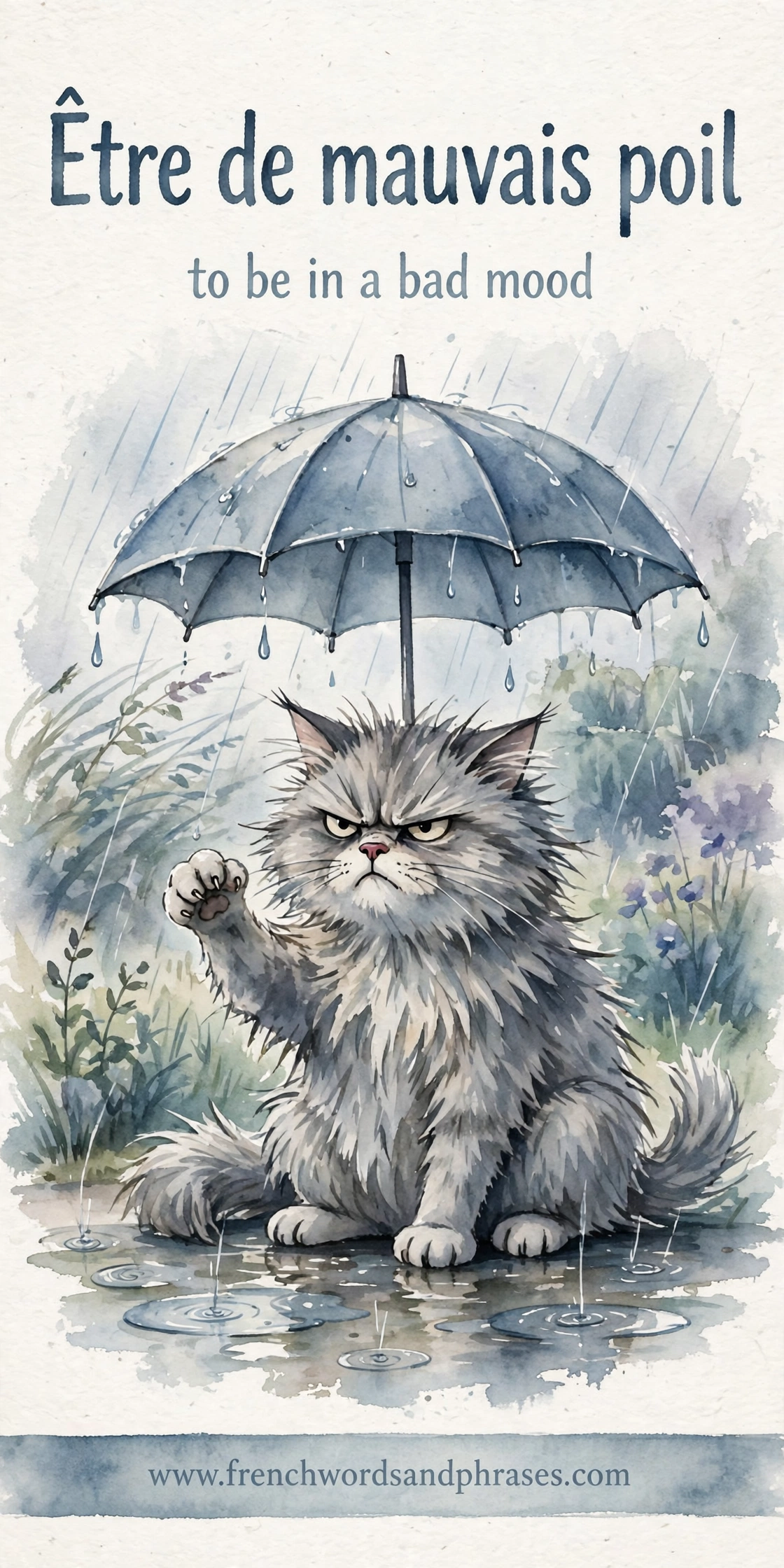
Être de mauvais poil is a French idiomatic expression built from être (to be), de (in a state of), mauvais (bad) and poil (hair, fur — the coat of an animal). It reads a person’s temper the way you would read a cat’s coat: smooth and glossy, all is well; rough and bristling, keep your hands to yourself.
It means to be in a bad mood — grumpy, irritable, ready to snap at small things. Nobody is discussing hairdressing: the poil is an animal’s coat, and French has long judged tempers by it. A person de mauvais poil is not sad and not ill — he is prickly, and the phrase is usually a friendly warning to everyone else in the room.
Type: Idiomatic expression — mood (être de + adjective + poil)
Answers the need: Warning others, or excusing someone: he’s in a bad mood today
Register: Informal — everyday speech; the neutral version is être de mauvaise humeur
Strength: Moderate — a passing grumpiness, a morning’s mood, not a character flaw
One important usage detail: the phrase has a cheerful twin — être de bon poil, to be in a good mood, bright and easy to approach. The pair work like a weather report for people: il est de bon poil aujourd’hui, profites-en pour lui demander. Note that poil here is the coat as a whole, so it stays singular: de mauvais poil, never de mauvais poils.
Experience the Word
Être de mauvais poil is a mood you can almost stroke — or rather, a mood that tells you not to try.
Imagine the family dog on a rainy morning, curled tight, growling softly at the world in general. Everyone in the house reads that coat at a glance and gives the basket a wide berth. Human beings, the phrase suggests, are read exactly the same way by the people who live with them.
French is honest about temper: it does not ask you to fix the mood. It teaches you to read the fur, and to wait for better weather.
How to Use Être de mauvais poil in French: Complete Guide
Let’s explore how être de mauvais poil works in French, beginning with the whole phrase on one card.
Être de mauvais poil at a Glance
The Whole Phrase on One Card
Real meaning, literal picture, English twin and register — être de mauvais poil in five lines.
| Point | Être de mauvais poil |
|---|---|
| What it really means | to be in a bad mood — grumpy and irritable |
| Word for word | to be of bad fur — the coat bristling like an annoyed animal’s |
| English equivalent | to be in a bad mood / to be grumpy / to be out of sorts |
| Register | informal — everyday speech and friendly warnings |
| Use it for | a morning’s temper, a colleague’s mood, a warning to tread carefully |
Example
Laisse-le tranquille, il est de mauvais poil ce matin.
Leave him alone, he’s in a bad mood this morning.
Word by Word: Building the Mood
Four small pieces — take them one by one and the fur starts to bristle.
| Word | Literal meaning | Its job in the phrase |
|---|---|---|
| être | to be | the verb that states the mood as a condition |
| de | of, in a state of | the little word that dresses the person in the mood |
| mauvais | bad | the verdict on the temper — its twin is bon, good |
| poil | hair, fur | an animal’s coat — read, in this phrase, as a mood |
Example
Le chat est de mauvais poil, et le patron aussi.
The cat is in a bad mood, and so is the boss.
Quick Quiz 1
Whose hair is the poil in this phrase — a person’s, or an animal’s?
Reveal the answer
An animal’s coat — the phrase reads a human temper the way you read a cat’s fur: bristling means keep away.
Le chien est de mauvais poil quand il pleut.
The dog is in a bad mood when it rains.
When You Say It: The Grumpy Moments
Être de mauvais poil fires at moments like these — a mood descends, and someone quietly warns the room.
| Situation | Example |
|---|---|
| The morning warning | attention, le chef est de mauvais poil — careful, the boss is in a bad mood |
| Excusing a friend | excuse-le, il est de mauvais poil aujourd’hui — forgive him, he’s in a bad mood today |
| At home | papa est de mauvais poil, on parlera plus tard — Dad’s in a bad mood, we’ll talk later |
| About oneself | je suis de mauvais poil ce matin, désolé — I’m in a bad mood this morning, sorry |
| Waiting it out | il est de mauvais poil, ça passera — he’s in a bad mood, it’ll pass |
Example
Je suis de mauvais poil ce matin, ne me parle pas avant le café.
I’m in a bad mood this morning, don’t talk to me before coffee.
Make It Yours: The Fur for Every Person
Être does the moving — the poil stays singular and the mood does the rest.
| Form | French | In English |
|---|---|---|
| I am | je suis de mauvais poil | I’m in a bad mood |
| He is | il est de mauvais poil | he’s in a bad mood |
| She is | elle est de mauvais poil | she’s in a bad mood |
| We are | on est de mauvais poil | we’re in a bad mood |
| The good twin | il est de bon poil | he’s in a good mood |
| Question | tu es de mauvais poil ? | are you in a bad mood? |
Example
Tu es de mauvais poil ou tu es juste fatigué ?
Are you in a bad mood, or just tired?
Quick Quiz 2
Which is correct — de mauvais poil or de mauvais poils?
Reveal the answer
De mauvais poil — poil is the coat as a whole and stays singular in the phrase.
Elle est de mauvais poil depuis ce matin.
She’s been in a bad mood since this morning.
Everyday Expressions: Building on the Fur
Être de mauvais poil slots into these everyday frames — each one ready to use as it stands.
| Frame | In English |
|---|---|
| être de mauvais poil | to be in a bad mood |
| être de bon poil | to be in a good mood — the cheerful twin |
| de mauvais poil ce matin | in a bad mood this morning |
| attention, il est de mauvais poil | careful, he’s in a bad mood |
| se lever de mauvais poil | to get up in a bad mood |
Example
Il s’est levé de mauvais poil et ça se voit.
He got up in a bad mood and it shows.
Close Cousins: The Other Moods
French has a whole shelf of mood phrases — the poil is the animal one; its cousins use humours, feet and moons.
| Expression | The difference |
|---|---|
| être de mauvais poil | to be in a bad mood — informal, the animal-coat picture |
| être de mauvaise humeur | to be in a bad mood — the neutral, standard version, safe in writing |
| être de bon poil | to be in a good mood — the exact twin, same fur, better weather |
| se lever du pied gauche | to get up on the wrong side of the bed — the mood blamed on the morning’s first step |
| être mal luné | to be in a bad mood — old-fashioned, blaming the moon |
Example
Hier de mauvais poil, aujourd’hui de bon poil : quel changement !
In a bad mood yesterday, in a good mood today: what a change!
Quick Quiz 3
Which cousin would you write in a formal report — de mauvais poil or de mauvaise humeur?
Reveal the answer
De mauvaise humeur — humeur is the standard, neutral word; the poil belongs to conversation.
Le directeur était de mauvaise humeur, selon le rapport.
The director was in a bad mood, according to the report.
Être de mauvais poil and Its Neighbours
The mood shelf around the phrase — tempers, mornings and the animals who show them.
| French | In English |
|---|---|
| l’humeur | mood, temper |
| de bonne humeur | in a good mood (neutral) |
| gronder | to grumble, to growl |
| les cheveux | head hair — the human kind, not the coat |
| un chat | a cat |
| sourire | to smile — what the mood is not doing |
Example
Son humeur change vite : de mauvais poil le matin, souriant à midi.
His mood changes fast: grumpy in the morning, smiling by noon.
Watch Out: The Traps Around Être de mauvais poil
The traps: two kinds of hair, a singular that stays singular, and a mood that is not an illness.
| Trap | The truth |
|---|---|
| poil versus cheveux | cheveux is the hair on a human head; poil is body hair and animal fur — the phrase needs the animal word |
| the singular | de mauvais poil, never poils — the coat is one thing, worn as a whole |
| mood, not health | être de mauvais poil is temper, not sickness — for feeling unwell, French says ne pas être dans son assiette |
| word for word in English | ‘of bad fur’ means nothing in English — translate with in a bad mood or grumpy |
Example
Il n’est pas malade, il est juste de mauvais poil.
He’s not ill, he’s just in a bad mood.
Quick Quiz 4
True or false: être de mauvais poil can describe a cat as well as a person.
Reveal the answer
True — the picture began with animals, and a grumpy cat can still be de mauvais poil in the literal spirit of the phrase.
Le chat est de mauvais poil, laisse-le dormir.
The cat is in a bad mood, let him sleep.
Être de mauvais poil in Everyday French: Real-Life Examples
Now that you know the word, let’s see how être de mauvais poil appears in everyday French.
Example 1 — The office warning
Attention, le chef est de mauvais poil ce matin.
Careful, the boss is in a bad mood this morning.
Example 2 — Excusing a friend
Excuse-le, il est de mauvais poil aujourd’hui.
Forgive him, he’s in a bad mood today.
Example 3 — At home
Papa est de mauvais poil, on lui parlera après le dîner.
Dad’s in a bad mood, we’ll talk to him after dinner.
Example 4 — About oneself
Je suis de mauvais poil, je vais prendre l’air.
I’m in a bad mood, I’m going to get some air.
Example 5 — The good twin
Elle est de bon poil aujourd’hui, demande-lui le service.
She’s in a good mood today, ask her the favour.
Example 6 — Waiting it out
Il est de mauvais poil, mais ça passera après le café.
He’s in a bad mood, but it’ll pass after coffee.
Beyond Translation: The Meaning of Être de mauvais poil
English puts bad moods in beds and feet — got up on the wrong side, out of sorts. French goes to the zoo: it strokes the animal’s coat the wrong way and reads the bristle. The picture is kinder than it looks — a mood, in this phrase, is weather on a living creature, not a defect of character.
Être de mauvais poil is a forecast, not a judgement: rough fur this morning, smooth by lunch, perhaps.
And the twin phrase, de bon poil, completes the mercy: the same animal, the same coat, a better day.
How to Remember the French Phrase Être de mauvais poil
Remember it this way: Être de mauvais poil is the cat’s coat read as a forecast — bristling fur, grumpy human, handle with care.
- You picture the animal — poil is fur, and a bristling coat means a mood to steer around.
- You learn the pair together — de mauvais poil grumpy, de bon poil cheerful: same fur, different weather.
- You keep the singular — one coat, worn whole: de mauvais poil, never poils.
The key idea is être de mauvais poil means to be in a bad mood — grumpy as a bristling animal.
Test Your Knowledge of Être de mauvais poil
Let’s see how much you’ve learned. Try answering these questions before revealing the answers.
Question 1
What does être de mauvais poil mean?
Reveal the answer
To be in a bad mood — grumpy, irritable, best approached with care.
Question 2
What is the cheerful twin of the phrase?
Reveal the answer
Être de bon poil — to be in a good mood, bright and easy to approach.
Question 3
What is the neutral, standard way to say the same thing?
Reveal the answer
Être de mauvaise humeur — the version safe in writing and formal speech.
Question 4
Why does poil stay singular?
Reveal the answer
Because it is the animal’s coat as a whole — one coat, one mood: de mauvais poil.
Question 5
Complete the sentence:
Laisse-le, il est de ______ poil ce matin. (Leave him, he’s in a bad mood this morning.)
Reveal the answer
mauvais
Laisse-le, il est de mauvais poil ce matin.
Leave him, he’s in a bad mood this morning.
Your Final Challenge
Can You Use It?
How would you say this in French?
“Careful, the boss is in a bad mood today.”
Reveal the answer
Attention, le chef est de mauvais poil aujourd’hui.
Careful, the boss is in a bad mood today.
A little French. A little curiosity. A richer everyday life.
LEARN FRENCH ONE WORD AT A TIME