A French Word to Live By
Translate Être à deux doigts de to English
/ɛtʁ a dø dwa də/
Être à deux doigts de means to be this close to — within two fingers of doing or reaching something.
The climber’s glove brushes the summit rock — brushes it — and then the gust arrives, and the rope sings, and the whole mountain says not today. Back at the refuge, wrapped in a blanket with tea going cold, she holds up one hand, thumb and finger a breath apart: « J’étais à deux doigts du sommet. » Two fingers: the smallest measuring tape in French, and the one reserved for heartbreaks.
Let’s explore how être à deux doigts de works in French, beginning with the whole phrase on one card.
Understanding the French Phrase Être à deux doigts de
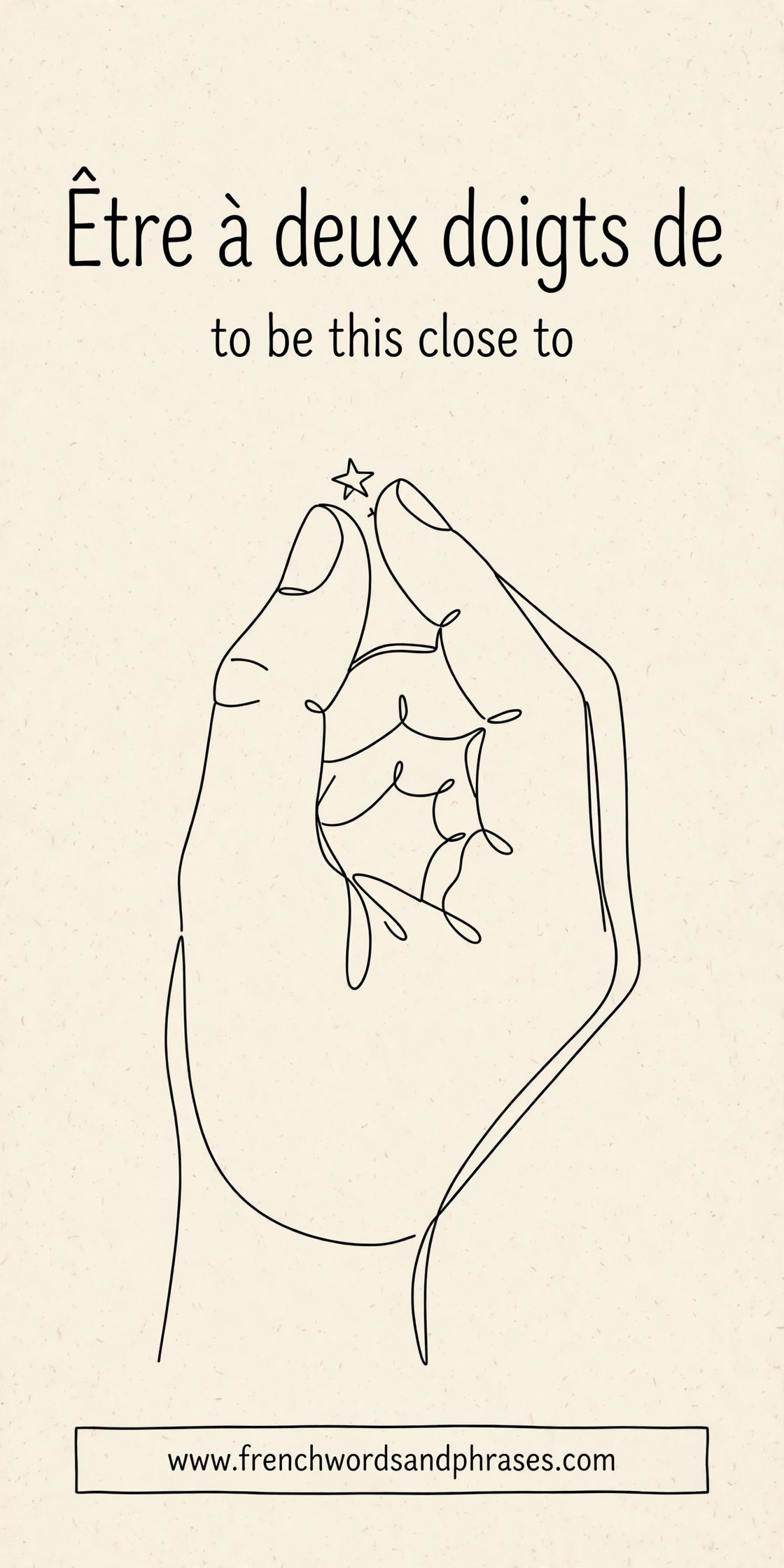
Être à deux doigts de is an idiomatic expression built from deux doigts — two fingers — and the preposition de. The picture is the universal gesture: thumb and forefinger held a hair apart, the gap you can measure a near-miss with. Followed by an infinitive (à deux doigts de tomber, to be this close to falling) or a noun (à deux doigts de la victoire), it says the thing was almost — almost — reached or done. The event has NOT happened: that hair of a gap is the whole meaning.
It means to be this close to — within two fingers of doing or reaching something. A student two fingers from passing, a horse two fingers from the post, you two fingers from tears at the wedding speech. The phrase carries the story’s suspense inside it: everything was in place, the distance was nothing, and then the world intervened. In the past it often mourns: « Il est passé à deux doigts de la mort » — he came within an inch of death, and the inch is still visible in the telling.
Type: Idiomatic expression — être + à deux doigts de + infinitive or noun
Answers the need: Saying something almost happened, or was almost reached
Register: Neutral — safe everywhere, in speech and writing
Strength: Strong — the gap is tiny; the phrase lives on suspense
One important usage detail: the thing after de has not happened — that is the contract of the phrase. For actions, de takes the infinitive: à deux doigts de pleurer. For states and prizes, de takes the noun: à deux doigts du succès, de la catastrophe. In the past, French often prefers the fuller form: être passé à deux doigts de — il est passé à deux doigts de la mort.
Experience the Word
Être à deux doigts de is the geometry of the near-miss — a whole novel of effort, measured at the end by the gap between two fingers.
Imagine the pastry apprentice at the regional final, her soufflé risen like a cathedral, the judges approaching with their spoons — and the kitchen door slamming somewhere behind her. The soufflé sighs and sits down. Two fingers, she tells her mother that night. Two fingers from the trophy, and the whole street can see the gap when she shows them.
Every life keeps a shelf of these measurements. The French genius is to have standardised the unit: not a mile, not a whisker of luck, but deux doigts — the distance everyone can hold up in the air and say: this much. This much was all it was.
How to Use Être à deux doigts de in French: Complete Guide
Let’s explore how être à deux doigts de works in French, beginning with the whole phrase on one card.
Être à deux doigts de at a Glance
The Whole Phrase on One Card
Real meaning, literal picture, English twin and register — être à deux doigts de in five lines.
| Point | Être à deux doigts de |
|---|---|
| What it really means | to be extremely close to doing or reaching something — but not there yet |
| Word for word | to be at two fingers of |
| English equivalent | to be this close to / within an inch of / on the verge of |
| Register | neutral — safe everywhere, speech and writing |
| Use it for | near-victories, near-tears, near-falls and every story that ends ‘so close’ |
Example
Elle a été à deux doigts de gagner la course.
She was this close to winning the race.
Word by Word: Measuring the Near-Miss
Three pieces — a number, the body’s smallest ruler, and the preposition that points at the prize.
| Word | Literal meaning | Its job in the phrase |
|---|---|---|
| deux | two | the count of the measuring instrument — never one, never three |
| doigts | fingers | thumb and forefinger, held a hair apart: the universal gesture of ‘this close’ |
| de | of, from | the link to the thing almost reached — infinitive for actions, noun for states |
Example
Il était à deux doigts de pleurer pendant le discours.
He was this close to crying during the speech.
Quick Quiz 1
Has the thing after de already happened, when you use this phrase?
Reveal the answer
No — that is the contract. The gap is tiny, but it is still a gap: the fall, the victory, the tears have not arrived.
J’étais à deux doigts de tomber, mais je me suis rattrapé.
I was this close to falling, but I caught myself.
When You Say It: The Near-Miss Scenes
Être à deux doigts de is pronounced at scenes like these — wherever a story ends with a held-up hand.
| Situation | Example |
|---|---|
| Nearly winning | à deux doigts de la victoire — this close to victory |
| Nearly crying | elle était à deux doigts de pleurer — she was this close to tears |
| Nearly falling | il a été à deux doigts de tomber — he was this close to falling |
| Nearly missing the train | nous étions à deux doigts de rater le train — we were this close to missing the train |
| The closest call | il est passé à deux doigts de la mort — he came within an inch of death |
Example
Le cheval a perdu à deux doigts du poteau.
The horse lost within two fingers of the post.
Make It Yours: Two Doors After De
The phrase opens two doors — the infinitive for actions, the noun for states and prizes.
| Form | French | In English |
|---|---|---|
| With an action | être à deux doigts de + infinitive | to be this close to doing something |
| With a prize | être à deux doigts de + noun | to be this close to victory, success, disaster |
| The past, fuller form | être passé à deux doigts de… | to have come within an inch of… |
| About yourself | j’étais à deux doigts de… | I was this close to… |
| The measurement shown | à deux doigts ! (hand held up) | this close! — the gesture completes the sentence |
Example
Nous sommes passés à deux doigts de la catastrophe.
We came within an inch of disaster.
Quick Quiz 2
‘He came within an inch of death’ — which fuller form does French prefer in the past?
Reveal the answer
Il est passé à deux doigts de la mort — être passé à deux doigts de is the past’s favourite shape for the closest calls.
Le pilote est passé à deux doigts de l’accident.
The pilot came within an inch of the accident.
Everyday Expressions: Nearness in Its Frames
À deux doigts slots into these everyday frames — each one ready to use as it stands.
| Frame | In English |
|---|---|
| être à deux doigts de + infinitive | to be this close to doing something |
| à deux doigts de la victoire | this close to victory |
| à deux doigts de pleurer | this close to tears |
| être passé à deux doigts de… | to have come within an inch of… |
| à deux pas (for places) | a stone’s throw away — places take pas, steps; deux doigts is for events |
Example
La gare est à deux pas, mais nous étions à deux doigts de rater le train.
The station is a stone’s throw away, but we were this close to missing the train.
Close Cousins: The Almost Shelf
French measures nearness several ways — our two fingers are the storyteller’s favourite.
| Expression | The difference |
|---|---|
| être à deux doigts de | to be this close to — the near-miss with the gesture built in |
| être sur le point de | to be on the point of — the neutral, textbook twin; the event is about to happen, no heartbreak implied |
| frôler | to come within a whisker of — frôler la catastrophe, to brush past disaster |
| ça s’est joué à rien | it was decided by nothing — the result hung on the tiniest margin |
| manquer de + infinitive | to nearly do — il a manqué de tomber, he nearly fell (an older, literary flavour) |
Example
Le match s’est joué à rien : un but à la dernière minute.
The match was decided by nothing: a goal in the last minute.
Quick Quiz 3
Which cousin is the neutral, no-drama version — être sur le point de or frôler?
Reveal the answer
Être sur le point de — on the point of simply announces what is about to happen; frôler keeps the brush with disaster.
Le train est sur le point de partir.
The train is about to leave.
Être à deux doigts de and Its Neighbours
The finger family — the hand does a surprising amount of French’s measuring and regretting.
| French | In English |
|---|---|
| un doigt | a finger — and a measure: un doigt de whisky is a finger of whisky in the glass |
| les doigts de pied | the toes — literally the foot’s fingers |
| s’en mordre les doigts | to kick oneself — literally to bite one’s fingers with regret |
| à deux pas | a stone’s throw away — the place version of our phrase |
| montrer du doigt | to point at — and, figuratively, to single out for blame |
Example
Il s’en mord les doigts de ne pas avoir acheté la maison.
He’s kicking himself for not buying the house.
Watch Out: The Traps Around Être à deux doigts de
The traps: an event that must stay un-happened, and toes that are fingers in disguise.
| Trap | The truth |
|---|---|
| the contract trap | the thing after de has not happened — for the completed event, the phrase is the wrong tool |
| the place trap | for physical nearness French says à deux pas (two steps) — deux doigts measures events and outcomes, not addresses |
| the toe trap | doigts are fingers; toes are doigts de pied or orteils — the near-miss is measured with the hand, not the foot |
| the number trap | it is always deux doigts — the gesture has two fingers; un doigt belongs to whisky |
Example
Elle habite à deux pas de la gare, pas à deux doigts.
She lives a stone’s throw from the station, not two fingers from it.
Quick Quiz 4
True or false: à deux doigts de can describe how near your house is to the station.
Reveal the answer
False — places take à deux pas, a stone’s throw; deux doigts measures how near an event came to happening.
Le café est à deux pas de la place.
The café is a stone’s throw from the square.
Être à deux doigts de in Everyday French: Real-Life Examples
Now that you know the word, let’s see how être à deux doigts de appears in everyday French.
Example 1 — The race
Elle a été à deux doigts de gagner la course : deux centimètres à l’arrivée !
She was this close to winning the race: two centimetres at the finish!
Example 2 — The tears
Pendant le discours de sa fille, il était à deux doigts de pleurer.
During his daughter’s speech, he was this close to tears.
Example 3 — The train
Nous étions à deux doigts de rater le train — le contrôleur fermait déjà les portes.
We were this close to missing the train — the guard was already closing the doors.
Example 4 — The fall
Sur la glace, il a été à deux doigts de tomber, mais la rambarde l’a sauvé.
On the ice, he was this close to falling, but the railing saved him.
Example 5 — The exam
Elle a réussi son examen à deux doigts de l’échec : un point de plus, un point de moins…
She passed her exam within two fingers of failing: one mark more, one mark less…
Example 6 — The closest call
Après l’accident, le médecin a dit qu’il était passé à deux doigts de la mort.
After the accident, the doctor said he had come within an inch of death.
Beyond Translation: The Meaning of Être à deux doigts de
English measures near-misses in inches and whiskers — units from the workshop and the barber’s. French uses the hand itself: two fingers, held up in the air, a gesture so universal that the phrase barely needs its words. Say « à deux doigts » in any café in France and every hand at every table knows the shape.
The phrase is a gesture that learned to speak — the smallest unit of heartbreak, standardised.
That may be why it leans toward stories rather than reports. An inch is a fact; deux doigts is a performance — the hand rises, the gap appears, and the audience supplies the gasp.
How to Remember the French Phrase Être à deux doigts de
Remember it this way: Être à deux doigts de is the near-miss with its own measuring tape — thumb and forefinger a hair apart, and a whole story hanging in the gap.
- You hold up the hand — two fingers, a hair of a gap: the prize is there, and not there.
- You respect the contract — after de, the thing has NOT happened; the gap is the meaning.
- You keep places out of it — addresses take à deux pas; deux doigts is for events.
The key idea is être à deux doigts de means to be this close to — two fingers from the thing that didn’t happen.
Test Your Knowledge of Être à deux doigts de
Let’s see how much you’ve learned. Try answering these questions before revealing the answers.
Question 1
What does être à deux doigts de mean?
Reveal the answer
To be this close to — within two fingers of doing or reaching something that has not happened.
Question 2
What is the literal, word-for-word meaning?
Reveal the answer
To be at two fingers of — the gap between thumb and forefinger, the universal ‘this close’ gesture.
Question 3
How do you say ‘She was this close to winning the race’?
Reveal the answer
Elle a été à deux doigts de gagner la course — de plus the infinitive for an action.
Question 4
What fuller form does French prefer for a past close call?
Reveal the answer
Être passé à deux doigts de… — il est passé à deux doigts de la mort, he came within an inch of death.
Question 5
Complete the sentence:
J’étais à deux ______ de pleurer pendant son discours. (I was this close to crying during his speech.)
Reveal the answer
doigts
J’étais à deux doigts de pleurer pendant son discours.
I was this close to crying during his speech.
Your Final Challenge
Can You Use It?
How would you say this in French?
“She was this close to winning the race.”
Reveal the answer
Elle a été à deux doigts de gagner la course.
She was this close to winning the race.
A little French. A little curiosity. A richer everyday life.
LEARN FRENCH ONE WORD AT A TIME