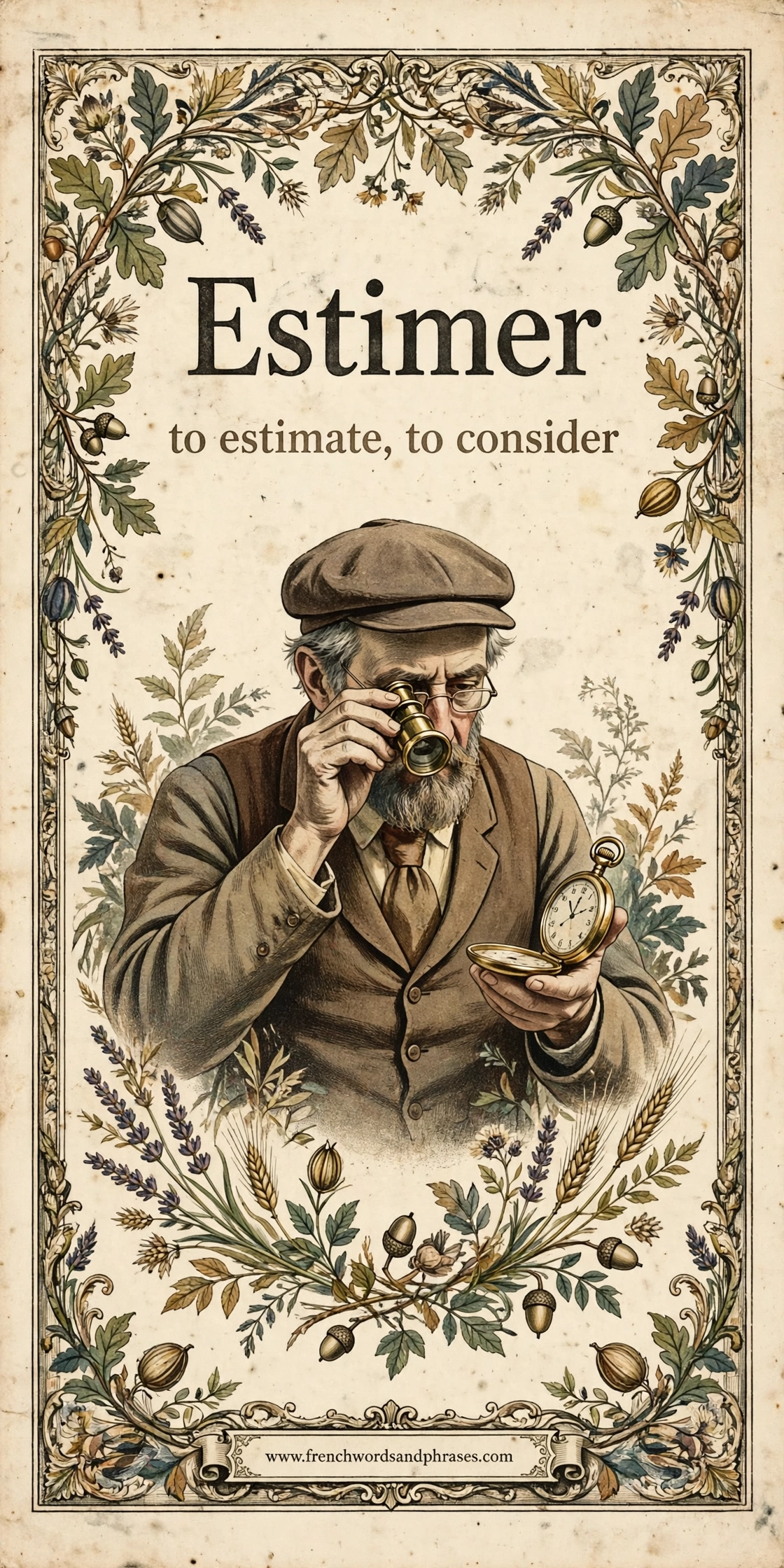
A French Word to Live By
How to Conjugate Estimer in French
/ɛs.ti.me/
Estimer means to estimate — to judge the value, size or cost of something — and to consider or deem: to hold an opinion that something is true, necessary or good.
A builder eyeing a wall and naming a price, a captain judging the distance to the shore, a committee deciding that a measure is necessary — estimer is the verb of measured judgement: the mind weighing, valuing, and giving its verdict.
In this guide, you’ll learn how to conjugate estimer in all the major French tenses and moods. Explore complete conjugation tables, French examples, English translations, and practice quizzes.
Understanding the French Verb Estimer
Estimer is a regular French verb belonging to the first group of verbs, those ending in-er.
It means to estimate, to consider. The measuring sense belongs to experts and insurers (un expert estime les dégâts); the judging sense belongs to everyone, and j’estime que… is the measured, slightly formal way of saying I think that… — an opinion presented as a weighed judgement rather than a hunch.
Verb classification: First group (-er)
Auxiliary verb: Avoir
Past participle: estimé
Present participle: estimant
English equivalents: To estimate, to value, to reckon; estimer le prix — to estimate the price; estimer la distance — to judge the distance; estimer que — to consider that, to be of the opinion that; estimer quelqu’un — to hold someone in esteem; s’estimer heureux — to consider oneself lucky.
One important detail: estimer has two great uses — measuring (estimer les dégâts, to assess the damage; estimer une maison, to value a house) and judging (j’estime que c’est trop cher — I consider it too expensive; il estime nécessaire de partir — he deems it necessary to leave). With people as object it means esteem itself: estimer un collègue, to think highly of a colleague. It is perfectly regular: j’estime, nous estimons, ils estiment, past participle estimé.
Experience the Word
Estimer is the verb of the weighed verdict — the eye that measures, and the mind that decides what a thing is worth.
Imagine an old antiques dealer in a country market. He picks up a battered clock, turns it over once, listens to its tick — il estime sa valeur en dix secondes: two hundred years of craft read at a glance, and a price named without a tremor.
No scales, no books, no hesitation. He estimated it — estimé — the way experience estimates everything: by eye and by judgement.
How to Conjugate Estimer: Complete French Conjugation Guide
Let’s explore every major conjugation of estimer, beginning with the indicative mood.
How to Conjugate Estimer in the Indicative Mood
The indicative mood is used to express facts, observations, actions, and events.
How to Conjugate Estimer in the Present Tense (Présent)
Used for actions happening now, habitual actions, and general truths.
| Subject | Conjugation |
|---|---|
| je | estime |
| tu | estimes |
| il / elle | estime |
| nous | estimons |
| vous | estimez |
| ils / elles | estiment |
L’expert estime les dégâts à dix mille euros.
The expert estimates the damage at ten thousand euros.
Quick Quiz 1
Complete the sentence:
Nous ______ ce projet nécessaire pour le village.
Reveal the answer
estimons
Nous estimons ce projet nécessaire pour le village.
We consider this project necessary for the village.
How to Conjugate Estimer in the Passé Composé
Used for completed actions in the past. Estimer takes the auxiliary verb avoir.
| Subject | Conjugation |
|---|---|
| j’ | ai estimé |
| tu | as estimé |
| il / elle | a estimé |
| nous | avons estimé |
| vous | avez estimé |
| ils / elles | ont estimé |
Example
Nous avons estimé le coût des travaux avant de signer.
We estimated the cost of the works before signing.
How to Conjugate Estimer in the Imparfait (Imperfect Tense)
Used for habitual past actions, descriptions, and ongoing situations in the past.
| Subject | Conjugation |
|---|---|
| je | estimais |
| tu | estimais |
| il / elle | estimait |
| nous | estimions |
| vous | estimiez |
| ils / elles | estimaient |
Example
Autrefois, les marins estimaient la distance à l’œil nu.
In the old days, sailors used to judge the distance with the naked eye.
Quick Quiz 2
Choose the correct form:
We estimated the cost before signing.
Nous ______ le coût avant de signer. (avons estimé / sommes estimés)
Reveal the answer
avons estimé
Nous avons estimé le coût avant de signer.
Estimer takes avoir.
How to Conjugate Estimer in the Plus-que-parfait
Used to describe an action that had already been completed before another past event.
| Subject | Conjugation |
|---|---|
| j’ | avais estimé |
| tu | avais estimé |
| il / elle | avait estimé |
| nous | avions estimé |
| vous | aviez estimé |
| ils / elles | avaient estimé |
Example
Elle avait estimé la maison bien au-dessous de sa valeur.
She had valued the house well below its worth.
How to Conjugate Estimer in the Passé Simple
Primarily used in formal writing, literature, and historical narratives. It is rarely used in everyday conversation.
| Subject | Conjugation |
|---|---|
| je | estimai |
| tu | estimas |
| il / elle | estima |
| nous | estimâmes |
| vous | estimâtes |
| ils / elles | estimèrent |
Example
Le jury estima la toile à une fortune.
The jury valued the painting at a fortune.
How to Conjugate Estimer in the Passé Antérieur
A literary tense used to express an action completed immediately before another past action, generally in the passé simple.
| Subject | Conjugation |
|---|---|
| j’ | eus estimé |
| tu | eus estimé |
| il / elle | eut estimé |
| nous | eûmes estimé |
| vous | eûtes estimé |
| ils / elles | eurent estimé |
Example
Quand il eut estimé les risques, le capitaine donna l’ordre de partir.
When he had assessed the risks, the captain gave the order to leave.
How to Conjugate Estimer in the Future Tense (Futur Simple)
Used to describe actions that will take place in the future.
| Subject | Conjugation |
|---|---|
| je | estimerai |
| tu | estimeras |
| il / elle | estimera |
| nous | estimerons |
| vous | estimerez |
| ils / elles | estimeront |
Example
Demain, l’assureur estimera les dégâts de l’incendie.
Tomorrow, the insurer will estimate the fire damage.
How to Conjugate Estimer in the Futur Antérieur (Future Perfect)
Used for an action that will have been completed before a particular point in the future.
| Subject | Conjugation |
|---|---|
| j’ | aurai estimé |
| tu | auras estimé |
| il / elle | aura estimé |
| nous | aurons estimé |
| vous | aurez estimé |
| ils / elles | auront estimé |
Example
À la fin de la semaine, nous aurons estimé tous les objets de la succession.
By the end of the week, we will have valued all the objects in the estate.
How to Conjugate Estimer in the Near Future (Futur Proche)
Used to describe something that is going to happen soon. Formed with aller + infinitive.
| Subject | Conjugation |
|---|---|
| je | vais estimer |
| tu | vas estimer |
| il / elle | va estimer |
| nous | allons estimer |
| vous | allez estimer |
| ils / elles | vont estimer |
Example
Je vais estimer le prix de cette vieille montre.
I am going to estimate the price of this old watch.
How to Conjugate Estimer in the Conditional Mood
The conditional mood expresses what would happen under certain circumstances. It is also frequently used to make polite requests or express wishes.
How to Conjugate Estimer in the Present Conditional
| Subject | Conjugation |
|---|---|
| je | estimerais |
| tu | estimerais |
| il / elle | estimerait |
| nous | estimerions |
| vous | estimeriez |
| ils / elles | estimeraient |
Example
À ta place, j’estimerais ce tableau à bien plus.
In your place, I would value this painting at much more.
How to Conjugate Estimer in the Past Conditional
| Subject | Conjugation |
|---|---|
| j’ | aurais estimé |
| tu | aurais estimé |
| il / elle | aurait estimé |
| nous | aurions estimé |
| vous | auriez estimé |
| ils / elles | auraient estimé |
Example
Il aurait estimé le voyage trop dangereux sans un bon guide.
He would have considered the journey too dangerous without a good guide.
Estimer in the Literary Past Conditional Form
This less common literary form uses the imperfect subjunctive of avoir.
| Subject | Conjugation |
|---|---|
| j’ | eusse estimé |
| tu | eusses estimé |
| il / elle | eût estimé |
| nous | eussions estimé |
| vous | eussiez estimé |
| ils / elles | eussent estimé |
Example
Le capitaine eût estimé la distance avec une précision parfaite.
The captain would have judged the distance with perfect accuracy.
How to Conjugate Estimer in the Subjunctive Mood
The subjunctive is used to express wishes, emotions, doubts, necessity, and uncertainty. It frequently follows expressions such as il faut que (it is necessary that) or bien que (although).
How to Conjugate Estimer in the Present Subjunctive
| Subject | Conjugation |
|---|---|
| que je | estime |
| que tu | estimes |
| qu’il / qu’elle | estime |
| que nous | estimions |
| que vous | estimiez |
| qu’ils / qu’elles | estiment |
Example
Il est normal que l’expert estime les dégâts avant tout paiement.
It is normal that the expert estimates the damage before any payment.
Quick Quiz 3
Complete the sentence using the subjunctive:
Je suis heureux qu’elle ______ mon travail à sa juste valeur.
Reveal the answer
ait estimé
Je suis heureux qu’elle ait estimé mon travail à sa juste valeur.
I am happy she valued my work at its true worth.
How to Conjugate Estimer in the Imperfect Subjunctive
A literary tense, rarely encountered in modern spoken French.
| Subject | Conjugation |
|---|---|
| que je | estimasse |
| que tu | estimasses |
| qu’il / qu’elle | estimât |
| que nous | estimassions |
| que vous | estimassiez |
| qu’ils / qu’elles | estimassent |
Example
Je voulais qu’il estimât le bijou devant moi.
I wanted him to value the jewel in front of me.
How to Conjugate Estimer in the Pluperfect Subjunctive
A literary construction used to express an action completed before another past action.
| Subject | Conjugation |
|---|---|
| que j’ | eusse estimé |
| que tu | eusses estimé |
| qu’il / qu’elle | eût estimé |
| que nous | eussions estimé |
| que vous | eussiez estimé |
| qu’ils / qu’elles | eussent estimé |
Example
On racontait que le notaire eût estimé la succession au plus juste.
People said the notary had valued the estate as fairly as possible.
How to Conjugate Estimer in the Past Subjunctive
| Subject | Conjugation |
|---|---|
| que j’ | aie estimé |
| que tu | aies estimé |
| qu’il / qu’elle | ait estimé |
| que nous | ayons estimé |
| que vous | ayez estimé |
| qu’ils / qu’elles | aient estimé |
Example
Je suis heureux qu’elle ait estimé mon travail à sa juste valeur.
I am happy she valued my work at its true worth.
How to Conjugate Estimer in the Imperative
The imperative is used to give commands, instructions, invitations, or suggestions. Subject pronouns are omitted.
How to Conjugate Estimer in the Present Imperative
| Person | Conjugation |
|---|---|
| (tu) | estime |
| (nous) | estimons |
| (vous) | estimez |
Example
Estimez d’abord les risques, vous déciderez ensuite !
Assess the risks first, you will decide afterwards!
Quick Quiz 4
How would you say Assess the risks first (tu form)?
Reveal the answer
Estime d’abord les risques !
French Participles of Estimer
Participles are verb forms that can be used in compound tenses and other grammatical constructions.
Present Participle of Estimer
estimant
En estimant la distance, le pilote a évité les rochers.
By judging the distance, the pilot avoided the rocks.
Past Participle of Estimer
estimé
Estimée par trois experts, la toile a été vendue une fortune.
Valued by three experts, the painting was sold for a fortune.
Estimer in Everyday French: Real-Life Examples
Now that you know the conjugations, let’s see how estimer appears in everyday French.
Example 1 — Present
L’expert estime les dégâts.
The expert estimates the damage.
Example 2 — Passé composé
Nous avons estimé le coût des travaux.
We estimated the cost of the works.
Example 3 — Imparfait
Les marins estimaient la distance à l’œil.
Sailors used to judge the distance by eye.
Example 4 — Future
L’assureur estimera les dégâts demain.
The insurer will estimate the damage tomorrow.
Example 5 — Conditional
J’estimerais ce tableau à bien plus.
I would value this painting at much more.
Example 6 — Imperative
Estimez d’abord les risques !
Assess the risks first!
Beyond Translation: The Meaning of Estimer
English estimate and esteem are the two halves of French estimer, separated in English and still united in French: to value a house and to value a friend are the same verb.
Judgement and respect share one root.
That is why s’estimer heureux — to consider oneself lucky — and tenir quelqu’un en haute estime — to hold someone in high esteem — grow from the same stem as the insurer’s estimate: all are ways of saying what something is worth.
How to Remember the French Verb Estimer
Remember it this way: Estimer is about the antiques dealer naming a price for the battered clock after one glance.
- Two uses, one verb: estimer un prix (measure) and estimer que… (judge, consider).
- With a person as object it is respect: estimer un collègue, to think highly of him.
- Regular -er: j’estime, nous estimons, past participle estimé.
The key idea is the antiques dealer naming a price for the battered clock after one glance.
Test Your Knowledge of Estimer
Let’s see how much you’ve learned. Try answering these questions before revealing the answers.
Question 1
What are the two great uses of estimer?
Reveal the answer
Measuring (estimating a price, a distance, damage) and judging (estimer que — to consider that; deeming something necessary).
Question 2
How do you say The expert estimates the damage at ten thousand euros in French?
Reveal the answer
L’expert estime les dégâts à dix mille euros.
Question 3
Translate: We estimated the cost of the works before signing.
Reveal the answer
Nous avons estimé le coût des travaux avant de signer.
Question 4
What is the past participle of estimer?
Reveal the answer
Estimé.
Question 5
Complete the sentence:
Il est normal que l’expert ______ les dégâts avant tout paiement.
Reveal the answer
estime
Il est normal que l’expert estime les dégâts avant tout paiement.
It is normal that the expert estimates the damage before any payment.
Your Final Challenge
Can You Use It?
How would you say this in French?
The old antiques dealer estimated the clock’s value with a single glance, and his price was right to the cent.
Reveal the answer
Le vieil antiquaire a estimé la pendule d’un seul regard, et son prix était juste au centime près.
The old antiques dealer estimated the clock’s value with a single glance, and his price was right to the cent.
A little French. A little curiosity. A richer everyday life.
LEARN FRENCH ONE WORD AT A TIME