
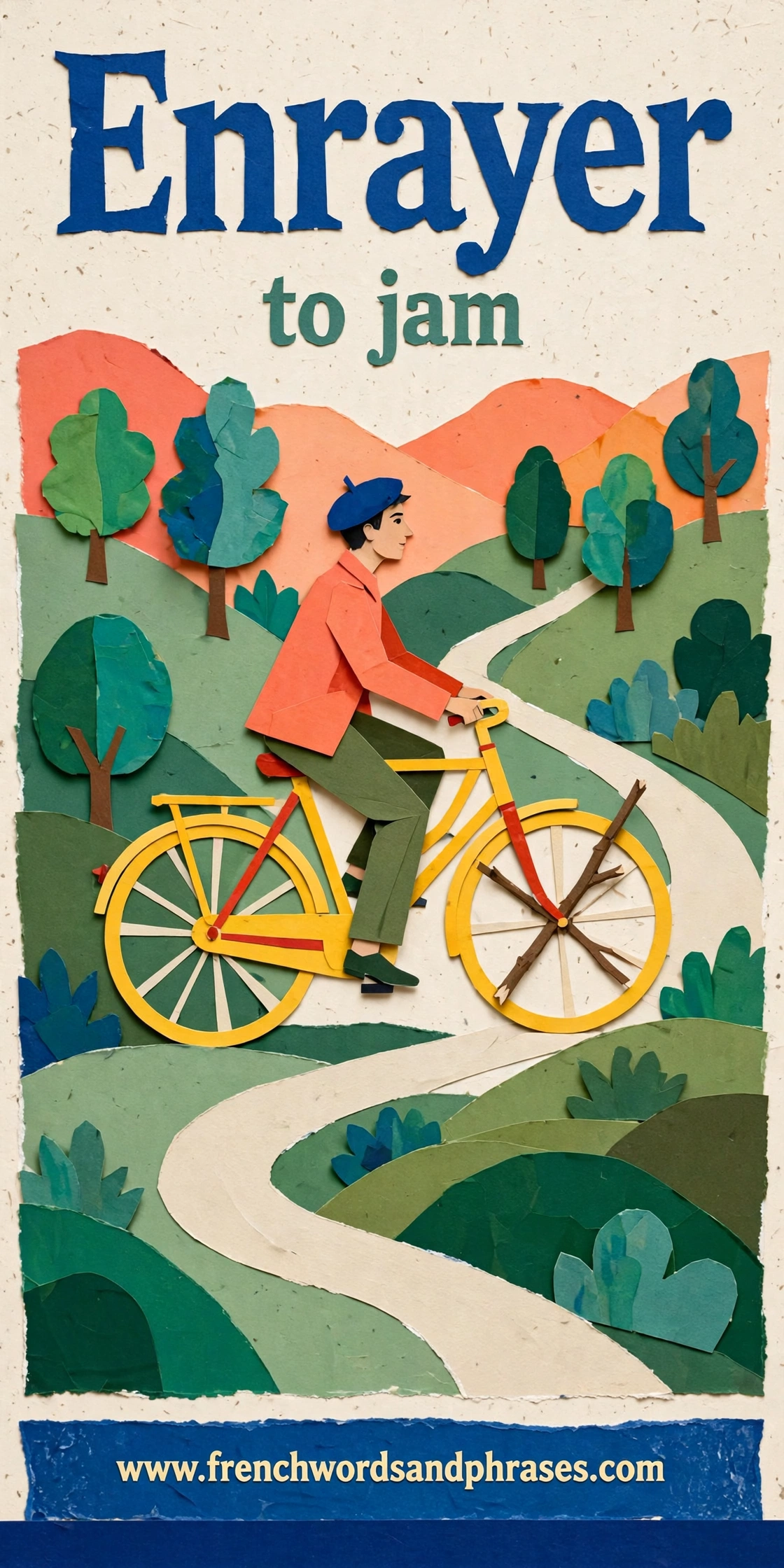
A French Word to Live By
How to Conjugate Enrayer in French
/ɑ̃.ʁɛ.je/
Enrayer means to jam — to block a mechanism so it stops dead, and, figuratively, to halt or curb something that is spreading.
A grain of sand in a watch movement, a cartridge stuck in a rifle, ice in a lock on the coldest morning of the year — enrayer is the verb of the sudden stoppage: to jam a mechanism, and by extension to jam an epidemic, a decline or a fire before it spreads.
In this guide, you’ll learn how to conjugate enrayer in all the major French tenses and moods. Explore complete conjugation tables, French examples, English translations, and practice quizzes.
Understanding the French Verb Enrayer
Enrayer is a regular French verb belonging to the first group of verbs, those ending in-er.
It means to jam. It works in two worlds: the workshop, where rust, sand and ice enraient locks, chains and weapons; and the newspaper, where governments and firefighters enraient things that spread — enrayer une épidémie, enrayer la propagation, enrayer la hausse des prix. In both worlds it means the same thing: something moving has been stopped in its tracks.
Verb classification: First group (-er)
Auxiliary verb: Avoir
Past participle: enrayé
Present participle: enrayant
English equivalents: To jam, to block; (figurative) to halt, to curb, to check; enrayer un mécanisme — to jam a mechanism; enrayer une arme — to jam a weapon; enrayer la propagation d’un incendie — to halt the spread of a fire; enrayer une épidémie — to curb an epidemic; enrayer le déclin — to check the decline.
One important detail: enrayer is a -ayer verb, and its y turns to i wherever the next syllable is mute — j’enraie, tu enraies, il enraie, ils enraient, all through the future and conditional (j’enraierai, j’enraierais) and in the tu imperative (enraie !) — while the y survives where the ending is sounded: nous enrayons, vous enrayez, j’enrayais, en enrayant. The y-spellings (je enraye, je enrayerai) are also accepted French, but the i-forms in the tables here are the traditional ones. For a mechanism jamming by itself, French uses the reflexive: la machine s’enraye.
Experience the Word
Enrayer is the art of the full stop — one small obstacle, correctly placed, and the whole machine of events halts.
Imagine a forest fire running before the wind on an August hillside, and a line of firefighters digging a bare-earth trench across its path. They are not putting the fire out; they are doing something cleverer — ils enraient sa propagation. Deprived of fuel at the trench, the great moving thing slows, hesitates, and stops, jammed like a wheel with a stone in it.
The fire is still burning behind them. It has been jammed — enrayé — and a jammed fire is a beaten one.
How to Conjugate Enrayer: Complete French Conjugation Guide
Let’s explore every major conjugation of enrayer, beginning with the indicative mood.
How to Conjugate Enrayer in the Indicative Mood
The indicative mood is used to express facts, observations, actions, and events.
How to Conjugate Enrayer in the Present Tense (Présent)
Used for actions happening now, habitual actions, and general truths.
| Subject | Conjugation |
|---|---|
| je | enraie |
| tu | enraies |
| il / elle | enraie |
| nous | enrayons |
| vous | enrayez |
| ils / elles | enraient |
Example
La rouille enraie le mécanisme de la vieille horloge.
Rust is jamming the mechanism of the old clock.
Quick Quiz 1
Complete the sentence:
Nous ______ la propagation du feu avec une tranchée.
Reveal the answer
enrayons
Nous enrayons la propagation du feu avec une tranchée.
We are halting the spread of the fire with a trench. The y survives before a sounded ending.
How to Conjugate Enrayer in the Passé Composé
Used for completed actions in the past. Enrayer takes the auxiliary verb avoir.
| Subject | Conjugation |
|---|---|
| j’ | ai enrayé |
| tu | as enrayé |
| il / elle | a enrayé |
| nous | avons enrayé |
| vous | avez enrayé |
| ils / elles | ont enrayé |
Example
Un grain de sable a enrayé la machine.
A grain of sand jammed the machine.
How to Conjugate Enrayer in the Imparfait (Imperfect Tense)
Used for habitual past actions, descriptions, and ongoing situations in the past.
| Subject | Conjugation |
|---|---|
| je | enrayais |
| tu | enrayais |
| il / elle | enrayait |
| nous | enrayions |
| vous | enrayiez |
| ils / elles | enrayaient |
Example
La poussière enrayait souvent les engrenages.
Dust often used to jam the gears.
Quick Quiz 2
Choose the correct form:
A grain of sand jammed the machine.
Un grain de sable ______ la machine. (a enrayé / est enrayée)
Reveal the answer
a enrayé
Un grain de sable a enrayé la machine.
Enrayer takes avoir.
How to Conjugate Enrayer in the Plus-que-parfait
Used to describe an action that had already been completed before another past event.
| Subject | Conjugation |
|---|---|
| j’ | avais enrayé |
| tu | avais enrayé |
| il / elle | avait enrayé |
| nous | avions enrayé |
| vous | aviez enrayé |
| ils / elles | avaient enrayé |
Example
La glace avait enrayé la serrure pendant la nuit.
Ice had jammed the lock during the night.
How to Conjugate Enrayer in the Passé Simple
Primarily used in formal writing, literature, and historical narratives. It is rarely used in everyday conversation.
| Subject | Conjugation |
|---|---|
| je | enrayai |
| tu | enrayas |
| il / elle | enraya |
| nous | enrayâmes |
| vous | enrayâtes |
| ils / elles | enrayèrent |
Example
Le sable enraya le fusil au premier coup.
Sand jammed the rifle at the first shot.
How to Conjugate Enrayer in the Passé Antérieur
A literary tense used to express an action completed immediately before another past action, generally in the passé simple.
| Subject | Conjugation |
|---|---|
| j’ | eus enrayé |
| tu | eus enrayé |
| il / elle | eut enrayé |
| nous | eûmes enrayé |
| vous | eûtes enrayé |
| ils / elles | eurent enrayé |
Example
Quand la boue eut enrayé les roues, le char s’arrêta.
When the mud had jammed the wheels, the cart stopped.
How to Conjugate Enrayer in the Future Tense (Futur Simple)
Used to describe actions that will take place in the future.
| Subject | Conjugation |
|---|---|
| je | enraierai |
| tu | enraieras |
| il / elle | enraiera |
| nous | enraierons |
| vous | enraierez |
| ils / elles | enraieront |
Example
Si tu ne graisses pas la chaîne, la rouille l’enraiera.
If you do not oil the chain, rust will jam it.
How to Conjugate Enrayer in the Futur Antérieur (Future Perfect)
Used for an action that will have been completed before a particular point in the future.
| Subject | Conjugation |
|---|---|
| j’ | aurai enrayé |
| tu | auras enrayé |
| il / elle | aura enrayé |
| nous | aurons enrayé |
| vous | aurez enrayé |
| ils / elles | auront enrayé |
Example
À la fin de l’hiver, le gel aura enrayé toutes les canalisations.
By the end of winter, the frost will have jammed all the pipes.
How to Conjugate Enrayer in the Near Future (Futur Proche)
Used to describe something that is going to happen soon. Formed with aller + infinitive.
| Subject | Conjugation |
|---|---|
| je | vais enrayer |
| tu | vas enrayer |
| il / elle | va enrayer |
| nous | allons enrayer |
| vous | allez enrayer |
| ils / elles | vont enrayer |
Example
Ce vieux verrou va enrayer la porte.
That old bolt is going to jam the door.
How to Conjugate Enrayer in the Conditional Mood
The conditional mood expresses what would happen under certain circumstances. It is also frequently used to make polite requests or express wishes.
How to Conjugate Enrayer in the Present Conditional
| Subject | Conjugation |
|---|---|
| je | enraierais |
| tu | enraierais |
| il / elle | enraierait |
| nous | enraierions |
| vous | enraieriez |
| ils / elles | enraieraient |
Example
Sans huile, la rouille enraierait la serrure en un hiver.
Without oil, rust would jam the lock in one winter.
How to Conjugate Enrayer in the Past Conditional
| Subject | Conjugation |
|---|---|
| j’ | aurais enrayé |
| tu | aurais enrayé |
| il / elle | aurait enrayé |
| nous | aurions enrayé |
| vous | auriez enrayé |
| ils / elles | auraient enrayé |
Example
Le sable aurait enrayé la machine sans le filtre.
The sand would have jammed the machine without the filter.
Enrayer in the Literary Past Conditional Form
This less common literary form uses the imperfect subjunctive of avoir.
| Subject | Conjugation |
|---|---|
| j’ | eusse enrayé |
| tu | eusses enrayé |
| il / elle | eût enrayé |
| nous | eussions enrayé |
| vous | eussiez enrayé |
| ils / elles | eussent enrayé |
Example
La glace eût enrayé les roues du moulin.
The ice would have jammed the wheels of the mill.
How to Conjugate Enrayer in the Subjunctive Mood
The subjunctive is used to express wishes, emotions, doubts, necessity, and uncertainty. It frequently follows expressions such as il faut que (it is necessary that) or bien que (although).
How to Conjugate Enrayer in the Present Subjunctive
| Subject | Conjugation |
|---|---|
| que je | enraie |
| que tu | enraies |
| qu’il / qu’elle | enraie |
| que nous | enrayions |
| que vous | enrayiez |
| qu’ils / qu’elles | enraient |
Example
Je crains que la rouille enraie la serrure.
I fear rust may jam the lock.
Quick Quiz 3
Complete the sentence using the subjunctive:
Je crains que le gel ______ les tuyaux.
Reveal the answer
enraie
Je crains que le gel enraie les tuyaux.
I fear the frost may jam the pipes.
How to Conjugate Enrayer in the Imperfect Subjunctive
A literary tense, rarely encountered in modern spoken French.
| Subject | Conjugation |
|---|---|
| que je | enrayasse |
| que tu | enrayasses |
| qu’il / qu’elle | enrayât |
| que nous | enrayassions |
| que vous | enrayassiez |
| qu’ils / qu’elles | enrayassent |
Example
Il fallait agir avant que la rouille enrayât la serrure.
We had to act before rust jammed the lock.
How to Conjugate Enrayer in the Pluperfect Subjunctive
A literary construction used to express an action completed before another past action.
| Subject | Conjugation |
|---|---|
| que j’ | eusse enrayé |
| que tu | eusses enrayé |
| qu’il / qu’elle | eût enrayé |
| que nous | eussions enrayé |
| que vous | eussiez enrayé |
| qu’ils / qu’elles | eussent enrayé |
Example
On craignait que le gel eût enrayé les tuyaux.
People feared the frost had jammed the pipes.
How to Conjugate Enrayer in the Past Subjunctive
| Subject | Conjugation |
|---|---|
| que j’ | aie enrayé |
| que tu | aies enrayé |
| qu’il / qu’elle | ait enrayé |
| que nous | ayons enrayé |
| que vous | ayez enrayé |
| qu’ils / qu’elles | aient enrayé |
Example
Je suis content que rien n’ait enrayé la machine.
I am glad nothing jammed the machine.
How to Conjugate Enrayer in the Imperative
The imperative is used to give commands, instructions, invitations, or suggestions. Subject pronouns are omitted.
How to Conjugate Enrayer in the Present Imperative
| Person | Conjugation |
|---|---|
| (tu) | enraie |
| (nous) | enrayons |
| (vous) | enrayez |
Example
N’enraie pas le mécanisme avec tes doigts !
Do not jam the mechanism with your fingers!
Quick Quiz 4
How would you say Do not jam the mechanism (tu form)?
Reveal the answer
N’enraie pas le mécanisme !
French Participles of Enrayer
Participles are verb forms that can be used in compound tenses and other grammatical constructions.
Present Participle of Enrayer
enrayant
En enrayant la propagation du feu, les pompiers ont sauvé la forêt.
By halting the spread of the fire, the firefighters saved the forest.
Past Participle of Enrayer
enrayé
Enrayée par un caillou, la machine s’est arrêtée net.
Jammed by a pebble, the machine stopped dead.
Enrayer in Everyday French: Real-Life Examples
Now that you know the conjugations, let’s see how enrayer appears in everyday French.
Example 1 — Present
La rouille enraie la serrure.
Rust is jamming the lock.
Example 2 — Passé composé
Un grain de sable a enrayé la machine.
A grain of sand jammed the machine.
Example 3 — Imparfait
La poussière enrayait les engrenages.
Dust used to jam the gears.
Example 4 — Future
Le gel enraiera les canalisations.
The frost will jam the pipes.
Example 5 — Conditional
La rouille enraierait la serrure sans huile.
Rust would jam the lock without oil.
Example 6 — Imperative
N’enraie pas le mécanisme !
Do not jam the mechanism!
Beyond Translation: The Meaning of Enrayer
Enrayer began in the workshop — its oldest picture is a wheel stopped by the ray, the brake-shoe or spoke — and French journalism adopted it for anything that spreads and must be stopped.
It is the verb of the well-placed obstacle.
Governments enraient epidemics and price rises the way sand enraie a rifle: not by destroying the moving thing, but by blocking its movement. Learn it once for locks and chains, and you will read it every week in the headlines.
How to Remember the French Verb Enrayer
Remember it this way: Enrayer is about the firefighters’ bare-earth trench, jamming the running fire like a stone in a wheel.
- -ayer spelling: j’enraie with i, but nous enrayons with y; the y-forms (je enraye) are also accepted.
- Two worlds, one picture: rust enraie a lock, firefighters enraient a fire’s spread.
- The mechanism jamming by itself is reflexive: la serrure s’enraye.
The key idea is the firefighters’ bare-earth trench, jamming the running fire like a stone in a wheel.
Test Your Knowledge of Enrayer
Let’s see how much you’ve learned. Try answering these questions before revealing the answers.
Question 1
How does the spelling of enrayer change in je enraie?
Reveal the answer
The y becomes i before a mute syllable — j’enraie, ils enraient, j’enraierai — while nous enrayons keeps the y.
Question 2
How do you say A grain of sand jammed the machine in French?
Reveal the answer
Un grain de sable a enrayé la machine.
Question 3
Translate: Rust is jamming the lock.
Reveal the answer
La rouille enraie la serrure.
Question 4
What is the past participle of enrayer?
Reveal the answer
Enrayé.
Question 5
Complete the sentence:
Je crains que la rouille ______ la serrure.
Reveal the answer
enraie
Je crains que la rouille enraie la serrure.
I fear rust may jam the lock.
Your Final Challenge
Can You Use It?
How would you say this in French?
A single grain of sand jams the finest machine, and the whole workshop stops to listen to it.
Reveal the answer
Un simple grain de sable enraye la plus belle machine, et tout l’atelier s’arrête pour l’écouter.
A single grain of sand jams the finest machine, and the whole workshop stops to listen to it.
A little French. A little curiosity. A richer everyday life.
LEARN FRENCH ONE WORD AT A TIME




