A French Word to Live By
How to Conjugate Enrailler in French
/ɑ̃.ʁa.je/
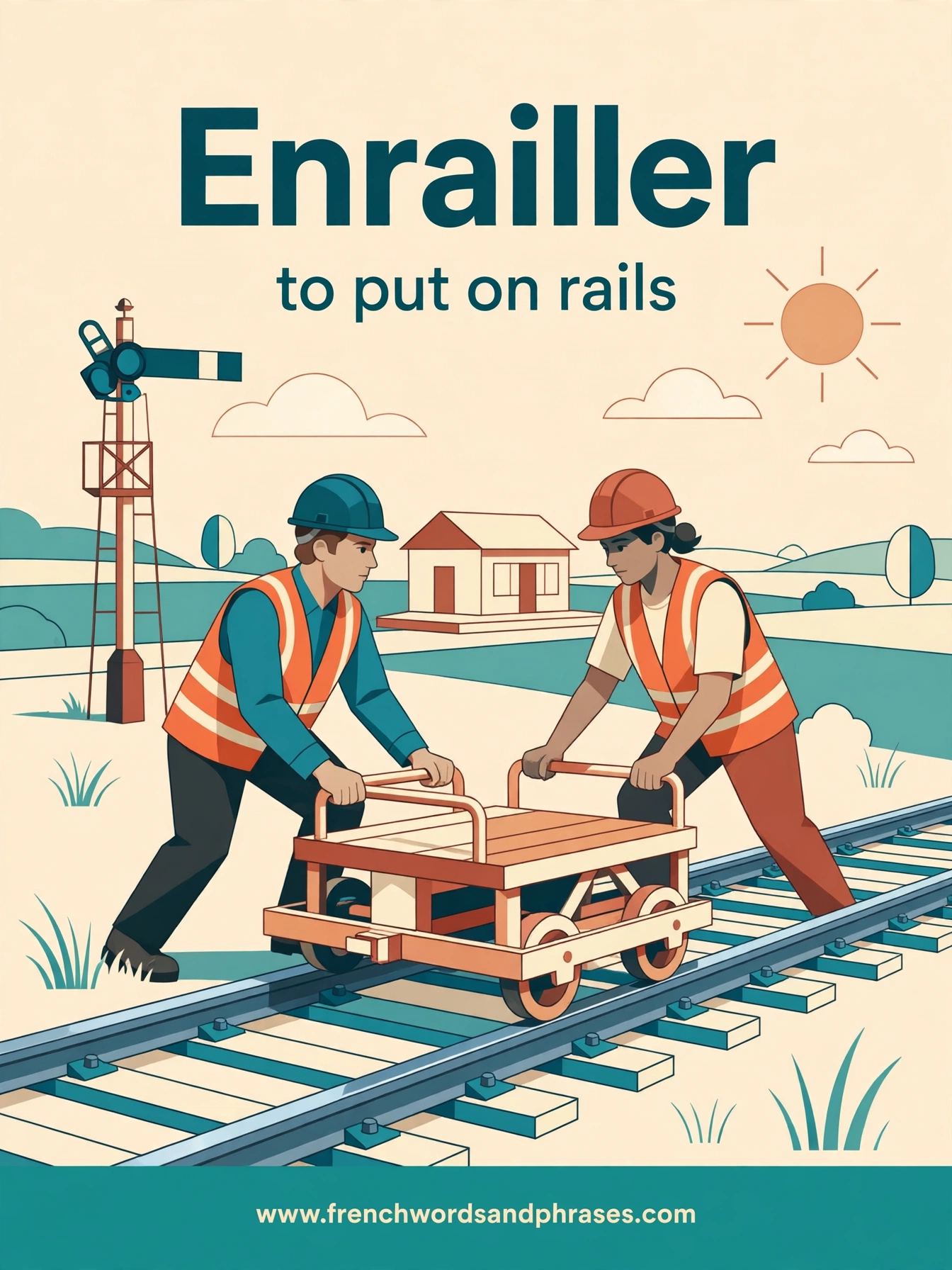
Enrailler means to put on rails — to lift a derailed wagon or locomotive and set it back onto the track so the line can run again.
A derailed wagon tilted beside the track at dawn, jacks and timbers ready, a gang of railwaymen waiting for the order — enrailler is the railwayman’s verb: to put a vehicle back on the rails, the slow, heavy, exact opposite of a derailment.
In this guide, you’ll learn how to conjugate enrailler in all the major French tenses and moods. Explore complete conjugation tables, French examples, English translations, and practice quizzes.
Understanding the French Verb Enrailler
Enrailler is a regular French verb belonging to the first group of verbs, those ending in-er.
It means to put on rails. It is a technical verb of the railway world — the word of breakdown gangs, depots and accident reports: enrailler un wagon déraillé. Outside the railways it is rare, though journalists occasionally borrow it for putting a stalled project ‘back on the rails’, a job French more often gives to remettre sur les rails.
Verb classification: First group (-er)
Auxiliary verb: Avoir
Past participle: enraillé
Present participle: enraillant
English equivalents: To put on rails, to re-rail; enrailler un wagon — to put a wagon back on the rails; enrailler une locomotive — to re-rail a locomotive; une grue d’enraillement — a re-railing crane; dérailler — to derail (its opposite).
One important detail: enrailler is simply un rail with the putting-into prefix en- — to put onto rails — and it is a perfectly regular -er verb: j’enraille, nous enraillons, ils enraillent, past participle enraillé. Keep the pair straight: dérailler is the accident, a train leaving the rails; enrailler is the repair, the long morning’s work of putting it back. The double l is pronounced as a y-glide: en-ra-yer.
Experience the Word
Enrailler is heavy patience — a derailed hundred tons persuaded, centimetre by centimetre, back onto two ribbons of steel.
Imagine a goods wagon that has slipped the track in the night fog outside a country station. By seven the breakdown gang is there with jacks, oak blocks and a small crane. Personne ne court: inch by inch the wagon rises, swings, settles — on enraille — until the last wheel drops onto the rail with a clang that everyone present has been waiting hours to hear.
The train has not been repaired or rebuilt. It has been put back on the rails — enraillé — and the line is alive again.
How to Conjugate Enrailler: Complete French Conjugation Guide
Let’s explore every major conjugation of enrailler, beginning with the indicative mood.
How to Conjugate Enrailler in the Indicative Mood
The indicative mood is used to express facts, observations, actions, and events.
How to Conjugate Enrailler in the Present Tense (Présent)
Used for actions happening now, habitual actions, and general truths.
| Subject | Conjugation |
|---|---|
| je | enraille |
| tu | enrailles |
| il / elle | enraille |
| nous | enraillons |
| vous | enraillez |
| ils / elles | enraillent |
Example
Les ouvriers enraillent le wagon avec des vérins.
The workmen are putting the wagon back on the rails with jacks.
Quick Quiz 1
Complete the sentence:
Nous ______ le wagon avec des vérins.
Reveal the answer
enraillons
Nous enraillons le wagon avec des vérins.
We are putting the wagon back on the rails with jacks.
How to Conjugate Enrailler in the Passé Composé
Used for completed actions in the past. Enrailler takes the auxiliary verb avoir.
| Subject | Conjugation |
|---|---|
| j’ | ai enraillé |
| tu | as enraillé |
| il / elle | a enraillé |
| nous | avons enraillé |
| vous | avez enraillé |
| ils / elles | ont enraillé |
Example
L’équipe a enraillé la locomotive en deux heures.
The team put the locomotive back on the rails in two hours.
How to Conjugate Enrailler in the Imparfait (Imperfect Tense)
Used for habitual past actions, descriptions, and ongoing situations in the past.
| Subject | Conjugation |
|---|---|
| je | enraillais |
| tu | enraillais |
| il / elle | enraillait |
| nous | enraillions |
| vous | enrailliez |
| ils / elles | enraillaient |
Example
Autrefois, on enraillait les wagons à la force des bras.
In the old days, wagons were put back on the rails by sheer muscle.
Quick Quiz 2
Choose the correct form:
The team re-railed the train before dawn.
L’équipe ______ le train avant l’aube. (a enraillé / est enraillée)
Reveal the answer
a enraillé
L’équipe a enraillé le train avant l’aube.
Enrailler takes avoir.
How to Conjugate Enrailler in the Plus-que-parfait
Used to describe an action that had already been completed before another past event.
| Subject | Conjugation |
|---|---|
| j’ | avais enraillé |
| tu | avais enraillé |
| il / elle | avait enraillé |
| nous | avions enraillé |
| vous | aviez enraillé |
| ils / elles | avaient enraillé |
Example
Ils avaient enraillé le train avant l’aube.
They had put the train back on the rails before dawn.
How to Conjugate Enrailler in the Passé Simple
Primarily used in formal writing, literature, and historical narratives. It is rarely used in everyday conversation.
| Subject | Conjugation |
|---|---|
| je | enraillai |
| tu | enraillas |
| il / elle | enrailla |
| nous | enraillâmes |
| vous | enraillâtes |
| ils / elles | enraillèrent |
Example
La brigade enrailla le wagon déraillé avant midi.
The gang put the derailed wagon back on the rails before noon.
How to Conjugate Enrailler in the Passé Antérieur
A literary tense used to express an action completed immediately before another past action, generally in the passé simple.
| Subject | Conjugation |
|---|---|
| j’ | eus enraillé |
| tu | eus enraillé |
| il / elle | eut enraillé |
| nous | eûmes enraillé |
| vous | eûtes enraillé |
| ils / elles | eurent enraillé |
Example
Quand on eut enraillé la machine, le trafic reprit.
When the engine had been put back on the rails, traffic resumed.
How to Conjugate Enrailler in the Future Tense (Futur Simple)
Used to describe actions that will take place in the future.
| Subject | Conjugation |
|---|---|
| je | enraillerai |
| tu | enrailleras |
| il / elle | enraillera |
| nous | enraillerons |
| vous | enraillerez |
| ils / elles | enrailleront |
Example
Demain, les techniciens enrailleront le tramway.
Tomorrow, the technicians will put the tram back on the rails.
How to Conjugate Enrailler in the Futur Antérieur (Future Perfect)
Used for an action that will have been completed before a particular point in the future.
| Subject | Conjugation |
|---|---|
| j’ | aurai enraillé |
| tu | auras enraillé |
| il / elle | aura enraillé |
| nous | aurons enraillé |
| vous | aurez enraillé |
| ils / elles | auront enraillé |
Example
À la fin de la nuit, ils auront enraillé tous les wagons.
By the end of the night, they will have put all the wagons back on the rails.
How to Conjugate Enrailler in the Near Future (Futur Proche)
Used to describe something that is going to happen soon. Formed with aller + infinitive.
| Subject | Conjugation |
|---|---|
| je | vais enrailler |
| tu | vas enrailler |
| il / elle | va enrailler |
| nous | allons enrailler |
| vous | allez enrailler |
| ils / elles | vont enrailler |
Example
L’équipe va enrailler le wagon renversé.
The team is going to put the overturned wagon back on the rails.
How to Conjugate Enrailler in the Conditional Mood
The conditional mood expresses what would happen under certain circumstances. It is also frequently used to make polite requests or express wishes.
How to Conjugate Enrailler in the Present Conditional
| Subject | Conjugation |
|---|---|
| je | enraillerais |
| tu | enraillerais |
| il / elle | enraillerait |
| nous | enraillerions |
| vous | enrailleriez |
| ils / elles | enrailleraient |
Example
Avec une grue plus forte, on enraillerait plus vite.
With a stronger crane, we would re-rail faster.
How to Conjugate Enrailler in the Past Conditional
| Subject | Conjugation |
|---|---|
| j’ | aurais enraillé |
| tu | aurais enraillé |
| il / elle | aurait enraillé |
| nous | aurions enraillé |
| vous | auriez enraillé |
| ils / elles | auraient enraillé |
Example
Ils auraient enraillé le train sans la tempête de neige.
They would have put the train back on the rails if not for the snowstorm.
Enrailler in the Literary Past Conditional Form
This less common literary form uses the imperfect subjunctive of avoir.
| Subject | Conjugation |
|---|---|
| j’ | eusse enraillé |
| tu | eusses enraillé |
| il / elle | eût enraillé |
| nous | eussions enraillé |
| vous | eussiez enraillé |
| ils / elles | eussent enraillé |
Example
On eût enraillé la locomotive avant la nuit.
They would have put the locomotive back on the rails before nightfall.
How to Conjugate Enrailler in the Subjunctive Mood
The subjunctive is used to express wishes, emotions, doubts, necessity, and uncertainty. It frequently follows expressions such as il faut que (it is necessary that) or bien que (although).
How to Conjugate Enrailler in the Present Subjunctive
| Subject | Conjugation |
|---|---|
| que je | enraille |
| que tu | enrailles |
| qu’il / qu’elle | enraille |
| que nous | enraillions |
| que vous | enrailliez |
| qu’ils / qu’elles | enraillent |
Example
Il faut que vous enrailliez ce wagon avant six heures.
You must put this wagon back on the rails before six o’clock.
Quick Quiz 3
Complete the sentence using the subjunctive:
Il faut que tu ______ la locomotive ce matin.
Reveal the answer
enrailles
Il faut que tu enrailles la locomotive ce matin.
You must put the locomotive back on the rails this morning.
How to Conjugate Enrailler in the Imperfect Subjunctive
A literary tense, rarely encountered in modern spoken French.
| Subject | Conjugation |
|---|---|
| que je | enraillasse |
| que tu | enraillasses |
| qu’il / qu’elle | enraillât |
| que nous | enraillassions |
| que vous | enraillassiez |
| qu’ils / qu’elles | enraillassent |
Example
Le chef exigeait qu’on enraillât la machine sur-le-champ.
The foreman demanded that the engine be put back on the rails at once.
How to Conjugate Enrailler in the Pluperfect Subjunctive
A literary construction used to express an action completed before another past action.
| Subject | Conjugation |
|---|---|
| que j’ | eusse enraillé |
| que tu | eusses enraillé |
| qu’il / qu’elle | eût enraillé |
| que nous | eussions enraillé |
| que vous | eussiez enraillé |
| qu’ils / qu’elles | eussent enraillé |
Example
On doutait qu’ils eussent enraillé le convoi à temps.
People doubted they had put the train back on the rails in time.
How to Conjugate Enrailler in the Past Subjunctive
| Subject | Conjugation |
|---|---|
| que j’ | aie enraillé |
| que tu | aies enraillé |
| qu’il / qu’elle | ait enraillé |
| que nous | ayons enraillé |
| que vous | ayez enraillé |
| qu’ils / qu’elles | aient enraillé |
Example
Je suis soulagé qu’on ait enraillé le train.
I am relieved the train has been put back on the rails.
How to Conjugate Enrailler in the Imperative
The imperative is used to give commands, instructions, invitations, or suggestions. Subject pronouns are omitted.
How to Conjugate Enrailler in the Present Imperative
| Person | Conjugation |
|---|---|
| (tu) | enraille |
| (nous) | enraillons |
| (vous) | enraillez |
Example
Enraillez ce wagon, le train doit partir !
Get this wagon back on the rails, the train must leave!
Quick Quiz 4
How would you say Get this wagon back on the rails (tu form)?
Reveal the answer
Enraille ce wagon !
French Participles of Enrailler
Participles are verb forms that can be used in compound tenses and other grammatical constructions.
Present Participle of Enrailler
enraillant
En enraillant le wagon, les ouvriers ont dégagé la voie.
By putting the wagon back on the rails, the workmen cleared the line.
Past Participle of Enrailler
enraillé
Enraillé à l’aube, le wagon a repris son service le soir même.
Put back on the rails at dawn, the wagon returned to service the same evening.
Enrailler in Everyday French: Real-Life Examples
Now that you know the conjugations, let’s see how enrailler appears in everyday French.
Example 1 — Present
Les ouvriers enraillent le wagon.
The workmen are putting the wagon back on the rails.
Example 2 — Passé composé
L’équipe a enraillé la locomotive en deux heures.
The team re-railed the locomotive in two hours.
Example 3 — Imparfait
On enraillait les wagons à la force des bras.
Wagons were re-railed by sheer muscle.
Example 4 — Future
Les techniciens enrailleront le tramway demain.
The technicians will re-rail the tram tomorrow.
Example 5 — Conditional
On enraillerait plus vite avec une grue.
We would re-rail faster with a crane.
Example 6 — Imperative
Enraillez ce wagon avant six heures !
Get this wagon back on the rails before six!
Beyond Translation: The Meaning of Enrailler
Enrailler is one of a family of railway twins built with prefixes: dérailler, to come off the rails, and enrailler, to go back on them.
The accident takes a second; the verb of repair takes all morning.
French keeps the word mostly in the depot and the accident report, but the picture it paints — heavy things lifted gently back into their groove — is exactly why speakers of French reach for rails whenever a life or a project needs putting right.
How to Remember the French Verb Enrailler
Remember it this way: Enrailler is about the dawn gang with jacks and oak blocks, easing the wagon’s last wheel onto the rail.
- Un rail plus the prefix en-: enrailler is to put onto rails — the repair that answers dérailler, to derail.
- Regular -er: j’enraille, nous enraillons, past participle enraillé.
- A breakdown-gang word: enrailler un wagon, enrailler une locomotive, with jacks and a crane.
The key idea is the dawn gang with jacks and oak blocks, easing the wagon’s last wheel onto the rail.
Test Your Knowledge of Enrailler
Let’s see how much you’ve learned. Try answering these questions before revealing the answers.
Question 1
What is the opposite of enrailler?
Reveal the answer
Dérailler — to derail, to come off the rails. Enrailler is putting the vehicle back on them.
Question 2
How do you say The team re-railed the locomotive in French?
Reveal the answer
L’équipe a enraillé la locomotive.
Question 3
Translate: The workmen are putting the wagon back on the rails.
Reveal the answer
Les ouvriers enraillent le wagon.
Question 4
What is the past participle of enrailler?
Reveal the answer
Enraillé.
Question 5
Complete the sentence:
Il faut que vous ______ ce wagon avant six heures.
Reveal the answer
enrailliez
Il faut que vous enrailliez ce wagon avant six heures.
You must put this wagon back on the rails before six o’clock.
Your Final Challenge
Can You Use It?
How would you say this in French?
At dawn, the workmen put the last wagon back on the rails, and the whole line breathes again.
Reveal the answer
À l’aube, les ouvriers enraillent le dernier wagon, et la ligne entière respire de nouveau.
At dawn, the workmen put the last wagon back on the rails, and the whole line breathes again.
A little French. A little curiosity. A richer everyday life.
LEARN FRENCH ONE WORD AT A TIME