A French Word to Live By
Translate Ennuyé to English
/ɑ̃.nɥi.je/
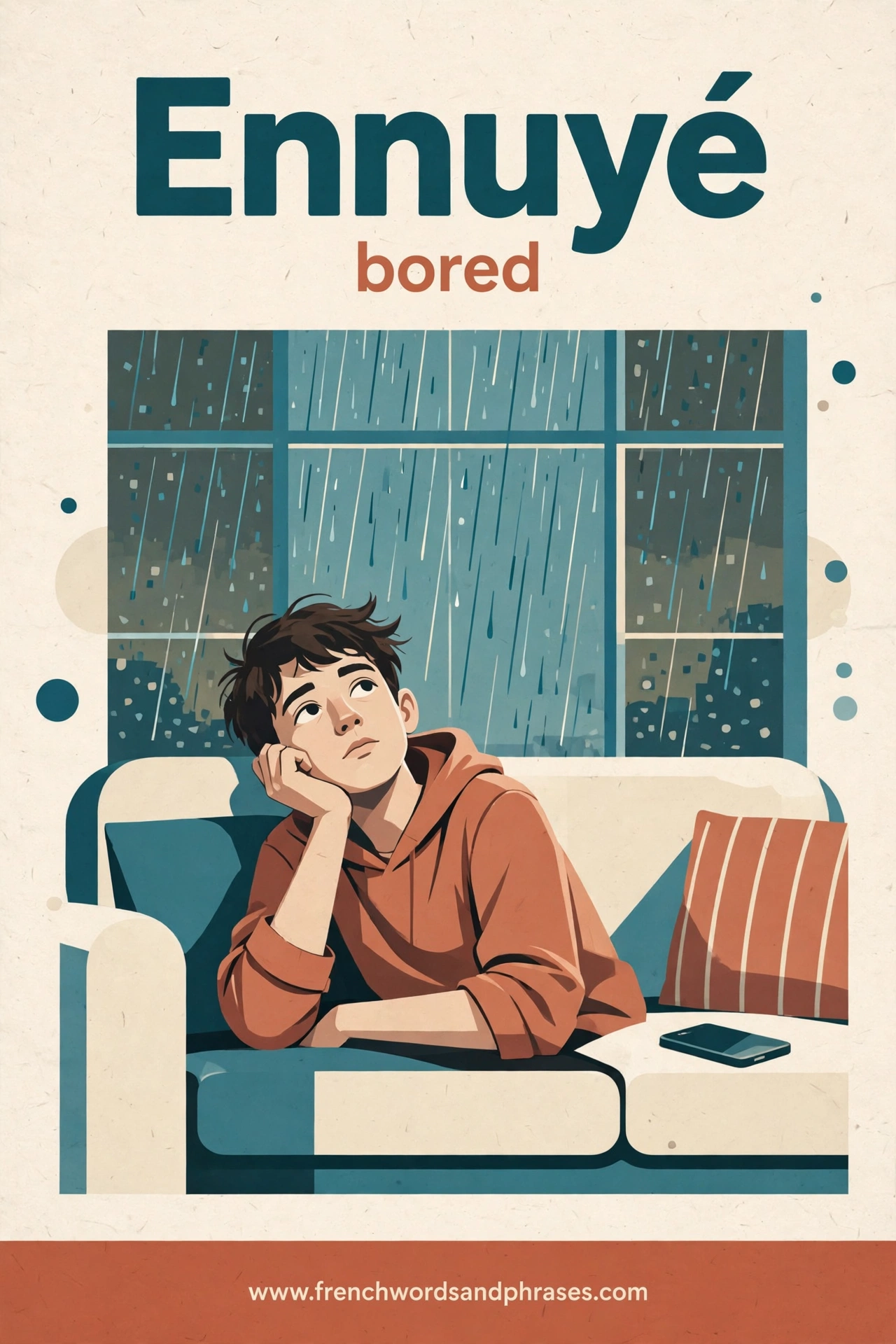
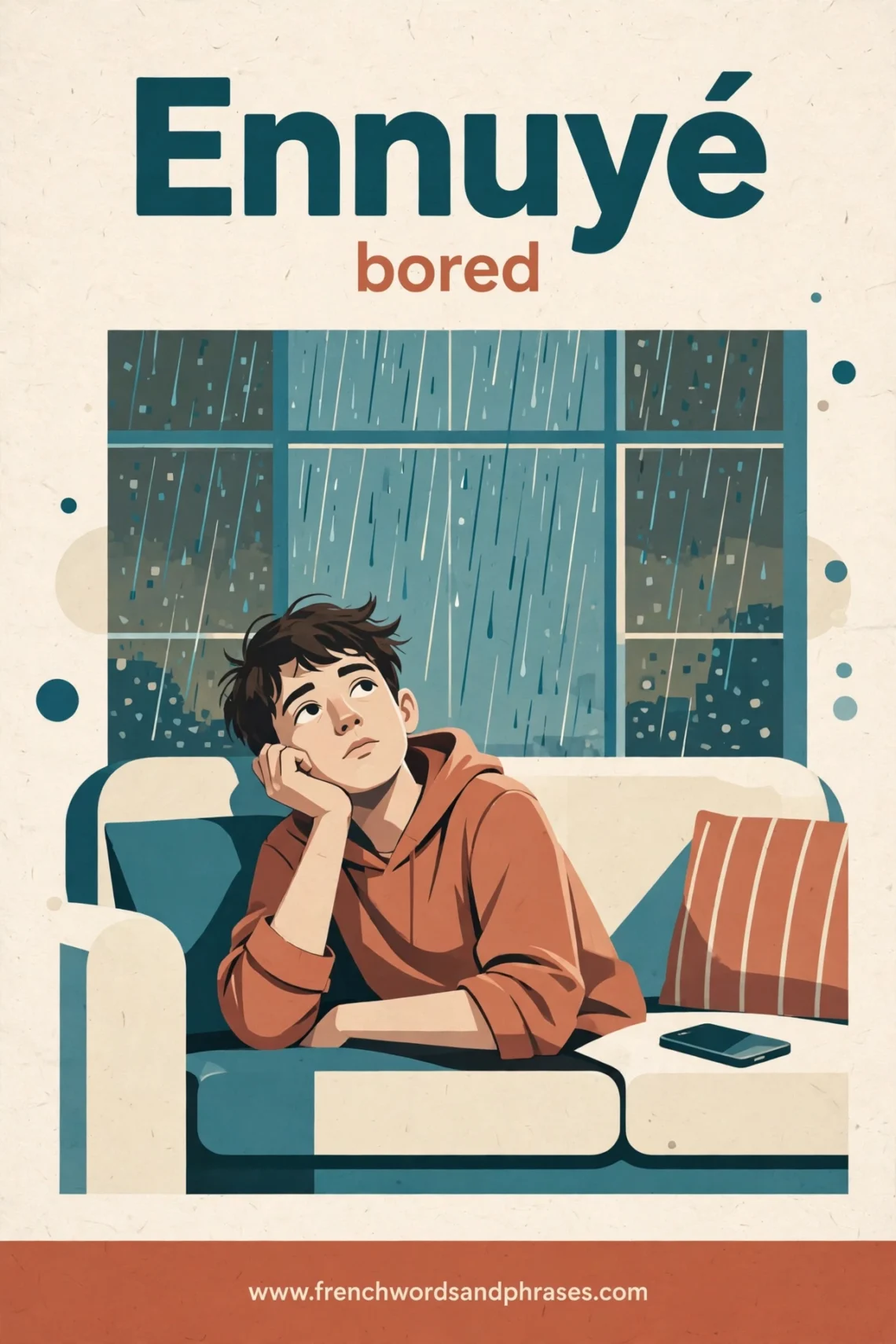
Ennuyé means bored.
A rainy Sunday in a small flat: the rain at the window, a jigsaw missing its last piece, a child swinging her legs under the table and sighing at the ceiling. Nothing is wrong, exactly — there is simply nothing to do. She is, completely and theatrically, ennuyée.
In this guide, you’ll learn what ennuyé means in English, its four forms, and the one distinction every learner must master — ennuyé for the person who feels it, ennuyeux for the thing that causes it. Explore French examples, English translations, and practice quizzes.
Understanding the French Adjective Ennuyé
Ennuyé is a French adjective of quality — an adjective of feelings. It is the past participle of the verb ennuyer (to bore) working as an adjective, so it agrees fully: four forms for masculine, feminine, singular and plural.
It means bored — the feeling of having nothing to hold your attention. Les enfants sont ennuyés, the children are bored; je m’ennuie, I’m bored (the verb at work). Its twin ennuyeux means boring, and keeping the two apart is the whole game: the person is ennuyé, the film is ennuyeux.
Type: Adjective of quality — feelings (past participle of ennuyer)
Answers the question: How does someone feel? — bored
Changes form: Yes — ennuyé, ennuyée, ennuyés, ennuyées
English equivalents: Bored; fed up (mildly).
One important usage detail: never mix up the pair — ennuyé describes the person who feels boredom, and ennuyeux describes the thing that causes it. Je suis ennuyé, I’m bored; ce film est ennuyeux, this film is boring. Say je suis ennuyeux and you have just called yourself a boring person.
Experience the Word
Ennuyé is the adjective of the long afternoon — the feeling French children announce like a weather report and French adults disguise as fatigue.
Imagine the youngest guest at a very long family lunch: the plates cleared, the coffee finished, the grown-ups still talking about the roof. She has drawn on her napkin, counted the spoons, and now delivers her verdict to the whole table: « je m’ennuie ! »
You have not just described a mood. You have filed an official complaint against the afternoon.
How to Use Ennuyé in French: Complete Guide
Let’s explore how ennuyé works in French, beginning with the whole word on one card.
Ennuyé at a Glance
Before the details, here is the whole word on one card.
The Whole Word on One Card
Meaning, type, position and forms — ennuyé in four lines.
| Point | Ennuyé |
|---|---|
| Meaning | bored |
| Type | adjective of quality — feelings |
| Usual position | after être — les enfants sont ennuyés |
| Form | ennuyé / ennuyée / ennuyés / ennuyées — full agreement |
Example
Les enfants sont ennuyés, il pleut depuis ce matin.
The children are bored, it has been raining since this morning.
The Four Forms of Ennuyé
Ennuyé agrees like a past participle: the feminine adds an -e you cannot hear but must write, and the plurals add -s.
| Form | Ennuyé | Example |
|---|---|---|
| Masculine singular | ennuyé | il est ennuyé — he is bored |
| Feminine singular | ennuyée | elle est ennuyée — she is bored |
| Masculine plural | ennuyés | ils sont ennuyés — they are bored |
| Feminine plural | ennuyées | elles sont ennuyées — they are bored |
Example
Les filles sont ennuyées, le spectacle est trop long.
The girls are bored, the show is too long.
Quick Quiz 1
Which form of ennuyé goes with les enfants (masculine plural) — ennuyé or ennuyés?
Reveal the answer
ennuyés
Les enfants sont ennuyés.
The children are bored.
Where Ennuyé Goes: After Être, and in Je M’ennuie
Ennuyé lives mostly after être, reporting a state. Its verb twin works too: s’ennuyer gives je m’ennuie, the everyday way of saying the same thing.
| Pattern | Example |
|---|---|
| After être | elle est ennuyée — she is bored |
| After the noun | des élèves ennuyés — bored pupils |
| The verb twin | je m’ennuie — I’m bored |
| Before the noun | un ennuyé élève — never; ennuyé goes after |
Example
Il a l’air ennuyé pendant la réunion.
He looks bored during the meeting.
More Bored: Comparing with Ennuyé
Ennuyé compares the regular way, with plus, moins and aussi — and French adds its own intensifiers for the theatrical cases.
| Degree | Example |
|---|---|
| As bored as | aussi ennuyé que — as bored as |
| More bored | plus ennuyé — plus ennuyé qu’hier |
| Less bored | moins ennuyé — less bored |
| The most bored | le plus ennuyé — le plus ennuyé de la classe |
| Intensified | mortellement ennuyé — deadly bored |
Example
C’est l’élève le plus ennuyé de la classe.
He’s the most bored pupil in the class.
Quick Quiz 2
A film makes you yawn. Is the film ennuyé or ennuyeux?
Reveal the answer
ennuyeux — the thing is boring; the person watching is ennuyé.
Ce film est ennuyeux, je suis ennuyé.
This film is boring, I am bored.
Everyday Expressions with Ennuyé
Boredom has a rich little family in French — a verb for the feeling, a sigh for the extreme case, and one famous comparison involving a dead rat.
| Expression | In English |
|---|---|
| je m’ennuie | I’m bored — the verb s’ennuyer at work |
| s’ennuyer à mourir | to be bored to death |
| ennuyé comme un rat mort | bored stiff — literally ‘bored like a dead rat’ |
| avoir l’air ennuyé | to look bored |
| mourir d’ennui | to die of boredom |
| des ennuis | troubles, problems — un ennui is also a worry or a hitch |
Example
Il s’ennuie à mourir dans ce village.
He is bored to death in this village.
Ennuyé and Its Neighbours
Around boredom, French keeps a whole shelf of low-energy words. Ennuyé is the everyday one; its neighbours add jadedness, gloom or simple tiredness.
| French | In English |
|---|---|
| ennuyeux | boring — the cause, not the feeling |
| fatigué | tired |
| blasé | jaded, unimpressed by everything |
| las | weary — literary |
| morne | gloomy, dreary — for places and moods |
| passionné | absorbed, passionate — the happy opposite |
Example
Elle n’est pas fatiguée, elle est ennuyée.
She isn’t tired, she’s bored.
Quick Quiz 3
What does je m’ennuie mean?
Reveal the answer
I’m bored — the verb s’ennuyer saying the same thing as je suis ennuyé.
Je m’ennuie à la maison.
I’m bored at home.
Ennuyé Through the Day: A Tour of French Boredom
Boredom keeps office hours in France — it clocks in at school, queues politely, and travels by train. A tour of its favourite appointments.
| Moment | Example |
|---|---|
| At school | un élève ennuyé regarde par la fenêtre — a bored pupil looks out of the window |
| In a queue | les gens ennuyés regardent leur téléphone — the bored people look at their phones |
| On a train | un voyageur ennuyé compte les gares — a bored traveller counts the stations |
| At a long lunch | les enfants ennuyés dessinent sur la nappe — the bored children draw on the tablecloth |
Example
Dans la salle d’attente, tout le monde avait l’air ennuyé.
In the waiting room, everyone looked bored.
Watch Out: The Traps Around Ennuyé
Four traps surround this word — the famous twin, the invented form, the double life of ennui, and the silent feminine -e.
| Trap | The truth |
|---|---|
| ennuyé / ennuyeux | ennuyé = bored (the person); ennuyeux = boring (the thing) — the classic mix-up |
| je suis ennuyant | ennuyant is not the standard adjective — say je suis ennuyé, or ce livre est ennuyeux |
| un ennui | not only boredom: un ennui is also a problem or a worry — j’ai des ennuis, I have troubles |
| elle est ennuyé | the feminine takes its written -e: elle est ennuyée |
Example
Ce livre est ennuyeux, mais elle n’est pas ennuyée, elle adore lire.
This book is boring, but she isn’t bored, she loves reading.
Quick Quiz 4
How do you say ‘the girls are bored’ — les filles sont ennuyé or les filles sont ennuyées?
Reveal the answer
les filles sont ennuyées
Feminine plural: ennuyées, with -e and -s.
Les filles sont ennuyées — the girls are bored.
Ennuyé in Everyday French: Real-Life Examples
Now that you know the word, let’s see how ennuyé appears in everyday French.
Example 1 — Rainy Sunday
Les enfants sont ennuyés, ils veulent jouer dehors.
The children are bored, they want to play outside.
Example 2 — In the waiting room
Je m’ennuie ici, le docteur a une heure de retard.
I’m bored here, the doctor is an hour late.
Example 3 — About a film
Ce film est ennuyeux, je suis ennuyé depuis le début.
This film is boring, I have been bored since the beginning.
Example 4 — At school
L’élève ennuyé dessine dans son cahier.
The bored pupil is drawing in his notebook.
Example 5 — On the phone
Tu as l’air ennuyé, je te rappelle plus tard ?
You sound bored, shall I call you back later?
Example 6 — The honest answer
Non, je ne suis pas fatigué, je suis juste un peu ennuyé.
No, I’m not tired, I’m just a bit bored.
Beyond Translation: The Meaning of Ennuyé
English says bored for the meaning of ennuyé — but French boredom, l’ennui, is almost a national literary theme, the grey sky of Baudelaire’s poems and a hundred French novels.
To be ennuyé in French is not just to lack entertainment — it is to feel time itself moving slowly.
And the same word leads a double life: un ennui is also a hitch or a worry, and des ennuis are troubles. In French, boredom and bother were never far apart.
How to Remember the French Adjective Ennuyé
Remember it this way: Ennuyé is the past participle of ennuyer wearing the feeling — the person ends in -é, the boring thing ends in -eux.
- You see the person in the armchair — ennuyé — and the film on the screen — ennuyeux.
- You write the feminine with its extra -e — elle est ennuyée — even though you cannot hear it.
- You let the verb help: je m’ennuie says the same thing in everyday dress.
The key idea is ennuyé means bored (the person), ennuyeux means boring (the thing), and the feminine is ennuyée.
Test Your Knowledge of Ennuyé
Let’s see how much you’ve learned. Try answering these questions before revealing the answers.
Question 1
What does ennuyé mean?
Reveal the answer
Bored — the feeling, felt by a person.
Question 2
What are the forms of ennuyé?
Reveal the answer
ennuyé, ennuyée, ennuyés, ennuyées — full past-participle agreement.
Question 3
Translate: this film is boring.
Reveal the answer
Ce film est ennuyeux.
Question 4
What does je m’ennuie mean?
Reveal the answer
I’m bored
Je m’ennuie à la maison.
I’m bored at home.
Question 5
Complete the sentence:
Les filles sont ______, le spectacle est trop long.
Reveal the answer
ennuyées
Les filles sont ennuyées, le spectacle est trop long.
The girls are bored, the show is too long.
Your Final Challenge
Can You Use It?
How would you say this in French?
“The children are bored, this film is boring.”
Reveal the answer
Les enfants sont ennuyés, ce film est ennuyeux.
The children are bored, this film is boring.
A little French. A little curiosity. A richer everyday life.
LEARN FRENCH ONE WORD AT A TIME