A French Word to Live By
How to Conjugate Enjamber in French
/ɑ̃.ʒɑ̃.be/
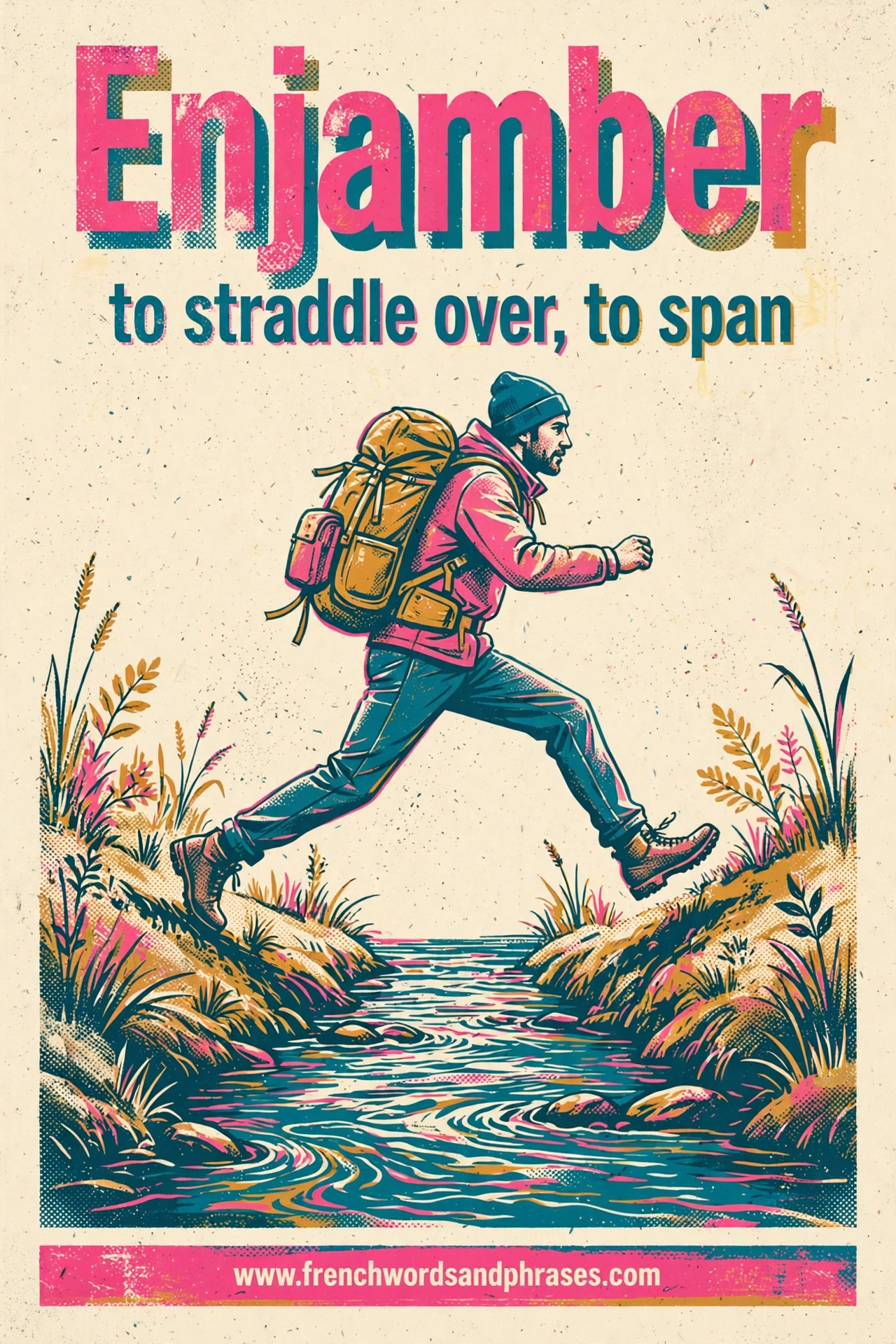
Enjamber means to straddle over, to span — to step right over an obstacle with one long stride, or to stretch across a gap, as a bridge spans a river.
A walker stepping over a fallen tree without breaking stride, a stone bridge leaping a gorge in a single arch, a giant in a fairy tale crossing a valley in three steps — enjamber is the verb of the long stride: one leg over, and the obstacle is behind you.
In this guide, you’ll learn how to conjugate enjamber in all the major French tenses and moods. Explore complete conjugation tables, French examples, English translations, and practice quizzes.
Understanding the French Verb Enjamber
Enjamber is a regular French verb belonging to the first group of verbs, those ending in-er.
It means to straddle over, to span. Enjamber is the word for clearing something in one movement, without climbing or stopping: fences, puddles, sleeping dogs and low walls are all enjambés daily. In poetry, it gives its name to enjambement — the line of verse that strides over its own ending into the next line, exactly like a leg over a fence.
Verb classification: First group (-er)
Auxiliary verb: Avoir
Past participle: enjambé
Present participle: enjambant
English equivalents: To straddle over, to step over, to span, to stride over; enjamber un obstacle — to stride over an obstacle; enjamber un ruisseau — to step over a stream; le pont enjambe la rivière — the bridge spans the river; une enjambée — a stride.
One important detail: enjamber is a regular -er verb built on la jambe, the leg — and its noun is one of the great French measurement words: une enjambée, a stride. The verb takes a direct object, never a preposition: enjamber un mur, enjamber un ruisseau. Bridges and arches enjambent rivers and valleys in the same word, which is why the verb means both ‘to step over’ (for legs) and ‘to span’ (for structures). The spelling is steady: j’enjambe, nous enjambons, past participle enjambé.
Experience the Word
Enjamber is the verb of the single stride — no ladder, no detour, just one leg over and on you go.
Imagine a shepherd crossing his own hillside at dawn. A stream in spate? He enjambe it. A fallen oak across the path? Enjambé without a pause. Below him in the valley, the old Roman bridge does exactly the same thing in stone: il enjambe la rivière, and has done for two thousand years.
Legs and bridges share the gesture. One stride, one arch — enjambé, and the obstacle is behind you.
How to Conjugate Enjamber: Complete French Conjugation Guide
Let’s explore every major conjugation of enjamber, beginning with the indicative mood.
How to Conjugate Enjamber in the Indicative Mood
The indicative mood is used to express facts, observations, actions, and events.
How to Conjugate Enjamber in the Present Tense (Présent)
Used for actions happening now, habitual actions, and general truths.
| Subject | Conjugation |
|---|---|
| je | enjambe |
| tu | enjambes |
| il / elle | enjambe |
| nous | enjambons |
| vous | enjambez |
| ils / elles | enjambent |
Example
Le pont enjambe la rivière en une seule arche.
The bridge spans the river in a single arch.
Quick Quiz 1
Complete the sentence:
Nous ______ le ruisseau en un pas.
Reveal the answer
enjambons
Nous enjambons le ruisseau en un pas.
We step over the stream in one stride.
How to Conjugate Enjamber in the Passé Composé
Used for completed actions in the past. Enjamber takes the auxiliary verb avoir.
| Subject | Conjugation |
|---|---|
| j’ | ai enjambé |
| tu | as enjambé |
| il / elle | a enjambé |
| nous | avons enjambé |
| vous | avez enjambé |
| ils / elles | ont enjambé |
Example
Il a enjambé la clôture sans s’arrêter.
He stepped over the fence without stopping.
How to Conjugate Enjamber in the Imparfait (Imperfect Tense)
Used for habitual past actions, descriptions, and ongoing situations in the past.
| Subject | Conjugation |
|---|---|
| je | enjambais |
| tu | enjambais |
| il / elle | enjambait |
| nous | enjambions |
| vous | enjambiez |
| ils / elles | enjambaient |
Example
Enfant, elle enjambait les flaques en riant.
As a child, she used to stride over the puddles, laughing.
Quick Quiz 2
Choose the correct form:
He stepped over the wall.
Il ______ le mur. (a enjambé / est enjambé)
Reveal the answer
a enjambé
Il a enjambé le mur.
Enjamber takes avoir.
How to Conjugate Enjamber in the Plus-que-parfait
Used to describe an action that had already been completed before another past event.
| Subject | Conjugation |
|---|---|
| j’ | avais enjambé |
| tu | avais enjambé |
| il / elle | avait enjambé |
| nous | avions enjambé |
| vous | aviez enjambé |
| ils / elles | avaient enjambé |
Example
Le géant avait enjambé la vallée en trois pas.
The giant had stridden across the valley in three steps.
How to Conjugate Enjamber in the Passé Simple
Primarily used in formal writing, literature, and historical narratives. It is rarely used in everyday conversation.
| Subject | Conjugation |
|---|---|
| je | enjambai |
| tu | enjambas |
| il / elle | enjamba |
| nous | enjambâmes |
| vous | enjambâtes |
| ils / elles | enjambèrent |
Example
Le cavalier descendit et enjamba le ruisseau.
The rider dismounted and stepped over the stream.
How to Conjugate Enjamber in the Passé Antérieur
A literary tense used to express an action completed immediately before another past action, generally in the passé simple.
| Subject | Conjugation |
|---|---|
| j’ | eus enjambé |
| tu | eus enjambé |
| il / elle | eut enjambé |
| nous | eûmes enjambé |
| vous | eûtes enjambé |
| ils / elles | eurent enjambé |
Example
Quand il eut enjambé le mur, il se retrouva dans le verger.
When he had climbed over the wall, he found himself in the orchard.
How to Conjugate Enjamber in the Future Tense (Futur Simple)
Used to describe actions that will take place in the future.
| Subject | Conjugation |
|---|---|
| je | enjamberai |
| tu | enjamberas |
| il / elle | enjambera |
| nous | enjamberons |
| vous | enjamberez |
| ils / elles | enjamberont |
Example
Ce nouveau pont enjambera le fleuve entier.
This new bridge will span the whole river.
How to Conjugate Enjamber in the Futur Antérieur (Future Perfect)
Used for an action that will have been completed before a particular point in the future.
| Subject | Conjugation |
|---|---|
| j’ | aurai enjambé |
| tu | auras enjambé |
| il / elle | aura enjambé |
| nous | aurons enjambé |
| vous | aurez enjambé |
| ils / elles | auront enjambé |
Example
À midi, le marcheur aura enjambé trois ruisseaux.
By noon, the walker will have stepped over three streams.
How to Conjugate Enjamber in the Near Future (Futur Proche)
Used to describe something that is going to happen soon. Formed with aller + infinitive.
| Subject | Conjugation |
|---|---|
| je | vais enjamber |
| tu | vas enjamber |
| il / elle | va enjamber |
| nous | allons enjamber |
| vous | allez enjamber |
| ils / elles | vont enjamber |
Example
Attention, je vais enjamber cette flaque !
Careful, I am going to stride over this puddle!
How to Conjugate Enjamber in the Conditional Mood
The conditional mood expresses what would happen under certain circumstances. It is also frequently used to make polite requests or express wishes.
How to Conjugate Enjamber in the Present Conditional
| Subject | Conjugation |
|---|---|
| je | enjamberais |
| tu | enjamberais |
| il / elle | enjamberait |
| nous | enjamberions |
| vous | enjamberiez |
| ils / elles | enjamberaient |
Example
Avec de plus longues jambes, j’enjamberais ce fossé.
With longer legs, I would stride over this ditch.
How to Conjugate Enjamber in the Past Conditional
| Subject | Conjugation |
|---|---|
| j’ | aurais enjambé |
| tu | aurais enjambé |
| il / elle | aurait enjambé |
| nous | aurions enjambé |
| vous | auriez enjambé |
| ils / elles | auraient enjambé |
Example
Elle aurait enjambé le mur si elle avait osé.
She would have stepped over the wall if she had dared.
Enjamber in the Literary Past Conditional Form
This less common literary form uses the imperfect subjunctive of avoir.
| Subject | Conjugation |
|---|---|
| j’ | eusse enjambé |
| tu | eusses enjambé |
| il / elle | eût enjambé |
| nous | eussions enjambé |
| vous | eussiez enjambé |
| ils / elles | eussent enjambé |
Example
Le géant eût enjambé la montagne en un seul pas.
The giant would have stridden over the mountain in a single step.
How to Conjugate Enjamber in the Subjunctive Mood
The subjunctive is used to express wishes, emotions, doubts, necessity, and uncertainty. It frequently follows expressions such as il faut que (it is necessary that) or bien que (although).
How to Conjugate Enjamber in the Present Subjunctive
| Subject | Conjugation |
|---|---|
| que je | enjambe |
| que tu | enjambes |
| qu’il / qu’elle | enjambe |
| que nous | enjambions |
| que vous | enjambiez |
| qu’ils / qu’elles | enjambent |
Example
Il faut que tu enjambes ce tronc pour passer.
You must step over this log to get past.
Quick Quiz 3
Complete the sentence using the subjunctive:
Il faut que vous ______ ce fossé.
Reveal the answer
enjambiez
Il faut que vous enjambiez ce fossé.
You must stride over this ditch.
How to Conjugate Enjamber in the Imperfect Subjunctive
A literary tense, rarely encountered in modern spoken French.
| Subject | Conjugation |
|---|---|
| que je | enjambasse |
| que tu | enjambasses |
| qu’il / qu’elle | enjambât |
| que nous | enjambassions |
| que vous | enjambassiez |
| qu’ils / qu’elles | enjambassent |
Example
Je doutais qu’il enjambât le fossé si facilement.
I doubted he would stride over the ditch so easily.
How to Conjugate Enjamber in the Pluperfect Subjunctive
A literary construction used to express an action completed before another past action.
| Subject | Conjugation |
|---|---|
| que j’ | eusse enjambé |
| que tu | eusses enjambé |
| qu’il / qu’elle | eût enjambé |
| que nous | eussions enjambé |
| que vous | eussiez enjambé |
| qu’ils / qu’elles | eussent enjambé |
Example
On racontait que le pont eût enjambé le fleuve sans pilier.
People said the bridge had spanned the river without a pier.
How to Conjugate Enjamber in the Past Subjunctive
| Subject | Conjugation |
|---|---|
| que j’ | aie enjambé |
| que tu | aies enjambé |
| qu’il / qu’elle | ait enjambé |
| que nous | ayons enjambé |
| que vous | ayez enjambé |
| qu’ils / qu’elles | aient enjambé |
Example
Je suis content que tu aies enjambé la clôture sans te blesser.
I am glad you stepped over the fence without hurting yourself.
How to Conjugate Enjamber in the Imperative
The imperative is used to give commands, instructions, invitations, or suggestions. Subject pronouns are omitted.
How to Conjugate Enjamber in the Present Imperative
| Person | Conjugation |
|---|---|
| (tu) | enjambe |
| (nous) | enjambons |
| (vous) | enjambez |
Example
Enjambe le ruisseau, l’eau est trop froide pour traverser !
Step over the stream, the water is too cold to wade through!
Quick Quiz 4
How would you say Step over the stream (tu form)?
Reveal the answer
Enjambe le ruisseau !
French Participles of Enjamber
Participles are verb forms that can be used in compound tenses and other grammatical constructions.
Present Participle of Enjamber
enjambant
En enjambant le muret, il a failli tomber.
While stepping over the low wall, he nearly fell.
Past Participle of Enjamber
enjambé
Le ruisseau enjambé, le chemin continuait vers la forêt.
The stream stepped over, the path continued towards the forest.
Enjamber in Everyday French: Real-Life Examples
Now that you know the conjugations, let’s see how enjamber appears in everyday French.
Example 1 — Present
Le pont enjambe la rivière.
The bridge spans the river.
Example 2 — Passé composé
Il a enjambé la clôture sans s’arrêter.
He stepped over the fence without stopping.
Example 3 — Imparfait
Elle enjambait les flaques en riant.
She used to stride over the puddles, laughing.
Example 4 — Future
Le nouveau pont enjambera le fleuve.
The new bridge will span the river.
Example 5 — Conditional
J’enjamberais ce fossé avec de plus longues jambes.
I would stride over this ditch with longer legs.
Example 6 — Imperative
Enjambe le ruisseau !
Step over the stream!
Beyond Translation: The Meaning of Enjamber
The leg inside the verb is la jambe — and English knows it from the card table, where the jamb of a door is the same old word for a leg-like support.
French poetry borrowed the stride itself.
An enjambement is a verse line that refuses to stop at its own end and strides into the next line mid-sentence — the poem enjambe its own border, exactly as the shepherd enjambe his stream.
How to Remember the French Verb Enjamber
Remember it this way: Enjamber is about one long stride over the stream — and a bridge doing the same.
- Built on jambe, the leg: one leg over — enjamber un mur, enjamber un ruisseau.
- Direct object, no preposition: le pont enjambe la rivière, the bridge spans the river.
- Regular -er: j’enjambe, nous enjambons, past participle enjambé; a stride is une enjambée.
The key idea is one long stride over the stream — and a bridge doing the same.
Test Your Knowledge of Enjamber
Let’s see how much you’ve learned. Try answering these questions before revealing the answers.
Question 1
What body part lives inside enjamber?
Reveal the answer
La jambe — the leg; enjamber is to put a leg right over something.
Question 2
How do you say The bridge spans the river in French?
Reveal the answer
Le pont enjambe la rivière.
Question 3
Translate: He stepped over the fence without stopping.
Reveal the answer
Il a enjambé la clôture sans s’arrêter.
Question 4
What is the past participle of enjamber?
Reveal the answer
Enjambé.
Question 5
Complete the sentence:
Il faut que tu ______ ce tronc pour passer.
Reveal the answer
enjambes
Il faut que tu enjambes ce tronc pour passer.
You must step over this log to get past.
Your Final Challenge
Can You Use It?
How would you say this in French?
The old bridge has spanned the river for a thousand years, indifferent to floods and to walkers alike.
Reveal the answer
Le vieux pont enjambe la rivière depuis mille ans, indifférent aux crues comme aux promeneurs.
The old bridge has spanned the river for a thousand years, indifferent to floods and to walkers alike.
A little French. A little curiosity. A richer everyday life.
LEARN FRENCH ONE WORD AT A TIME