A French Word to Live By
How to Conjugate Enivrer in French
/ɑ̃.ni.vʁe/
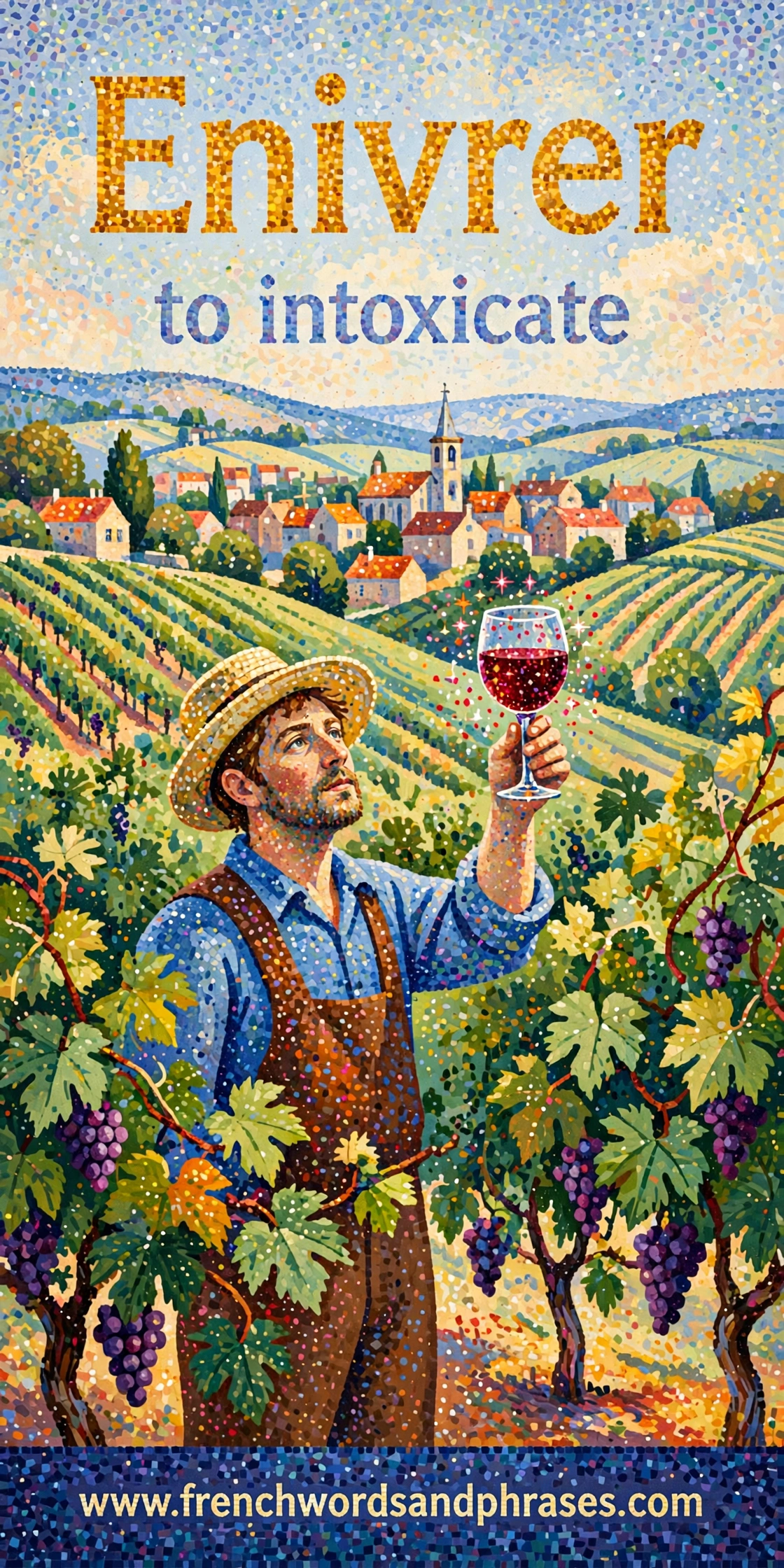
Enivrer means to intoxicate — to make someone drunk, with wine, with fumes, or, figuratively, with success, praise and heady perfume, until their head spins.
A glass too many at a harvest dinner, the heavy scent of lilies in a closed room, a young author drunk on his first reviews — enivrer is the verb of heads turned and senses swimming: whatever fills someone until they lose their footing, enivre them.
In this guide, you’ll learn how to conjugate enivrer in all the major French tenses and moods. Explore complete conjugation tables, French examples, English translations, and practice quizzes.
Understanding the French Verb Enivrer
Enivrer is a regular French verb belonging to the first group of verbs, those ending in-er.
It means to intoxicate. Enivrer is more elegant than the blunt rendre ivre, and it slides naturally between the literal and the figurative: wine enivre at the table, but so do speed, power and applause. The adjective enivrant (intoxicating, heady) is very common for perfumes, evenings and successes — un parfum enivrant, un succès enivrant.
Verb classification: First group (-er)
Auxiliary verb: Avoir
Past participle: enivré
Present participle: enivrant
English equivalents: To intoxicate, to make drunk, to go to someone’s head; le vin l’a enivré — the wine went to his head; enivrer quelqu’un de compliments — to intoxicate someone with compliments; un parfum qui enivre — a heady perfume; le succès enivre — success is intoxicating.
One important detail: enivrer is a regular -er verb built on ivre, drunk — the same root as ivrogne, a drunkard. The spelling never wavers: j’enivre, nous enivrons, past participle enivré. Its classic partners are the things that intoxicate: le vin, les vapeurs, le parfum — and, in the figurative sense that French loves, le succès, la gloire, les louanges. For the person doing the drinking, French turns the verb reflexive: s’enivrer, to get drunk.
Experience the Word
Enivrer is the verb of the spinning head — wine can do it, but so can glory.
Imagine a young singer after her first triumph. The reviews are glowing, strangers stop her in the street, offers arrive by the dozen. None of it is alcohol, yet she walks as if the pavement moved: le succès l’enivre. Her old teacher takes her aside — enjoy it, he says, but keep one foot on the ground.
Nothing was poured into a glass. Success itself intoxicated her — le succès l’a enivrée.
How to Conjugate Enivrer: Complete French Conjugation Guide
Let’s explore every major conjugation of enivrer, beginning with the indicative mood.
How to Conjugate Enivrer in the Indicative Mood
The indicative mood is used to express facts, observations, actions, and events.
How to Conjugate Enivrer in the Present Tense (Présent)
Used for actions happening now, habitual actions, and general truths.
| Subject | Conjugation |
|---|---|
| je | enivre |
| tu | enivres |
| il / elle | enivre |
| nous | enivrons |
| vous | enivrez |
| ils / elles | enivrent |
Example
Ce vin doux enivre vite les invités.
This sweet wine quickly goes to the guests’ heads.
Quick Quiz 1
Complete the sentence:
Nous ______ les invités avec ce vin doux.
Reveal the answer
enivrons
Nous enivrons les invités avec ce vin doux.
We get the guests drunk on this sweet wine.
How to Conjugate Enivrer in the Passé Composé
Used for completed actions in the past. Enivrer takes the auxiliary verb avoir.
| Subject | Conjugation |
|---|---|
| j’ | ai enivré |
| tu | as enivré |
| il / elle | a enivré |
| nous | avons enivré |
| vous | avez enivré |
| ils / elles | ont enivré |
Example
Le succès l’a enivré dès son premier roman.
Success went to his head from his first novel onwards.
How to Conjugate Enivrer in the Imparfait (Imperfect Tense)
Used for habitual past actions, descriptions, and ongoing situations in the past.
| Subject | Conjugation |
|---|---|
| je | enivrais |
| tu | enivrais |
| il / elle | enivrait |
| nous | enivrions |
| vous | enivriez |
| ils / elles | enivraient |
Example
Le parfum des tilleuls enivrait les promeneurs du soir.
The scent of the lime trees used to intoxicate the evening strollers.
Quick Quiz 2
Choose the correct form:
The wine went to his head.
Le vin ______. (l’a enivré / l’est enivré)
Reveal the answer
l’a enivré
Le vin l’a enivré.
Enivrer takes avoir.
How to Conjugate Enivrer in the Plus-que-parfait
Used to describe an action that had already been completed before another past event.
| Subject | Conjugation |
|---|---|
| j’ | avais enivré |
| tu | avais enivré |
| il / elle | avait enivré |
| nous | avions enivré |
| vous | aviez enivré |
| ils / elles | avaient enivré |
Example
Les vapeurs du pressoir avaient enivré les vendangeurs.
The fumes from the wine press had made the grape-pickers dizzy.
How to Conjugate Enivrer in the Passé Simple
Primarily used in formal writing, literature, and historical narratives. It is rarely used in everyday conversation.
| Subject | Conjugation |
|---|---|
| je | enivrai |
| tu | enivras |
| il / elle | enivra |
| nous | enivrâmes |
| vous | enivrâtes |
| ils / elles | enivrèrent |
Example
La gloire enivra le jeune général en quelques mois.
Glory went to the young general’s head within a few months.
How to Conjugate Enivrer in the Passé Antérieur
A literary tense used to express an action completed immediately before another past action, generally in the passé simple.
| Subject | Conjugation |
|---|---|
| j’ | eus enivré |
| tu | eus enivré |
| il / elle | eut enivré |
| nous | eûmes enivré |
| vous | eûtes enivré |
| ils / elles | eurent enivré |
Example
Quand la musique eut enivré toute la salle, la danse commença.
When the music had intoxicated the whole hall, the dancing began.
How to Conjugate Enivrer in the Future Tense (Futur Simple)
Used to describe actions that will take place in the future.
| Subject | Conjugation |
|---|---|
| je | enivrerai |
| tu | enivreras |
| il / elle | enivrera |
| nous | enivrerons |
| vous | enivrerez |
| ils / elles | enivreront |
Example
Cette victoire enivrera les supporters ce soir.
This victory will go to the fans’ heads tonight.
How to Conjugate Enivrer in the Futur Antérieur (Future Perfect)
Used for an action that will have been completed before a particular point in the future.
| Subject | Conjugation |
|---|---|
| j’ | aurai enivré |
| tu | auras enivré |
| il / elle | aura enivré |
| nous | aurons enivré |
| vous | aurez enivré |
| ils / elles | auront enivré |
Example
À minuit, le vin aura enivré la moitié des invités.
By midnight, the wine will have gone to half the guests’ heads.
How to Conjugate Enivrer in the Near Future (Futur Proche)
Used to describe something that is going to happen soon. Formed with aller + infinitive.
| Subject | Conjugation |
|---|---|
| je | vais enivrer |
| tu | vas enivrer |
| il / elle | va enivrer |
| nous | allons enivrer |
| vous | allez enivrer |
| ils / elles | vont enivrer |
Example
Attention, ce punch va enivrer tout le monde.
Careful, this punch is going to go to everyone’s head.
How to Conjugate Enivrer in the Conditional Mood
The conditional mood expresses what would happen under certain circumstances. It is also frequently used to make polite requests or express wishes.
How to Conjugate Enivrer in the Present Conditional
| Subject | Conjugation |
|---|---|
| je | enivrerais |
| tu | enivrerais |
| il / elle | enivrerait |
| nous | enivrerions |
| vous | enivreriez |
| ils / elles | enivreraient |
Example
Un tel parfum enivrerait n’importe qui.
Such a perfume would intoxicate anyone.
How to Conjugate Enivrer in the Past Conditional
| Subject | Conjugation |
|---|---|
| j’ | aurais enivré |
| tu | aurais enivré |
| il / elle | aurait enivré |
| nous | aurions enivré |
| vous | auriez enivré |
| ils / elles | auraient enivré |
Example
Sans le succès, la célébrité ne l’aurait pas enivré.
Without the success, fame would not have gone to his head.
Enivrer in the Literary Past Conditional Form
This less common literary form uses the imperfect subjunctive of avoir.
| Subject | Conjugation |
|---|---|
| j’ | eusse enivré |
| tu | eusses enivré |
| il / elle | eût enivré |
| nous | eussions enivré |
| vous | eussiez enivré |
| ils / elles | eussent enivré |
Example
La louange l’eût enivré comme le vin le plus fort.
Praise would have intoxicated him like the strongest wine.
How to Conjugate Enivrer in the Subjunctive Mood
The subjunctive is used to express wishes, emotions, doubts, necessity, and uncertainty. It frequently follows expressions such as il faut que (it is necessary that) or bien que (although).
How to Conjugate Enivrer in the Present Subjunctive
| Subject | Conjugation |
|---|---|
| que je | enivre |
| que tu | enivres |
| qu’il / qu’elle | enivre |
| que nous | enivrions |
| que vous | enivriez |
| qu’ils / qu’elles | enivrent |
Example
Il est rare qu’un seul verre enivre un homme.
It is rare for a single glass to intoxicate a man.
Quick Quiz 3
Complete the sentence using the subjunctive:
Elle craignait que la gloire n’______ son fils.
Reveal the answer
enivrât
Elle craignait que la gloire n’enivrât son fils.
She feared glory might go to her son’s head.
How to Conjugate Enivrer in the Imperfect Subjunctive
A literary tense, rarely encountered in modern spoken French.
| Subject | Conjugation |
|---|---|
| que je | enivrasse |
| que tu | enivrasses |
| qu’il / qu’elle | enivrât |
| que nous | enivrassions |
| que vous | enivrassiez |
| qu’ils / qu’elles | enivrassent |
Example
Elle craignait que la gloire n’enivrât son fils.
She feared glory might go to her son’s head.
How to Conjugate Enivrer in the Pluperfect Subjunctive
A literary construction used to express an action completed before another past action.
| Subject | Conjugation |
|---|---|
| que j’ | eusse enivré |
| que tu | eusses enivré |
| qu’il / qu’elle | eût enivré |
| nous | eussions enivré |
| que vous | eussiez enivré |
| qu’ils / qu’elles | eussent enivré |
Example
On disait que le pouvoir les eût enivrés dès la première année.
People said power had gone to their heads from the first year.
How to Conjugate Enivrer in the Past Subjunctive
| Subject | Conjugation |
|---|---|
| que j’ | aie enivré |
| que tu | aies enivré |
| qu’il / qu’elle | ait enivré |
| que nous | ayons enivré |
| que vous | ayez enivré |
| qu’ils / qu’elles | aient enivré |
Example
Je suis étonné que ce vin léger t’ait enivré.
I am surprised this light wine went to your head.
How to Conjugate Enivrer in the Imperative
The imperative is used to give commands, instructions, invitations, or suggestions. Subject pronouns are omitted.
How to Conjugate Enivrer in the Present Imperative
| Person | Conjugation |
|---|---|
| (tu) | enivre |
| (nous) | enivrons |
| (vous) | enivrez |
Example
N’enivre pas tes invités avec ce vin traître !
Do not get your guests drunk on that treacherous wine!
Quick Quiz 4
How would you say Do not get your guests drunk (tu form)?
Reveal the answer
N’enivre pas tes invités !
French Participles of Enivrer
Participles are verb forms that can be used in compound tenses and other grammatical constructions.
Present Participle of Enivrer
enivrant
En enivrant ses lecteurs de belles phrases, l’auteur oublie son sujet.
By intoxicating his readers with fine phrases, the author forgets his subject.
Past Participle of Enivrer
enivré
Enivré de compliments, il ne voit plus ses erreurs.
Intoxicated with compliments, he no longer sees his mistakes.
Enivrer in Everyday French: Real-Life Examples
Now that you know the conjugations, let’s see how enivrer appears in everyday French.
Example 1 — Present
Ce vin doux enivre vite.
This sweet wine goes to your head quickly.
Example 2 — Passé composé
Le succès l’a enivré.
Success went to his head.
Example 3 — Imparfait
Le parfum des tilleuls enivrait les promeneurs.
The scent of the lime trees intoxicated the strollers.
Example 4 — Future
Cette victoire enivrera les supporters.
This victory will go to the fans’ heads.
Example 5 — Conditional
Un tel parfum enivrerait n’importe qui.
Such a perfume would intoxicate anyone.
Example 6 — Imperative
N’enivre pas tes invités !
Do not get your guests drunk!
Beyond Translation: The Meaning of Enivrer
The root is ivre, drunk — a very old French word, cousin to Latin ebrius, which also gave English the splendid inebriated.
French keeps the whole family at the table.
Ivre is the state, enivrer is causing it, s’enivrer is doing it to yourself, and enivrant describes anything — a scent, an evening, a triumph — that makes the world tilt pleasantly sideways.
How to Remember the French Verb Enivrer
Remember it this way: Enivrer is about a head spinning — from wine, or from glory.
- Built on ivre, drunk: enivrer is to put someone INTO drunkenness — or into a spin of success.
- Regular -er: j’enivre, nous enivrons, past participle enivré.
- Figurative partners: le succès, la gloire, les louanges enivrent — they go to your head.
The key idea is a head spinning — from wine, or from glory.
Test Your Knowledge of Enivrer
Let’s see how much you’ve learned. Try answering these questions before revealing the answers.
Question 1
What adjective lives inside enivrer?
Reveal the answer
Ivre — drunk; enivrer is to make someone ivre.
Question 2
How do you say Success went to his head in French?
Reveal the answer
Le succès l’a enivré.
Question 3
Translate: This sweet wine quickly goes to the guests’ heads.
Reveal the answer
Ce vin doux enivre vite les invités.
Question 4
What is the past participle of enivrer?
Reveal the answer
Enivré.
Question 5
Complete the sentence:
Je suis étonné que ce vin léger t’______.
Reveal the answer
ait enivré
Je suis étonné que ce vin léger t’ait enivré.
I am surprised this light wine went to your head.
Your Final Challenge
Can You Use It?
How would you say this in French?
Intoxicated by his triumph, the young violinist bowed to the hall like a king greeting his kingdom.
Reveal the answer
Enivré par son triomphe, le jeune violoniste salua la salle comme un roi salue son royaume.
Intoxicated by his triumph, the young violinist bowed to the hall like a king greeting his kingdom.
A little French. A little curiosity. A richer everyday life.
LEARN FRENCH ONE WORD AT A TIME