A French Word to Live By
How to Conjugate Engrener in French
/ɑ̃.ɡʁə.ne/
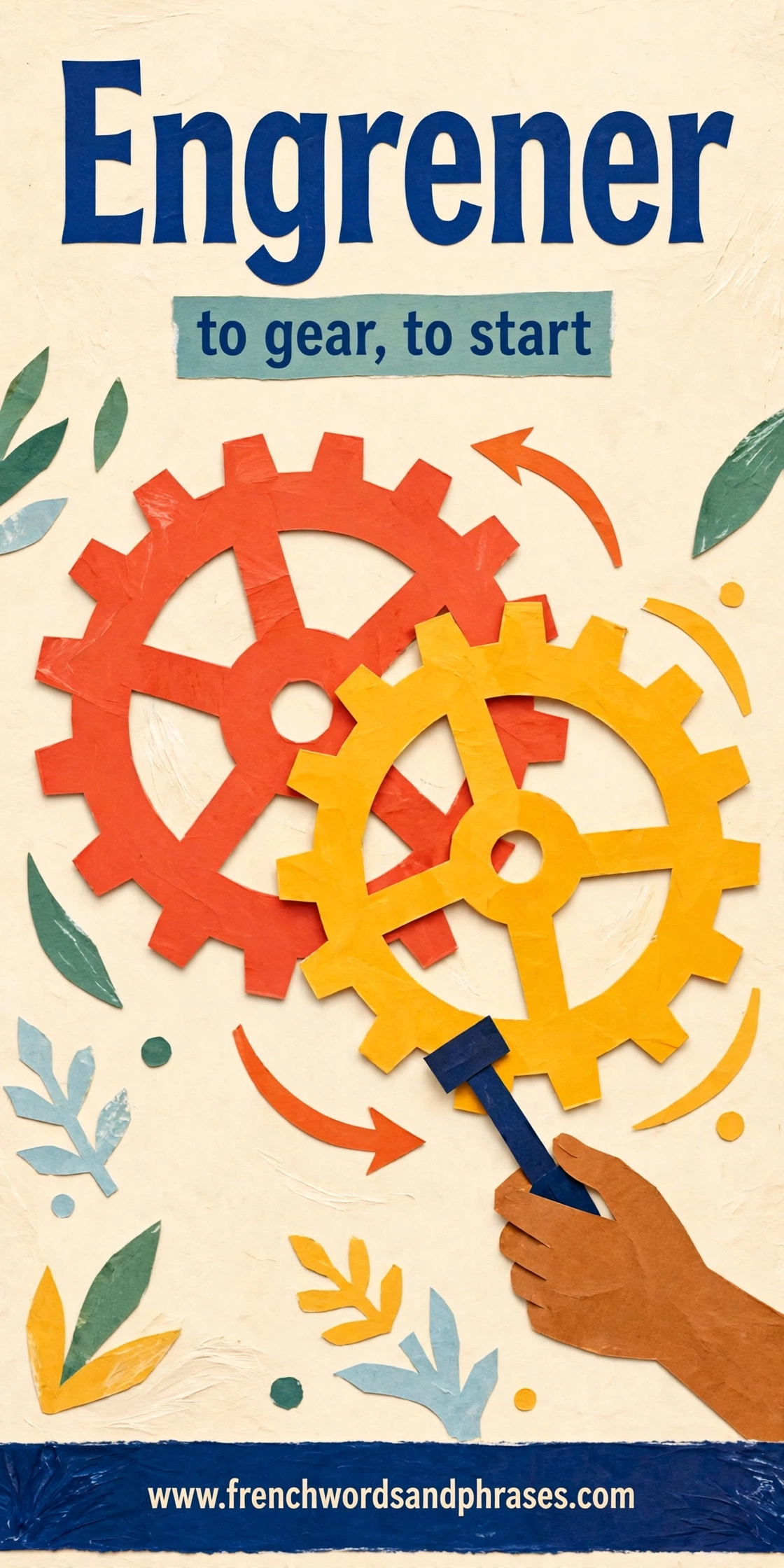
Engrener means to gear, to start — to set tooth into tooth so that a machine begins to move, and to set any process in motion.
Two gear wheels face each other across a hair’s breadth of air. One turns, the teeth meet — engrener is the moment of contact, when separate wheels become one machine and everything starts to move together.
In this guide, you’ll learn how to conjugate engrener in all the major French tenses and moods. Explore complete conjugation tables, French examples, English translations, and practice quizzes.
Understanding the French Verb Engrener
Engrener is a regular French verb belonging to the first group of verbs, those ending in-er.
It means to gear, to start. It is used of gear teeth meshing and machines engaging, in farming for feeding grain into the threshing machine, and figuratively for starting a process or a conversation — engrener la conversation, engrener un processus. Its noun engrenage has escaped the workshop entirely: l’engrenage de la violence, l’engrenage de la drogue.
Verb classification: First group (-er)
Auxiliary verb: Avoir
Past participle: engrené
Present participle: engrenant
English equivalents: To gear, to mesh, to engage, to set in motion; les roues engrènent — the gears mesh; engrener une machine — to engage a machine; engrener la conversation — to get the conversation going; un engrenage — a gear train, a spiral (un engrenage de violence).
One important detail: engrener follows the mener pattern — the stem vowel opens to è wherever the ending is mute: j’engrène, tu engrènes, il engrène, ils engrènent, and all through the future and conditional: j’engrènerai, j’engrènerais. Where the ending is sounded, the plain e stays: nous engrenons, vous engrenez, je engrenais. Its family noun is everywhere in modern French: un engrenage is a gear train — and, figuratively, a spiral nobody can stop.
Experience the Word
Engrener is the verb of the first contact — the instant when teeth meet teeth and stillness becomes machinery.
Imagine a millwright rebuilding an old mill. Wheel by wheel the great wooden gears go back onto their shafts; at the last one he turns the master wheel by hand — les dents engrènent, the whole building stirs, and the mill wakes up after fifty years of sleep.
One wheel alone was just timber. Meshed — engrenées, tooth into tooth — they are a machine again.
How to Conjugate Engrener: Complete French Conjugation Guide
Let’s explore every major conjugation of engrener, beginning with the indicative mood.
How to Conjugate Engrener in the Indicative Mood
The indicative mood is used to express facts, observations, actions, and events.
How to Conjugate Engrener in the Present Tense (Présent)
Used for actions happening now, habitual actions, and general truths.
| Subject | Conjugation |
|---|---|
| je | engrène |
| tu | engrènes |
| il / elle | engrène |
| nous | engrenons |
| vous | engrenez |
| ils / elles | engrènent |
Example
Les deux roues engrènent parfaitement.
The two wheels mesh perfectly.
Quick Quiz 1
Complete the sentence:
Nous ______ les roues avec soin.
Reveal the answer
engrenons
Nous engrenons les roues avec soin.
We mesh the wheels with care.
How to Conjugate Engrener in the Passé Composé
Used for completed actions in the past. Engrener takes the auxiliary verb avoir.
| Subject | Conjugation |
|---|---|
| j’ | ai engrené |
| tu | as engrené |
| il / elle | a engrené |
| nous | avons engrené |
| vous | avez engrené |
| ils / elles | ont engrené |
Example
Le mécanicien a engrené le mécanisme avec soin.
The mechanic engaged the mechanism with care.
How to Conjugate Engrener in the Imparfait (Imperfect Tense)
Used for habitual past actions, descriptions, and ongoing situations in the past.
| Subject | Conjugation |
|---|---|
| je | engrenais |
| tu | engrenais |
| il / elle | engrenait |
| nous | engrenions |
| vous | engreniez |
| ils / elles | engrenaient |
Example
Les roues engrenaient avec un léger grincement.
The wheels used to mesh with a slight grinding sound.
Quick Quiz 2
Choose the correct form:
The mechanic engaged the mechanism.
Le mécanicien ______ le mécanisme. (a engrené / est engrené)
Reveal the answer
a engrené
Le mécanicien a engrené le mécanisme.
Engrener takes avoir.
How to Conjugate Engrener in the Plus-que-parfait
Used to describe an action that had already been completed before another past event.
| Subject | Conjugation |
|---|---|
| j’ | avais engrené |
| tu | avais engrené |
| il / elle | avait engrené |
| nous | avions engrené |
| vous | aviez engrené |
| ils / elles | avaient engrené |
Example
Elle avait engrené la conversation dès son arrivée.
She had got the conversation going as soon as she arrived.
How to Conjugate Engrener in the Passé Simple
Primarily used in formal writing, literature, and historical narratives. It is rarely used in everyday conversation.
| Subject | Conjugation |
|---|---|
| je | engrenai |
| tu | engrenas |
| il / elle | engrena |
| nous | engrenâmes |
| vous | engrenâtes |
| ils / elles | engrenèrent |
Example
La machine engrena ses roues dans un cliquetis sec.
The machine engaged its wheels with a dry clicking.
How to Conjugate Engrener in the Passé Antérieur
A literary tense used to express an action completed immediately before another past action, generally in the passé simple.
| Subject | Conjugation |
|---|---|
| j’ | eus engrené |
| tu | eus engrené |
| il / elle | eut engrené |
| nous | eûmes engrené |
| vous | eûtes engrené |
| ils / elles | eurent engrené |
Example
Quand les roues eurent engrené, la machine se mit en marche.
When the wheels had meshed, the machine started up.
How to Conjugate Engrener in the Future Tense (Futur Simple)
Used to describe actions that will take place in the future.
| Subject | Conjugation |
|---|---|
| je | engrènerai |
| tu | engrèneras |
| il / elle | engrènera |
| nous | engrènerons |
| vous | engrènerez |
| ils / elles | engrèneront |
Example
Au signal, le mécanisme engrènera sans à-coups.
At the signal, the mechanism will engage smoothly.
How to Conjugate Engrener in the Futur Antérieur (Future Perfect)
Used for an action that will have been completed before a particular point in the future.
| Subject | Conjugation |
|---|---|
| j’ | aurai engrené |
| tu | auras engrené |
| il / elle | aura engrené |
| nous | aurons engrené |
| vous | aurez engrené |
| ils / elles | auront engrené |
Example
À la fin du montage, toutes les roues auront engrené.
By the end of the assembly, all the wheels will have meshed.
How to Conjugate Engrener in the Near Future (Futur Proche)
Used to describe something that is going to happen soon. Formed with aller + infinitive.
| Subject | Conjugation |
|---|---|
| je | vais engrener |
| tu | vas engrener |
| il / elle | va engrener |
| nous | allons engrener |
| vous | allez engrener |
| ils / elles | vont engrener |
Example
Attention, la machine va engrener.
Careful, the machine is going to engage.
How to Conjugate Engrener in the Conditional Mood
The conditional mood expresses what would happen under certain circumstances. It is also frequently used to make polite requests or express wishes.
How to Conjugate Engrener in the Present Conditional
| Subject | Conjugation |
|---|---|
| je | engrènerais |
| tu | engrènerais |
| il / elle | engrènerait |
| nous | engrènerions |
| vous | engrèneriez |
| ils / elles | engrèneraient |
Example
Avec des dents neuves, les roues engrèneraient mieux.
With new teeth, the wheels would mesh better.
How to Conjugate Engrener in the Past Conditional
| Subject | Conjugation |
|---|---|
| j’ | aurais engrené |
| tu | aurais engrené |
| il / elle | aurait engrené |
| nous | aurions engrené |
| vous | auriez engrené |
| ils / elles | auraient engrené |
Example
Il aurait engrené la conversation si on l’avait écouté.
He would have got the conversation going if people had listened to him.
Engrener in the Literary Past Conditional Form
This less common literary form uses the imperfect subjunctive of avoir.
| Subject | Conjugation |
|---|---|
| j’ | eusse engrené |
| tu | eusses engrené |
| il / elle | eût engrené |
| nous | eussions engrené |
| vous | eussiez engrené |
| ils / elles | eussent engrené |
Example
La machine eût engrené ses roues sans le sable dans le mécanisme.
The machine would have engaged its wheels without the sand in the mechanism.
How to Conjugate Engrener in the Subjunctive Mood
The subjunctive is used to express wishes, emotions, doubts, necessity, and uncertainty. It frequently follows expressions such as il faut que (it is necessary that) or bien que (although).
How to Conjugate Engrener in the Present Subjunctive
| Subject | Conjugation |
|---|---|
| que je | engrène |
| que tu | engrènes |
| qu’il / qu’elle | engrène |
| que nous | engrenions |
| que vous | engreniez |
| qu’ils / qu’elles | engrènent |
Example
Il faut que les roues engrènent exactement.
The wheels must mesh exactly.
Quick Quiz 3
Complete the sentence using the subjunctive:
Il faut que les roues ______ exactement.
Reveal the answer
engrènent
Il faut que les roues engrènent exactement.
The wheels must mesh exactly.
How to Conjugate Engrener in the Imperfect Subjunctive
A literary tense, rarely encountered in modern spoken French.
| Subject | Conjugation |
|---|---|
| que je | engrenasse |
| que tu | engrenasses |
| qu’il / qu’elle | engrenât |
| que nous | engrenassions |
| que vous | engrenassiez |
| qu’ils / qu’elles | engrenassent |
Example
L’ingénieur exigeait que le pignon engrenât sans jeu.
The engineer required the pinion to mesh without play.
How to Conjugate Engrener in the Pluperfect Subjunctive
A literary construction used to express an action completed before another past action.
| Subject | Conjugation |
|---|---|
| que j’ | eusse engrené |
| que tu | eusses engrené |
| qu’il / qu’elle | eût engrené |
| que nous | eussions engrené |
| que vous | eussiez engrené |
| qu’ils / qu’elles | eussent engrené |
Example
On craignait que la machine n’eût engrené de travers.
People feared the machine had engaged crookedly.
How to Conjugate Engrener in the Past Subjunctive
| Subject | Conjugation |
|---|---|
| que j’ | aie engrené |
| que tu | aies engrené |
| qu’il / qu’elle | ait engrené |
| que nous | ayons engrené |
| que vous | ayez engrené |
| qu’ils / qu’elles | aient engrené |
Example
Je suis content que les roues aient engrené du premier coup.
I am glad the wheels meshed at the first try.
How to Conjugate Engrener in the Imperative
The imperative is used to give commands, instructions, invitations, or suggestions. Subject pronouns are omitted.
How to Conjugate Engrener in the Present Imperative
| Person | Conjugation |
|---|---|
| (tu) | engrène |
| (nous) | engrenons |
| (vous) | engrenez |
Example
Engrène la première vitesse doucement !
Engage first gear gently!
Quick Quiz 4
How would you say Engage first gear (tu form)?
Reveal the answer
Engrène la première !
French Participles of Engrener
Participles are verb forms that can be used in compound tenses and other grammatical constructions.
Present Participle of Engrener
engrenant
En engrenant les roues, le mécanicien vérifie l’alignement.
As he meshes the wheels, the mechanic checks the alignment.
Past Participle of Engrener
engrené
Engrenées avec précision, les roues tournent sans bruit.
Meshed with precision, the wheels turn without noise.
Engrener in Everyday French: Real-Life Examples
Now that you know the conjugations, let’s see how engrener appears in everyday French.
Example 1 — Present
Les roues engrènent sans bruit.
The wheels mesh without noise.
Example 2 — Passé composé
Il a engrené la machine.
He engaged the machine.
Example 3 — Imparfait
Les pignons engrenaient lentement.
The pinions used to mesh slowly.
Example 4 — Future
Le mécanisme engrènera au signal.
The mechanism will engage at the signal.
Example 5 — Conditional
Les roues engrèneraient mieux avec des dents neuves.
The wheels would mesh better with new teeth.
Example 6 — Imperative
Engrène la première !
Engage first gear!
Beyond Translation: The Meaning of Engrener
Ask a French journalist about un engrenage and you will not hear about machinery: the word has become the standard metaphor for a spiral — l’engrenage de la violence, each act meshing with the next like teeth on wheels nobody can stop.
The verb engrener is the innocent start of it.
To engage the first tooth — engrener la machine, engrener la conversation — is to set a train of consequences moving, for better or for worse.
How to Remember the French Verb Engrener
Remember it this way: Engrener is about gear teeth meshing so the machine can start.
- Mener-type accent: j’engrène with è wherever the ending is mute, and engrènerai all through the future.
- Teeth into teeth: when les roues engrènent, the machine can start — un engrenage is the gear train.
- Nous engrenons keeps the plain e: the accent only appears where the syllable goes quiet.
The key idea is gear teeth meshing so the machine can start.
Test Your Knowledge of Engrener
Let’s see how much you’ve learned. Try answering these questions before revealing the answers.
Question 1
Why is it j’engrène but nous engrenons?
Reveal the answer
The mener-type rule — the stem vowel opens to è before a mute ending (j’engrène), and stays plain e where the ending is sounded (nous engrenons).
Question 2
How do you say The wheels mesh perfectly in French?
Reveal the answer
Les roues engrènent parfaitement.
Question 3
Translate: He engaged the machine.
Reveal the answer
Il a engrené la machine.
Question 4
What is the past participle of engrener?
Reveal the answer
Engrené.
Question 5
Complete the sentence:
Il faut que les roues ______ exactement.
Reveal the answer
engrènent
Il faut que les roues engrènent exactement.
The wheels must mesh exactly.
Your Final Challenge
Can You Use It?
How would you say this in French?
When the gears mesh, the whole machine remembers why it exists.
Reveal the answer
Quand les roues engrènent, toute la machine se souvient pourquoi elle existe.
When the gears mesh, the whole machine remembers why it exists.
A little French. A little curiosity. A richer everyday life.
LEARN FRENCH ONE WORD AT A TIME