A French Word to Live By
How to Conjugate Engraver in French
/ɑ̃.ɡʁa.ve/
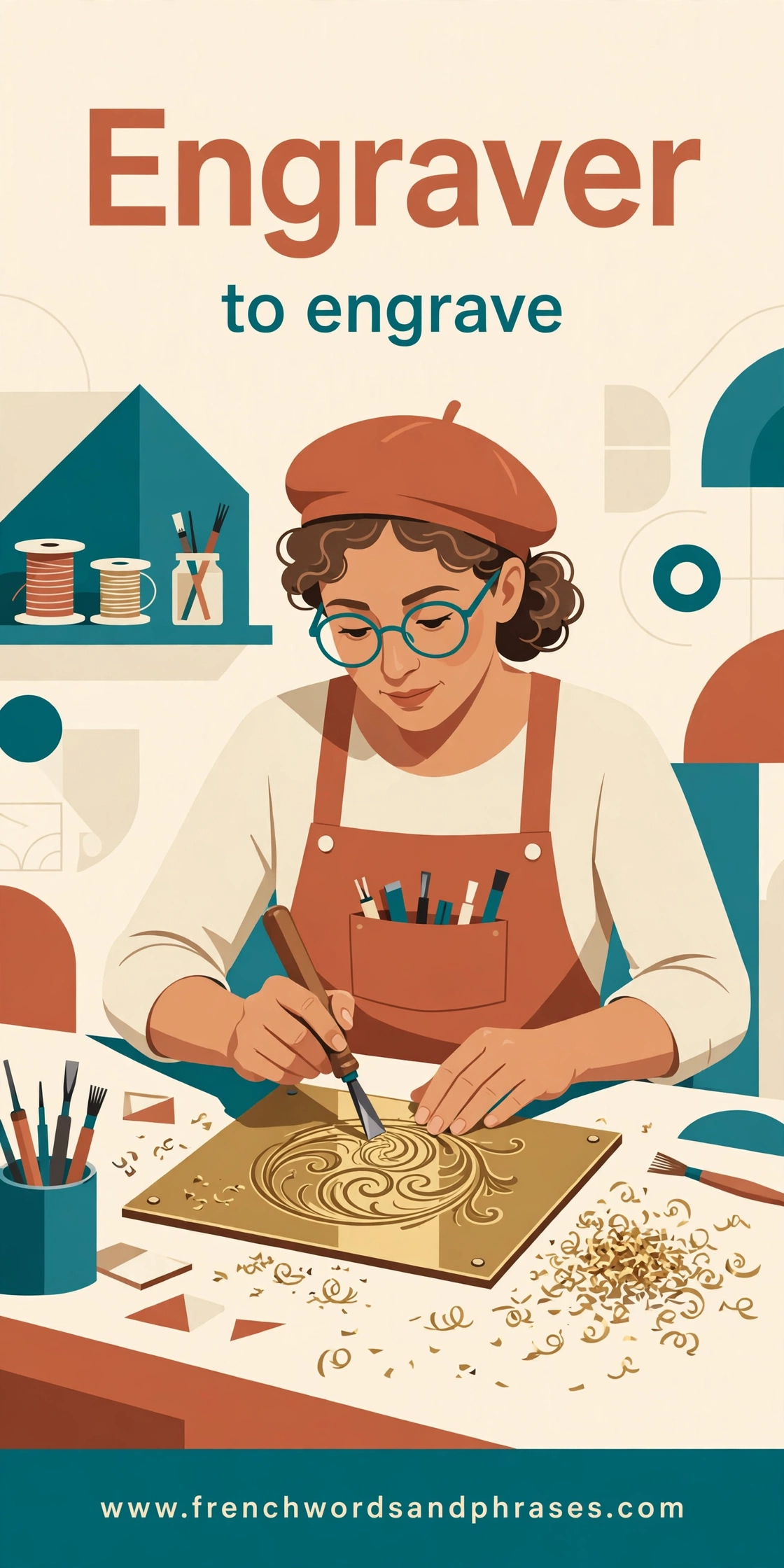
Engraver means to engrave — to cut letters or pictures into wood, metal or stone with a sharp tool, so that they stay there for good.
A goldsmith bent over a wedding ring, a stone-cutter at a church door, a printmaker over a copper plate — engraver is the verb of the burin’s slow work: cutting into a hard surface a mark meant to outlast its maker.
In this guide, you’ll learn how to conjugate engraver in all the major French tenses and moods. Explore complete conjugation tables, French examples, English translations, and practice quizzes.
Understanding the French Verb Engraver
Engraver is a regular French verb belonging to the first group of verbs, those ending in-er.
It means to engrave. It is used of inscriptions, initials and designs cut into rings, plaques, bells, tombstones and printing plates — anywhere a mark is meant to be permanent. In modern everyday French graver does most of this work, and engraver keeps a slightly old-fashioned, craftsman’s flavour.
Verb classification: First group (-er)
Auxiliary verb: Avoir
Past participle: engravé
Present participle: engravant
English equivalents: To engrave, to carve, to cut; engraver une inscription — to engrave an inscription; engraver sur bois — to engrave on wood; engraver ses initiales — to engrave one’s initials; un graveur — an engraver; (marine) s’engraver — to run aground on the sand.
One important detail: engraver is the older, rarer twin of graver, the everyday verb for engraving — dictionaries keep both, and the senses are the same. There is also a nautical cousin, s’engraver, said of a ship that runs onto a sandbank and sticks fast. The verb itself is perfectly regular: j’engrave, nous engravons, ils engravent.
Experience the Word
Engraver is the verb of the permanent mark — ink fades and paper burns, but what is cut into stone or metal stays.
Imagine a jeweller’s bench the day before a wedding. Under the lamp, the burin moves a fraction at a time inside a gold ring, and two sets of initials appear letter by letter — il engrave la date et les prénoms, a message only the couple will ever read, cut to last as long as the gold.
It cannot be erased or corrected. It is engraved — engravé, in the metal, for good.
How to Conjugate Engraver: Complete French Conjugation Guide
Let’s explore every major conjugation of engraver, beginning with the indicative mood.
How to Conjugate Engraver in the Indicative Mood
The indicative mood is used to express facts, observations, actions, and events.
How to Conjugate Engraver in the Present Tense (Présent)
Used for actions happening now, habitual actions, and general truths.
| Subject | Conjugation |
|---|---|
| je | engrave |
| tu | engraves |
| il / elle | engrave |
| nous | engravons |
| vous | engravez |
| ils / elles | engravent |
Example
L’artisan engrave les initiales sur la bague.
The craftsman is engraving the initials on the ring.
Quick Quiz 1
Complete the sentence:
Nous ______ les initiales sur la plaque.
Reveal the answer
engravons
Nous engravons les initiales sur la plaque.
We are engraving the initials on the plate.
How to Conjugate Engraver in the Passé Composé
Used for completed actions in the past. Engraver takes the auxiliary verb avoir.
| Subject | Conjugation |
|---|---|
| j’ | ai engravé |
| tu | as engravé |
| il / elle | a engravé |
| nous | avons engravé |
| vous | avez engravé |
| ils / elles | ont engravé |
Example
Il a engravé une devise sur la pierre.
He engraved a motto on the stone.
How to Conjugate Engraver in the Imparfait (Imperfect Tense)
Used for habitual past actions, descriptions, and ongoing situations in the past.
| Subject | Conjugation |
|---|---|
| je | engravais |
| tu | engravais |
| il / elle | engravait |
| nous | engravions |
| vous | engraviez |
| ils / elles | engravaient |
Example
Les moines engravaient des images sur le bois.
The monks used to engrave pictures on wood.
Quick Quiz 2
Choose the correct form:
She engraved the date.
Elle ______ la date. (a engravé / est engravée)
Reveal the answer
a engravé
Elle a engravé la date.
Engraver takes avoir.
How to Conjugate Engraver in the Plus-que-parfait
Used to describe an action that had already been completed before another past event.
| Subject | Conjugation |
|---|---|
| j’ | avais engravé |
| tu | avais engravé |
| il / elle | avait engravé |
| nous | avions engravé |
| vous | aviez engravé |
| ils / elles | avaient engravé |
Example
Elle avait engravé son nom sur le couvercle.
She had engraved her name on the lid.
How to Conjugate Engraver in the Passé Simple
Primarily used in formal writing, literature, and historical narratives. It is rarely used in everyday conversation.
| Subject | Conjugation |
|---|---|
| je | engravai |
| tu | engravas |
| il / elle | engrava |
| nous | engravâmes |
| vous | engravâtes |
| ils / elles | engravèrent |
Example
L’artiste engrava la plaque en une nuit.
The artist engraved the plate in one night.
How to Conjugate Engraver in the Passé Antérieur
A literary tense used to express an action completed immediately before another past action, generally in the passé simple.
| Subject | Conjugation |
|---|---|
| j’ | eus engravé |
| tu | eus engravé |
| il / elle | eut engravé |
| nous | eûmes engravé |
| vous | eûtes engravé |
| ils / elles | eurent engravé |
Example
Quand il eut engravé l’inscription, on dressa la pierre.
When he had engraved the inscription, the stone was raised.
How to Conjugate Engraver in the Future Tense (Futur Simple)
Used to describe actions that will take place in the future.
| Subject | Conjugation |
|---|---|
| je | engraverai |
| tu | engraveras |
| il / elle | engravera |
| nous | engraverons |
| vous | engraverez |
| ils / elles | engraveront |
Example
Demain, elle engravera les alliances des mariés.
Tomorrow, she will engrave the couple’s wedding rings.
How to Conjugate Engraver in the Futur Antérieur (Future Perfect)
Used for an action that will have been completed before a particular point in the future.
| Subject | Conjugation |
|---|---|
| j’ | aurai engravé |
| tu | auras engravé |
| il / elle | aura engravé |
| nous | aurons engravé |
| vous | aurez engravé |
| ils / elles | auront engravé |
Example
À midi, l’artisan aura engravé les deux plaques.
By noon, the craftsman will have engraved both plates.
How to Conjugate Engraver in the Near Future (Futur Proche)
Used to describe something that is going to happen soon. Formed with aller + infinitive.
| Subject | Conjugation |
|---|---|
| je | vais engraver |
| tu | vas engraver |
| il / elle | va engraver |
| nous | allons engraver |
| vous | allez engraver |
| ils / elles | vont engraver |
Example
Le bijoutier va engraver vos initiales.
The jeweller is going to engrave your initials.
How to Conjugate Engraver in the Conditional Mood
The conditional mood expresses what would happen under certain circumstances. It is also frequently used to make polite requests or express wishes.
How to Conjugate Engraver in the Present Conditional
| Subject | Conjugation |
|---|---|
| je | engraverais |
| tu | engraverais |
| il / elle | engraverait |
| nous | engraverions |
| vous | engraveriez |
| ils / elles | engraveraient |
Example
Avec un meilleur burin, il engraverait plus finement.
With a better burin, he would engrave more finely.
How to Conjugate Engraver in the Past Conditional
| Subject | Conjugation |
|---|---|
| j’ | aurais engravé |
| tu | aurais engravé |
| il / elle | aurait engravé |
| nous | aurions engravé |
| vous | auriez engravé |
| ils / elles | auraient engravé |
Example
Elle aurait engravé la date si on le lui avait demandé.
She would have engraved the date if she had been asked.
Engraver in the Literary Past Conditional Form
This less common literary form uses the imperfect subjunctive of avoir.
| Subject | Conjugation |
|---|---|
| j’ | eusse engravé |
| tu | eusses engravé |
| il / elle | eût engravé |
| nous | eussions engravé |
| vous | eussiez engravé |
| ils / elles | eussent engravé |
Example
Le lapidaire eût engravé la devise sans la fissure de la pierre.
The stone-cutter would have engraved the motto without the crack in the stone.
How to Conjugate Engraver in the Subjunctive Mood
The subjunctive is used to express wishes, emotions, doubts, necessity, and uncertainty. It frequently follows expressions such as il faut que (it is necessary that) or bien que (although).
How to Conjugate Engraver in the Present Subjunctive
| Subject | Conjugation |
|---|---|
| que je | engrave |
| que tu | engraves |
| qu’il / qu’elle | engrave |
| que nous | engravions |
| que vous | engraviez |
| qu’ils / qu’elles | engravent |
Example
Il faut que l’artisan engrave le nom sans faute.
The craftsman must engrave the name without a mistake.
Quick Quiz 3
Complete the sentence using the subjunctive:
Il faut que l’artisan ______ le nom sans faute.
Reveal the answer
engrave
Il faut que l’artisan engrave le nom sans faute.
The craftsman must engrave the name without a mistake.
How to Conjugate Engraver in the Imperfect Subjunctive
A literary tense, rarely encountered in modern spoken French.
| Subject | Conjugation |
|---|---|
| que je | engravasse |
| que tu | engravasses |
| qu’il / qu’elle | engravât |
| que nous | engravassions |
| que vous | engravassiez |
| qu’ils / qu’elles | engravassent |
Example
On lui demanda qu’il engravât les initiales en lettres d’or.
He was asked to engrave the initials in gold letters.
How to Conjugate Engraver in the Pluperfect Subjunctive
A literary construction used to express an action completed before another past action.
| Subject | Conjugation |
|---|---|
| que j’ | eusse engravé |
| que tu | eusses engravé |
| qu’il / qu’elle | eût engravé |
| que nous | eussions engravé |
| que vous | eussiez engravé |
| qu’ils / qu’elles | eussent engravé |
Example
On admirait qu’il eût engravé tant de détail dans si peu d’espace.
People admired that he had engraved so much detail in so little space.
How to Conjugate Engraver in the Past Subjunctive
| Subject | Conjugation |
|---|---|
| que j’ | aie engravé |
| que tu | aies engravé |
| qu’il / qu’elle | ait engravé |
| que nous | ayons engravé |
| que vous | ayez engravé |
| qu’ils / qu’elles | aient engravé |
Example
Je suis content qu’elle ait engravé la date exacte.
I am glad she engraved the exact date.
How to Conjugate Engraver in the Imperative
The imperative is used to give commands, instructions, invitations, or suggestions. Subject pronouns are omitted.
How to Conjugate Engraver in the Present Imperative
| Person | Conjugation |
|---|---|
| (tu) | engrave |
| (nous) | engravons |
| (vous) | engravez |
Example
Engravez la devise en lettres simples !
Engrave the motto in plain letters!
Quick Quiz 4
How would you say Engrave your name (tu form)?
Reveal the answer
Engrave ton nom !
French Participles of Engraver
Participles are verb forms that can be used in compound tenses and other grammatical constructions.
Present Participle of Engraver
engravant
En engravant la plaque, l’artisan retient son souffle.
As he engraves the plate, the craftsman holds his breath.
Past Participle of Engraver
engravé
Engravée dans le marbre, la devise a traversé les siècles.
Engraved in the marble, the motto has crossed the centuries.
Engraver in Everyday French: Real-Life Examples
Now that you know the conjugations, let’s see how engraver appears in everyday French.
Example 1 — Present
Le bijoutier engrave les initiales.
The jeweller is engraving the initials.
Example 2 — Passé composé
Il a engravé une devise sur la pierre.
He engraved a motto on the stone.
Example 3 — Imparfait
On engravait les noms sur les cloches.
Names used to be engraved on the bells.
Example 4 — Future
Elle engravera les alliances.
She will engrave the wedding rings.
Example 5 — Conditional
Il engraverait plus finement avec un burin neuf.
He would engrave more finely with a new burin.
Example 6 — Imperative
Engrave ton nom sur la médaille !
Engrave your name on the medal!
Beyond Translation: The Meaning of Engraver
English engrave and French engraver are the same word twice — both come from the old Germanic root for cutting a groove, which also gives English grave, the trench in the earth.
Cutting is the family trade.
French mostly handed the everyday work to the shorter graver — graver un disque, graver dans sa mémoire — while engraver survives in the workshop, the dictionary, and the fine print of old title pages: engravé par…
How to Remember the French Verb Engraver
Remember it this way: Engraver is about initials cut into the ring for good.
- Graver is the everyday twin; engraver is its older, rarer double — same burin, same stone.
- What is engravé is cut to last: une inscription engravée dans le marbre.
- Regular -er: j’engrave, nous engravons, past participle engravé.
The key idea is initials cut into the ring for good.
Test Your Knowledge of Engraver
Let’s see how much you’ve learned. Try answering these questions before revealing the answers.
Question 1
What is the difference between engraver and graver?
Reveal the answer
Almost none in meaning — graver is the everyday verb; engraver is its older, rarer twin.
Question 2
How do you say The jeweller is engraving the initials in French?
Reveal the answer
Le bijoutier engrave les initiales.
Question 3
Translate: He engraved a motto on the stone.
Reveal the answer
Il a engravé une devise sur la pierre.
Question 4
What is the past participle of engraver?
Reveal the answer
Engravé.
Question 5
Complete the sentence:
Il faut que l’artisan ______ le nom sans faute.
Reveal the answer
engrave
Il faut que l’artisan engrave le nom sans faute.
The craftsman must engrave the name without a mistake.
Your Final Challenge
Can You Use It?
How would you say this in French?
Names are engraved in stone, but it is the heart that keeps them.
Reveal the answer
On engrave les noms dans la pierre, mais c’est le cœur qui les garde.
Names are engraved in stone, but it is the heart that keeps them.
A little French. A little curiosity. A richer everyday life.
LEARN FRENCH ONE WORD AT A TIME