A French Word to Live By
How to Conjugate Enfourner in French
/ɑ̃.fuʁ.ne/
Enfourner means to put in the oven — to slide a dish, a loaf or a tray into the heat and shut the door.
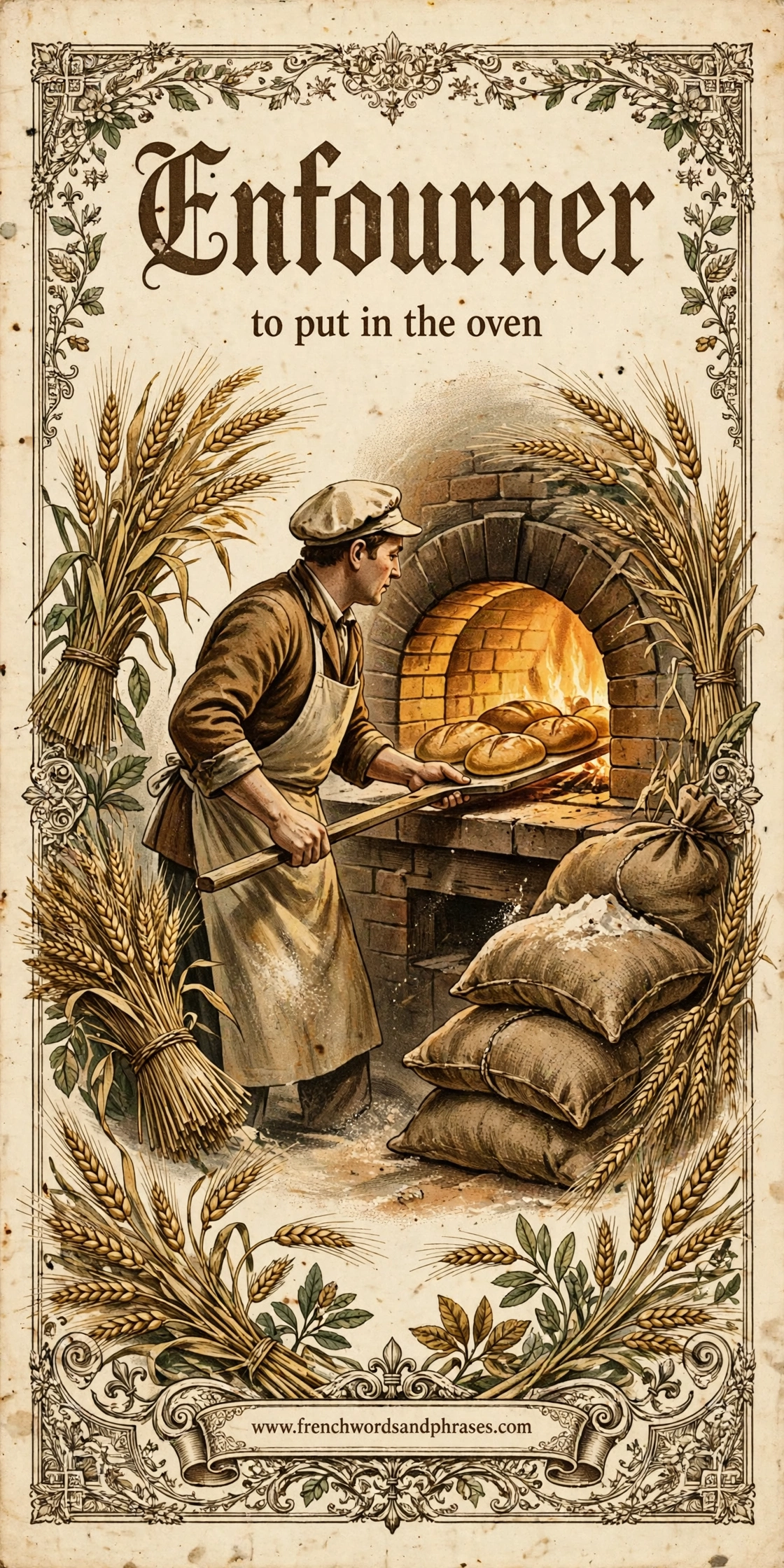
The baker at five in the morning sliding his loaves onto the hot stone, the pizzaiolo feeding pizzas into the wood fire, a tarte going in as the guests arrive — enfourner is the kitchen’s moment of commitment: once it is in the oven, the cooking has truly begun.
In this guide, you’ll learn how to conjugate enfourner in all the major French tenses and moods. Explore complete conjugation tables, French examples, English translations, and practice quizzes.
Understanding the French Verb Enfourner
Enfourner is a regular French verb belonging to the first group of verbs, those ending in-er.
It means to put in the oven. It belongs to bakers and home cooks alike: bread, pizzas, gratins, roasts and cakes are all enfournés, and recipes give the order constantly — préchauffez le four, puis enfournez pour 30 minutes. A baker’s batch, une fournée, is named after this single gesture.
Verb classification: First group (-er)
Auxiliary verb: Avoir
Past participle: enfourné
Present participle: enfournant
English equivalents: To put in the oven, to pop into the oven; enfourner le pain — to put the bread in the oven; enfourner à 180 degrés — to bake at 180 degrees; une fournée — a batch, an oven-load; le four — the oven.
One important detail: enfourner is le four, the oven, turned into a verb — and French uses it where English needs a whole phrase, ‘to put in the oven’. It is a perfectly regular -er verb (j’enfourne, nous enfournons, participle enfourné), and it takes the dish as its direct object: enfourner le gratin, enfourner les croissants. Temperatures ride along: enfourner à four chaud, enfourner pour vingt minutes. The opposite movement is défourner — to take out of the oven.
Experience the Word
Enfourner is the point of no return in the kitchen — the door closes, the heat takes over, and now you wait.
Imagine a village baker in the dark of early morning. The loaves are shaped, the oven is roaring; with a long wooden peel he enfourne forty loaves in a minute, and the smell that will wake the village begins to rise.
The bread is out of his hands now. It is in the oven — enfourné — and the fire does the rest.
How to Conjugate Enfourner: Complete French Conjugation Guide
Let’s explore every major conjugation of enfourner, beginning with the indicative mood.
How to Conjugate Enfourner in the Indicative Mood
The indicative mood is used to express facts, observations, actions, and events.
How to Conjugate Enfourner in the Present Tense (Présent)
Used for actions happening now, habitual actions, and general truths.
| Subject | Conjugation |
|---|---|
| je | enfourne |
| tu | enfournes |
| il / elle | enfourne |
| nous | enfournons |
| vous | enfournez |
| ils / elles | enfournent |
Example
Le boulanger enfourne les pains à cinq heures du matin.
The baker puts the loaves in the oven at five in the morning.
Quick Quiz 1
Complete the sentence:
Nous ______ le gratin à 180 degrés.
Reveal the answer
enfournons
Nous enfournons le gratin à 180 degrés.
We put the gratin in the oven at 180 degrees.
How to Conjugate Enfourner in the Passé Composé
Used for completed actions in the past. Enfourner takes the auxiliary verb avoir.
| Subject | Conjugation |
|---|---|
| j’ | ai enfourné |
| tu | as enfourné |
| il / elle | a enfourné |
| nous | avons enfourné |
| vous | avez enfourné |
| ils / elles | ont enfourné |
Example
Elle a enfourné la tarte à 180 degrés.
She put the tart in the oven at 180 degrees.
How to Conjugate Enfourner in the Imparfait (Imperfect Tense)
Used for habitual past actions, descriptions, and ongoing situations in the past.
| Subject | Conjugation |
|---|---|
| je | enfournais |
| tu | enfournais |
| il / elle | enfournait |
| nous | enfournions |
| vous | enfourniez |
| ils / elles | enfournaient |
Example
Chaque soir, grand-mère enfournait un poulet.
Every evening, grandmother used to put a chicken in the oven.
Quick Quiz 2
Choose the correct form:
She put the tart in the oven.
Elle ______ la tarte. (a enfourné / est enfournée)
Reveal the answer
a enfourné
Elle a enfourné la tarte.
Enfourner takes avoir.
How to Conjugate Enfourner in the Plus-que-parfait
Used to describe an action that had already been completed before another past event.
| Subject | Conjugation |
|---|---|
| j’ | avais enfourné |
| tu | avais enfourné |
| il / elle | avait enfourné |
| nous | avions enfourné |
| vous | aviez enfourné |
| ils / elles | avaient enfourné |
Example
Le pizzaiolo avait enfourné vingt pizzas avant l’ouverture.
The pizza maker had put twenty pizzas in the oven before opening time.
How to Conjugate Enfourner in the Passé Simple
Primarily used in formal writing, literature, and historical narratives. It is rarely used in everyday conversation.
| Subject | Conjugation |
|---|---|
| je | enfournai |
| tu | enfournas |
| il / elle | enfourna |
| nous | enfournâmes |
| vous | enfournâtes |
| ils / elles | enfournèrent |
Example
Le cuisinier enfourna le rôti et ferma la porte du four.
The cook put the roast in the oven and closed the oven door.
How to Conjugate Enfourner in the Passé Antérieur
A literary tense used to express an action completed immediately before another past action, generally in the passé simple.
| Subject | Conjugation |
|---|---|
| j’ | eus enfourné |
| tu | eus enfourné |
| il / elle | eut enfourné |
| nous | eûmes enfourné |
| vous | eûtes enfourné |
| ils / elles | eurent enfourné |
Example
Quand elle eut enfourné le gratin, elle mit la table.
When she had put the gratin in the oven, she laid the table.
How to Conjugate Enfourner in the Future Tense (Futur Simple)
Used to describe actions that will take place in the future.
| Subject | Conjugation |
|---|---|
| je | enfournerai |
| tu | enfourneras |
| il / elle | enfournera |
| nous | enfournerons |
| vous | enfournerez |
| ils / elles | enfourneront |
Example
J’enfournerai le gâteau dans dix minutes.
I will put the cake in the oven in ten minutes.
How to Conjugate Enfourner in the Futur Antérieur (Future Perfect)
Used for an action that will have been completed before a particular point in the future.
| Subject | Conjugation |
|---|---|
| j’ | aurai enfourné |
| tu | auras enfourné |
| il / elle | aura enfourné |
| nous | aurons enfourné |
| vous | aurez enfourné |
| ils / elles | auront enfourné |
Example
À midi, le boulanger aura enfourné sa troisième fournée.
By noon, the baker will have put his third batch in the oven.
How to Conjugate Enfourner in the Near Future (Futur Proche)
Used to describe something that is going to happen soon. Formed with aller + infinitive.
| Subject | Conjugation |
|---|---|
| je | vais enfourner |
| tu | vas enfourner |
| il / elle | va enfourner |
| nous | allons enfourner |
| vous | allez enfourner |
| ils / elles | vont enfourner |
Example
Vite, je vais enfourner les croissants !
Quick, I am going to put the croissants in the oven!
How to Conjugate Enfourner in the Conditional Mood
The conditional mood expresses what would happen under certain circumstances. It is also frequently used to make polite requests or express wishes.
How to Conjugate Enfourner in the Present Conditional
| Subject | Conjugation |
|---|---|
| je | enfournerais |
| tu | enfournerais |
| il / elle | enfournerait |
| nous | enfournerions |
| vous | enfourneriez |
| ils / elles | enfourneraient |
Example
Avec un plus grand four, nous enfournerions deux plats à la fois.
With a bigger oven, we would put two dishes in at once.
How to Conjugate Enfourner in the Past Conditional
| Subject | Conjugation |
|---|---|
| j’ | aurais enfourné |
| tu | aurais enfourné |
| il / elle | aurait enfourné |
| nous | aurions enfourné |
| vous | auriez enfourné |
| ils / elles | auraient enfourné |
Example
Il aurait enfourné le pain plus tôt si le four avait été chaud.
He would have put the bread in earlier if the oven had been hot.
Enfourner in the Literary Past Conditional Form
This less common literary form uses the imperfect subjunctive of avoir.
| Subject | Conjugation |
|---|---|
| j’ | eusse enfourné |
| tu | eusses enfourné |
| il / elle | eût enfourné |
| nous | eussions enfourné |
| vous | eussiez enfourné |
| ils / elles | eussent enfourné |
Example
Elle eût enfourné le rôti sans attendre les invités.
She would have put the roast in without waiting for the guests.
How to Conjugate Enfourner in the Subjunctive Mood
The subjunctive is used to express wishes, emotions, doubts, necessity, and uncertainty. It frequently follows expressions such as il faut que (it is necessary that) or bien que (although).
How to Conjugate Enfourner in the Present Subjunctive
| Subject | Conjugation |
|---|---|
| que je | enfourne |
| que tu | enfournes |
| qu’il / qu’elle | enfourne |
| que nous | enfournions |
| que vous | enfourniez |
| qu’ils / qu’elles | enfournent |
Example
Il faut que tu enfournes le poulet maintenant.
You must put the chicken in the oven now.
Quick Quiz 3
Complete the sentence using the subjunctive:
Il faut que vous ______ le poulet maintenant.
Reveal the answer
enfourniez
Il faut que vous enfourniez le poulet maintenant.
You must put the chicken in the oven now.
How to Conjugate Enfourner in the Imperfect Subjunctive
A literary tense, rarely encountered in modern spoken French.
| Subject | Conjugation |
|---|---|
| que je | enfournasse |
| que tu | enfournasses |
| qu’il / qu’elle | enfournât |
| que nous | enfournassions |
| que vous | enfournassiez |
| qu’ils / qu’elles | enfournassent |
Example
Maman voulait que j’enfournasse la tarte moi-même.
Mum wanted me to put the tart in the oven myself.
How to Conjugate Enfourner in the Pluperfect Subjunctive
A literary construction used to express an action completed before another past action.
| Subject | Conjugation |
|---|---|
| que j’ | eusse enfourné |
| que tu | eusses enfourné |
| qu’il / qu’elle | eût enfourné |
| que nous | eussions enfourné |
| que vous | eussiez enfourné |
| qu’ils / qu’elles | eussent enfourné |
Example
On racontait qu’il eût enfourné cent pains avant l’aube.
People said he had put a hundred loaves in the oven before dawn.
How to Conjugate Enfourner in the Past Subjunctive
| Subject | Conjugation |
|---|---|
| que j’ | aie enfourné |
| que tu | aies enfourné |
| qu’il / qu’elle | ait enfourné |
| que nous | ayons enfourné |
| que vous | ayez enfourné |
| qu’ils / qu’elles | aient enfourné |
Example
Je suis content que tu aies enfourné le gratin à temps.
I am glad you put the gratin in the oven in time.
How to Conjugate Enfourner in the Imperative
The imperative is used to give commands, instructions, invitations, or suggestions. Subject pronouns are omitted.
How to Conjugate Enfourner in the Present Imperative
| Person | Conjugation |
|---|---|
| (tu) | enfourne |
| (nous) | enfournons |
| (vous) | enfournez |
Example
Enfourne les biscuits et surveille la cuisson !
Put the biscuits in the oven and watch them bake!
Quick Quiz 4
How would you say Put the biscuits in the oven (tu form)?
Reveal the answer
Enfourne les biscuits !
French Participles of Enfourner
Participles are verb forms that can be used in compound tenses and other grammatical constructions.
Present Participle of Enfourner
enfournant
En enfournant la pizza, il s’est brûlé le doigt.
As he put the pizza in the oven, he burnt his finger.
Past Participle of Enfourner
enfourné
À peine enfourné, le pain embauma toute la maison.
Hardly in the oven, the bread filled the whole house with its smell.
Enfourner in Everyday French: Real-Life Examples
Now that you know the conjugations, let’s see how enfourner appears in everyday French.
Example 1 — Present
Le boulanger enfourne les pains à cinq heures.
The baker puts the loaves in the oven at five.
Example 2 — Passé composé
Elle a enfourné la tarte à 180 degrés.
She put the tart in the oven at 180 degrees.
Example 3 — Imparfait
Grand-mère enfournait un poulet chaque soir.
Grandmother used to put a chicken in the oven every evening.
Example 4 — Future
J’enfournerai le gâteau dans dix minutes.
I will put the cake in the oven in ten minutes.
Example 5 — Conditional
Nous enfournerions deux plats avec un plus grand four.
We would put two dishes in with a bigger oven.
Example 6 — Imperative
Enfourne les biscuits et surveille la cuisson !
Put the biscuits in the oven and watch them bake!
Beyond Translation: The Meaning of Enfourner
English splits this moment into words — put in, pop in, slide in; French has one verb, enfourner, because the gesture matters enough to name.
It is the baker’s signature move.
Everything before it is preparation; everything after is waiting. Its family is warm: le four the oven, la fournée the batch, le fournil the bakehouse — and its opposite, défourner, is the moment of truth when the door opens again.
How to Remember the French Verb Enfourner
Remember it this way: Enfourner is about the baker sliding forty loaves into the roaring oven at dawn.
- Le four is the oven; enfourner is the one-word French for ‘put in the oven’.
- Recipes command it constantly: enfournez pour 30 minutes — bake for 30 minutes.
- Regular -er: j’enfourne, nous enfournons, past participle enfourné.
The key idea is the baker sliding forty loaves into the roaring oven at dawn.
Test Your Knowledge of Enfourner
Let’s see how much you’ve learned. Try answering these questions before revealing the answers.
Question 1
What single English phrase does enfourner replace?
Reveal the answer
To put in the oven — enfourner le pain, to put the bread in the oven.
Question 2
How do you say She put the tart in the oven at 180 degrees in French?
Reveal the answer
Elle a enfourné la tarte à 180 degrés.
Question 3
Translate: I will put the cake in the oven in ten minutes.
Reveal the answer
J’enfournerai le gâteau dans dix minutes.
Question 4
What is the past participle of enfourner?
Reveal the answer
Enfourné.
Question 5
Complete the sentence:
Il faut que tu ______ le poulet maintenant.
Reveal the answer
enfournes
Il faut que tu enfournes le poulet maintenant.
You must put the chicken in the oven now.
Your Final Challenge
Can You Use It?
How would you say this in French?
The baker puts his loaves in the oven in the dark, and the village wakes to the smell of warm bread.
Reveal the answer
Le boulanger enfourne ses pains dans le noir, et le village se réveille à l’odeur du pain chaud.
The baker puts his loaves in the oven in the dark, and the village wakes to the smell of warm bread.
A little French. A little curiosity. A richer everyday life.
LEARN FRENCH ONE WORD AT A TIME