A French Word to Live By
How to Conjugate Effleurer in French
/e.flœ.ʁe/
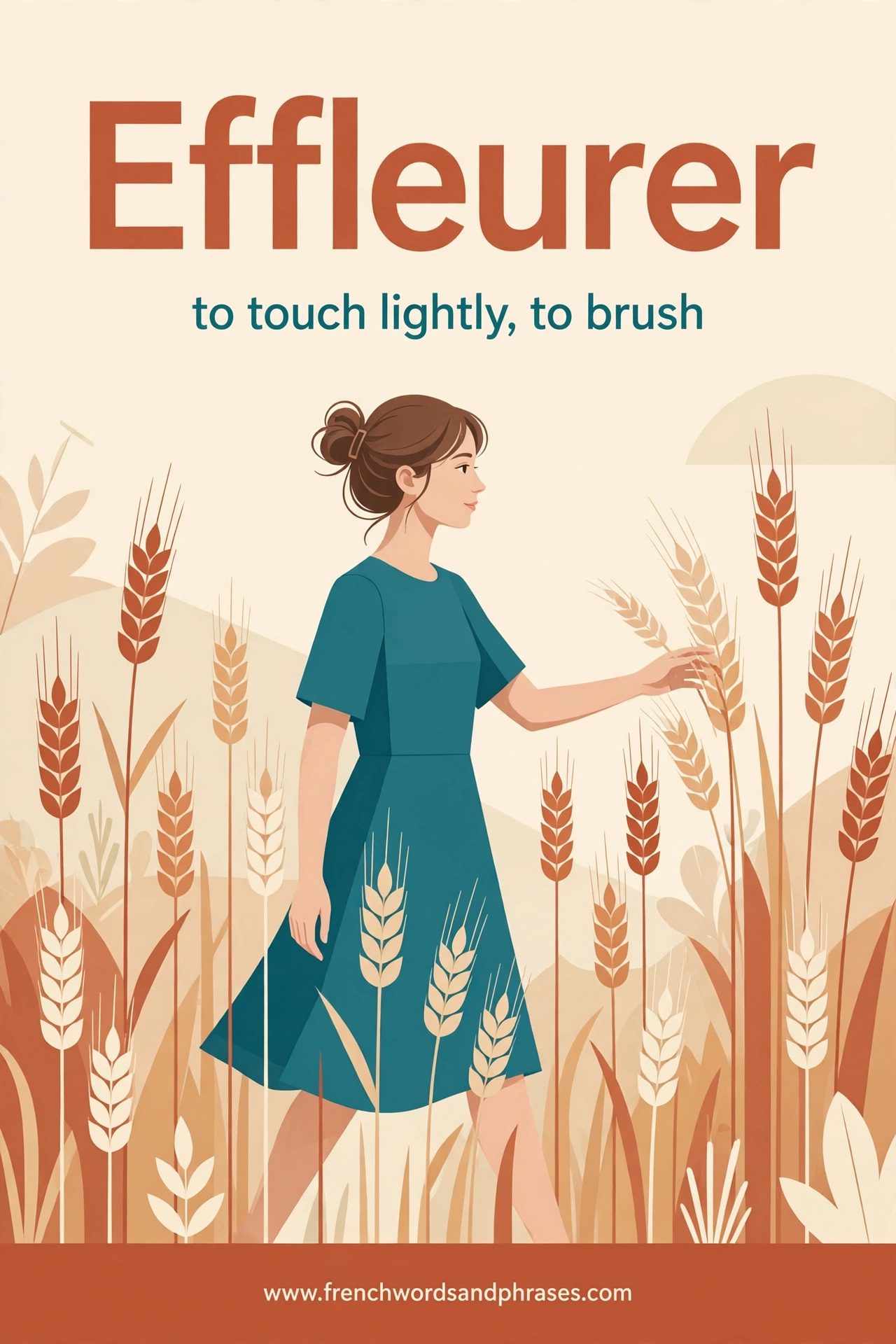
Effleurer means to touch lightly, to brush — to make the briefest, gentlest contact, barely more than a whisper of a touch.
A fingertip grazing a cheek, a sleeve brushing a stranger’s arm in a crowd, a leaf landing for one second on a shoulder — effleurer is the verb of the lightest possible touch: contact so gentle it is almost an idea.
In this guide, you’ll learn how to conjugate effleurer in all the major French tenses and moods. Explore complete conjugation tables, French examples, English translations, and practice quizzes.
Understanding the French Verb Effleurer
Effleurer is a regular French verb belonging to the first group of verbs, those ending in-er.
It means to touch lightly, to brush. It is commonly used for the lightest physical contacts — a hand, a hem, a wing grazing something in passing — and just as often in the figurative sense: a speaker effleure a delicate subject, a doubt effleure someone’s mind for a moment and is gone.
Verb classification: First group (-er)
Auxiliary verb: Avoir
Past participle: effleuré
Present participle: effleurant
English equivalents: To touch lightly, to brush, to graze; effleurer du doigt — to touch lightly with a fingertip; effleurer un sujet — to touch on a subject, to mention it in passing; une idée l’a effleuré — an idea crossed his mind, brushed his mind; effleurer la surface — to skim the surface.
One important detail: effleurer is built on fleur, a flower — and the touch it names is exactly that light, the petal-touch that leaves no mark. It is perfectly regular: je effleure, nous effleurons, ils effleurent, past participle effleuré. Do not confuse it with its near-twin affleurer, to come level with a surface (water rising to the brim, rock showing at ground level). And watch its second, figurative life: ideas and subjects can be effleurés too — une idée m’a effleuré, a thought brushed my mind; effleurer un sujet, to touch on a topic without going into it.
Experience the Word
Effleurer is the verb of almost-touching — the contact you feel more in the nerves than on the skin.
Imagine a violinist in a silent hall. Before the first note, her bow descends and effleure the string — no pressure, no sound yet, just the promise of one. The whole audience holds its breath at a touch that has barely happened.
Nothing has been pressed or struck. The string has been brushed — effleurée — and that was enough.
How to Conjugate Effleurer: Complete French Conjugation Guide
Let’s explore every major conjugation of effleurer, beginning with the indicative mood.
How to Conjugate Effleurer in the Indicative Mood
The indicative mood is used to express facts, observations, actions, and events.
How to Conjugate Effleurer in the Present Tense (Présent)
Used for actions happening now, habitual actions, and general truths.
| Subject | Conjugation |
|---|---|
| je | effleure |
| tu | effleures |
| il / elle | effleure |
| nous | effleurons |
| vous | effleurez |
| ils / elles | effleurent |
Example
Sa main effleure la mienne quand elle passe.
Her hand brushes mine as she goes past.
Quick Quiz 1
Complete the sentence:
Nous ______ la surface de l’eau avec la rame.
Reveal the answer
effleurons
Nous effleurons la surface de l’eau avec la rame.
We skim the surface of the water with the oar.
How to Conjugate Effleurer in the Passé Composé
Used for completed actions in the past. Effleurer takes the auxiliary verb avoir.
| Subject | Conjugation |
|---|---|
| j’ | ai effleuré |
| tu | as effleuré |
| il / elle | a effleuré |
| nous | avons effleuré |
| vous | avez effleuré |
| ils / elles | ont effleuré |
Example
Le rideau a effleuré la bougie et a pris feu.
The curtain brushed the candle and caught fire.
How to Conjugate Effleurer in the Imparfait (Imperfect Tense)
Used for habitual past actions, descriptions, and ongoing situations in the past.
| Subject | Conjugation |
|---|---|
| je | effleurais |
| tu | effleurais |
| il / elle | effleurait |
| nous | effleurions |
| vous | effleuriez |
| ils / elles | effleuraient |
Example
En marchant, sa robe effleurait les fleurs du chemin.
As she walked, her dress brushed the flowers along the path.
Quick Quiz 2
Choose the correct form:
The curtain brushed the candle.
Le rideau ______ la bougie. (a effleuré / est effleuré)
Reveal the answer
a effleuré
Le rideau a effleuré la bougie.
Effleurer takes avoir.
How to Conjugate Effleurer in the Plus-que-parfait
Used to describe an action that had already been completed before another past event.
| Subject | Conjugation |
|---|---|
| j’ | avais effleuré |
| tu | avais effleuré |
| il / elle | avait effleuré |
| nous | avions effleuré |
| vous | aviez effleuré |
| ils / elles | avaient effleuré |
Example
Il avait effleuré le sujet sans oser l’aborder.
He had touched on the subject without daring to tackle it.
How to Conjugate Effleurer in the Passé Simple
Primarily used in formal writing, literature, and historical narratives. It is rarely used in everyday conversation.
| Subject | Conjugation |
|---|---|
| je | effleurai |
| tu | effleuras |
| il / elle | effleura |
| nous | effleurâmes |
| vous | effleurâtes |
| ils / elles | effleurèrent |
Example
Le vent effleura la surface du lac au crépuscule.
The wind brushed the surface of the lake at dusk.
How to Conjugate Effleurer in the Passé Antérieur
A literary tense used to express an action completed immediately before another past action, generally in the passé simple.
| Subject | Conjugation |
|---|---|
| j’ | eus effleuré |
| tu | eus effleuré |
| il / elle | eut effleuré |
| nous | eûmes effleuré |
| vous | eûtes effleuré |
| ils / elles | eurent effleuré |
Example
Dès que l’idée l’eut effleuré, il se leva pour la noter.
As soon as the idea had crossed his mind, he got up to write it down.
How to Conjugate Effleurer in the Future Tense (Futur Simple)
Used to describe actions that will take place in the future.
| Subject | Conjugation |
|---|---|
| je | effleurerai |
| tu | effleureras |
| il / elle | effleurera |
| nous | effleurerons |
| vous | effleurerez |
| ils / elles | effleureront |
Example
Demain, le voilier effleurera les vagues dès l’aube.
Tomorrow, the sailing boat will skim the waves from dawn.
How to Conjugate Effleurer in the Futur Antérieur (Future Perfect)
Used for an action that will have been completed before a particular point in the future.
| Subject | Conjugation |
|---|---|
| j’ | aurai effleuré |
| tu | auras effleuré |
| il / elle | aura effleuré |
| nous | aurons effleuré |
| vous | aurez effleuré |
| ils / elles | auront effleuré |
Example
À la fin du chapitre, elle aura effleuré trois sujets délicats.
By the end of the chapter, she will have touched on three delicate subjects.
How to Conjugate Effleurer in the Near Future (Futur Proche)
Used to describe something that is going to happen soon. Formed with aller + infinitive.
| Subject | Conjugation |
|---|---|
| je | vais effleurer |
| tu | vas effleurer |
| il / elle | va effleurer |
| nous | allons effleurer |
| vous | allez effleurer |
| ils / elles | vont effleurer |
Example
Attention, tu vas effleurer la peinture fraîche !
Careful, you are going to brush the wet paint!
How to Conjugate Effleurer in the Conditional Mood
The conditional mood expresses what would happen under certain circumstances. It is also frequently used to make polite requests or express wishes.
How to Conjugate Effleurer in the Present Conditional
| Subject | Conjugation |
|---|---|
| je | effleurerais |
| tu | effleurerais |
| il / elle | effleurerait |
| nous | effleurerions |
| vous | effleureriez |
| ils / elles | effleureraient |
Example
Un mot de plus effleurerait à peine la vérité.
One more word would barely touch the truth.
How to Conjugate Effleurer in the Past Conditional
| Subject | Conjugation |
|---|---|
| j’ | aurais effleuré |
| tu | aurais effleuré |
| il / elle | aurait effleuré |
| nous | aurions effleuré |
| vous | auriez effleuré |
| ils / elles | auraient effleuré |
Example
Sans le vent, la branche n’aurait jamais effleuré la fenêtre.
Without the wind, the branch would never have brushed the window.
Effleurer in the Literary Past Conditional Form
This less common literary form uses the imperfect subjunctive of avoir.
| Subject | Conjugation |
|---|---|
| j’ | eusse effleuré |
| tu | eusses effleuré |
| il / elle | eût effleuré |
| nous | eussions effleuré |
| vous | eussiez effleuré |
| ils / elles | eussent effleuré |
Example
Le doute l’eût effleuré un instant, puis il eût continué.
Doubt would have brushed his mind for a moment, then he would have carried on.
How to Conjugate Effleurer in the Subjunctive Mood
The subjunctive is used to express wishes, emotions, doubts, necessity, and uncertainty. It frequently follows expressions such as il faut que (it is necessary that) or bien que (although).
How to Conjugate Effleurer in the Present Subjunctive
| Subject | Conjugation |
|---|---|
| que je | effleure |
| que tu | effleures |
| qu’il / qu’elle | effleure |
| que nous | effleurions |
| que vous | effleuriez |
| qu’ils / qu’elles | effleurent |
Example
Je doute que ce discours effleure le vrai problème.
I doubt this speech even touches on the real problem.
Quick Quiz 3
Complete the sentence using the subjunctive:
Je doute que cette remarque ______ le vrai sujet.
Reveal the answer
effleure
Je doute que cette remarque effleure le vrai sujet.
I doubt this remark even touches on the real subject.
How to Conjugate Effleurer in the Imperfect Subjunctive
A literary tense, rarely encountered in modern spoken French.
| Subject | Conjugation |
|---|---|
| que je | effleurasse |
| que tu | effleurasses |
| qu’il / qu’elle | effleurât |
| que nous | effleurassions |
| que vous | effleurassiez |
| qu’ils / qu’elles | effleurassent |
Example
Il suffisait que sa main effleurât la sienne pour qu’elle rougisse.
His hand only had to brush hers for her to blush.
How to Conjugate Effleurer in the Pluperfect Subjunctive
A literary construction used to express an action completed before another past action.
| Subject | Conjugation |
|---|---|
| que j’ | eusse effleuré |
| que tu | eusses effleuré |
| qu’il / qu’elle | eût effleuré |
| que nous | eussions effleuré |
| que vous | eussiez effleuré |
| qu’ils / qu’elles | eussent effleuré |
Example
On sentait que la tristesse l’eût effleuré malgré son sourire.
You could feel that sadness had brushed him despite his smile.
How to Conjugate Effleurer in the Past Subjunctive
| Subject | Conjugation |
|---|---|
| que j’ | aie effleuré |
| que tu | aies effleuré |
| qu’il / qu’elle | ait effleuré |
| que nous | ayons effleuré |
| que vous | ayez effleuré |
| qu’ils / qu’elles | aient effleuré |
Example
Je suis surpris que l’idée vous ait effleuré si tard.
I am surprised the idea crossed your mind so late.
How to Conjugate Effleurer in the Imperative
The imperative is used to give commands, instructions, invitations, or suggestions. Subject pronouns are omitted.
How to Conjugate Effleurer in the Present Imperative
| Person | Conjugation |
|---|---|
| (tu) | effleure |
| (nous) | effleurons |
| (vous) | effleurez |
Example
Effleure la pâte du bout des doigts, sans appuyer.
Touch the dough lightly with your fingertips, without pressing.
Quick Quiz 4
How would you say Touch the dough lightly (tu form)?
Reveal the answer
Effleure la pâte du bout des doigts !
French Participles of Effleurer
Participles are verb forms that can be used in compound tenses and other grammatical constructions.
Present Participle of Effleurer
effleurant
En effleurant la corde, le musicien obtient un son très doux.
By lightly touching the string, the musician gets a very soft sound.
Past Participle of Effleurer
effleuré
Effleurée par la brise, la surface de l’eau se ride à peine.
Brushed by the breeze, the surface of the water barely ripples.
Effleurer in Everyday French: Real-Life Examples
Now that you know the conjugations, let’s see how effleurer appears in everyday French.
Example 1 — Present
Sa main effleure la mienne.
Her hand brushes mine.
Example 2 — Passé composé
Le rideau a effleuré la bougie.
The curtain brushed the candle.
Example 3 — Imparfait
Sa robe effleurait les fleurs.
Her dress used to brush the flowers.
Example 4 — Future
Le voilier effleurera les vagues.
The sailing boat will skim the waves.
Example 5 — Conditional
Un mot de plus effleurerait à peine la vérité.
One more word would barely touch the truth.
Example 6 — Imperative
Effleure la pâte sans appuyer !
Touch the dough lightly without pressing!
Beyond Translation: The Meaning of Effleurer
The word hides a flower: fleur. To effleurer was first to touch as lightly as a petal lands.
French keeps the flower inside the gesture.
That is why the verb suits ideas as well as hands — une idée m’effleure is a thought landing for one petal-second on the mind, and effleurer un sujet is how careful speakers mention a delicate matter without ever pressing on it.
How to Remember the French Verb Effleurer
Remember it this way: Effleurer is about a petal landing on skin — the lightest touch there is.
- Picture a petal landing: effleurer is the flower-light touch, from fleur.
- Two lives: hands brush things, and ideas brush minds — une idée m’a effleuré.
- Regular -er: je effleure, nous effleurons, past participle effleuré.
The key idea is a petal landing on skin — the lightest touch there is.
Test Your Knowledge of Effleurer
Let’s see how much you’ve learned. Try answering these questions before revealing the answers.
Question 1
What everyday word hides inside effleurer, and what does it tell you?
Reveal the answer
Fleur, a flower — the touch is petal-light, barely a contact at all.
Question 2
How do you say Her hand brushes mine in French?
Reveal the answer
Sa main effleure la mienne.
Question 3
Translate: The curtain brushed the candle.
Reveal the answer
Le rideau a effleuré la bougie.
Question 4
What is the past participle of effleurer?
Reveal the answer
Effleuré.
Question 5
Complete the sentence:
Je doute que ce discours ______ le vrai problème.
Reveal the answer
effleure
Je doute que ce discours effleure le vrai problème.
I doubt this speech even touches on the real problem.
Your Final Challenge
Can You Use It?
How would you say this in French?
She brushes the letter with her fingertips, as if the paper could break.
Reveal the answer
Elle effleure la lettre du bout des doigts, comme si le papier pouvait se briser.
She brushes the letter with her fingertips, as if the paper could break.
A little French. A little curiosity. A richer everyday life.
LEARN FRENCH ONE WORD AT A TIME