A French Word to Live By
How to Conjugate Effigier in French
/e.fi.ʒje/
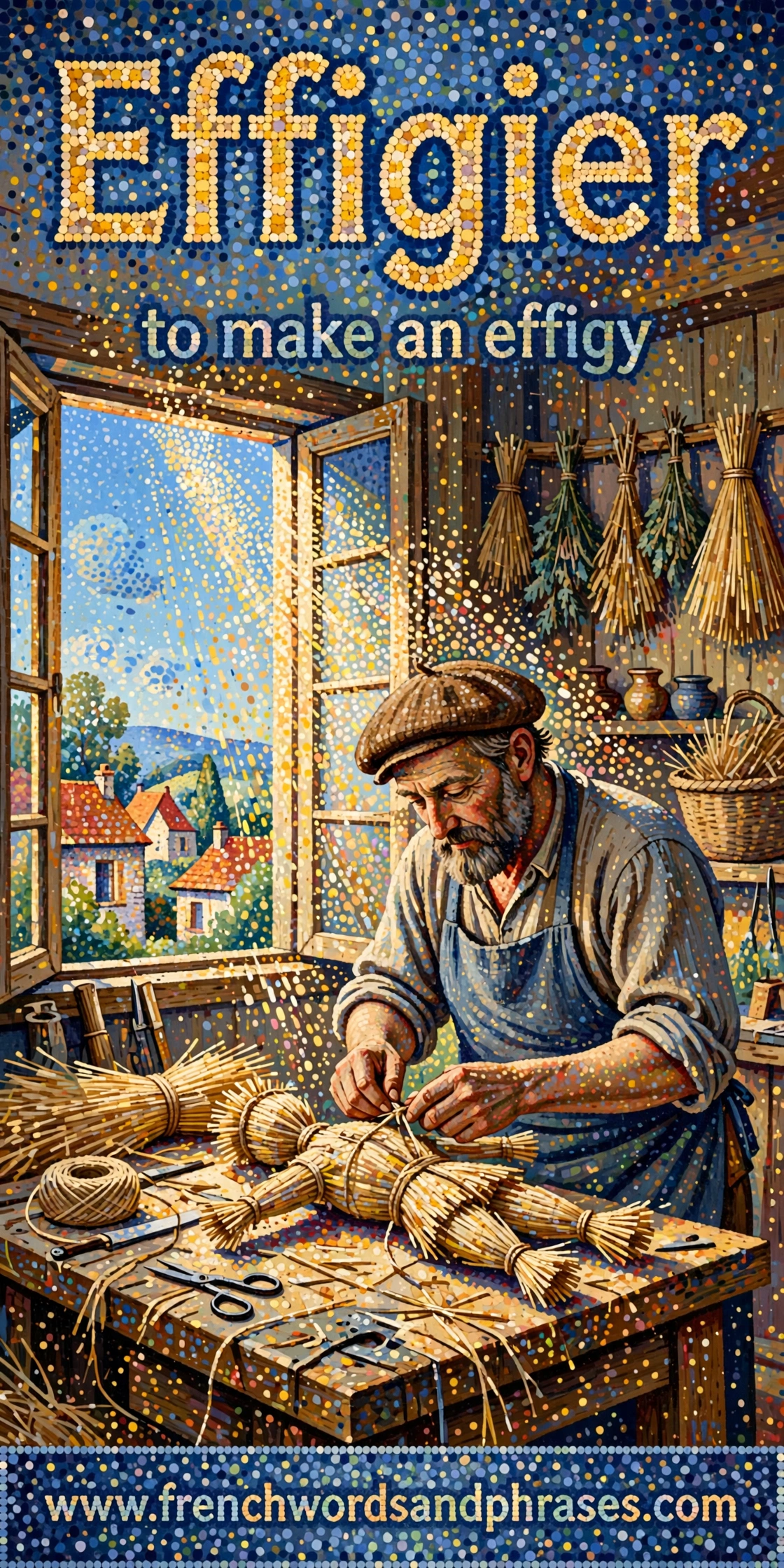
Effigier means to make an effigy — to fashion a person’s likeness in wax, straw or clay, usually so that a crowd can mock it, hang it or burn it.
A village square at carnival, a straw figure with the tax-collector’s hat being stitched together by laughing hands; a wax king taking shape under a sculptor’s fingers — effigier is the rare, old verb of making someone’s double, and the double rarely comes to a good end.
In this guide, you’ll learn how to conjugate effigier in all the major French tenses and moods. Explore complete conjugation tables, French examples, English translations, and practice quizzes.
Understanding the French Verb Effigier
Effigier is a regular French verb belonging to the first group of verbs, those ending in-er.
It means to make an effigy. It is commonly used in historical and literary French: crowds effigiaient traitors, tax-collectors and unpopular ministers in straw or cardboard, and museums still effigient kings and celebrities in wax — the Musée Grévin in Paris is a whole palace of people effigiés en cire.
Verb classification: First group (-er)
Auxiliary verb: Avoir
Past participle: effigié
Present participle: effigiant
English equivalents: To make an effigy of, to fashion someone’s likeness; effigier quelqu’un en paille — to make someone’s effigy in straw; effigier en cire — to model in wax; brûler quelqu’un en effigie — to burn someone in effigy; pendre en effigie — to hang in effigy; une effigie — an effigy, a likeness.
One important detail: effigier barely walks alone in modern French — it lives inside the set phrases brûler en effigie and pendre en effigie, to burn or hang someone in effigy, the old punishment for criminals who had escaped the rope. It is an -ier verb, so watch the double i where two i-sounds meet: nous effigiions, vous effigiiez in the imperfect and subjunctive. Otherwise it behaves like any -er verb: j’effigie, nous effigions, ils effigient.
Experience the Word
Effigier is the verb of the double — make the likeness, and the crowd can do to it what it cannot do to the man.
Imagine a village in 1750. The tax-collector has fled, but his hat has not. By nightfall a straw figure wearing it stands in the square, crudely stitched and stuffed — on l’a effigié, and tomorrow it will hang from the big oak.
The man is miles away and safe. His likeness — effigiée en paille — will pay in his place.
How to Conjugate Effigier: Complete French Conjugation Guide
Let’s explore every major conjugation of effigier, beginning with the indicative mood.
How to Conjugate Effigier in the Indicative Mood
The indicative mood is used to express facts, observations, actions, and events.
How to Conjugate Effigier in the Present Tense (Présent)
Used for actions happening now, habitual actions, and general truths.
| Subject | Conjugation |
|---|---|
| je | effigie |
| tu | effigies |
| il / elle | effigie |
| nous | effigions |
| vous | effigiez |
| ils / elles | effigient |
Example
L’artisan effigie le roi en cire avec un soin étonnant.
The craftsman is fashioning the king’s effigy in wax with astonishing care.
Quick Quiz 1
Complete the sentence:
Nous ______ le maire en papier mâché pour le carnaval.
Reveal the answer
effigions
Nous effigions le maire en papier mâché pour le carnaval.
We are making an effigy of the mayor in papier-mâché for the carnival.
How to Conjugate Effigier in the Passé Composé
Used for completed actions in the past. Effigier takes the auxiliary verb avoir.
| Subject | Conjugation |
|---|---|
| j’ | ai effigié |
| tu | as effigié |
| il / elle | a effigié |
| nous | avons effigié |
| vous | avez effigié |
| ils / elles | ont effigié |
Example
Ils ont effigié le tyran en paille avant de le brûler.
They made an effigy of the tyrant in straw before burning it.
How to Conjugate Effigier in the Imparfait (Imperfect Tense)
Used for habitual past actions, descriptions, and ongoing situations in the past.
| Subject | Conjugation |
|---|---|
| je | effigiais |
| tu | effigiais |
| il / elle | effigiait |
| nous | effigiions |
| vous | effigiiez |
| ils / elles | effigiaient |
Example
Autrefois, on effigiait les traîtres en paille sur la place du village.
In the old days, traitors were made in effigy in straw on the village square.
Quick Quiz 2
Choose the correct form:
They made an effigy of the tyrant.
Ils ______ le tyran en paille. (ont effigié / sont effigiés)
Reveal the answer
ont effigié
Ils ont effigié le tyran en paille.
Effigier takes avoir.
How to Conjugate Effigier in the Plus-que-parfait
Used to describe an action that had already been completed before another past event.
| Subject | Conjugation |
|---|---|
| j’ | avais effigié |
| tu | avais effigié |
| il / elle | avait effigié |
| nous | avions effigié |
| vous | aviez effigié |
| ils / elles | avaient effigié |
Example
La foule avait effigié le ministre en carton avant la manifestation.
The crowd had made an effigy of the minister in cardboard before the demonstration.
How to Conjugate Effigier in the Passé Simple
Primarily used in formal writing, literature, and historical narratives. It is rarely used in everyday conversation.
| Subject | Conjugation |
|---|---|
| je | effigiai |
| tu | effigias |
| il / elle | effigia |
| nous | effigiâmes |
| vous | effigiâtes |
| ils / elles | effigièrent |
Example
Le peuple effigia le roi en paille et le brûla sur la place.
The people made an effigy of the king in straw and burned it on the square.
How to Conjugate Effigier in the Passé Antérieur
A literary tense used to express an action completed immediately before another past action, generally in the passé simple.
| Subject | Conjugation |
|---|---|
| j’ | eus effigié |
| tu | eus effigié |
| il / elle | eut effigié |
| nous | eûmes effigié |
| vous | eûtes effigié |
| ils / elles | eurent effigié |
Example
Quand les paysans eurent effigié le seigneur en paille, ils le pendirent à un arbre.
When the peasants had made an effigy of the lord in straw, they hanged it from a tree.
How to Conjugate Effigier in the Future Tense (Futur Simple)
Used to describe actions that will take place in the future.
| Subject | Conjugation |
|---|---|
| je | effigierai |
| tu | effigieras |
| il / elle | effigiera |
| nous | effigierons |
| vous | effigierez |
| ils / elles | effigieront |
Example
Demain, les étudiants effigieront le recteur en papier mâché.
Tomorrow, the students will make an effigy of the rector in papier-mâché.
How to Conjugate Effigier in the Futur Antérieur (Future Perfect)
Used for an action that will have been completed before a particular point in the future.
| Subject | Conjugation |
|---|---|
| j’ | aurai effigié |
| tu | auras effigié |
| il / elle | aura effigié |
| nous | aurons effigié |
| vous | aurez effigié |
| ils / elles | auront effigié |
Example
À midi, ils auront effigié trois ministres en carton.
By noon, they will have made effigies of three ministers in cardboard.
How to Conjugate Effigier in the Near Future (Futur Proche)
Used to describe something that is going to happen soon. Formed with aller + infinitive.
| Subject | Conjugation |
|---|---|
| je | vais effigier |
| tu | vas effigier |
| il / elle | va effigier |
| nous | allons effigier |
| vous | allez effigier |
| ils / elles | vont effigier |
Example
Regarde, ils vont effigier le maire en paille !
Look, they are going to make an effigy of the mayor in straw!
How to Conjugate Effigier in the Conditional Mood
The conditional mood expresses what would happen under certain circumstances. It is also frequently used to make polite requests or express wishes.
How to Conjugate Effigier in the Present Conditional
| Subject | Conjugation |
|---|---|
| je | effigierais |
| tu | effigierais |
| il / elle | effigierait |
| nous | effigierions |
| vous | effigieriez |
| ils / elles | effigieraient |
Example
Sans la cire, il effigierait le modèle en argile.
Without wax, he would make the model’s effigy in clay.
How to Conjugate Effigier in the Past Conditional
| Subject | Conjugation |
|---|---|
| j’ | aurais effigié |
| tu | aurais effigié |
| il / elle | aurait effigié |
| nous | aurions effigié |
| vous | auriez effigié |
| ils / elles | auraient effigié |
Example
Elle aurait effigié le héros en bronze si elle avait eu le temps.
She would have made an effigy of the hero in bronze if she had had the time.
Effigier in the Literary Past Conditional Form
This less common literary form uses the imperfect subjunctive of avoir.
| Subject | Conjugation |
|---|---|
| j’ | eusse effigié |
| tu | eusses effigié |
| il / elle | eût effigié |
| nous | eussions effigié |
| vous | eussiez effigié |
| ils / elles | eussent effigié |
Example
Le sculpteur eût effigié le roi en marbre sans la révolution.
The sculptor would have made an effigy of the king in marble without the revolution.
How to Conjugate Effigier in the Subjunctive Mood
The subjunctive is used to express wishes, emotions, doubts, necessity, and uncertainty. It frequently follows expressions such as il faut que (it is necessary that) or bien que (although).
How to Conjugate Effigier in the Present Subjunctive
| Subject | Conjugation |
|---|---|
| que je | effigie |
| que tu | effigies |
| qu’il / qu’elle | effigie |
| que nous | effigiions |
| que vous | effigiiez |
| qu’ils / qu’elles | effigient |
Example
Je doute que l’artiste effigie le président en cire.
I doubt the artist will model the president’s effigy in wax.
Quick Quiz 3
Complete the sentence using the subjunctive:
Je doute que vous ______ le président en cire.
Reveal the answer
effigiiez
Je doute que vous effigiiez le président en cire.
I doubt you will model the president’s effigy in wax.
How to Conjugate Effigier in the Imperfect Subjunctive
A literary tense, rarely encountered in modern spoken French.
| Subject | Conjugation |
|---|---|
| que je | effigiasse |
| que tu | effigiasses |
| qu’il / qu’elle | effigiât |
| que nous | effigiassions |
| que vous | effigiassiez |
| qu’ils / qu’elles | effigiassent |
Example
Il fallait que le sculpteur effigiât le héros en cire.
The sculptor had to fashion the hero’s effigy in wax.
How to Conjugate Effigier in the Pluperfect Subjunctive
A literary construction used to express an action completed before another past action.
| Subject | Conjugation |
|---|---|
| que j’ | eusse effigié |
| que tu | eusses effigié |
| qu’il / qu’elle | eût effigié |
| que nous | eussions effigié |
| que vous | eussiez effigié |
| qu’ils / qu’elles | eussent effigié |
Example
On racontait qu’ils eussent effigié le tyran en paille dès la première nuit.
People said they had made an effigy of the tyrant in straw on the very first night.
How to Conjugate Effigier in the Past Subjunctive
| Subject | Conjugation |
|---|---|
| que j’ | aie effigié |
| que tu | aies effigié |
| qu’il / qu’elle | ait effigié |
| que nous | ayons effigié |
| que vous | ayez effigié |
| qu’ils / qu’elles | aient effigié |
Example
Je suis surpris qu’elle ait effigié son propre père en argile.
I am surprised she made an effigy of her own father in clay.
How to Conjugate Effigier in the Imperative
The imperative is used to give commands, instructions, invitations, or suggestions. Subject pronouns are omitted.
How to Conjugate Effigier in the Present Imperative
| Person | Conjugation |
|---|---|
| (tu) | effigie |
| (nous) | effigions |
| (vous) | effigiez |
Example
Effigie-le en cire, avec tous ses défauts !
Make his effigy in wax, with all his flaws!
Quick Quiz 4
How would you say Make his effigy in wax (tu form)?
Reveal the answer
Effigie-le en cire !
French Participles of Effigier
Participles are verb forms that can be used in compound tenses and other grammatical constructions.
Present Participle of Effigier
effigiant
En effigiant le roi en cire, l’artisan risquait sa tête.
By making the king’s effigy in wax, the craftsman was risking his head.
Past Participle of Effigier
effigié
Effigié en paille, le traître fut brûlé sur la place.
Made in effigy in straw, the traitor was burned on the square.
Effigier in Everyday French: Real-Life Examples
Now that you know the conjugations, let’s see how effigier appears in everyday French.
Example 1 — Present
L’artisan effigie le roi en cire.
The craftsman fashions the king’s effigy in wax.
Example 2 — Passé composé
Ils ont effigié le tyran en paille.
They made an effigy of the tyrant in straw.
Example 3 — Imparfait
On effigiait les traîtres sur la place du village.
Traitors were made in effigy on the village square.
Example 4 — Future
Les étudiants effigieront le recteur en carton.
The students will make an effigy of the rector in cardboard.
Example 5 — Conditional
Elle effigierait le héros en bronze avec plus de temps.
She would make the hero’s effigy in bronze with more time.
Example 6 — Imperative
Effigiez-le en paille, comme autrefois !
Make his effigy in straw, as in the old days!
Beyond Translation: The Meaning of Effigier
An effigie is a likeness — the word sits on every French coin, where the Republic or a king is portrayed: à l’effigie de Marianne, bearing Marianne’s effigy.
The verb remembers the darker use of likenesses.
French law once condemned absent criminals par contumace and executed them symbolically — pendus ou brûlés en effigie — hanged or burned in effigy, the portrait suffering in the person’s place.
How to Remember the French Verb Effigier
Remember it this way: Effigier is about the straw double on the village square — stitched, hanged and burned in the man’s place.
- A verb that lives in phrases: brûler en effigie, pendre en effigie — the likeness suffers for the man.
- An -ier verb: watch the double i in nous effigiions, vous effigiiez.
- Regular endings otherwise: j’effigie, nous effigions, past participle effigié.
The key idea is the straw double on the village square — stitched, hanged and burned in the man’s place.
Test Your Knowledge of Effigier
Let’s see how much you’ve learned. Try answering these questions before revealing the answers.
Question 1
In which famous phrases does effigier mostly live?
Reveal the answer
Brûler en effigie and pendre en effigie — to burn or hang someone in effigy.
Question 2
How do you say They made an effigy of the tyrant in straw in French?
Reveal the answer
Ils ont effigié le tyran en paille.
Question 3
Translate: The craftsman fashions the king’s effigy in wax.
Reveal the answer
L’artisan effigie le roi en cire.
Question 4
What is the past participle of effigier?
Reveal the answer
Effigié.
Question 5
Complete the sentence:
Il fallait que le sculpteur ______ le héros en cire.
Reveal the answer
effigiât
Il fallait que le sculpteur effigiât le héros en cire.
The sculptor had to fashion the hero’s effigy in wax.
Your Final Challenge
Can You Use It?
How would you say this in French?
The tyrant had fled, but the crowd made his effigy in straw, and the straw burned in his place.
Reveal the answer
Le tyran s’était enfui, mais la foule l’a effigié en paille, et la paille a brûlé pour lui.
The tyrant had fled, but the crowd made his effigy in straw, and the straw burned in his place.
A little French. A little curiosity. A richer everyday life.
LEARN FRENCH ONE WORD AT A TIME