A French Word to Live By
How to Conjugate Éfaufiler in French
/e.fo.fi.le/
Éfaufiler means to unthread.
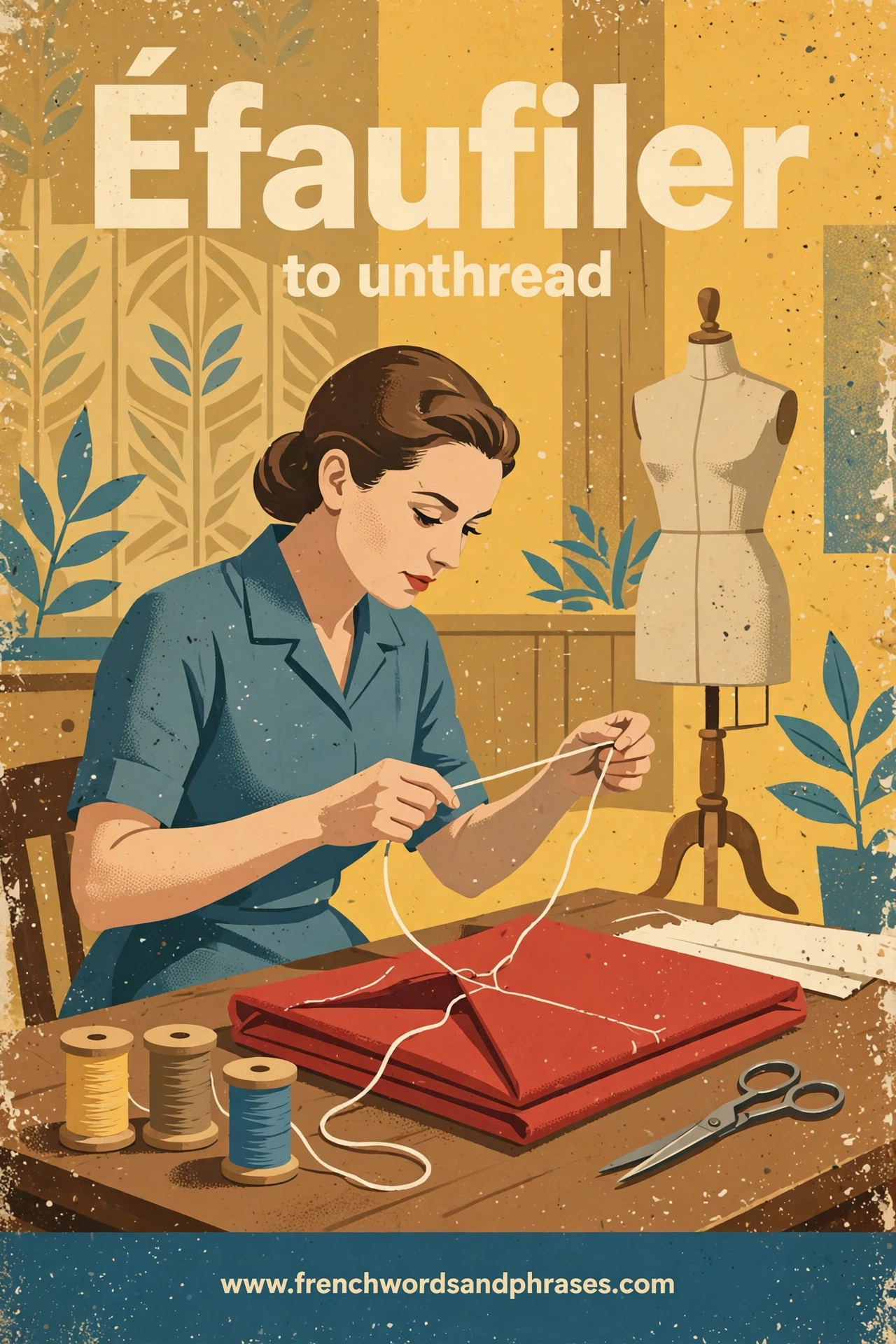
A needle losing its thread, the long basting stitches of a dress being drawn out one by one the night before the wedding — éfaufiler is a quiet seamstress’s verb, the undoing that finishes the making.
In this guide, you’ll learn how to conjugate éfaufiler in all the major French tenses and moods. Explore complete conjugation tables, French examples, English translations, and practice quizzes.
Understanding the French Verb Éfaufiler
Éfaufiler is a regular French verb belonging to the first group of verbs, those ending in -er.
It means to unthread. It is commonly used in sewing rooms for removing basting thread once a garment is properly sewn, for drawing any temporary thread out of fabric, and for unthreading a needle — a small verb from the finishing stage of dressmaking, when everything provisional comes away.
Verb classification: First group (-er)
Auxiliary verb: Avoir
Past participle: éfaufilé
Present participle: éfaufilant
English equivalents: To unthread, to draw the thread out; faufiler — to baste, to tack (the temporary stitching that éfaufiler undoes); le fil de bâti — basting thread.
One important detail: éfaufiler only makes sense beside its twin faufiler — to tack a garment together with long, temporary stitches, the famous fil de bâti. When the real seam is sewn, the basting has done its work, and the dressmaker éfaufile: she draws the loose thread out, stitch by stitch, and also unthreads her needle at the end of the day. The opening é- is the old ‘out’ prefix, as in écosser (to shell out). It is a rare, specialised word — sewing manuals and older novels are its natural home.
Experience the Word
Éfaufiler is the verb of the last quiet hour — the making is done, and now the traces of making are removed.
Imagine a dressmaker’s table at dusk. The dress stands finished on its stand; the seamstress takes the loose red basting thread between finger and thumb and pulls, gently, metre by metre, until the garment is pure sewing and nothing else.
The dress has not been changed. It has been éfaufilée — freed of every temporary thread.
How to Conjugate Éfaufiler: Complete French Conjugation Guide
Let’s explore every major conjugation of éfaufiler, beginning with the indicative mood.
How to Conjugate Éfaufiler in the Indicative Mood
The indicative mood is used to express facts, observations, actions, and events.
How to Conjugate Éfaufiler in the Present Tense (Présent)
Used for actions happening now, habitual actions, and general truths.
| Subject | Conjugation |
|---|---|
| je | éfaufile |
| tu | éfaufiles |
| il / elle | éfaufile |
| nous | éfaufilons |
| vous | éfaufilez |
| ils / elles | éfaufilent |
Example
La couturière éfaufile le bâti avant le repassage.
The dressmaker unthreads the basting before ironing.
Quick Quiz 1
Complete the sentence:
Nous ______ les coutures demain.
Reveal the answer
éfaufilerons
Nous éfaufilerons les coutures demain.
We will remove the temporary stitching tomorrow.
How to Conjugate Éfaufiler in the Passé Composé
Used for completed actions in the past. Éfaufiler takes the auxiliary verb avoir.
| Subject | Conjugation |
|---|---|
| j’ | ai éfaufilé |
| tu | as éfaufilé |
| il / elle | a éfaufilé |
| nous | avons éfaufilé |
| vous | avez éfaufilé |
| ils / elles | ont éfaufilé |
Example
Elle a éfaufilé toutes les coutures provisoires.
She removed all the temporary stitching.
How to Conjugate Éfaufiler in the Imparfait (Imperfect Tense)
Used for habitual past actions, descriptions, and ongoing situations in the past.
| Subject | Conjugation |
|---|---|
| je | éfaufilais |
| tu | éfaufilais |
| il / elle | éfaufilait |
| nous | éfaufilions |
| vous | éfaufiliez |
| ils / elles | éfaufilaient |
Example
Ma grand-mère éfaufilait ses ouvrages le soir, près de la lampe.
My grandmother used to unthread her sewing in the evening, by the lamp.
Quick Quiz 2
Choose the correct form:
She removed the basting.
Elle ______ le bâti. (a éfaufilé / est éfaufilée)
Reveal the answer
a éfaufilé
Elle a éfaufilé le bâti.
Éfaufiler takes avoir.
How to Conjugate Éfaufiler in the Plus-que-parfait
Used to describe an action that had already been completed before another past event.
| Subject | Conjugation |
|---|---|
| j’ | avais éfaufilé |
| tu | avais éfaufilé |
| il / elle | avait éfaufilé |
| nous | avions éfaufilé |
| vous | aviez éfaufilé |
| ils / elles | avaient éfaufilé |
Example
Elle avait éfaufilé la doublure avant d’essayer la robe.
She had unthreaded the lining before trying on the dress.
How to Conjugate Éfaufiler in the Passé Simple
Primarily used in formal writing, literature, and historical narratives. It is rarely used in everyday conversation.
| Subject | Conjugation |
|---|---|
| je | éfaufilai |
| tu | éfaufilas |
| il / elle | éfaufila |
| nous | éfaufilâmes |
| vous | éfaufilâtes |
| ils / elles | éfaufilèrent |
Example
La couturière éfaufila le bâti d’un geste sûr.
The dressmaker drew out the basting thread with a sure hand.
How to Conjugate Éfaufiler in the Passé Antérieur
A literary tense used to express an action completed immediately before another past action, generally in the passé simple.
| Subject | Conjugation |
|---|---|
| j’ | eus éfaufilé |
| tu | eus éfaufilé |
| il / elle | eut éfaufilé |
| nous | eûmes éfaufilé |
| vous | eûtes éfaufilé |
| ils / elles | eurent éfaufilé |
Example
Quand elle eut éfaufilé la jupe, elle la présenta à la cliente.
When she had unthreaded the skirt, she showed it to the client.
How to Conjugate Éfaufiler in the Future Tense (Futur Simple)
Used to describe actions that will take place in the future.
| Subject | Conjugation |
|---|---|
| je | éfaufilerai |
| tu | éfaufileras |
| il / elle | éfaufilera |
| nous | éfaufilerons |
| vous | éfaufilerez |
| ils / elles | éfaufileront |
Example
Demain, j’éfaufilerai les manches avant la finition.
Tomorrow, I will remove the basting from the sleeves before finishing.
How to Conjugate Éfaufiler in the Futur Antérieur (Future Perfect)
Used for an action that will have been completed before a particular point in the future.
| Subject | Conjugation |
|---|---|
| j’ | aurai éfaufilé |
| tu | auras éfaufilé |
| il / elle | aura éfaufilé |
| nous | aurons éfaufilé |
| vous | aurez éfaufilé |
| ils / elles | auront éfaufilé |
Example
À midi, elle aura éfaufilé toute la robe.
By noon, she will have unthreaded the whole dress.
How to Conjugate Éfaufiler in the Near Future (Futur Proche)
Used to describe something that is going to happen soon. Formed with aller + infinitive.
| Subject | Conjugation |
|---|---|
| je | vais éfaufiler |
| tu | vas éfaufiler |
| il / elle | va éfaufiler |
| nous | allons éfaufiler |
| vous | allez éfaufiler |
| ils / elles | vont éfaufiler |
Example
Je vais éfaufiler cette couture, elle ne sert plus.
I am going to unthread this seam, it is no longer needed.
How to Conjugate Éfaufiler in the Conditional Mood
The conditional mood expresses what would happen under certain circumstances. It is also frequently used to make polite requests or express wishes.
How to Conjugate Éfaufiler in the Present Conditional
| Subject | Conjugation |
|---|---|
| je | éfaufilerais |
| tu | éfaufilerais |
| il / elle | éfaufilerait |
| nous | éfaufilerions |
| vous | éfaufileriez |
| ils / elles | éfaufileraient |
Example
Avec des ciseaux fins, on éfaufilerait sans abîmer le tissu.
With fine scissors, you would unthread without damaging the fabric.
How to Conjugate Éfaufiler in the Past Conditional
| Subject | Conjugation |
|---|---|
| j’ | aurais éfaufilé |
| tu | aurais éfaufilé |
| il / elle | aurait éfaufilé |
| nous | aurions éfaufilé |
| vous | auriez éfaufilé |
| ils / elles | auraient éfaufilé |
Example
Elle aurait éfaufilé le bâti plus tôt si la robe avait été prête.
She would have removed the basting earlier if the dress had been ready.
Éfaufiler in the Literary Past Conditional Form
This less common literary form uses the imperfect subjunctive of avoir.
| Subject | Conjugation |
|---|---|
| j’ | eusse éfaufilé |
| tu | eusses éfaufilé |
| il / elle | eût éfaufilé |
| nous | eussions éfaufilé |
| vous | eussiez éfaufilé |
| ils / elles | eussent éfaufilé |
Example
La brodeuse eût éfaufilé son ouvrage avant la nuit.
The embroiderer would have unthreaded her work before nightfall.
How to Conjugate Éfaufiler in the Subjunctive Mood
The subjunctive is used to express wishes, emotions, doubts, necessity, and uncertainty. It frequently follows expressions such as il faut que (it is necessary that) or bien que (although).
How to Conjugate Éfaufiler in the Present Subjunctive
| Subject | Conjugation |
|---|---|
| que je | éfaufile |
| que tu | éfaufiles |
| qu’il / qu’elle | éfaufile |
| que nous | éfaufilions |
| que vous | éfaufiliez |
| qu’ils / qu’elles | éfaufilent |
Example
Il faut que tu éfaufiles le bâti avant de repasser.
You must remove the basting before ironing.
Quick Quiz 3
Complete the sentence using the subjunctive:
Il faut que vous ______ le bâti avant le repassage.
Reveal the answer
éfaufiliez
Il faut que vous éfaufiliez le bâti avant le repassage.
You must remove the basting before ironing.
How to Conjugate Éfaufiler in the Imperfect Subjunctive
A literary tense, rarely encountered in modern spoken French.
| Subject | Conjugation |
|---|---|
| que je | éfaufilasse |
| que tu | éfaufilasses |
| qu’il / qu’elle | éfaufilât |
| que nous | éfaufilassions |
| que vous | éfaufilassiez |
| qu’ils / qu’elles | éfaufilassent |
Example
La maîtresse voulait que l’apprentie éfaufilât sans tirer le tissu.
The teacher wanted the apprentice to unthread without pulling the fabric.
How to Conjugate Éfaufiler in the Pluperfect Subjunctive
A literary construction used to express an action completed before another past action.
| Subject | Conjugation |
|---|---|
| que j’ | eusse éfaufilé |
| que tu | eusses éfaufilé |
| qu’il / qu’elle | eût éfaufilé |
| que nous | eussions éfaufilé |
| que vous | eussiez éfaufilé |
| qu’ils / qu’elles | eussent éfaufilé |
Example
On vérifia que la couturière eût éfaufilé toutes les pièces.
They checked that the dressmaker had unthreaded all the pieces.
How to Conjugate Éfaufiler in the Past Subjunctive
| Subject | Conjugation |
|---|---|
| que j’ | aie éfaufilé |
| que tu | aies éfaufilé |
| qu’il / qu’elle | ait éfaufilé |
| que nous | ayons éfaufilé |
| que vous | ayez éfaufilé |
| qu’ils / qu’elles | aient éfaufilé |
Example
Je suis contente que tu aies éfaufilé la doublure.
I am glad you unthreaded the lining.
How to Conjugate Éfaufiler in the Imperative
The imperative is used to give commands, instructions, invitations, or suggestions. Subject pronouns are omitted.
How to Conjugate Éfaufiler in the Present Imperative
| Person | Conjugation |
|---|---|
| (tu) | éfaufile |
| (nous) | éfaufilons |
| (vous) | éfaufilez |
Example
Éfaufile doucement, le tissu est fragile !
Unthread gently, the fabric is fragile!
Quick Quiz 4
How would you say Remove the basting gently (tu form)?
Reveal the answer
Éfaufile le bâti doucement !
French Participles of Éfaufiler
Participles are verb forms that can be used in compound tenses and other grammatical constructions.
Present Participle of Éfaufiler
éfaufilant
En éfaufilant le bâti, elle a trouvé une épingle oubliée.
While removing the basting, she found a forgotten pin.
Past Participle of Éfaufiler
éfaufilé
Éfaufilée avec soin, la robe ne garde aucune trace du bâti.
Carefully unthreaded, the dress keeps no trace of the basting.
Éfaufiler in Everyday French: Real-Life Examples
Now that you know the conjugations, let’s see how éfaufiler appears in everyday French.
Example 1 — Present
Elle éfaufile le bâti de la jupe.
She is removing the basting from the skirt.
Example 2 — Passé composé
J’ai éfaufilé l’aiguille par erreur.
I unthreaded the needle by mistake.
Example 3 — Imparfait
Les apprenties éfaufilaient les pièces en fin de journée.
The apprentices used to unthread the pieces at the end of the day.
Example 4 — Future
Nous éfaufilerons les coutures demain.
We will remove the temporary stitching tomorrow.
Example 5 — Conditional
Tu éfaufilerais ce fil sans casser l’aiguille ?
Could you draw out this thread without breaking the needle?
Example 6 — Imperative
Éfaufilez le bâti avant le repassage !
Remove the basting before ironing!
Beyond Translation: The Meaning of Éfaufiler
English has no everyday word for this gesture at all — you would have to say take the tacking stitches out. French éfaufiler preserves it in a single verb, a fossil of the centuries when every garment passed through this stage.
Every finished dress was éfaufilée.
The word survives wherever sewing is still done by hand: the provisional thread goes in with faufiler, does its quiet work, and comes out with éfaufiler — making and unmaking, each with its own verb.
How to Remember the French Verb Éfaufiler
Remember it this way: Éfaufiler is about the seamstress’s quiet undoing — out comes the thread.
- Faufiler tacks it in; éfaufiler draws it out — the é- means ‘out’.
- Le fil de bâti — the basting thread, the thing this verb removes.
- Regular -er: j’éfaufile, nous éfaufilons, past participle éfaufilé.
The key idea is the seamstress’s quiet undoing — out comes the thread.
Test Your Knowledge of Éfaufiler
Let’s see how much you’ve learned. Try answering these questions before revealing the answers.
Question 1
What is faufiler?
Reveal the answer
To baste, to tack — to stitch temporarily with the fil de bâti that éfaufiler later removes.
Question 2
How do you say She is removing the basting from the skirt in French?
Reveal the answer
Elle éfaufile le bâti de la jupe.
Question 3
Translate: I unthreaded the needle by mistake.
Reveal the answer
J’ai éfaufilé l’aiguille par erreur.
Question 4
What is the past participle of éfaufiler?
Reveal the answer
Éfaufilé.
Question 5
Complete the sentence:
Il faut que tu ______ le bâti avant de repasser.
Reveal the answer
éfaufiles
Il faut que tu éfaufiles le bâti avant de repasser.
You must remove the basting before ironing.
Your Final Challenge
Can You Use It?
How would you say this in French?
She removes the last basting thread, and the dress is finally ready.
Reveal the answer
Elle éfaufile le dernier bâti, et la robe est enfin prête.
She removes the last basting thread, and the dress is finally ready.
A little French. A little curiosity. A richer everyday life.
LEARN FRENCH ONE WORD AT A TIME